If only we had a President like this today: classy, compassionate, inclusive! That is what a lot of diehard Obama cultists are still saying in social media, conveniently forgetting his actual record.
The quotation is authentic. Also, "Obama said this year’s influx reflects 'the desperation and the violence
that exists in some of these Central American countries.'" That was true, as Obama knew well, for he had encouraged and supported the violence in some of those Central American countries - Honduras, for one, which suffered a military coup followed by state killings of dissidents. But he has a history of smirking disdain for the suffering inflicted by the US and its proxies, to say nothing of his embrace of dictators around the world.
Even if the US had no share of responsibility for the violence and desperation these refugees are fleeing, we would still have an obligation to help them when they arrive. Refugees are not illegal immigrants: under the law they have a right to seek asylum here. And given the US' reluctance to honor that right, it's hardly surprising that many of them would try to bypass the official process -- especially since, as the ABC story admits, many of them have relatives here, including parents, who could take them in. The whole aim of US immigration policy for the past several decades has been to make it more difficult for immigrants, or migrant workers, or refugees to cross the border safely. That so many risk death anyway doesn't speak badly for them, it speaks badly for the US.
Comparisons to the Holocaust are distasteful to many, and aren't really necessary to condemn Obama and Trump, but it's worth remembering that many Jewish refugees found it difficult to escape Nazi Germany or occupied Europe, not only because the Nazis wouldn't let them out, but because other countries, including the US, wouldn't let them in. That's as much a stain on our history as the internment of Japanese American citizens, though it's less remembered now. It should be remembered: it's as relevant to current events as the concentration camps.
Showing posts with label obama. Show all posts
Wednesday, June 26, 2019
Friday, November 1, 2013
Would You Buy a Used Health Care System from This Man?
I'm still seeing rebuttals of the complaints about the Affordable Care Act, and I'm disturbed by the kinds of arguments they're using. This is a paraphrase, but I think it accurately represents the gist of what I'm seeing.
Meanwhile, though, I think it can fairly be said that B's rebuttal is a crooked salesman's defense: you don't really want what I promised to sell you, and what I'm substituting is much better, for only a little more than I said you would pay. Even if it's true that the substituted product is better, and costs the same or less or only a little more than what the customer ordered, it's not what the customer ordered. And that matters.
For those who want to know, this is not about me. I'm on a group insurance plan through my former employer, and so far it appears that my policy hasn't been canceled. In this post I'm evaluating claims other people are making about their situations. I'm skeptical of the stories people are making about their options now that their policies have been canceled, but the fact remains that Obama lied when he said they'd be able to keep their policies. The answers he and his apologists are giving to these complaints are dishonest, since they dodge the main issue. And I doubt that they really know what kinds of experience people are mostly having on the exchanges, any more than I do.
Today Roy Edroso wrote an imagined and hopefully satirical version of the complaints of those who have had their policies canceled. It's easy to dismiss the ignorance and frequent stupidity of the Republican base (as opposed to the elites who are our government's real base), but as I've argued before, the fact that the Republicans are stupid doesn't mean Democrats and especially Obama apologists like Edroso are smart. Obama supporters are just as determined not to face reality about their guy as Republicans are about their side, just as prone to misrepresent Obama's critics from the left as the Right is to misrepresent Obama. When Edroso dishonestly attacked Glenn Greenwald for pointing out that Ron Paul was right about a few things, he got his ass handed back to him on a platter, and could only whine that it was unfair that Greenwald was right, but only Edroso's own partisan blinders made him misread him. But that was long ago, almost two years! And Edroso continues to work his own side of the street, finding and delineating and giggling at the Stoopid of the American Right. Which is just fine -- it just shouldn't be mistaken for a serious discussion of the American political scene.
Something else emerges again in Edroso's post and the comments below it: the contempt for the Opponent. Now, suppose that what I think (no less than Edroso and the ACA's other defenders) is true, that the people who've come forward to complain about Obamacare are stupid and lazy, and that if they really looked on their state exchanges they could find policies as good as or better than the ones that were canceled, without having to pay (very much more). I wouldn't take this for granted, because of course what Obama and his posse say should not be taken as true, simply because they said it. But again, suppose this time they're right. Since we're talking about people who have individual policies and who therefore must have done some shopping to get them, they should be capable of watching out for their own interests to replace them. (Not least because they tend to present themselves as canny, self-reliant individuals who don't need government handouts aside from the many government handouts they do get.) But the same is going to be at least as true of the uninsured who'll be shopping on those same exchanges. The Republicans dismiss the uninsured as stupid, feckless, lazy parasites who think that the world owes them a living; the Democrats dismiss those whose policies have been canceled as stupid, lazy, bigoted assholes who want the country run to suit them and only them. Even if both sides are correct, access to health care should not be dependent on a person's intelligence. Especially if, as the ACA defenders like to claim, health care is a human right. That means that even people they (or I) don't respect have that same right. If the Right are daunted by the complexity of the ACA website and the exchanges, surely so are the uninsured. The process of signing up must be made as easy as possible for both groups.
Here's an analogy: I often help friends of mine with problems they have with Facebook and their e-mail, which they mostly access on their smartphones. Usually I helped them set up those accounts to start with, so when they have trouble they tell me that they've been locked out of Facebook, they don't know why. So I sit down with them and ask them to show me what happens when they try to log in. Every time it turns out to be something trivial: they have tried to log in with the wrong e-mail account, or the wrong password, or they've gotten one character wrong in their password, or tried to write their e-mail address with spaces instead of periods between the names, and so on. They haven't been blocked by Facebook at all; they just have trouble with the pickiness of computer systems. Are they stupid? No. (The computers are.) Ignorant? Yes. Am I a genius? No. I just have lots more experience with computers than they do. So I get them sorted out -- until the next time.
The same is going to be true of people who are having trouble, for whatever reason, with the ACA. It's likely that the software they had to navigate when they first got their policies was different than what they must deal with now, even if it were to get the same policies they've lost. The kind of people who are deriding them online are somewhat more computer-savvy, more at ease with filling out forms either virtual or paper, and so on. But all that has to be taken into account when designing websites for services like this. It can't be designed solely for smart, literate, computer-facile intellectuals and tech geeks; it has be designed for the doofuses, because doofuses are people too, whether they're poor uninsured Democrats or well-to-do Tea Party Republicans. Is it really necessary to say that? Evidently it is, and that's why I find most dispiriting about American political discourse today, even or especially by people who are nominally on my side. Even if they are smarter than what they like to call the Reichtards and Rethugs, they're not as smart as they like to think.
P.S. I should admit that I'm feeling some personal anger, or at least pique, about all this. I was one of the people who assured others that they would be able to keep their present policies under the ACA. One of the others I assured was one of the people I mentioned above, who got a cancellation letter. As far as their original concerns went, I was half right: they believed that everybody would lose their existing policies and have to submit to Obama's brute will. (Rather like those people who believe that when same-sex marriage is legal, all heterosexual marriages will be dissolved and everybody will have to gay-marry.) It looks like people like me, on group policies, who constitute 80 percent of the American insured, will get to keep the insurance we already have.
But I've noticed some dissembling with the numbers by ACA defenders now, when they dismiss the complaints about canceled policies. I've seen some saying that only about 5% of the population will face cancellations. But when you consider that the people most affected by cancellations appear to be people with individual policies, who constitute about 14% of the population, you're talking about a plurality or even a majority of that group. And in a country with 300 million people, 5 or 10 percent of the population is 15 to 30 million people -- not a negligible number. Ironically, Atlantic writer Garance Franke-Ruta posted a piece today about the "squeaky-wheel problem in Obamacare coverage":
That's the thing about government. I can't remember who said that you have to remember that every person sees him or herself as the center of the universe, with interests that matter to him or her more than anyone else. No one is dispensable to him or herself. If a government ignores the interests of enough people, it will lose its legitimacy, and our government has been doing just that for the past several decades. In a matter like health care, you can't take away from one group while giving to another: rather you must add the other group, so that the number of people protected increases. I feel the same impulse to dismiss the worries of the aging white Right that so many liberals do, but even leaving ordinary basic humanity out of it, dismissing them is bad politics. We've had enough bad politics, haven't we?
A: The President said I could keep the health insurance policy I already have if I want to, but I just got a letter canceling it. I'll have to pay a lot more for a replacement.
B: But your policy was crap insurance, so you shouldn't want to keep it. The President is offering you something better, something you'll like much more, even if it costs you a little extra; but it will probably cost you less.Notice that I'm not saying anything about the accuracy of certain claims here, either that A will have to pay more for a new policy, or B's assertion that the new policy won't cost much more, or will cost even less. Those are important questions, to be sure. It's hard to know what to make of the anecdotes the corporate media are pushing about people who say their individual policies have been canceled and the only policies they can find to replace them will cost much more. As I wrote yesterday, some of those stories have been debunked, even by right-wing Fox News. It'll take time to find out how true and representative these stories are, just as it will take time to evaluate the claims of Obama's apologists that people whose policies are canceled will be able to replace them for less, or for not much more money.
Meanwhile, though, I think it can fairly be said that B's rebuttal is a crooked salesman's defense: you don't really want what I promised to sell you, and what I'm substituting is much better, for only a little more than I said you would pay. Even if it's true that the substituted product is better, and costs the same or less or only a little more than what the customer ordered, it's not what the customer ordered. And that matters.
For those who want to know, this is not about me. I'm on a group insurance plan through my former employer, and so far it appears that my policy hasn't been canceled. In this post I'm evaluating claims other people are making about their situations. I'm skeptical of the stories people are making about their options now that their policies have been canceled, but the fact remains that Obama lied when he said they'd be able to keep their policies. The answers he and his apologists are giving to these complaints are dishonest, since they dodge the main issue. And I doubt that they really know what kinds of experience people are mostly having on the exchanges, any more than I do.
Today Roy Edroso wrote an imagined and hopefully satirical version of the complaints of those who have had their policies canceled. It's easy to dismiss the ignorance and frequent stupidity of the Republican base (as opposed to the elites who are our government's real base), but as I've argued before, the fact that the Republicans are stupid doesn't mean Democrats and especially Obama apologists like Edroso are smart. Obama supporters are just as determined not to face reality about their guy as Republicans are about their side, just as prone to misrepresent Obama's critics from the left as the Right is to misrepresent Obama. When Edroso dishonestly attacked Glenn Greenwald for pointing out that Ron Paul was right about a few things, he got his ass handed back to him on a platter, and could only whine that it was unfair that Greenwald was right, but only Edroso's own partisan blinders made him misread him. But that was long ago, almost two years! And Edroso continues to work his own side of the street, finding and delineating and giggling at the Stoopid of the American Right. Which is just fine -- it just shouldn't be mistaken for a serious discussion of the American political scene.
Something else emerges again in Edroso's post and the comments below it: the contempt for the Opponent. Now, suppose that what I think (no less than Edroso and the ACA's other defenders) is true, that the people who've come forward to complain about Obamacare are stupid and lazy, and that if they really looked on their state exchanges they could find policies as good as or better than the ones that were canceled, without having to pay (very much more). I wouldn't take this for granted, because of course what Obama and his posse say should not be taken as true, simply because they said it. But again, suppose this time they're right. Since we're talking about people who have individual policies and who therefore must have done some shopping to get them, they should be capable of watching out for their own interests to replace them. (Not least because they tend to present themselves as canny, self-reliant individuals who don't need government handouts aside from the many government handouts they do get.) But the same is going to be at least as true of the uninsured who'll be shopping on those same exchanges. The Republicans dismiss the uninsured as stupid, feckless, lazy parasites who think that the world owes them a living; the Democrats dismiss those whose policies have been canceled as stupid, lazy, bigoted assholes who want the country run to suit them and only them. Even if both sides are correct, access to health care should not be dependent on a person's intelligence. Especially if, as the ACA defenders like to claim, health care is a human right. That means that even people they (or I) don't respect have that same right. If the Right are daunted by the complexity of the ACA website and the exchanges, surely so are the uninsured. The process of signing up must be made as easy as possible for both groups.
Here's an analogy: I often help friends of mine with problems they have with Facebook and their e-mail, which they mostly access on their smartphones. Usually I helped them set up those accounts to start with, so when they have trouble they tell me that they've been locked out of Facebook, they don't know why. So I sit down with them and ask them to show me what happens when they try to log in. Every time it turns out to be something trivial: they have tried to log in with the wrong e-mail account, or the wrong password, or they've gotten one character wrong in their password, or tried to write their e-mail address with spaces instead of periods between the names, and so on. They haven't been blocked by Facebook at all; they just have trouble with the pickiness of computer systems. Are they stupid? No. (The computers are.) Ignorant? Yes. Am I a genius? No. I just have lots more experience with computers than they do. So I get them sorted out -- until the next time.
The same is going to be true of people who are having trouble, for whatever reason, with the ACA. It's likely that the software they had to navigate when they first got their policies was different than what they must deal with now, even if it were to get the same policies they've lost. The kind of people who are deriding them online are somewhat more computer-savvy, more at ease with filling out forms either virtual or paper, and so on. But all that has to be taken into account when designing websites for services like this. It can't be designed solely for smart, literate, computer-facile intellectuals and tech geeks; it has be designed for the doofuses, because doofuses are people too, whether they're poor uninsured Democrats or well-to-do Tea Party Republicans. Is it really necessary to say that? Evidently it is, and that's why I find most dispiriting about American political discourse today, even or especially by people who are nominally on my side. Even if they are smarter than what they like to call the Reichtards and Rethugs, they're not as smart as they like to think.
P.S. I should admit that I'm feeling some personal anger, or at least pique, about all this. I was one of the people who assured others that they would be able to keep their present policies under the ACA. One of the others I assured was one of the people I mentioned above, who got a cancellation letter. As far as their original concerns went, I was half right: they believed that everybody would lose their existing policies and have to submit to Obama's brute will. (Rather like those people who believe that when same-sex marriage is legal, all heterosexual marriages will be dissolved and everybody will have to gay-marry.) It looks like people like me, on group policies, who constitute 80 percent of the American insured, will get to keep the insurance we already have.
But I've noticed some dissembling with the numbers by ACA defenders now, when they dismiss the complaints about canceled policies. I've seen some saying that only about 5% of the population will face cancellations. But when you consider that the people most affected by cancellations appear to be people with individual policies, who constitute about 14% of the population, you're talking about a plurality or even a majority of that group. And in a country with 300 million people, 5 or 10 percent of the population is 15 to 30 million people -- not a negligible number. Ironically, Atlantic writer Garance Franke-Ruta posted a piece today about the "squeaky-wheel problem in Obamacare coverage":
It's all well and good to argue that only a small fraction of Americans will see premium increases in the individual market, but most of those who are seeing them—and who also are subsidy-ineligible under Obamacare—are from the middle to upper-income part of the middle class. More than 40 percent of people in the individual market are there because they are self-employed or running a small business. They're entrepreneurial and independent-spirited by nature, and when they squeak, they make a lot of noise.She has a point here. I agree, the corporate media will be much less interested in stories about the low-income people getting insurance than in petit bourgeois white Republicans whose individual policies are canceled. They also aren't very interested in "those who are being denied Medicaid coverage because they happen to live in states where officials have decided not to participate in the expansion." It's like predicting that the sun will rise tomorrow. But all those stories should be told. The irony is that Franke-Ruta was a member of the AIDS activist group ACT-UP, who knew a lot about squeaky wheels getting the oil. (You can see her in the great documentary How to Survive a Plague.) Since then she's become a fairly shameless Obamabot, whom I read mainly for her representation of that position. The number of Americans with HIV/AIDS in the late Eighties and early Nineties was even smaller than those who will be affected by the cancellation of their individual policies, but they didn't think that meant their problems were of no consequence -- very much the opposite. And while the right-wing Republicans are easy to despise (I, too, dislike them), they are still people and they have a right to make noise when their interests are affected, no less than poor uninsured people do.
By contrast, I'll be shocked if we see nearly as much attention devoted to the personal stories of the tens of thousands of low-income people now getting insurance through Obamacare's Medicaid expansion. Instead, we get experts tut-tutting over whether the planned expansion that's intended to cover an additional 9 million near-poor people over the next year is going to be a burden on the states.
That's the thing about government. I can't remember who said that you have to remember that every person sees him or herself as the center of the universe, with interests that matter to him or her more than anyone else. No one is dispensable to him or herself. If a government ignores the interests of enough people, it will lose its legitimacy, and our government has been doing just that for the past several decades. In a matter like health care, you can't take away from one group while giving to another: rather you must add the other group, so that the number of people protected increases. I feel the same impulse to dismiss the worries of the aging white Right that so many liberals do, but even leaving ordinary basic humanity out of it, dismissing them is bad politics. We've had enough bad politics, haven't we?
Saturday, October 5, 2013
Already It Was Impossible to Tell Which Was Which
Okay, I don't disagree that the Tea Party minority in the House who've shut the federal government down are bad people; their account of what is wrong with the government, and what would be a good government, is irrational, misinformed, dishonest, self-serving. Is that understood?
Where I begin to part company with Democratic partisans is on their conviction that because their opponents are irrational, they must, by the process of elimination, be rational, well-informed, and concerned only with the common good. Not only doesn't it follow logically, it's fairly obvious that many if not most Dems are fighting irrationality with irrationality, batshit crazy with batshit crazy. And hell, I don't know, maybe that's the right thing to do. The Tea Party's irrationality, combined with generous corporate support and the use of that support to do some grassroots organizing, has taken them pretty far. I'd like to think it won't get them much farther, and that the present crisis will leave scorched earth behind it where the Republican Party formerly stood. It would be even nicer if the Democrats learned something from the shutdown in their turn, and stopped trying to out-batshit the Right, but that of course would be irrational for me to believe. It's "cynical," as I was told last week by one Obama devotee, to judge the Democrats by their record; it is not cynical to judge the Republicans by theirs.
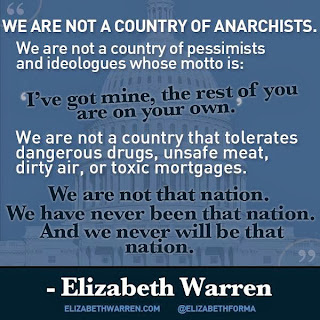
So, I'm now seeing a meme featuring Elizabeth Warren denouncing the shutdown in these terms:
There's actually been some pushback against this one. Some anarchists (and fellow-travelers like me) have pointed out that anarchism does not mean something like "every man for himself" (that would be free-market capitalism, as it's laughingly known), and that Warren is simply using the word to mean something like "uppity troublemakers I don't like," which is hardly a contribution to reasoned discourse. (She doesn't like real anarchists anyway: she fell into the corporate elite line on the Occupy movement, for example. But then so, in the end, did most mainstream Democrats.)
An old friend linked to a rant by a Methodist minister somewhere, and added his own layer of froth to it:
After a few snarling comments between us, my friend wrote exactly that: "There is no compromising on this issue," he wrote. Wait a minute, didn't you just demand compromise a few minutes ago? Compromise isn't a bad word, and all that? It's convenient, if not exactly gratifying, to have such a blatant textbook example of doublethink in action.
Then I got in e-mail a link to a Daily Kos post, "President Obama NAILS IT in one sentence," by a writer using the pixelname MinistryOfTruth. Once again reality leaves satire gasping in the dust, since in Orwell's 1984 "The Ministry of Peace concerns itself with war, the Ministry of Truth with lies, the Ministry of Love with torture, and the Ministry of Plenty with starvation. These contradictions are not accidental, nor do they result from ordinary hypocrisy: they are deliberate exercises in doublethink." And credit where credit's due: the Daily Kos writer seems to have mastered doublethink in that pseudonym -- there's no indication that he or she is aware of the irony in that choice of name.
But I digress. What is Obama's one sentence that NAILS IT? "The American people elected their representatives to make their lives easier, not harder." Okay, I know I'm like hypercritical, but I'm not impressed. But Minitrue thinks it's so nice it should be quoted twice:
"Millions of Americans voted for a government that makes our lives better, not harder," wrote Ministry of Truth. But instead they got a government that entrenched health care in the hands of private corporate insurance companies, that refused to hold Wall Street accountable for the crash of 2008, continued and escalated wars that killed and injured more people of various nations and made the US more hated and therefore insecure, that capitulated in advance to the Republicans by extending upper-bracket tax cuts before negotiations on the stimulus had even begun (via), so that the economy continues to stagnate -- except for the very rich. But then, the One Percent elected their representatives to make their lives easier, not harder; and President Obama is their representative, all that stands between them and the pitchforks and torches.
Though I'm the first to point out the limits of reason, reason is important to me. When the Right mounts its deranged campaigns, I look to evidence and reason to try to keep my balance. The Democrats, all too often, join the Republicans in hysteria and irrationality.
"The two aims of the Party are to conquer the whole surface of the earth and to extinguish once and for all the possibility of independent thought," Orwell also wrote in 1984. Which party? Both parties. And they're winning.
Where I begin to part company with Democratic partisans is on their conviction that because their opponents are irrational, they must, by the process of elimination, be rational, well-informed, and concerned only with the common good. Not only doesn't it follow logically, it's fairly obvious that many if not most Dems are fighting irrationality with irrationality, batshit crazy with batshit crazy. And hell, I don't know, maybe that's the right thing to do. The Tea Party's irrationality, combined with generous corporate support and the use of that support to do some grassroots organizing, has taken them pretty far. I'd like to think it won't get them much farther, and that the present crisis will leave scorched earth behind it where the Republican Party formerly stood. It would be even nicer if the Democrats learned something from the shutdown in their turn, and stopped trying to out-batshit the Right, but that of course would be irrational for me to believe. It's "cynical," as I was told last week by one Obama devotee, to judge the Democrats by their record; it is not cynical to judge the Republicans by theirs.
So, I'm now seeing a meme featuring Elizabeth Warren denouncing the shutdown in these terms:
There's actually been some pushback against this one. Some anarchists (and fellow-travelers like me) have pointed out that anarchism does not mean something like "every man for himself" (that would be free-market capitalism, as it's laughingly known), and that Warren is simply using the word to mean something like "uppity troublemakers I don't like," which is hardly a contribution to reasoned discourse. (She doesn't like real anarchists anyway: she fell into the corporate elite line on the Occupy movement, for example. But then so, in the end, did most mainstream Democrats.)
An old friend linked to a rant by a Methodist minister somewhere, and added his own layer of froth to it:
This is EXACTLY right. So much bull shit propaganda is speed out to the public as "facts". These are the real facts. The moderate - and trainable - on both sides need to come together to permanently oust these tea party legislative terrorists. It's time to take back our country with reason and compromise. These are NOT bad words and what WILL get our government working again."Moderate" is a "bad word," in my opinion, for reasons I've given before. "Trainable" is even worse. Just off the bat, who's going to do the training? Our government wasn't founded to "train" us, or our elected representatives. "Reason" is an okay word, but there's no reason in my friend's words. "Compromise" is a bad word, since in practice what it has meant during the Obama administration is that the Republicans have been handed much of what they want, and are thereby emboldened to demand the rest of it later. And it's hilarious of my friend (and he's far from alone among pious Democrats) to demand compromise, when both sides here are refusing to compromise. That is not necessarily a bad thing, because there are times when one must not give in. Obama and the Democrats have decided not to compromise any further on the Affordable Care Act. Their supporters agree that they shouldn't. So this time, right now, compromise is a bad word.
After a few snarling comments between us, my friend wrote exactly that: "There is no compromising on this issue," he wrote. Wait a minute, didn't you just demand compromise a few minutes ago? Compromise isn't a bad word, and all that? It's convenient, if not exactly gratifying, to have such a blatant textbook example of doublethink in action.
Then I got in e-mail a link to a Daily Kos post, "President Obama NAILS IT in one sentence," by a writer using the pixelname MinistryOfTruth. Once again reality leaves satire gasping in the dust, since in Orwell's 1984 "The Ministry of Peace concerns itself with war, the Ministry of Truth with lies, the Ministry of Love with torture, and the Ministry of Plenty with starvation. These contradictions are not accidental, nor do they result from ordinary hypocrisy: they are deliberate exercises in doublethink." And credit where credit's due: the Daily Kos writer seems to have mastered doublethink in that pseudonym -- there's no indication that he or she is aware of the irony in that choice of name.
But I digress. What is Obama's one sentence that NAILS IT? "The American people elected their representatives to make their lives easier, not harder." Okay, I know I'm like hypercritical, but I'm not impressed. But Minitrue thinks it's so nice it should be quoted twice:
This is what a dying Republican party looks like. I'm glad President Obama has brought out the BIG STICK.... though in neither case does that sentence, as quoted, end with a period. As for "BIG STICK" -- no, I shouldn't, but I will anyway. But I knew Sheriff Bart, and President Obama is no Sheriff Bart. MinistryOfTruth returned to the BIG STICK in comments, again with remarkable unselfconsciousness.
President Obama: The American people elected their representatives to make their lives easier, not harder
"Millions of Americans voted for a government that makes our lives better, not harder," wrote Ministry of Truth. But instead they got a government that entrenched health care in the hands of private corporate insurance companies, that refused to hold Wall Street accountable for the crash of 2008, continued and escalated wars that killed and injured more people of various nations and made the US more hated and therefore insecure, that capitulated in advance to the Republicans by extending upper-bracket tax cuts before negotiations on the stimulus had even begun (via), so that the economy continues to stagnate -- except for the very rich. But then, the One Percent elected their representatives to make their lives easier, not harder; and President Obama is their representative, all that stands between them and the pitchforks and torches.
Though I'm the first to point out the limits of reason, reason is important to me. When the Right mounts its deranged campaigns, I look to evidence and reason to try to keep my balance. The Democrats, all too often, join the Republicans in hysteria and irrationality.
"The two aims of the Party are to conquer the whole surface of the earth and to extinguish once and for all the possibility of independent thought," Orwell also wrote in 1984. Which party? Both parties. And they're winning.
Monday, August 12, 2013
Regardless of What They Say About It, We're Gonna Keep It
The Snopeses have never, as far as I can tell, seen a living President whose side they wouldn't take. It's rather touching. Today they took on a recurrent slur on President Obama: that the family dog Bo had been flown in his own personal jet to meet the Obamas when they arrived in Massachusetts for their vacation. I think it's a safe bet that this rumor was fostered by Republicans, because in one version quoted by Snopes, the writer asks rhetorically "I wonder if that sets well with all the unemployed, hurting, U S citizens who can't afford food, but we can pay for this." Republicans only care about the unemployed, hurting U S citizens when a Democrat is President, or when some other partisan advantage can be gained by pretending to care. Democrats play the same game in reverse.
So, according to Snopes, Bo is sometimes shipped out on a separate plane, but they quote a newspaper report that he doesn't have the plane to himself, or even to himself and just one handler: "there were other occupants on the plane, including several other staffers. The presidential party took two small jets to the Hancock County-Bar Harbor Airport in Trenton because the airport was too small to accommodate the President's usual jet."
Fair enough, I guess. This tale reminded me of a review the late John Kenneth Galbraith wrote of A Time for Truth (McGraw-Hill 1978), by former energy "czar" and Secretary of the Treasury William Simon. (The review was collected in Annals of an Abiding Liberal, published in 1979 by Houghton Mifflin.) As if unwilling to let the book stand on its own two feet, so to speak, Simon got introductory essays written by two ultraconservative economists, Milton Friedman and F. A. Hayek. Galbraith reported that Simon wrote
So, according to Snopes, Bo is sometimes shipped out on a separate plane, but they quote a newspaper report that he doesn't have the plane to himself, or even to himself and just one handler: "there were other occupants on the plane, including several other staffers. The presidential party took two small jets to the Hancock County-Bar Harbor Airport in Trenton because the airport was too small to accommodate the President's usual jet."
Fair enough, I guess. This tale reminded me of a review the late John Kenneth Galbraith wrote of A Time for Truth (McGraw-Hill 1978), by former energy "czar" and Secretary of the Treasury William Simon. (The review was collected in Annals of an Abiding Liberal, published in 1979 by Houghton Mifflin.) As if unwilling to let the book stand on its own two feet, so to speak, Simon got introductory essays written by two ultraconservative economists, Milton Friedman and F. A. Hayek. Galbraith reported that Simon wrote
of going to Moscow in April 1975 [that is, during the Republican Gerald Ford administration] for a worthy but modest public relations exercise on behalf of Soviet-American trade. What he calls "a staff group from the departments of State and Commerce and others" were along. It was a relief, he says, to be on the way home, and as they soared out of the Soviet capital on Air Force Two, "seventy-eight dignified representatives of the United States of America shouted and applauded like youngsters in sheer relief ..." A more candid man would condemn taking seventy-eight people all that distance for such a job. That, in all truth, Mr. Simon, was bureaucracy run wild [Annals of an Abiding Liberal, 104-5].The President is a different case than a "public relations exercise," of course. He can't really travel without support staff. I suppose the amount of tax money that goes to pay for those two small jets is infinitesimal compared to the full Federal Budget. And Air Force One also goes with the job. I doubt that Republicans really want to impose the same austerity measures on Republican Presidents that they'd happily impose on Democrats. Or vice versa. It's funny, really.
Friday, June 7, 2013
Everyone That Doeth Evil Hateth the Light
My Right Wing Acquaintance Number One linked to a Washington Post article on the PRISM program FISA seizure of telephone and Internet data. His one remark, "'scholar' president." I'm grateful to him for supplying such a clear example of his partisanship. As the article makes clear, the current electronic surveillance programs are survivors from the Bush-Cheney era, though the Clinton administration also jacked up surveillance after the Oklahoma City bombing. When a Republican administration did such things, Democrats howled about civil liberties, and Republicans accused them of softness on terrorism if not treason. When Obama took over, Democrats suddenly became fans of wiretapping and data-mining, and declared themselves the real tough guys on terrorism and national security. (Actually, the stage was set even before Obama was elected, when he supported and then voted for the original FISA bill. Then-Senator Hillary Clinton voted against it. But while many Democrats attacked Obama then, most gradually went along with the program.) I don't remember RWA1 having anything to say about it at the time, though he wasn't on Facebook then. But I've known him for forty years, and at most I would expect him to criticize it quietly and equivocally in private while publicly maintaining Party discipline. He would say that he's no fan of Bush, which may be true; but I don't recall him ever making any public criticism of the man or his policies either.
At alicublog, Roy Edroso helpfully collected some examples of right-wing support for this kind of surveillance under Bush. I think that one of the rightbloggers he quotes is right: liberals do owe Bush and the Republicans an apology, for standing by quietly or even defending policies from Obama that they attacked when Bush implemented them. But the same applies in reverse: Republicans can hardly attack Obama for policies that originated as Bush policies. If they didn't mind when Bush's security apparatus was tapping their phones, why should they object to Obama's security apparatus doing it?
Someone, I think on Democracy Now! a day or two ago, pointed out that one reason Obama's getting some serious criticism and opposition from the corporate press is that their toes are being stepped on. As long as Bush and Obama were just picking on a few swarthy "terrorists", they didn't much mind. Noam Chomsky has always said the same thing about Nixon and Watergate: as long as the government just trashed the offices of some antiwar hippies, the media didn't care. It was only when Nixon made the mistake of targeting rich, respectable and powerful people as his enemies that he got into trouble.
This morning, Democracy Now! reported that "Senate Intelligence Committee Chair Dianne Feinstein told reporters in the Senate gallery that the government’s top-secret court order to obtain phone records on millions of Americans is, quote, 'lawful.'"
One point that isn't not important, but it amuses me. Apparently our government wants the National Security Agency to be referred to simply as "NSA," not "the NSA." I noticed that, deliberately or not, Glenn Greenwald still uses the article.
At alicublog, Roy Edroso helpfully collected some examples of right-wing support for this kind of surveillance under Bush. I think that one of the rightbloggers he quotes is right: liberals do owe Bush and the Republicans an apology, for standing by quietly or even defending policies from Obama that they attacked when Bush implemented them. But the same applies in reverse: Republicans can hardly attack Obama for policies that originated as Bush policies. If they didn't mind when Bush's security apparatus was tapping their phones, why should they object to Obama's security apparatus doing it?
Someone, I think on Democracy Now! a day or two ago, pointed out that one reason Obama's getting some serious criticism and opposition from the corporate press is that their toes are being stepped on. As long as Bush and Obama were just picking on a few swarthy "terrorists", they didn't much mind. Noam Chomsky has always said the same thing about Nixon and Watergate: as long as the government just trashed the offices of some antiwar hippies, the media didn't care. It was only when Nixon made the mistake of targeting rich, respectable and powerful people as his enemies that he got into trouble.
This morning, Democracy Now! reported that "Senate Intelligence Committee Chair Dianne Feinstein told reporters in the Senate gallery that the government’s top-secret court order to obtain phone records on millions of Americans is, quote, 'lawful.'"
Speaking on MSNBC, she said the leak should be investigated and that the U.S. has a, quote, "culture of leaks."She said that like it's a bad thing! Leaving aside the fact that the administration itself uses leaks when it suits its purposes, why shouldn't their malfeasance be exposed? Of course it's hardly surprising that people like Obama and Feinstein don't want their secrets revealed; again, I wish I'd saved a link to the video clip where Obama told an activist that while transparency was important, he just couldn't do his job with the American citizenry breathing down his neck, watching everything he does. That may well be true, but his abuse of secrecy (not unique to him: again, he's just following in his predecessors' footsteps) has made it imperative to shed light on his activities. (See also this piece at the Atlantic, pointing out that although Obama talks about the importance of "debate," he works hard to thwart it. The information about the NSA data grab didn't emerge because Obama wanted a debate on privacy and surveillance -- it was leaked without his consent.)
SEN. DIANNE FEINSTEIN: There is nothing new in this program. The fact of the matter is that this was a routine three-month approval, under seal, that was leaked.
ANDREA MITCHELL: Should it be—should the leak be investigated?
SEN. DIANNE FEINSTEIN: I think so. I mean, I think we have become a culture of leaks now.
One point that isn't not important, but it amuses me. Apparently our government wants the National Security Agency to be referred to simply as "NSA," not "the NSA." I noticed that, deliberately or not, Glenn Greenwald still uses the article.
Labels:
nsa,
obama,
prism,
rwa1,
surveillance
Sunday, January 20, 2013
No One Could Have Foreseen This Situation
(This photo appeared on Reuters (I think), which suggests it may be genuine. I haven't been able to find it anywhere else, so it's suspicious. But it sure fits.)
Today Avedon Carol linked to a recent post at The Nation by Rick Perlstein:
Liberals and many leftists tend to agree with the far Right that Obama is really a diabolically clever rope-a-dope Eleven-Dimensional Chess master, manipulating his opponents to get what he really wants -- though they disagree as to what he really wants. I think both groups are giving him too much credit. I also think it's irrelevant. If I could know that Obama's totally sincere, I'd still criticize his policies and his ability to negotiate. If he's a canny secret corporatist (I'd agree that he is, except it's not secret) or a wily secret anti-colonialist socialist, the question still arises of what to do it about it: elect more Democrats to Congress? Or more Tea Party Republicans, to defeat the Kenyan Usurper? It is to laugh. The epithet "conspiracy theory" is thrown around by right-thinking people of both parties to dismiss explanations they dislike, whether the theory is supportable or not; but only for other people's conspiracy theories.
Perlstein also writes that in 2011
Today Avedon Carol linked to a recent post at The Nation by Rick Perlstein:
We have on our hands a President Groundhog Day ... [R]egularly, and regularly and regularly, Obama initiates a negotiation; finds his negotiating partner maneuvering him into an absurd impasse; then “negotiates” his way out of a crisis with a settlement deferring reckoning (in the former of further negotiation) to some specified time in the future, at which point he somehow imagines negotiation will finally, at long last, work—at which point the next precipice arrives, and he lets his negotiating partners defer the reckoning once more.Perlstein thinks this pattern comes from Obama's personal psychology, which he promises to explore in a future post. Avedon thinks it's conscious and deliberate: "Or, at least, that's the story we're meant to believe...."
Liberals and many leftists tend to agree with the far Right that Obama is really a diabolically clever rope-a-dope Eleven-Dimensional Chess master, manipulating his opponents to get what he really wants -- though they disagree as to what he really wants. I think both groups are giving him too much credit. I also think it's irrelevant. If I could know that Obama's totally sincere, I'd still criticize his policies and his ability to negotiate. If he's a canny secret corporatist (I'd agree that he is, except it's not secret) or a wily secret anti-colonialist socialist, the question still arises of what to do it about it: elect more Democrats to Congress? Or more Tea Party Republicans, to defeat the Kenyan Usurper? It is to laugh. The epithet "conspiracy theory" is thrown around by right-thinking people of both parties to dismiss explanations they dislike, whether the theory is supportable or not; but only for other people's conspiracy theories.
Perlstein also writes that in 2011
The president reportedly thought he and Boehner were working together—'to freeze out their respective extremists and make the kind of historic deal that no one really thought possible anymore—bigger than when Reagan and Tip O’Neill overhauled the tax code in 1986 or when Bill Clinton and Newt Gingrich passed welfare reform a decade later.'It's the bit about "their respective extremists" that's important here. Boehner's "extremists" are those Republicans who want to dismantle the Federal Government except for the military and the surveillance machinery, which is arguably an "extreme" position. Obama's "extremists" are those Democrats who want to preserve the New Deal and the Great Society, which is a conservative position in the strict sense of the word, and anything but extremist. If anything is really "centrist" in the US today, it's opposition to cuts in social programs and support for higher taxes on the wealthy. Which, among other things, goes to show how meaningless the word "extremist" is. Insofar as the word applies to anyone, it applies to President Obama, Speaker Boehner, and their loyal supporters.
Sunday, December 9, 2012
Grumpy Old Man
Oh dear, was I being grumpy again? I promise you, I didn't mean to be, I was trying to be upbeat for a change. The other day, a liberal friend on Facebook (not the law professor; this one's a local commercial artist) remarked that I must be on vacation, because I wasn't in "the grumpy chair" about one of his posts. But that very same day he approved of my being "grumpy" about a right-wing GOP meme. So it's only risible grumpiness to criticize right-wing Democrats; got it.
But what I meant to write about was my Right Wing Acquaintance Number One's return to the political fray; apparently he's begun to recover from the devastating trauma of Obama's reelection.
Or maybe not. He posted a couple of links about the "looming fiscal cliff crisis," one of which claimed that the real danger comes from the "looming debt crisis." On this one RWA1 remarked "There is the real crisis, and the Democrats pretend it that it's all taken care of." Of course the Fiscal Cliff is largely manufactured by the corporate media and their allies in Washington, including Obama himself. I'm ready to blame the Democrats for their role in our economic troubles, but that role mostly consists of collaborating with the Republicans. I pointed out that as far the debt goes, the Republicans raised the debt ceiling for Bush and Reagan, so their present concern about the debt is as deceitful as their concern about the future of Social Security and Medicare. RWA1 ignored this, mumbling something about what will happen when "the Chinese stop buying our debt." But it's all the Democrats' fault, even though the Chinese bought a lot of our debt from the Bush crime family. That's a benefit of being on the losing side in a major election: you can blame everything on the other guys, though as the past four years show, even when you win you can blame everything on the other guys. It's no substitute for thought, of course.
The other link, to an op-ed, called for the GOP to "force Obama's hand," with no comment from RWA1. I remarked that I'm all for the GOP continuing to self-destruct, since it would leave the Democrats no excuse for screwing things up. RWA1 replied, "I foresee a mess, as there is a paucity of courage on all [!] sides." That was nice and vacuous, but also willfully irrelevant. (Though "foresee" also means "I hope I hope I hope." Apocalypse is a typical right-wing fantasy; it never seems to occur to them that a catastrophe could affect them too.)
As with principles, courage doesn't mean anything in itself if you don't exercise it in a good cause. It's no recommendation to have the courage to destroy the economy; the deficit hawks of both parties have shown numerous times that they do have that courage. The weird thing is that like so many people on both major parties, RWA1 overlooks the fundamental agreement between Obama and the Republicans: cut government spending, including on social programs; don't raise taxes on the wealthy too much; lower the deficit at all costs. The main difference between them is that Obama is more willing to raises taxes on the rich. He has already lowered spending (a disastrous policy in a troubled economy) more than any recent president; he has put Social Security and Medicare on the chopping block; he appointed a bipartisan commission to make recommendations on cutting the deficit, packing with deficit hawks -- and when it failed, even so, to reach conclusions, he accepted the report of the two chairmen.
I don't know what RWA1 thinks would be the courageous thing for "all sides" to do. But it's clear that Obama is ready to do most of what the Republicans say they want done, and to defy his base in doing so. It won't matter to him, since he doesn't have to appease voters to be re-elected again. If the Democrats do badly in 2014 because of Obama's policies, the damage will have been done to the economy and it will be hard, nearly impossible, to repair. I'd suspect that RWA1 still hasn't recovered from the elections, but he's consistently attacked a fantasy Obama for the past four years, so that can't be the explanation.
I confess, I didn't read either article he linked to; what interested me was what RWA1 was saying. It's the same old swill.
The same day, my liberal law-professor friend linked to this Paul Krugman column, where he frets and whimpers about rumors that President Obama may already have sold the farm.
I asked my friend why Krugman was undermining POTUS, though. Even his timid and reserved criticism of President Obama could hurt the Democrats in 2014. Nothing less than total devotion will do, or the Republicans will take over, and where will we be then?
But what I meant to write about was my Right Wing Acquaintance Number One's return to the political fray; apparently he's begun to recover from the devastating trauma of Obama's reelection.
Or maybe not. He posted a couple of links about the "looming fiscal cliff crisis," one of which claimed that the real danger comes from the "looming debt crisis." On this one RWA1 remarked "There is the real crisis, and the Democrats pretend it that it's all taken care of." Of course the Fiscal Cliff is largely manufactured by the corporate media and their allies in Washington, including Obama himself. I'm ready to blame the Democrats for their role in our economic troubles, but that role mostly consists of collaborating with the Republicans. I pointed out that as far the debt goes, the Republicans raised the debt ceiling for Bush and Reagan, so their present concern about the debt is as deceitful as their concern about the future of Social Security and Medicare. RWA1 ignored this, mumbling something about what will happen when "the Chinese stop buying our debt." But it's all the Democrats' fault, even though the Chinese bought a lot of our debt from the Bush crime family. That's a benefit of being on the losing side in a major election: you can blame everything on the other guys, though as the past four years show, even when you win you can blame everything on the other guys. It's no substitute for thought, of course.
The other link, to an op-ed, called for the GOP to "force Obama's hand," with no comment from RWA1. I remarked that I'm all for the GOP continuing to self-destruct, since it would leave the Democrats no excuse for screwing things up. RWA1 replied, "I foresee a mess, as there is a paucity of courage on all [!] sides." That was nice and vacuous, but also willfully irrelevant. (Though "foresee" also means "I hope I hope I hope." Apocalypse is a typical right-wing fantasy; it never seems to occur to them that a catastrophe could affect them too.)
As with principles, courage doesn't mean anything in itself if you don't exercise it in a good cause. It's no recommendation to have the courage to destroy the economy; the deficit hawks of both parties have shown numerous times that they do have that courage. The weird thing is that like so many people on both major parties, RWA1 overlooks the fundamental agreement between Obama and the Republicans: cut government spending, including on social programs; don't raise taxes on the wealthy too much; lower the deficit at all costs. The main difference between them is that Obama is more willing to raises taxes on the rich. He has already lowered spending (a disastrous policy in a troubled economy) more than any recent president; he has put Social Security and Medicare on the chopping block; he appointed a bipartisan commission to make recommendations on cutting the deficit, packing with deficit hawks -- and when it failed, even so, to reach conclusions, he accepted the report of the two chairmen.
I don't know what RWA1 thinks would be the courageous thing for "all sides" to do. But it's clear that Obama is ready to do most of what the Republicans say they want done, and to defy his base in doing so. It won't matter to him, since he doesn't have to appease voters to be re-elected again. If the Democrats do badly in 2014 because of Obama's policies, the damage will have been done to the economy and it will be hard, nearly impossible, to repair. I'd suspect that RWA1 still hasn't recovered from the elections, but he's consistently attacked a fantasy Obama for the past four years, so that can't be the explanation.
I confess, I didn't read either article he linked to; what interested me was what RWA1 was saying. It's the same old swill.
The same day, my liberal law-professor friend linked to this Paul Krugman column, where he frets and whimpers about rumors that President Obama may already have sold the farm.
So this looks crazy to me; it looks like a deal that makes no sense either substantively or in terms of the actual bargaining strength of the parties. And if it does happen, the disillusionment on the Democratic side would be huge. All that effort to reelect Obama, and the first thing he does is give away two years of Medicare? How’s that going to play in future attempts to get out the vote?I also hope the rumors turn out to be false, but I'm not betting anything on it; Obama has such a long record of selling out his base to his right-wing allies and donors that the rumors seem entirely too plausible. And what does Obama care about future attempts to get out the vote? That is not his problem anymore. The only question is what can be done to block him, or to punish him afterward if he does it. "Disillusionment on the Democratic side" and a dollar will get you on the bus, and if Obama does queer the deal, I fully expect all the Obama cultists out there to fall into line behind their guy, as they always have before: If Barack says it, it must be right.
I asked my friend why Krugman was undermining POTUS, though. Even his timid and reserved criticism of President Obama could hurt the Democrats in 2014. Nothing less than total devotion will do, or the Republicans will take over, and where will we be then?
Thursday, December 6, 2012
Don't Let Me Be Misunderstood
As I'm sure everyone has noticed, after the elections there was a flurry of pronouncements by several corporate bigwigs, more in anger than in sorrow, that they were just going to have cut costs some more because of Obamacare. Probably the most notorious was Papa John's CEO John Schnatter, but there were others.
Today I stumbled on an interesting article, also from an industry source, which reported that
Not all the Obamacare warnings came from the top dogs: some came from franchise owners who ran numerous restaurants, and some came from individual restaurant owners in the franchises. We hear a lot about the practical common sense of those great job creators, the small businesspeople of America, no less than we do about the wisdom of the great entrepreneurs. But I think that stories like this should make us all skeptical about what we hear on that score. Schnatter, for example, claimed that Papa John's would have to raise pizza prices by 11 to 14 cents apiece to make up for increased costs entailed by providing insurance to their employees. Those numbers have been disputed, but who knows? Some will call me just a reflexive hater of rich people, but that's not true; I only reflexively hate rich people who are stupid, vicious, and dishonest.
Just from a shareholder's point of view, there'd be good reason to have doubts about a CEO who took advantage of his prominence to run to the media and make Scrooge-like pronouncements that made the company look bad. Papa John's stocks took a dive right after he vented, which probably had something to do with his recantation. (I took that information from the same Forbes article I just linked to -- again, a business-friendly source, not the Daily Worker.) I suspect that Schnatter pulled the 11 to 14-cent numbers out of his ass, just because he felt like throwing a tantrum over Obama's survival and the very idea of having to provide health insurance to his employees. Which is his right in a free society, just as the reactions he got were everybody else's right. It's nice to be reminded, though, that it wasn't just the little people, the mob, who were put off by the hysteria of Schnatter and his ilk; even the real America, the 1 percent, turned against him.
Still, the next time you hear someone babbling about the wisdom of entrepreneurs, their competence, their practical common sense, remember that you're hearing about people like John Schnatter, and he's evidently not unrepresentative of the breed. Rich guys all over America are stamping their expensively-shod feet and screaming like two-year-olds at Obama's socialist agenda. At the very least, this is imprudent of them, since he is all that stands between them and the pitchforks. (O faithful servant! no matter how much they abuse him, still he offers himself as a human shield, again and again. I trust he has his reward in the life to come, by which I mean after January 20, 2017.)
Speaking of Obama, he's still making it clear whose side he's on. The other day he told the Business Roundtable:
Papa John's CEO John Schnatter says that Obamacare will result in a $0.11 to $0.14 price increase per pizza, or $0.15 to $0.20 cents per order, Pizza Marketplace, a trade publication, reports ...Not too surprisingly, Schnatter backtracked almost immediately, and claimed he'd been misquoted and misunderstood. Poor baby. (It's hard for me to believe that a damn pizza-industry publication would misquote or misunderstand one of its own, but maybe some Communists infiltrated it.)
“We're not supportive of Obamacare, like most businesses in our industry,” Schnatter was quoted as saying in Politico. “But our business model and unit economics are about as ideal as you can get for a food company to absorb Obamacare."
Schnatter has thrown his weight behind Republican presidential candidate Mitt Romney this election season, even hosting a campaign fundraiser at his Louisville-area mansion in May. "Don’t you love this country?" Romney, who attended, asked during the event. "What a home this is, what grounds these are, the pool, the golf course."
Today I stumbled on an interesting article, also from an industry source, which reported that
The brand perception of Papa John's, Applebee's and Denny's took a beating after high-ranking representatives of the companies said Obamacare would force them to stop building restaurants, cut worker hours and raise prices.As the article reports, correlation doesn't equal cause, so it isn't certain that the lowered approval of these brands was a reaction to the announcements. But it's noteworthy that people like Schnatter found it prudent to repudiate their earlier remarks, even to pretend that they hadn't made them, even before data like this turned up. But there's something else that I take from this story.
Not all the Obamacare warnings came from the top dogs: some came from franchise owners who ran numerous restaurants, and some came from individual restaurant owners in the franchises. We hear a lot about the practical common sense of those great job creators, the small businesspeople of America, no less than we do about the wisdom of the great entrepreneurs. But I think that stories like this should make us all skeptical about what we hear on that score. Schnatter, for example, claimed that Papa John's would have to raise pizza prices by 11 to 14 cents apiece to make up for increased costs entailed by providing insurance to their employees. Those numbers have been disputed, but who knows? Some will call me just a reflexive hater of rich people, but that's not true; I only reflexively hate rich people who are stupid, vicious, and dishonest.
Just from a shareholder's point of view, there'd be good reason to have doubts about a CEO who took advantage of his prominence to run to the media and make Scrooge-like pronouncements that made the company look bad. Papa John's stocks took a dive right after he vented, which probably had something to do with his recantation. (I took that information from the same Forbes article I just linked to -- again, a business-friendly source, not the Daily Worker.) I suspect that Schnatter pulled the 11 to 14-cent numbers out of his ass, just because he felt like throwing a tantrum over Obama's survival and the very idea of having to provide health insurance to his employees. Which is his right in a free society, just as the reactions he got were everybody else's right. It's nice to be reminded, though, that it wasn't just the little people, the mob, who were put off by the hysteria of Schnatter and his ilk; even the real America, the 1 percent, turned against him.
Still, the next time you hear someone babbling about the wisdom of entrepreneurs, their competence, their practical common sense, remember that you're hearing about people like John Schnatter, and he's evidently not unrepresentative of the breed. Rich guys all over America are stamping their expensively-shod feet and screaming like two-year-olds at Obama's socialist agenda. At the very least, this is imprudent of them, since he is all that stands between them and the pitchforks. (O faithful servant! no matter how much they abuse him, still he offers himself as a human shield, again and again. I trust he has his reward in the life to come, by which I mean after January 20, 2017.)
Speaking of Obama, he's still making it clear whose side he's on. The other day he told the Business Roundtable:
We’ve seen some movement over the last several days among some Republicans. I think there’s a recognition that maybe they can accept some rate increases as long as it’s combined with serious entitlement reform and additional spending cuts. And if we can get the leadership on the Republican side to take that framework, to acknowledge that reality, then the numbers actually aren’t that far apart. Another way of putting this is, we can probably solve this in about a week; it’s not that tough.The key word for my purpose here is "entitlement." Several of my liberal friends have been throwing tantrums of their own over that word as used by Republicans, typically having hissyfits over words rather than what they refer to. (This, for instance.) But they're less attentive to their god-king's use of the word. Bear in mind that part of what Obama means by "serious entitlement reform" is cutting Social Security benefits for new retirees by raising the age of eligibility -- again -- as part of his program to cut the deficit, though Social Security has nothing to do with the deficit. The reason for making such cuts is to appease people -- mostly, but not all, Republicans -- who want to get rid of Social Security, Medicare, and other social programs for other, Scroogier reasons.
Sunday, November 11, 2012
Stuck in the Middle With You
You might think of this as an uncompressed VastLeft cartoon, the kind of raw material that he boils down for them.
One of my liberal Facebook friends -- let's call him MC -- posted this today, after we'd sparred back and forth on the same subject a bit:
Oddly, MC wrote this in reply to my rebuttal:
I replied:
[P.S. I meant to point out somewhere in there that someone who is temperamentally averse to conflict, as Obama reportedly is, will surrender incrementally to those who thrive on conflict. Rather than get into a messy squabble, they'll make concession after concession to appease the other party, and before you know it, they've conceded a great deal, if not everything. Even if I grant that Obama doesn't really want to go along with much of the Republicans' agenda, his supposed aversion to conflict guarantees that he will do so. As he has done. That's not "moderation." And someone who is temperamentally averse to conflict probably should not be in politics, much less the Oval Office.]
One of my liberal Facebook friends -- let's call him MC -- posted this today, after we'd sparred back and forth on the same subject a bit:
Funny. I have a very "conservative" friend (in the current American Republican sense) who insists Obama is a socialist. And I have a very "leftish" friend who claims Obama is Reagan reincarnated. To me, Obama seems generally like a moderate centrist. But when I say that, both these fellows wonder what planet I've been living on, that I could be so deluded. (If they spoke to each other, their heads might explode.) Makes me think of the story of the blind men and the elephant.I recognized myself as the "very 'leftish" person in his post, so I wrote:
Well, I gave a number of reasons why I consider him to be the New Reagan, and I'm hardly alone in thinking so. (I also mentioned Clinton in that regard, and I seem to recall Clinton saying he was a Reagan Democrat, though it was 20 years ago and I could be wrong.) Does your right-wing friend give reasons why he considers Obama a socialist?I might have added that MC has not given any reasons why I'm wrong about Obama. I don't think I've called him "deluded", and I don't think he is; I do think he's intellectually dishonest. When you can't offer serious arguments in support of your positions, it's fair and reasonable to doubt your bona fides. Anyway, MC replied:
That being said, "centrist" is a meaningless word. It has no content. As the political elites move ever Rightward, the "center" moves with them. I also think it's important to distinguish between the political elites, who are not representative of the general populace, and the rest of the nation.
Your opposite number is a little shell-shocked right now and not really in the mood to discuss politics, and I respect that. I've been looking around elsewhere among reactions on the right for reasons why Obama would be any more socialist than any other somewhat liberal Democrat, and haven't found any. They seem to take it as a given. Maybe just the fact that he's not a total market fundamentalist, and considers that the government has some role to play in the economy? In which case, almost any major politician from the last several decades is a socialist. Or maybe it's "Obamacare" - even though that's a program to aid for-profit insurance companies, so it makes pretty inept socialism. I dunno, it's a puzzle.I replied:
Yes, the claim that O is a socialist has been going around since he became a viable candidate. My opposite number may be reeling right now, but I imagine he was part of the chorus before the election. As you say, what reasons are given are not convincing: if O is a socialist, so were George W. Bush and Ronald Reagan. He's not a total market fundamentalist, but he makes much of his background at the University of Chicago, a hotbed of Friedmanism. As you say, the ACA is pretty weak socialism. But we're talking about the same people who consider Obama a Kenyan, an anti-colonialist, a Muslim. The salt of the earth, the common clay of the new West. You know.
As for "If they spoke to each other, their heads might explode", I am made of sterner stuff than that. I've been debating people on politics (and religion and gay issues) for a long time.After I wrote that, I realized who he meant by my "opposite number." If I'm right, my opposite number and I have spoken to each other often, both online and face to face, yet both heads are so far intact. I also know that my opposite number never gave any reasons for calling Obama a socialist, even before he suffered the PTSD of this week's election.
Oddly, MC wrote this in reply to my rebuttal:
Oh, I agree. The "on this hand, on the other hand" that journalists feel obliged to do (thus bringing on e.g. a climate-change denier) - or the "both sides are hating on me, so I must be right" formulation. (No, you might still be wrong!) And Kristol is slimy, and Yoo detestable. Yep.Here MC was doing exactly the "on this hand, on the other hand" thing he rejected. As always, the benefit of defining your position as "moderate" is that anyone can look moderate if he's allowed to pick -- or, as here, invent -- the extremes he sits midway between. Ironically, though, the Right in America comes closer to one of MC's extremes, what with its fantasy of shrinking government until you can drown it in the bathtub. Most of Obama's left critics, on the other hand, don't want to eliminate the private sphere: certainly not me, Senator Bernie Sanders, Avedon Carol, Glenn Greenwald, Noam Chomsky ... the list could go on. In much the same way, the Obama administration sought to marginalize its left critics on the Affordable Care Act by dismissing them as drug-addled, "fucking retards" (in Rahm Emanuel's delicate, tactful phrase), or 'disappointed' (mark the word) that Obama hadn't turned the US into a Communist country like ... Canada. As you can see, the commonsense moderates of Obama Nation have reason and fact rather than emotion on their side.
But there is also "moderate" in terms of what you call "content" - for instance, those of us who think there is definitely a role for government in the economy, but that there also can be dangers or disadvantages that come with overextending government's role - and conversely, that market forces do a lot of things well, but not everything that's important (and that some of their side effects need to be ameliorated). Seems almost obvious - unless you're one of those who reflexively hates "Government" or "Business." The ability to find this kind of commonsense "content" or "substance" comes precisely from the lack of interest in being an ideological purist, and the ability/willingness to listen to ideas and suggestions from a variety of points of view on the "political spectrum."
I replied:
By the way, I do not think that Obama is "Reagan reincarnated," though he might like to believe he is. I do point out Obama's own declared affinity and admiration for Reagan, which is a bit different.
Yes, there is also "moderate" in terms of what I call "content." But that's not what you were talking about: you were talking about Obama's style, tone, etc., and his apparent aversion to conflict -- neither of which has to do with content. As for the rest, "commonsense" is vacuous and usually bogus. "Commonsense" tells me that the government should not go into debt, that it should be "run like a business," that women are naturally nurturing and close to nature, that homosexuals are women trapped in men's bodies, that the sun goes around the earth and not vice versa. "Ideological purist" is a diversion, also free of content. You're attacking a straw man here, again.MC is another of those Obama supporters who follow their leader in casting Ronald Reagan as too moderate to be nominated by today's Republican party. But this is the reverse of the truth: rather, the Democratic party leadership has swung to what in the 1960s would have been the extreme right. At the same time, most Americans have continued to favor what now is derogated by Obama and his faithful as crazy radical notions: not only continued but expanded social safety-net programs, cuts in military spending and overseas adventurism, less concern about the deficit and more about jobs, and a progressive tax system. Even most Republicans believe that corporations have too much power. No doubt this can be interpreted to mean that most Americans are stuck in the middle of the twentieth century; I would suggest that there are worse places to be.
[P.S. I meant to point out somewhere in there that someone who is temperamentally averse to conflict, as Obama reportedly is, will surrender incrementally to those who thrive on conflict. Rather than get into a messy squabble, they'll make concession after concession to appease the other party, and before you know it, they've conceded a great deal, if not everything. Even if I grant that Obama doesn't really want to go along with much of the Republicans' agenda, his supposed aversion to conflict guarantees that he will do so. As he has done. That's not "moderation." And someone who is temperamentally averse to conflict probably should not be in politics, much less the Oval Office.]
Monday, November 5, 2012
Making Excuses for the Inexcusable
This turned up on Facebook today:
In the case of Obama, the racist attacks began as soon as he became a national public figure, escalated when he became the Democratic nominee, and continued at a sustained screech after his election. Since many white Americans have no idea what racism is, they couldn't understand why their principled expressions of criticism (like posting Photoshopped images of Obama as an African witch doctor) were called racist. Or maybe they were just stupid; the CDC needs to get on the case of stupidity as a communicable disease that has reached epidemic proportions in the past several years.
Here's why I'm not simply being snarky by saying that. (Though yes, I am being snarky. It's almost the only defense one has sometimes.) If one is not stupid, one responds to false ad hominem accusations first with surprise that one's opponent is ignoring the issue, and second by doubling down on the issue. One does not respond by proving the accusation true. Consider the following dramatization:
But if "America is far more racist now than before [Obama] was elected," we anti-racists need to pick on racism and racists, not enable or pander to them. ("Tolerance of intolerance is cowardice.") Did I ever mention in these precincts the right-wing Republican former schoolmate of mine who told me on Facebook that Obama had been more racially divisive than any President since Lincoln, "and look what happened to him"? Blaming Obama for the white racist reaction to him isn't limited to the person quoted by Progressive Centralist. (Whatever happened to the supposed Republican virtue of taking responsibility for one's actions?) Opposing racism is an uphill struggle, I know. From long hard experience.
Of course, this doesn't excuse people like Melissa Harris-Perry who have claimed that any criticism of Obama is motivated by racism. This claim didn't make me turn racist, but it did make me more hostile to Obama cultists, who've done their best to match the Right's pollution of political discourse with malignant irrationality and dishonesty.
If those who merely tried to "offer criticism" of Obama on substantive issues and were accused of racism for doing so, really were interested in substantive criticism and debate, they would work to sharpen up their critical skills. But only someone who was racist to begin with, or just extremely stupid, would start being racist because of such accusations. Way to go, White Middle America! Let's have four more years of the same!
Something remarkably disturbing occurred today on another site, in response to a post I made..Pay special attention to his "solution" to racism. He wants a "new law".That's Republicans for you, always demanding new laws to fix social problems. I've often heard this same complaint by bigots of various stripes, usually antigay bigots: Because you're so mean, I'm not going to support your cause anymore! But they didn't support it before. One of the great things about the Internet, in my opinion, is that you can usually find and refer to a person's previous comments on a topic. I never said that ... someone protests, and you can not only show that they did, you can quote their exact words. This is considered highly unfair by many: how can you hold someone responsible for what they said half an hour ago, when they were so much younger and less mature? I hadn't realized until I'd encountered this pattern numerous times how much many people rely on the evanescence of spoken words to cover up the stupid or evil things they say. I didn't say that, they can declare, and with luck they can divert the discussion into an argument over whether they said something.
"Oddly, in a way, what you say is true. He was voted into office by white people. But then when they were dissatisfied with one thing or another and they tried to offer criticism, they were accused of being racist by people who wanted to shut them up. Ultimately, it cause a bone fide racial bias to develop. It then became obvious that there is a serious disadvantage to having a black man (or any minority, for that matter as President). So insidious is this disadvantage that a new law requiring that only a white male can be President would be in the best interest of our country. America is far more racist now than before he was elected, because of it. "
In the case of Obama, the racist attacks began as soon as he became a national public figure, escalated when he became the Democratic nominee, and continued at a sustained screech after his election. Since many white Americans have no idea what racism is, they couldn't understand why their principled expressions of criticism (like posting Photoshopped images of Obama as an African witch doctor) were called racist. Or maybe they were just stupid; the CDC needs to get on the case of stupidity as a communicable disease that has reached epidemic proportions in the past several years.
Here's why I'm not simply being snarky by saying that. (Though yes, I am being snarky. It's almost the only defense one has sometimes.) If one is not stupid, one responds to false ad hominem accusations first with surprise that one's opponent is ignoring the issue, and second by doubling down on the issue. One does not respond by proving the accusation true. Consider the following dramatization:
Obama Critic: Obama has killed American citizens without due process, in violation of the US Constitution.I'm not sure white racism in the US actually became more common after Obama's election; it was more common than most whites acknowledged before. It might have become more virulent, and it certainly became more visible because it had a highly visible, internationally known target. But most white Americans think that you're only racist if you actually put on a KKK robe and lynch somebody. As long as Negroes and Meskins stay in their place, they believe they're amazingly tolerant, given the myriad humiliations inflicted on white people every day.
Obama Defender: You hate POTUS because you're a racist.
Obama Critic: I'm not a racist! Obama is not fit to be President because he was born in Kenya and learned anti-colonialism at his father's knee! You can tell he's a terrorist because of his name! Did you see this hilarious picture of the Obama family as a bunch of chimpanzees? I found it on the Internet and sent it out to the entire municipal e-mail list.
But if "America is far more racist now than before [Obama] was elected," we anti-racists need to pick on racism and racists, not enable or pander to them. ("Tolerance of intolerance is cowardice.") Did I ever mention in these precincts the right-wing Republican former schoolmate of mine who told me on Facebook that Obama had been more racially divisive than any President since Lincoln, "and look what happened to him"? Blaming Obama for the white racist reaction to him isn't limited to the person quoted by Progressive Centralist. (Whatever happened to the supposed Republican virtue of taking responsibility for one's actions?) Opposing racism is an uphill struggle, I know. From long hard experience.
Of course, this doesn't excuse people like Melissa Harris-Perry who have claimed that any criticism of Obama is motivated by racism. This claim didn't make me turn racist, but it did make me more hostile to Obama cultists, who've done their best to match the Right's pollution of political discourse with malignant irrationality and dishonesty.
If those who merely tried to "offer criticism" of Obama on substantive issues and were accused of racism for doing so, really were interested in substantive criticism and debate, they would work to sharpen up their critical skills. But only someone who was racist to begin with, or just extremely stupid, would start being racist because of such accusations. Way to go, White Middle America! Let's have four more years of the same!
Thursday, November 1, 2012
Pearls Before Swine
Okay, this is something I just don't get, and it has been a frequent complaint by Democrats. First, the demand that "our elected officials should be cooperating like this all the time, not just in the face of terrible disasters." Really? So Cleage approves of Democratic politicians' willingness to cooperate with George Bush, ratifying his tax cuts for the wealthy and his nomination of some of the vilest people available to important posts, going along with his criminal invasions of other countries, passing on his use of torture and ignoring his contempt for the Constitution? Really?
Somehow I doubt it. What I think Cleage means is that Republicans should "cooperate" with President Obama, and maybe with any Democratic President. Ironically, they have often done so, though usually in the worst cases, like the NDAA. If Mitt Romney wins the election next week, will Cleage demand that the Democrats work with him as he slashes Social Security and other support programs, invades Iraq, repeals Obamacare, bans abortion, and legalizes polygamy? Or will Democrats be exempted from the requirement of "cooperation" when a Republican is President?
I suppose the underlying idea is that politicians should "cooperate" to do the right thing and the best thing for the nation and the world. That sounds really nice, but under the best of circumstances people differ about the best and the right thing to do. You could make a case that the Republicans should have cooperated more with Obama than they have in fact, because the policies he was trying to implement were mostly Republican policies, and they opposed them simply because he was a Democrat. Much the same happened when Bill Clinton was President, after all: he was aggressively business-friendly, pushing through the North American Free Trade Agreement, trying (but failing) to pass GATT, and "reforming" the welfare system while nurturing a couple of major market bubbles -- in Internet stocks and housing -- that made lots of money for the rich before they came crashing down. The Republicans never appreciated how helpful Clinton was to their aims, just as they don't appreciate Obama now.
It is reasonable to call for cooperation on shared goals, but I don't think Cleage really wants to acknowledge that Obama and his opponents share so many important goals, though they certainly do. Where one side wants one thing and the other wants the opposite, cooperation really isn't the right approach, especially when one side believes that the others side's aims are wrong. Then it's entirely appropriate to dig in your heels and refuse to budge. You might still be wrong -- as I've said before, consistency is only a virtue if you're consistent about the right things -- but refusing to cooperate for the right reason, on the right issue, is a virtue. Surely Cleage, with her background in the Civil Rights Movement, knows that.
It was hypocritical of the Congressional Republicans to refuse to raise the debt ceiling for Obama last year, when they'd done it without complaint for Bush and his predecessors. They were caught flat-footed when Obama wanted to "intervene" in Libya, because they couldn't very well defend Qaddafi but didn't want their nemesis Obama to look good by shedding Muslim blood while posing as a champion of democracy. Similar difficulties arose when our good friend Hosni Mubarak experienced some trouble in Egypt: on the one hand, democracy against dictatorship is Good, so Obama should let Mubarak fall; on the other, Mubarak was repressing Muslims, so Obama should support him -- preferably he should do both at once. Even his violation of the War Powers Act after the Libyan intervention didn't bother them much; why should it? And so on. But addressing these points would require pointing out where Obama was wrong, so Cleage and her fellow devotees can't really go there.
Which brings me to my second point. We have been told indignantly over the past four years that it's foolish to expect idealism or principle to triumph in politics. That's not what politics is about. At the same time, Obama represents the triumph of idealism and principle. Anyone who expected Obama to stand by his progressive-sounding promises was naive or a cynic. True Obama supporters, by contrast, are just cynical enough. They understand the necessity of Realpolitik as Obama practices it. Politics is a brutal, heartless game, a blood sport, and we should cheer on our star player without being Monday-morning quarterbacks; we can't know what he knows, and we must trust him. Whatever Barack does is good, by definition. He knows best, certainly better than we do. The true believer must hold the two opposing beliefs in mind at once -- Obama is pragmatic, dirtying his hands in our service; Obama is a shining idealist, fighting amoral opponents with the power of true goodness -- unified by faith. Those who fall away due to lack of faith are anathema; don't even mention those who never had faith to begin with: their god is their stomach, their glory is in their shame, their destiny is destruction. Obama is great by ascription; there cannot be any valid criticism of him, because by definition he is always right. He may perhaps disappoint, but even there the fault lies with you for being disappointed.
The trouble with reason and principle, to loyalists like Cleage, is that they are unpredictable: they may lead to unacceptable conclusions. You might discover that what you wanted to believe is not true after all. You might end up criticizing or -- horrors! -- condemning someone you revere. What counts to a loyalist is the conclusion you reach, not the process by which you reach it; the loyalist starts with the conclusion, and works backwards.
A Good Day to Meme
I saw this meme on Facebook today, just a day after I read Richard Seymour's post on memes at Lenin's Tomb. As is sometimes the case, it's fair enough as long as you keep your partisan blinders on: yes, the Republican candidates are not good on Social Security and Medicare. But neither are the Democrats. Obama also wants to raise the retirement age and cut benefits for future generations; as I've already mentioned, he has been quite open and consistent about this, and we can expect him to make a move after the elections, no matter how they turn out. Former President Bill Clinton, who's been getting a lot of adulation from Democrats lately, was interested in privatizing Social Security until he got entangled in the sex scandal that almost cost him his office. Obama even said during the first presidential debate that on Social Security, he suspected that he and Romney have "a somewhat similar position." So what's his grade?
Go back to that last link for a moment, where Obama declared his agreement with Romney on Social Security.
This same move kept turning up during the fuss earlier this year, over the requirement that employees' health care plans must include contraception coverage. The Right talked as though employees would be required to use contraception, whether or not they needed or wanted to. But they wouldn't, any more than I have to have surgery every year just because my insurance plan covers it. Do Republicans actually believe that "the retirement age" means mandatory retirement at that age? Some do, I suspect. So, I suspect, do some Democrats, and if Obama moves to raise the retirement age as he has said he wants to do, many of them will use exactly this argument to defend him.
I retired last year at the age of 60, and began drawing my state pension but not (yet) Social Security. Quite a number of my age mates had done so at the same age or younger, not because they were infirm (though some were), but because they were eligible for a pension, or (like me) took advantage of an early-retirement incentive plan. Yes, employers, public and private, often want their high-seniority workers to retire early, and will sweeten the deal with lump-sum payments and other incentives. I know US military personnel who retired after twenty years -- which means, in their forties -- with full pensions, often quite comfortable since they were officers. Some of them started new careers while continuing to draw their pensions. Would Romney or Obama care to tell them that they are contributing to the tax burden of their children and grandchildren? (If so, I'd enjoy watching.)
If anything, it's raising the retirement age and cutting benefits -- the same thing, really, in different guises -- that will increase the burden on coming generations by increasing the numbers of indigent seniors. As Dean Baker wrote recently, cutting benefits "might be reasonable policy if we had some cause to believe that workers in the future will be better prepared for retirement than current retirees; however there is no evidence to support this view."
Earlier retirement, say at 62, doesn't contribute to any burden of present or future taxpayers anyhow: Social Security is fully funded by the contributions that go into the Social Security Trust Fund. The same is true of the state pension I'm now drawing, as far as I know. The currently diminishing interval before the Social Security fund will start giving out more money than it takes in is due in large part to drastically lower growth in the US economy. I recall seeing, when I first began paying attention to this issue a decade ago, that the official estimates were based on the assumption of 2 percent growth per year -- which at that time was a very conservatively low assumption: growth was higher than 2 percent at that time. Thanks to the economic policies that produced the crash of 2008, economic growth has slowed to less than 2 percent per year. I'm not saying that was deliberate, but it was convenient for opponents of Social Security, and the overall lowered growth hasn't hurt the rich. So one way -- practical and better in the long run, though unpopular among the richest Americans -- to protect Social Security would be policies that foster economic growth.
Another would be meaningful job growth, by which I don't mean minimum-wage, no-benefits jobs of the kind that most people are scrambling for since Reaganism took over this country in the 1980s. Whether this is possible given the current political climate, it is necessary. I've been seeing more journalists and economists raising the same question that a working-class interviewee in one of Michael Moore's films asked years ago: If all the jobs go overseas and people in the US can't earn a living wage, who's going to buy the products of American companies? The answer, it turned out, was people overseas, buying products made by American companies in other countries: automobiles made by Jeep in Chinese factories for sale in China, for example, where the profit margin is higher. Which is fine for the people who'll rake in those profits, but not for the rest of us. (True, computers and other electronic gadgets have gotten progressively cheaper, which is fine as long as you have electricity; but try eating them.)
The US economy could support Social Security easily, and probably Medicare too. The trouble with Medicare is that our privately-controlled profit-driven health insurance system is wasteful and, well, profit-driven, not directed by people's actual health care needs. The Medicare system is cost-efficient itself, but is not allowed to have much effect on the costs of health care and medication. Private insurance companies, even constrained slightly by the Affordable Care Act, are about making money, not about people's health. And in these areas, there really is little if anything to choose between Obama and Romney. I give them both an F.
Go back to that last link for a moment, where Obama declared his agreement with Romney on Social Security.
Indeed, Romney, in his book "No Apology," said he backs changing the payment structure for Social Security benefits and said that there is a "certain logic" to increasing the retirement age at which one begins to receive Social Security payments, while protecting those who may be physically unable to work.That's some interesting sleight-of-hand going on there. It reminded me of something an old friend from high school said the other day on this very subject: he also said that he wasn't interested in retiring, he wasn't happy unless he was working. He said he'd retire when his health failed and he could no longer work. But "the retirement age" doesn't mean the age at which you must retire; it means the age at which you can retire, if you wish to and if you can afford it. Someone like Joe doesn't want to retire yet, so he doesn't have to.
"Many older Americans are healthy, vital, and want to stay engaged in meaningful work," he wrote. "If we increased the retirement age, we would encourage seniors to stay healthier longer, keep their minds active and alert, and at the same time, we would relieve the terrible Social Security burden our children and grandchildren face."
This same move kept turning up during the fuss earlier this year, over the requirement that employees' health care plans must include contraception coverage. The Right talked as though employees would be required to use contraception, whether or not they needed or wanted to. But they wouldn't, any more than I have to have surgery every year just because my insurance plan covers it. Do Republicans actually believe that "the retirement age" means mandatory retirement at that age? Some do, I suspect. So, I suspect, do some Democrats, and if Obama moves to raise the retirement age as he has said he wants to do, many of them will use exactly this argument to defend him.
I retired last year at the age of 60, and began drawing my state pension but not (yet) Social Security. Quite a number of my age mates had done so at the same age or younger, not because they were infirm (though some were), but because they were eligible for a pension, or (like me) took advantage of an early-retirement incentive plan. Yes, employers, public and private, often want their high-seniority workers to retire early, and will sweeten the deal with lump-sum payments and other incentives. I know US military personnel who retired after twenty years -- which means, in their forties -- with full pensions, often quite comfortable since they were officers. Some of them started new careers while continuing to draw their pensions. Would Romney or Obama care to tell them that they are contributing to the tax burden of their children and grandchildren? (If so, I'd enjoy watching.)
If anything, it's raising the retirement age and cutting benefits -- the same thing, really, in different guises -- that will increase the burden on coming generations by increasing the numbers of indigent seniors. As Dean Baker wrote recently, cutting benefits "might be reasonable policy if we had some cause to believe that workers in the future will be better prepared for retirement than current retirees; however there is no evidence to support this view."
Earlier retirement, say at 62, doesn't contribute to any burden of present or future taxpayers anyhow: Social Security is fully funded by the contributions that go into the Social Security Trust Fund. The same is true of the state pension I'm now drawing, as far as I know. The currently diminishing interval before the Social Security fund will start giving out more money than it takes in is due in large part to drastically lower growth in the US economy. I recall seeing, when I first began paying attention to this issue a decade ago, that the official estimates were based on the assumption of 2 percent growth per year -- which at that time was a very conservatively low assumption: growth was higher than 2 percent at that time. Thanks to the economic policies that produced the crash of 2008, economic growth has slowed to less than 2 percent per year. I'm not saying that was deliberate, but it was convenient for opponents of Social Security, and the overall lowered growth hasn't hurt the rich. So one way -- practical and better in the long run, though unpopular among the richest Americans -- to protect Social Security would be policies that foster economic growth.
Another would be meaningful job growth, by which I don't mean minimum-wage, no-benefits jobs of the kind that most people are scrambling for since Reaganism took over this country in the 1980s. Whether this is possible given the current political climate, it is necessary. I've been seeing more journalists and economists raising the same question that a working-class interviewee in one of Michael Moore's films asked years ago: If all the jobs go overseas and people in the US can't earn a living wage, who's going to buy the products of American companies? The answer, it turned out, was people overseas, buying products made by American companies in other countries: automobiles made by Jeep in Chinese factories for sale in China, for example, where the profit margin is higher. Which is fine for the people who'll rake in those profits, but not for the rest of us. (True, computers and other electronic gadgets have gotten progressively cheaper, which is fine as long as you have electricity; but try eating them.)
The US economy could support Social Security easily, and probably Medicare too. The trouble with Medicare is that our privately-controlled profit-driven health insurance system is wasteful and, well, profit-driven, not directed by people's actual health care needs. The Medicare system is cost-efficient itself, but is not allowed to have much effect on the costs of health care and medication. Private insurance companies, even constrained slightly by the Affordable Care Act, are about making money, not about people's health. And in these areas, there really is little if anything to choose between Obama and Romney. I give them both an F.
Thursday, October 18, 2012
Disappointment?
It's a humbling experience to realize how long it takes me to sort out and focus my thoughts on some subjects. I take some comfort from people like Noam Chomsky, who has often remembered how timid at first was the movement against the US invasion of Vietnam. The same goes for my responses to Obama loyalists during the present election campaign. But tonight I think I managed to clarify something in my own mind, if in no one else's.
One of my Facebook friends linked to someone's tweet, to the effect that Governor Romney blamed parents for the violent tendencies of their children. "Then, Tagg Romney said he wanted to punch the President." Fantasizing about violence against one's political enemies is popular among the ruling elites, let alone ordinary Americans, and Tagg's remark (like his Dad's "binders full of women" remark) mainly served as a distractive tactic for Obama's fans to dwell on.
Who, I asked, should I blame for Obama's violence (not just tendencies -- he has a lot of blood on his hands)? My friend surprised me by answering "Obama." That, at least, was honest, and I said so. My friend replied:
One of my Facebook friends linked to someone's tweet, to the effect that Governor Romney blamed parents for the violent tendencies of their children. "Then, Tagg Romney said he wanted to punch the President." Fantasizing about violence against one's political enemies is popular among the ruling elites, let alone ordinary Americans, and Tagg's remark (like his Dad's "binders full of women" remark) mainly served as a distractive tactic for Obama's fans to dwell on.
Who, I asked, should I blame for Obama's violence (not just tendencies -- he has a lot of blood on his hands)? My friend surprised me by answering "Obama." That, at least, was honest, and I said so. My friend replied:
In all seriousness, Obama's use of drones is one of the reason that I consider him a disappointment as a president. He'd be better, all things considered, than Romney but he also hasn't done enough to distance the nation from the arrogant bomb-first attitude of the Bush administration. That said, I don't know of anyone out there who'd be much better; I doubt Ron Paul would really break that much from previous policies overseas -- too much of the economy is organized around the military to cut the defense budget as drastically and immediately as he has indicated he would do.... Which wasn't honest, on any level. I replied:
What boggles my mind is people who say things like Obama's use of drones being a "disappointment", and think that has appropriate gravitas. He's a war criminal and a bloodsoaked butcher, not a disappointment. (This also relates to the Obama devotees who sneer about Obama supporters who've been "disappointed" by his failure to save the world in six months etc. "Disappointed" is not the word. I was never an Obama supporter and never had any illusions about him, any more than I had illusions about Bush, though I admit that both turned out to be much worse than even I had expected. The Left has often been accused of cynicism, but once again Obama has shown that we aren't nearly cynical enough.)I think I put my finger on something here: the use of the word "disappointment" by Obama supporters to express their admission that the POTUS isn't perfect (though he's still awfully good), while remaining convinced of their own great seriousness, unlike Obama's shallow, immature, drug-addled critics from the left. Some other Obama critics, including VastLeft I think, have pointed this out too, but I hadn't realized before how much weight that one word carries in apologetics for Obama's administration. Imagine someone defending a serial killer, or a child rapist, by saying that they couldn't think of anyone out there who'd be much better. That, of course, keeps the focus on personalities instead of structural factors, but also keeps the discussion (to use the word loosely) within the gamut from A to B that is typical of normal political discourse. Real "transformative" hope and change don't come from political business-as-usual, they come from people who refuse to work within the system as it exists.
Let alone the fantasy that Obama ever intended to "distance the nation from the arrogant bomb-first attitude of the Bush Administration." Why do you bring in Ron Paul? I don't, and never have, endorsed or supported him. Nor does it matter if there's "anyone out there who'd be much better." It doesn't matter if there's any candidate who would do what I think should be done. I can still criticize the existing candidates for what they do and what they fail to do. (In Romney's case, remember, all such considerations are purely speculative. I know what Obama has done as President.)
Remember too that serious social change is not brought about by voting. It's brought about by direct action -- organizing, demonstrating, and so on. To cite a minor example: Harry Truman didn't issue an executive order forbidding racial segregation in the military because people voted for it, he did it because he was threatened with massive protests in an election year. There's a limit to the effectiveness of such tactics, but they are much more effective than voting. Change doesn't come from elected officials, it comes from groups of people putting pressure on them. Obama might have been less destructive if people had done the same to him, instead of sitting around in a puddle of drool over him and his adorable family. The moral vacuity of American liberals these past four years has been an education to me, though.
Subscribe to:
Posts (Atom)