Showing posts with label social security. Show all posts

Wednesday, January 22, 2020

The Twitterverse of Hysteria

On Friday Donald Trump delivered himself of another rambling word salad to CNBC's fawning Joe Kernen.  As usual, there was little substance in his remarks, but the closing upset a lot of people, particularly people who hadn't read it.  Or people who can't read; take your pick.

Kernen approached his quarry cautiously:
JOE KERNEN: Do I dare-- one last question.

PRESIDENT TRUMP: Go ahead.

JOE KERNEN: Entitlements ever be on your plate?

PRESIDENT TRUMP: At some point they will be. We have tremendous growth. We’re going to have tremendous growth. This next year I-- it’ll be toward the end of the year. The growth is going to be incredible. And at the right time, we will take a look at that. You know, that’s actually the easiest of all things, if you look, cause it’s such a--

JOE KERNEN: If you’re willing--

PRESIDENT TRUMP: --big percentage.

JOE KERNEN: --to do some of the things that you said you wouldn’t do in the past, though, in terms of Medicare--

PRESIDENT TRUMP: Well, we’re going-- we’re going[,] look. We also have-- assets that we’ve never had. I mean we’ve never had growth like this. We never had a consumer that was taking in, through-- different means, over $10,000 a family. We never had the kind of-- the kind of things that we have. Look, our country is the hottest in the world. We have the hottest economy in the world....
Some people on Twitter have suggested that Trump doesn't know what "entitlements" are.  That's plausible, but it seems more likely to me that he just wasn't listening, and he didn't let himself be diverted by Kernen's attempt to drive him the way he wanted him to go.  Trump didn't take up the subject of entitlements, and Kernen gave up on it.

However, some on Twitter panicked; I'm not sure why.  One business journalist, Pedro Nicolasi da Costa, said flatly "Trump told CNBC he wants to cut Social Security."  I imagine he does want to, but he didn't say so to Kernen.  For backup he retweeted a tweet from something called The Bridge Project: "realDonaldTrump admitted he’s coming for your Medicare and SocialSecurity at the 'end of the year.'"  No, he didn't, but who cares?  We've got an endless election campaign going on here, and there can be no lily-livered white-feather conscientious objectors.

Two main themes emerged in replies.  One was that Trump and the GOP want to get rid of Social Security and Medicare, and his base of old white people are stupid to support him because he's taking away their money and OMFG we have to vote Democrat in November!  It's true that the GOP wants to get rid of Social Security, Medicare, and your little Medicaid too, but so do elite Democrats.  The current Democratic favorite among older voters, Joe Biden, has been trying to cut these programs for forty years.  How will voting for Biden benefit me on this issue?  I spent some time pointing this out, and the few people who answered me said that Trump must go and they will Vote Blue No Matter Who so don't bother me with this trivia.  

They simply ignored the little problem of Biden, though I liked the person who wrote: "Interesting some claim Joe Biden is for cutting Social Security but ignore that Trump AND [McConnell]have been saying it for months and ARE CUTTING SSDI & EBT now. They openly say they will cut SS if they win the 2020 election. It should be a major scandal but is ignored!"  "Some claim" - that's funny, because Biden's record on cutting Social Security is well-documented, but his campaign claims that the videos have been misleadingly edited and are Fake News.  Even such Trumpian tactics are acceptable when Democrats use them.

Not only that, but Barack Obama wanted to cut Social Security and Medicare, blaming them for the deficitHe failed because the Congressional GOP was so determined to block him that they wouldn't accept a gift they'd long wanted.  (One person answered me, claiming that yes, Obama wanted to, but he failed and he realized he was wrong, so it doesn't count.  First, it's not true, Obama never changed his position; and second, this is exactly the argument Trump's defenders have made: that yes, he wanted to withhold military aid from Ukraine, but he didn't get the investigation he asked for, and he released the aid in the end, so it doesn't count.  Again, it's okay to use such a worthless defense for Obama, but not for Trump.)  Trump's willfully blind base have nothing on these people.

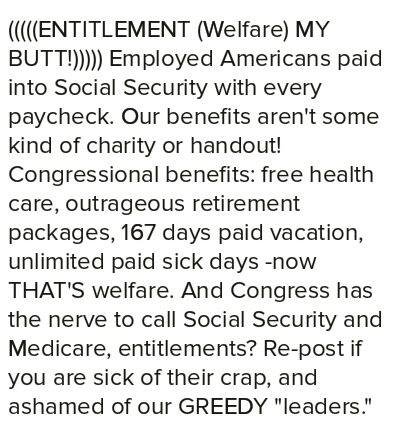
The other theme was the familiar one about how Social Security and Medicare are not "entitlements," they're "earned benefits," and anyway, it's our money that we worked for and paid, so they are entitlements and we are entitled, so there, too!  If you don't like it, I want my money back!  You'll remember the suggestion that Trump doesn't know what "entitlement" means?  Well, neither do Democrats.  (To be quite honest, I'm not sure it's only Democrats who say this; pro-Trump Republicans do too, if they think a Democrat wants to put his government hands on their Medicare and Social Security.)

But really, the worst part -- both hilarious and terrifying -- is the claim that Democrats will protect our Social Security and Medicare so Vote Blue No Matter Who.  What Obama tried to do is down the memory hole, if they ever noticed it -- and it's not as if Obama weren't open about it and it weren't covered in the mainstream media.  Bill Clinton also tried, but was blocked by his impeachment.  But what must not be cannot be. 

Wednesday, March 15, 2017

Grassroots, Downhome Jesus People

I've seen versions of these meme before, and when I see it I usually point out that "entitlement" doesn't mean "some kind of charity or handout."  It's true, I suppose, that some government and corporate elites have turned the word "entitlement" into a cussword; but then they also consider any form of government assistance, for anyone except the rich and big corporations, to be an intolerable drag on taxpayers' money that could better be spent subsidizing Wall Street.  The people I know who post memes like this generally regard everyone who receives government assistance (except themselves and their families and friends, of course) as lazy parasitic free-riders, so I don't take their political acuity for granted anyway.  So, it's the same old same-old, the "Get Your Government Hands Off My Medicare" syndrome.  Probably these people are ineducable, but they should at least be confronted and challenged when they lie.

But this time something else occurred to me.  What's wrong, exactly, with "some kind of charity or handout"?  There seems to be a general social consensus that charity and handouts are Very, Very Bad Things, and that people who accept charity or handouts should be ashamed of themselves; so, they often are.  Of course, people who believe this will pay lip service to help for those in genuine need.  The former Welfare Prince (son of a Welfare Queen) Ben Carson told The View, for example:
I have no desire to get rid of safety nets for people who need them. I have a strong desire to get rid of programs that create dependency in able-bodied people.
Snopes.com, in a convoluted post, tried to defend Carson against charges of dishonesty and hypocrisy by pointing to this quotation among others.  But it's a meaningless evasion, typical of the Right.  Judging from their attitudes, I suppose they wouldn't mind providing that safety net as long as those to whom it's provided are relentlessly and heartlessly reminded of their shame for not being able to care for themselves.  It's this attitude that has put the stench into the word "charity," especially when it's preceded by "Christian."

The thing is, the people who post the above meme and others with the same agenda are mostly obnoxiously devout Christians, studding their Facebook pages with declarations of their faith in God and the certainty that he is looking out for them.  (Which are often the less creepy of their religious declarations.)  Yet Jesus himself did works of charity, provided food and healthcare handouts without (mostly) asking anything in return.  The daily bread mentioned in Jesus' prayer is provided by God, not by human effort.  The earliest Christian groups did a lot of charity work, supporting widows and orphans and the poor; ostensibly they didn't limit this support only to their fellow Christians.  This is all in the New Testament, including the gospels. There is no indication I remember that those who received such handouts were supposed to be ashamed of doing so.

Yet right-wing Christians tend to be extremely hostile to works of charity that benefit other people, people they judge unworthy of receiving help.  (Especially children.  Are there no prisons?  Are there no workhouses?)  Given their hostility to some fundamental Christian values, it's not surprising that people like those behind this meme regard "charity" and "handout" as cusswords.  Nor are their hypocrisy and inhumanity any surprise.  This is just one more point on which to challenge them.

Tuesday, May 17, 2016

Already It Was Impossible to Say Which Was Which

The Intercept reports that Donald Trump appears to be changing his stance on entitlements.  Up till now Trump has insisted that he would protect Social Security, Medicare, and Medicaid against attempts to cut benefits, promising to "focus on economic growth so that we’d get 'so rich you don’t have to do that.'"

But now he's backing down, or at least reconsidering.
Trump policy adviser and co-chairman Sam Clovis said last week that the real estate mogul would look at changes to all federal programs, “including entitlement programs like Social Security and Medicare,” as part of a deficit reduction effort.

Clovis made the comments at the 2016 Fiscal Summit of the Pete Peterson Foundation, an organization whose founder has spent almost half a billion dollars to hype the U.S. debt and persuade people that the Medicare and Social Security programs are unsustainable. Trump also met privately last week with House Speaker Paul Ryan, R-Wis., an outspoken Medicare privatization advocate.
All pretty predictable, no?  My first reaction was that this sounded familiar.  Didn't Barack Obama follow a similar trajectory?  Yes, he did.

When he was campaigning for his first term as President, he told an AARP convention on September 6, 2008 (via), "But his [McCain’s] campaign has gone even further, suggesting that the best answer to the growing pressures on Social Security might be to cut cost-of-living adjustments or raise the retirement age. I will not do either."

Of course, he did both.  In 2010 he appointed a commission to make recommendations on cutting the national deficit, packing it with deficit hawks (including Paul Ryan).  Despite the way Obama had rigged it, the Simpson-Bowles commission was unable to agree on conclusions, so Alan Simpson and Erskine Bowles wrote up their own recommendations, which President Obama and most of the media treated as if they represented the commission as a whole.  These recommendations included phasing in a raise in the "retirement age" (meaning the age at which a retiree can receive full benefits) to 69 and changing the index for cost-of-living adjustments so as to lessen those adjustments, resulting in a benefits cut of 3 percent according to the economist Dean BakerObama also announced his willingness to use cuts in Social Security and Medicare to bargain with the Republican Congress on the debt ceiling.  The Business Roundtable, a gang of corporate CEOs, would prefer raising "full retirement age" to 70, and of course the usual Republican suspects in Congress were already on board for that.

So there's concern that "A Trump presidency would threaten programs like Social Security."  It would probably would, but so would any other Republican candidate's presidency.  So, most likely, would a Clinton presidency.  But an Obama presidency already has.

Thursday, December 6, 2012

Don't Let Me Be Misunderstood

As I'm sure everyone has noticed, after the elections there was a flurry of pronouncements by several corporate bigwigs, more in anger than in sorrow, that they were just going to have cut costs some more because of Obamacare.  Probably the most notorious was Papa John's CEO John Schnatter, but there were others.
Papa John's CEO John Schnatter says that Obamacare will result in a $0.11 to $0.14 price increase per pizza, or $0.15 to $0.20 cents per order, Pizza Marketplace, a trade publication, reports ...

“We're not supportive of Obamacare, like most businesses in our industry,” Schnatter was quoted as saying in Politico. “But our business model and unit economics are about as ideal as you can get for a food company to absorb Obamacare." 

Schnatter has thrown his weight behind Republican presidential candidate Mitt Romney this election season, even hosting a campaign fundraiser at his Louisville-area mansion in May. "Don’t you love this country?" Romney, who attended, asked during the event. "What a home this is, what grounds these are, the pool, the golf course."
Not too surprisingly, Schnatter backtracked almost immediately, and claimed he'd been misquoted and misunderstood.  Poor baby.  (It's hard for me to believe that a damn pizza-industry publication would misquote or misunderstand one of its own, but maybe some Communists infiltrated it.)

Today I stumbled on an interesting article, also from an industry source, which reported that
The brand perception of Papa John's, Applebee's and Denny's took a beating after high-ranking representatives of the companies said Obamacare would force them to stop building restaurants, cut worker hours and raise prices.
As the article reports, correlation doesn't equal cause, so it isn't certain that the lowered approval of these brands was a reaction to the announcements.  But it's noteworthy that people like Schnatter found it prudent to repudiate their earlier remarks, even to pretend that they hadn't made them, even before data like this turned up.  But there's something else that I take from this story.

Not all the Obamacare warnings came from the top dogs: some came from franchise owners who ran numerous restaurants, and some came from individual restaurant owners in the franchises.  We hear a lot about the practical common sense of those great job creators, the small businesspeople of America, no less than we do about the wisdom of the great entrepreneurs.  But I think that stories like this should make us all skeptical about what we hear on that score.  Schnatter, for example, claimed that Papa John's would have to raise pizza prices by 11 to 14 cents apiece to make up for increased costs entailed by providing insurance to their employees.  Those numbers have been disputed, but who knows?  Some will call me just a reflexive hater of rich people, but that's not true; I only reflexively hate rich people who are stupid, vicious, and dishonest. 

Just from a shareholder's point of view, there'd be good reason to have doubts about a CEO who took advantage of his prominence to run to the media and make Scrooge-like pronouncements that made the company look bad.  Papa John's stocks took a dive right after he vented, which probably had something to do with his recantation.  (I took that information from the same Forbes article I just linked to -- again, a business-friendly source, not the Daily Worker.)  I suspect that Schnatter pulled the 11 to 14-cent numbers out of his ass, just because he felt like throwing a tantrum over Obama's survival and the very idea of having to provide health insurance to his employees.  Which is his right in a free society, just as the reactions he got were everybody else's right.  It's nice to be reminded, though, that it wasn't just the little people, the mob, who were put off by the hysteria of Schnatter and his ilk; even the real America, the 1 percent, turned against him.

Still, the next time you hear someone babbling about the wisdom of entrepreneurs, their competence, their practical common sense, remember that you're hearing about people like John Schnatter, and he's evidently not unrepresentative of the breed. Rich guys all over America are stamping their expensively-shod feet and screaming like two-year-olds at Obama's socialist agenda.  At the very least, this is imprudent of them, since he is all that stands between them and the pitchforks.  (O faithful servant! no matter how much they abuse him, still he offers himself as a human shield, again and again.  I trust he has his reward in the life to come, by which I mean after January 20, 2017.)

Speaking of Obama, he's still making it clear whose side he's on.  The other day he told the Business Roundtable:
We’ve seen some movement over the last several days among some Republicans. I think there’s a recognition that maybe they can accept some rate increases as long as it’s combined with serious entitlement reform and additional spending cuts. And if we can get the leadership on the Republican side to take that framework, to acknowledge that reality, then the numbers actually aren’t that far apart. Another way of putting this is, we can probably solve this in about a week; it’s not that tough.
The key word for my purpose here is "entitlement."  Several of my liberal friends have been throwing tantrums of their own over that word as used by Republicans, typically having hissyfits over words rather than what they refer to.  (This, for instance.)  But they're less attentive to their god-king's use of the word.  Bear in mind that part of what Obama means by "serious entitlement reform" is cutting Social Security benefits for new retirees by raising the age of eligibility -- again -- as part of his program to cut the deficit, though Social Security has nothing to do with the deficit.  The reason for making such cuts is to appease people -- mostly, but not all, Republicans -- who want to get rid of Social Security, Medicare, and other social programs for other, Scroogier reasons.

Thursday, November 1, 2012

A Good Day to Meme

I saw this meme on Facebook today, just a day after I read Richard Seymour's post on memes at Lenin's Tomb.  As is sometimes the case, it's fair enough as long as you keep your partisan blinders on: yes, the Republican candidates are not good on Social Security and Medicare.   But neither are the Democrats.  Obama also wants to raise the retirement age and cut benefits for future generations; as I've already mentioned, he has been quite open and consistent about this, and we can expect him to make a move after the elections, no matter how they turn out.  Former President Bill Clinton, who's been getting a lot of adulation from Democrats lately, was interested in privatizing Social Security until he got entangled in the sex scandal that almost cost him his office.  Obama even said during the first presidential debate that on Social Security, he suspected that he and Romney have "a somewhat similar position."  So what's his grade?

Go back to that last link for a moment, where Obama declared his agreement with Romney on Social Security.
Indeed, Romney, in his book "No Apology," said he backs changing the payment structure for Social Security benefits and said that there is a "certain logic" to increasing the retirement age at which one begins to receive Social Security payments, while protecting those who may be physically unable to work.

"Many older Americans are healthy, vital, and want to stay engaged in meaningful work," he wrote. "If we increased the retirement age, we would encourage seniors to stay healthier longer, keep their minds active and alert, and at the same time, we would relieve the terrible Social Security burden our children and grandchildren face."
That's some interesting sleight-of-hand going on there.  It reminded me of something an old friend from high school said the other day on this very subject: he also said that he wasn't interested in retiring, he wasn't happy unless he was working.  He said he'd retire when his health failed and he could no longer work.  But "the retirement age" doesn't mean the age at which you must retire; it means the age at which you can retire, if you wish to and if you can afford it.  Someone like Joe doesn't want to retire yet, so he doesn't have to.

This same move kept turning up during the fuss earlier this year, over the requirement that employees' health care plans must include contraception coverage.  The Right talked as though employees would be required to use contraception, whether or not they needed or wanted to.  But they wouldn't, any more than I have to have surgery every year just because my insurance plan covers it.  Do Republicans actually believe that "the retirement age" means mandatory retirement at that age?  Some do, I suspect.  So, I suspect, do some Democrats, and if Obama moves to raise the retirement age as he has said he wants to do, many of them will use exactly this argument to defend him.

I retired last year at the age of 60, and began drawing my state pension but not (yet) Social Security.  Quite a number of my age mates had done so at the same age or younger, not because they were infirm (though some were), but because they were eligible for a pension, or (like me) took advantage of an early-retirement incentive plan.  Yes, employers, public and private, often want their high-seniority workers to retire early, and will sweeten the deal with lump-sum payments and other incentives.  I know US military personnel who retired after twenty years -- which means, in their forties -- with full pensions, often quite comfortable since they were officers.  Some of them started new careers while continuing to draw their pensions.  Would Romney or Obama care to tell them that they are contributing to the tax burden of their children and grandchildren?  (If so, I'd enjoy watching.)

If anything, it's raising the retirement age and cutting benefits -- the same thing, really, in different guises -- that will increase the burden on coming generations by increasing the numbers of indigent seniors.  As Dean Baker wrote recently, cutting benefits "might be reasonable policy if we had some cause to believe that workers in the future will be better prepared for retirement than current retirees; however there is no evidence to support this view."

Earlier retirement, say at 62, doesn't contribute to any burden of present or future taxpayers anyhow: Social Security is fully funded by the contributions that go into the Social Security Trust Fund.  The same is true of the state pension I'm now drawing, as far as I know.  The currently diminishing interval before the Social Security fund will start giving out more money than it takes in is due in large part to drastically lower growth in the US economy.  I recall seeing, when I first began paying attention to this issue a decade ago, that the official estimates were based on the assumption of 2 percent growth per year -- which at that time was a very conservatively low assumption: growth was higher than 2 percent at that time.  Thanks to the economic policies that produced the crash of 2008, economic growth has slowed to less than 2 percent per year.  I'm not saying that was deliberate, but it was convenient for opponents of Social Security, and the overall lowered growth hasn't hurt the rich.  So one way -- practical and better in the long run, though unpopular among the richest Americans -- to protect Social Security would be policies that foster economic growth.

Another would be meaningful job growth, by which I don't mean minimum-wage, no-benefits jobs of the kind that most people are scrambling for since Reaganism took over this country in the 1980s.  Whether this is possible given the current political climate, it is necessary.  I've been seeing more journalists and economists raising the same question that a working-class interviewee in one of Michael Moore's films asked years ago: If all the jobs go overseas and people in the US can't earn a living wage, who's going to buy the products of American companies?  The answer, it turned out, was people overseas, buying products made by American companies in other countries: automobiles made by Jeep in Chinese factories for sale in China, for example, where the profit margin is higher.  Which is fine for the people who'll rake in those profits, but not for the rest of us.  (True, computers and other electronic gadgets have gotten progressively cheaper, which is fine as long as you have electricity; but try eating them.)

The US economy could support Social Security easily, and probably Medicare too.  The trouble with Medicare is that our privately-controlled profit-driven health insurance system is wasteful and, well, profit-driven, not directed by people's actual health care needs.  The Medicare system is cost-efficient itself, but is not allowed to have much effect on the costs of health care and medication.  Private insurance companies, even constrained slightly by the Affordable Care Act, are about making money, not about people's health.  And in these areas, there really is little if anything to choose between Obama and Romney.  I give them both an F.

Sunday, October 28, 2012

There's Just Not Enough of the Pie of Sacrifice for Everybody!

Lately I've been seeing more people claiming online that Obama intends to push for cuts in Social Security and Medicare after the elections.  Whether he wins or not, Congress will be in a lame-duck session, and Obama himself will be beyond accountability, either as a lame-duck president or a re-elected incumbent, free at last to do what he wants, not what his base wants.  This wouldn't be surprising, since Obama already put these important social programs on the chopping block during the great Debt Ceiling wars of 2011, and had spoken the requisite code words ("reform" for example) even before he was elected the first time.

But then it emerged that Obama gave an "off-the-record" interview to an Iowa newspaper in which he gave the game away.  After the newspaper "pitched a fit" (via), the "campaign allowed it to be published."  There are numerous WTFs here, starting with a newspaper allowing an entire interview to be off the record, and continuing through asking the campaign's permission to publish it.  I'd like to think they would have gone ahead and published it anyway.  What were they afraid of, that the President wouldn't grant them any more off-the-record interviews?

Anyway, Obama said:
It will probably be messy. It won’t be pleasant. But I am absolutely confident that we can get what is the equivalent of the grand bargain that essentially I’ve been offering to the Republicans for a very long time, which is $2.50 worth of cuts for every dollar in spending, and work to reduce the costs of our health care programs.

And we can easily meet -- “easily” is the wrong word -- we can credibly meet the target that the Bowles-Simpson Commission established of $4 trillion in deficit reduction, and even more in the out-years, and we can stabilize our deficit-to-GDP ratio in a way that is really going to be a good foundation for long-term growth. Now, once we get that done, that takes a huge piece of business off the table.
Just in passing: The Bowles-Simpson Commission (easily and credibly called the Catfood Commission) did not "establish" anything.  Although Obama packed it with deficit hawks, the Commission was unable to agree on recommendations, so its chairmen, Bowles and Simpson, released their own recommendations, which have ever since been treated by the media and by the President as the report of the Commission.  (I've noticed that I've made the same mistake in some posts here; I should make some corrections.)  Bowles and Simpson "essentially saw deficit-reduction as an opportunity to redistribute income upwards: by capping government revenues, cutting tax rates for the wealthy and corporations (while raising them for the middle class), lowering Social Security benefits and making the elderly pay more for their healthcare."  This is not only a very unpopular course of action (except among the very rich and their toadies), it will be harmful to the economy and to most of the country (though not to the very rich and their toadies).

So this is what, according to President Obama, he hopes to achieve.  He even referred in that interview to "the commitment of both myself and my opponent -- at least Governor Romney claims that he wants to reduce the deficit" to carry out this agenda.  Just in case you had any illusions about differences between the candidates on this little matter.

I posted a couple of links about this to Facebook today, and soon had an angry comment from my Obama-Democrat liberal law-professor friend.  First she lectured me that there's never going to be a candidate I agree with 100%, so I should not whine or make posts that "undermine" President Obama, because he's not a Republican (I hadn't said that he is), and today's Republicans would never agree that he was.  "I hope that Social Security won't have to be sacrificed," she wrote.  Obama apologetics of the campaign's final month in a nutshell, you see.

I replied that of course no candidate is perfect, which is why I can't see why she hates on Romney so much, even if he has been something of a "disappointment" to many Democrats.  As for "undermining" Obama, why the hell not?  But then, as my friend knows very well (we have some of the same right-wing frother friends in common), I've spent just as much time "undermining" Romney on Facebook, so it all balances out.  As Avedon Carol pointed out anent Richard Mourdock in the same post, "I swear, it's as if they are doing damage control for Obama - no sooner does he step in it than they come in swinging to punch themselves in the face."  And if anyone has undermined Obama, it has been Obama himself.

And it really makes no difference: Obama cultists have consistently thrown tantrums over any criticism of their God-king from the time he became nationally prominent and a contender for the Presidency.  I fully expect that if he is reelected, they'll continue to denounce any criticism of Obama in the same terms, with fabricated accusations and no substantive rebuttal, forever.  (See examples, mostly anonymous, in the comments under Susan of Texas's post hereThis one, say, and this reply.)

But "I hope that Social Security won't have to be sacrificed"?  My only reply to that was "Jesus H. Christ", though I'll probably have more to say to her about it later.  The sheer dishonesty and stupidity of that remark floored me.

Let me begin by pointing past the blind passive in what she wrote: Obama doesn't have to sacrifice Social SecurityIt doesn't contribute to the deficit; there's no fiscal necessity to cut the program.  As with the pre-emptive tax cuts in his 2009 stimulus bill, Obama offered cuts in social programs to the Republicans during the debt-ceiling fight without their having to demand them.  He's not obligated to accept Simpson and Bowles recommendations, since they aren't binding, but he accepted them anyway -- and he did appoint those two deficit hawks to his deficit-reduction commission, knowing in advance that they are advocates of cutting Social Security and Medicare.  Nor is there support in the general population for cutting Social Security and Medicare; they are both very popular, which is why Social Security has long been called the Third Rail of American politics.  Only Obama's wealthy campaign donors support his intentions, but as both his left critics and his right-wing supporters have been saying, once he's re-elected he'll be beholden to no one.  He doesn't have to cut Social Security and Medicare -- he wants to.  And he's always wanted to.

As for today's Republicans' denial that Obama is a Republican -- which, I repeat, I hadn't said, but attacking a straw man is so much easier -- they love his policies but hate the man, for well-known reasons.  Much as with Clinton, who pushed through much of Ronald Reagan's wish list (NAFTA and "welfare reform," for instance), Obama has continued and extended many Bush policies. Even some of Bush's people have praised him for it, especially on foreign policy and civil liberties, and he has returned the favor.  If Obama were a white, card-carrying Republican, the Republican fringe would adore him.  That's why they have to attack him on fictional grounds -- that he's not a citizen, that he's a Muslim, that he's a socialist, etc.  For their part, his Democratic defenders have to defend him on largely fictional grounds.

The problem is not that I don't agree with Obama 100%, as my friend put it.  I'm not sure how to quantify it, but it's probably in the ballpark to say that I don't agree with him even 50%, maybe not even 10%.  The Obamabots keep falling back on the Supreme Court and they really have nothing else to point to, so it might even be 1 percent.  It's like the "disappointment" line.  The dishonesty of the Democratic loyalists rivals that of the Republicans.

Sunday, June 3, 2012

There He Goes Again, and Again and Again

I'd put my copy of There He Goes Again: Ronald Reagan's Reign of Error into storage, partly because I hadn't realized it would come in handy later.  Compiled by Mark Green and Gail MacColl and published in 1983, it collected and corrected dozens of the Gipper's most significant falsehoods.  The age of Reagan is over -- or so I thought -- so There He Goes Again could safely be put aside.

But then, a few weeks ago, President Obama proudly asserted the Reagan Revolution as his heritage, and Reagan as a fellow centrist who couldn't have won the presidential nomination from today's Republican party.  The Right jeered -- one pundit asked "Where are the moderate Democrats?", thereby supporting Obama's, and Mike Huckabee's, and the Economist's (via) claim.  Obama's toadies jumped in line behind him, and stuff like the above cartoon began turning up on Facebook.  It was time, I realized, to dust off There He Goes Again.

I'd already noticed that a couple of minor details had been overlooked.  Take the notion that Reagan "was too reasonable," because he raised taxes, enacted tariffs to protect American industries, supported environmental protection, and as Obama put it, "understood repeatedly that when the deficit started to get out of control, that for him to make a deal he would have to propose both spending cuts and tax increases. Did it multiple times."  These were things Reagan did after he was in office.  He campaigned on a platform that rejected such measures. An apologist might argue that Obama did the same thing: he adjusted to political realities that hadn't been effective while he was running for office.  But that isn't true: Obama expressed his admiration for Reagan while he was campaigning, and the economy was already staggering before he was elected.  Obama had already supported Bush's TARP program, and defended it during the campaign.  He also spoke of the need for "reform" of Social Security, which he misrepresented as being in crisis.  While he did reverse himself on a public option for health insurance reform, and on support for labor, and some other matters, he was already obviously a politician of the Right before he took office.

Reagan, by contrast, was forced by political reality to move toward the left.  As with Obama, his devotees were ready to forget his lapses from small-government right-wing orthodoxy while he was governor of California, and his election was hailed by the Christian Right as their Vindication, the proof that Yes They Could.  That was because Reagan had a long history as a vicious far-right demagogue, at odds with his own record as a working politician, but true believers look to what their leader says, not what he does.

[P.S. The difference between them could be summed up this way: Reagan campaigned as a right-wing extremist, but had to govern as a relative moderate; Obama campaigned as a moderate, but governs as a right-wing extremist.  It should also be remembered that polls showed that people voted for Reagan because they liked him; they opposed his policies and hoped he wouldn't carry them out.]

Social Security is a good example of this.  I'll take as given that the Reagan quotation in the above cartoon is accurate, though a look at its historical context would probably be less flattering to Obama.  But a look at There He Goes Again shows that Reagan had campaigned against Social Security for decades; he had to moderate his rhetoric somewhat as a major-party nominee, but he continued to work against it.  In September of 1980, during the campaign, he told the New York Times, "I never suggesteded that Social Security should be voluntary."  Green and MacColl commented (page 87):
Not never.  Voluntary Social Security was a staple of Reagan's mashed potato circuit speeches of the '60s.  For example: "Social Security ought to be voluntary ... so those who can make better provision for themselves are allowed to do so" (Human Events, Nov. 1966).  Or, "Don't exchange freedom for the soup kitchen of compulsory insurance" (New York Times, 1/17/76).
In a radio address a year later (September 24, 1981), President Reagan declared: "There has been a great deal of misinformation and for that matter pure demagoguery on the subject of Social Security ..."
The misinformation is on the subject of just how much the President wants to cut.  He has acted to eliminate Social Security benefits for students who are children of deceased and disabled workers; proposed cutting the minimum benefit for Social Security recipients; and allowed his Health and Human Services Secretary to propose cutting benefits at 62 years of age -- a proposal rejected by the Senate, 95-0 [pp. 87-88].
In the long run, Reagan got his way.  There are calls to raise the retirement age and cut benefits, from President Obama's Catfood Commission for example.  (The Commission was unable to agree on a report, but the two chairmen, Erskine Bowles and Alan Simpson, issued their own recommendations, which were widely misrepresented as speaking for the Commission as a whole, though it rejected them.)

But back to the first Reagan.
During the 1982 election campaigns, the Republican TV advertisement showed a white-haired mailman delivering July's Social Security Check, which contained an automatic cost-of-living increase in benefits.  "President Reagan kept his promise to the American people," the ad proclaimed.

In fact, Reagan opposed the increase in Congress, which passed it anyway.  Rep. Claude Pepper (D-Fla.) chairman of the House Committee on Aging, said that for Reagan to claim credit for the increase "lowers the art of deception to depths not explored since the Nixon Administration" (New York Times, 7/7/82) [p. 89].
As you can see, Obama learned to prevaricate from a master.

Tuesday, April 24, 2012

Lies, Damned Lies, and the Associated Press

I've said before that the corporate media's distortions are often a matter of tone or emphasis rather than fact; but sometimes they just lie.  Today I found in my local paper a full page Associated Press story on Social Security, reporting that "the government" says that Social Security will "run dry" in 2033, three years earlier than previously predicted.  This is not only false, it's a falsehood that has been advanced and refuted many times over the past decade and more.

I had a bit of trouble finding an online link for the story: the local paper and the Christian Science Monitor ("Social Security Fund: Cash Gone by 2033"), Newsday, and other sites require registration or jumping through various hoops to read it.  But here's a link.

Yesterday PBS had a faux debate between an advocate for Social Security, Nancy Altman, and someone who wants to dance on its grave, David John of the Heritage Foundation.  Host Ray Suarez spoke of the "economic swoon of 2008-9" as a factor in the program's declining revenues.  "Swoon" seems like a tendentious understatement; something like "kneecapping" would have been a better metaphor, it seems to me.  And it's true, earlier more optimistic projections of Social Security's future were based on a higher (but still very conservative) assumption about America's economic growth.  The crash of 2008-9 put paid to such an assumption, and Republicans and Democrats have been collaborating assiduously to keep growth (though not corporate profits) hobbled; but I don't think that's intended purely to damage Social Security -- it's the general well-being of American workers (employment, wages, hours, etc.) that is the target.

What will happen in 2033, as even the AP story admits, is not that the trust fund will run dry, run out of cash, be insolvent, etc.  What will happen is that Social Security will still be taking in payroll taxes, which will enable payment of about 75% of benefits.  (The story further confuses things by combining Social Security and Medicare, two different programs with different problems.)  And as FAIR pointed out of another recent attack on Social Security, this isn't a problem "unless you believe the money in the trust fund won't be paid back to taxpayers."  Dean [Baker] wrote, "This is the same situation the government faces when Wall Street investment banker Peter Peterson or any other holder of government bonds decides to cash in their bonds when they become due. In such cases it 'must raise taxes, cut spending or borrow more heavily from outside investors.'" Our corporate media pundits have no objection to Pete Peterson or other wealthy people's cashing in their government bonds to get the money that is owed them -- only ordinary citizens like you and me.  And as the the pundit Baker was criticizing tacitly conceded, the trust fund could be built up by various means if the People Who Matter wanted to; the trouble is that they don't.  Social Security is a thorn in their sides -- not because it costs them anything (it's self-financing), but because it apparently drives them crazy to see the hoi polloi deriving benefits from their government, as if they were real people.

As I indicated before, the AP story isn't anything new; it's just the latest installment in the long propaganda war against Social Security and other government programs which protect the interests of the vast majority of American citizens, as opposed to those which support the tiny majority of the most well-off.  But it's propaganda that many of us believe, so it needs to be answered every time.

Tuesday, January 25, 2011

The Snake and the Stone of Spiritual Abundance

I didn't watch or listen to Obama's State of the Union speech, but I did find this status message on Facebook today from my minister friend:
Praying for President Obama as he prepares the State of the Nation address for tonight. We need to be challenged, asked to sacrifice, in good ways for the future of the republic. Debt is going to swallow us if we don't all take a slice of the pie of sacrifice.
This reminds me of an exchange from Firesign Theatre's Don't Crush That Dwarf, Hand Me the Pliers! I quote from memory: a woman on a TV game show trades everything she's won so far for a little bag, but after she opens it, she protests, "But -- but -- this is a bag of shit!" The Master of Ceremonies replies, "But it's really great shit, Mrs. Presge!"

Or, as Jesus once said, according to Matthew 7:9, "Or what man is there of you, whom if his son ask for bread, will he give him a stone?" And if millions of Americans are out of work and have been so for a long time, and if many more have lost their homes in foreclosures of dubious legality, what man out there will then offer them "the pie of sacrifice"? But it's really great sacrifice, Mr. and Mrs. America, and it will be good for you, all the way down!

My old friend seems to have a thing for this kind of sacrifice. Just about a year ago he quoted a column by the New York Times's Bob Herbert, and complained "few of us [are] willing to sacrifice today for a better tomorrow." I thought he was full of shit (but really great shit) then, and I think so now. And remember, this guy isn't a fundamentalist -- he's an organization man in a mainline Protestant denomination, who was appalled by Pat Robertson's nasty remarks about Haiti after the January 2010 earthquake but still thought that the US should go easy on the aid until the Haitians got their act together and learned how to do an economy right.

We know already that Obama is ready to dish out big slices of the pie of sacrifice to most Americans, in the form of later retirement and cuts in Social Security benefits; he's already begun his assault. I wondered what Bob Herbert was up to these days, and by an interesting coincidence his latest column was on Social Security, opposing any such assaults on America's elderly while carefully not mentioning Obama's name.

The deficit hawks and the right-wingers can scream all they want, but there is no Social Security crisis. There is a foreseeable problem with the program’s long-term financing, but it can be fixed with changes that do no harm to its elderly beneficiaries. One obvious step would be to raise the cap on payroll taxes so that wealthy earners shoulder a fairer share of the burden.

The alarmist rhetoric should cease. Americans have enough economic problems to worry about without being petrified that their Social Security benefits will be curtailed. A Gallup poll taken recently found that 90 percent of Americans ages 44 to 75 believed that the country was facing a retirement crisis. Nearly two-thirds were more fearful of depleting their assets than they were of dying. The fears about retirement are well placed — most Americans do not have enough to retire on. But there should be no reason to believe that Social Security is in jeopardy.

The folks who want to raise the retirement age and hack away at benefits for ordinary working Americans are inevitably those who have not the least worry about their own retirement. The haves so often get a perverse kick out of bullying the have-nots.

You know those "deficit hawks"? One of them is named Barack Obama. In fairness I must stress that I don't know what kind of filling my minister friend has in mind for the pie of sacrifice, since he was (probably deliberately) vague on details, but given his adoption of deficit-hawk rhetoric, I have to suspect that that's part of what he has in mind. It's a perfectly middle-of-the-road position, after all. I wonder what sacrifices he has in mind for himself?

Monday, November 15, 2010

Think of the Starving Children in Africa Who'd Love to Have That Catfood!

If I still needed a reason to consider Barack Obama a congenital cheap pig*, I'd have it in the now well-circulated remarks he made last week about negative reactions to the draft report of his Catfood Commission:

"Before anybody starts shooting down proposals, I think we need to listen, we need to gather up all the facts," Obama told reporters.

He added: "If people are, in fact, concerned about spending, debt, deficits and the future of our country, then they're going to need to be armed with the information about the kinds of choices that are going to be involved, and we can't just engage in political rhetoric."

Now, "political rhetoric" is exactly what Obama was engaging in there. (I think he wanted to say something like "partisan bickering", but the criticism he was addressing came from his own party.) Notice that even though he hadn't seen the draft report when he started defending it, he still said that its recommendations are "the kinds of choices that are going to be involved" -- not even "may be involved." Certain "choices," like cutting back on his wars and his surveillance state, are not going to be involved. But he doesn't mind going after Social Security and Medicare, or raising the federal gasoline tax by 80 percent or so (which is highly regressive -- that is, it will hurt people in lower income brackets more). To counter discrimination against the vulnerable Corporate-Americans (corporations are people too, you know! they have feelings! they can hurt!), the corporate tax rate will be cut by about 25 percent, from 35 to 26 percent. The hike in the gasoline tax is intended to make up for the loss of revenue that will result from that generous gesture.

Another thing to remember (and there are many) is that while the Catfood Commission was meeting in quasi-secrecy, most of what it turned out to recommend was anything but secret, and was being discussed publicly. Critics of "the kinds of choices that are going to be involved" are already armed with information. Obama isn't interested, of course. You already know his attitude to his Democratic and 'left' critics. All that interests him is whether he's giving enough to his corporate and banking buddies. (Gee, do you think 26 percent is low enough?)

I'm using the pejorative name "Catfood Commission," by the way, because of the confusion in certain media -- well, most of the corporate media, it looks like -- about what its mission is. This writer at Bloomberg, for example, equivocates between the "deficit" and the "debt" -- and the two are not the same thing. And, of course, Social Security has nothing to do with the deficit; it's already fully funded by our contributions. Obama's owners just hate the idea of all that money going to the wrong people. They love the idea of privatizing it, and giving it to Wall Street (who are, remember, among Obama's major owners) to play with, so that it can all disappear during the next big crash, just as so many people's 401k accounts did a few years ago -- but not before it is diverted to executive salaries and bonuses, where in these people's minds it really belongs.

*I had the odd difference with Hunter S. Thompson, but I will always love his gift for invective. "A congenital cheap pig" was what he once called the despicable Reagan toady Ed Meese: "a person without any honor, a fat bastard, really a congenital cheap pig in the style of and on the level of Richard Nixon." Change "fat" to "skinny," and the whole line describes Barack Hussein Obama to a T.