Showing posts with label doublethink. Show all posts

Monday, December 21, 2020

What Can You Do With a Boy Like Pete?

When President-elect Biden announced his first batch of staff and cabinet nominees, there was a great surge of celebration among liberal Democrats online.  So wonderful! they exulted. He's appointing competent, qualified adults! and so on. I had the feeling something was wrong, but concentrated more on what the reporters I trust were saying about the appointees.

As time went on and more nominees were put on display, a reasonable amount of skepticism about some of them emerged.  Biden-Harris loyalists angrily rejected discussion, which didn't keep it from continuing, but basically they were trolling: Who cares, they're all better than Trump's people, I'm just so glad I don't have to think about what he's doing! I suppose you wish Trump had won the election, you dirty Bernie Bro!

This came to a head with speculation about what role Pete Buttigieg would play in the Biden administration.  Word was that Buttigieg insisted on a cabinet post and wouldn't settle for less. Excited Mayor Pete fans tossed out possibilities.  An ambassadorship?  China, maybe?  He speaks so many languages, he could pick up Mandarin in no time!  Or how about the United Nations?  He's so smart, he's qualified for anything and everything!  He's got this youthful energy!  He went on Fox News and shut them down!

Now, most of these recommendations didn't amount to much, certainly not as qualifications.  I noted that Buttigieg's polyglot brilliance was exaggerated; the two languages he speaks that I know (without calling myself fluent in either Spanish or French), he doesn't speak very well.  The United Nations has a corps of interpreters so that ambassadors don't need to try to master dozens of languages.  Even if Buttigieg were as fluent in seven languages as his fans believe, it's not a qualification for a prominent government post.  Nor are most of the qualities his fans gushed about.

I haven't watched his appearance on Fox News, but I do remember that when he was asked a pointed question by a New York Times reporter, he got flustered and tried to cuss and lie his way out of it, without success.  In general he doesn't seem to deal well with disagreement or criticism; his blundering encounter with angry black voters in South Bend, for example. I see no reason to suppose that he's cut out to be a diplomat, even on the rather soft level of an ambassador.  He's simply too inexperienced for any important post on the level of China.

His inexperience is the sticking point for a cabinet post too.  Two terms as mayor of a small city -- I was going to call his tenure undistinguished, but even that might be too kind -- are not enough to let him lay claim to any national office.  Buttigieg's a fairly adroit and mostly lucky self-promoter, but most of the image he projected when he began running for President crumbled under press scrutiny.  It was widely held, this past week or two, that he thought he'd earned a place in the cabinet simply by quitting the primaries to clear the way for Joe Biden; I began to wonder if he might be hurting himself by his entitlement.  Importunate troublemakers with little to offer tend not to get what they want.

But no, Biden tapped Buttigieg for Secretary of Transportation.  Stress was laid on his homosexuality, on what a historic first it will be for an openly gay man to head DoT.  It is that, but homosexuality is not a qualification for a cabinet post.  Biden's been touting the diversity of his cabinet choices, and I bet he's going to try to distract attention from the inadequacy of several of them by pointing to it.  Certainly his toadies and trolls will do it, as Obama's and Hillary Clinton's did for them.  I don't think it will work too well, but what else has he got right now?

I've been arguing about this with a lot of people on social media, and it's fascinating (as well as dispiriting) to see how quickly Democrats have abandoned any concern that the Biden administration should be competent or qualified.  It's all the more remarkable when you recall how exercised they were by the inadequacy of Trump and his people, right up to the present.  That's one of their rebuttals in fact: Who cares, he's better than the trash Trump put into those positions!  Which may be true, but it sets the bar absurdly low.  Someone actually argued seriously that Buttigieg would lower the average age of Biden's cabinet.  So it would, but you could say the same about Ivanka or Jared.  (Most defenses of Biden, as with Clinton or Obama, could be made as fairly of Trump.)  As someone pointed out, "The defense of the centrist establishment of how Pete Buttigieg is qualified to be Transportation Secretary is pretty funny to watch & akin to Trump saying how Dr. Atlas was qualified."

Ryan Grim and David Sirota, who are among the left journalists I rely on these days, have made cases that some of Biden's nominees are pretty good, just as some are very bad.  They're still being attacked by Biden-Harris trolls for their lack of obedience and submission, but the trolls have no real arguments and are getting a lot of good pushback.  On the other hand, I just had a depressing exchange over Buttigieg with my old friend the ambivalent Obama supporter, who at first defended Buttigieg as smart enough to learn to do the job -- quite a weak defense.  When I leaned on him a bit, he conceded that Buttigieg wasn't a good choice, but Biden could have done worse.  That's not even a defense; it's capitulation to the Dark Side.  Of course Biden could have done worse, but this country may not survive four more years of "could have done worse."

I've seen several statements (including long threads) like this:

The doublethink is impressive; these people are dedicated servants of Big Brother.  I'm beginning to realize that they don't know what qualifications are, and they don't care.  They want to forget that the Trump years ever happened, though as with George W. Bush, it's difficult at times to figure out precisely what they objected to about him.  Policies that liberals claimed to hate from Dubya became virtuous when Obama took them up, and I expect we'll see the same pattern with Biden.  I also expect that Biden won't get the same indulgence that many progressives extended to Obama, which hindered resistance to his worst policies. It may even be that liberals' expressed intention to shut off their brains for the next four years while Uncle Joe takes care of them will keep them out of the way to some extent.  Not many people are genuinely excited about Biden, as they were about Obama, so he may have fewer defenders.

"Even if our country goes off the rails," a DJ on the community radio station just said a moment ago, "we have a heritage of music that delights and inspires."  That doesn't make me feel even a little better; Trump Derangement Syndrome is a hell of a thing.  Fasten your seatbelts, liberals: we're all in for a bumpy ride.

Sunday, November 22, 2020

What's in a Name?

I feel for writers and journalists who cover politics, because they have to attend to the corporate news media: Fox, CNN, the corporate broadcast networks, public broadcasting, and a range of print media.  Just listening to NPR for an hour or two each morning makes me climb the walls: how much worse would it be if it were my job to follow it and all the others?

Last Sunday, for example, NPR's Weekend Edition gave airtime to an instructor in government at Dartmouth College, to opine on Donald Trump's refusal to concede the election to Joe Biden.  Host Lulu Garcia-Navarro asked Brendan Nyhan "Why is he doing this? Is this a soft coup? And what I'm hearing you say is that this misses the larger picture of what's happening to democracy itself."

NYHAN: That's right. I think coup is the wrong way to think about this. We're not seeing an attempted military takeover. What we're seeing instead is a violation of the norms of democracy that we depend on to make the peaceful transfer of power possible. And as those norms get called into question, we start to see more of what political scientists call democratic erosion, where a system of government remains a democracy, but the norms and values that make democracy work start to be called into question.

Most of this is unexceptionable, a string of the buzzwords you'll hear on any network.  I do take serious exception to Nyhan's claim that "coup is he wrong way to think about this."  While most Americans probably do think that "coup" (short for "coup d'état") refers to a military takeover, it actually means any sudden and extralegal seizure of power in an institution.  Violence is optional, the icing on the cake.  An academic should know better, and clarify the issue rather than obscuring it.  Instead the one substantive assertion Nyhan made was false.  But this is NPR we're dealing with.

Later in the week, on Friday, Morning Edition brought in a heavy-hitter, an intelligence officer in the Trump regime until 2019.  Host Steve Inskeep asked Sue Gordon, "I'm thinking about the fact that you have briefed presidents. If this event were happening in a different country and you were briefing the president about it, what would you call it?"

Gordon worded her response with some care:

SUE GORDON: We would talk about it as basically - if it were a purported democracy, I think we would say the democracy's teetering on the edge. If I were briefing the president on this at this moment in time, and this White House were doing what this is doing and I happen to be in the Oval, I would say stop it.

"If it were a purported democracy"?  This is hard to take seriously.  Whether a country is a "purported democracy" has little to do with its political institutions and practices and a lot to do with how the US views it.  During the Trump years the US has backed and even participated in at least two coups against elected governments, in Venezuela and Bolivia.  Harking back to Brendan Nyhan, in Venezuela the military didn't back the coup, much to the indignation of US commentators, so by his standards it may not count.  In Bolivia the military carried out the coup with considerable violence, so Nyhan would presumably be satisfied.  Mainstream US and UK commentators and political authorities were reluctant to label either action a coup, partly for reasons I'll into presently, but for now the fact that two democratically elected governments were overthrown, with various degrees of violence, didn't concern the media or the US government: they denied the legitimacy of the elections instead.  (Does that sound familiar?)  Contrary to Sue Gordon, in such cases US intelligence would not say to "stop it."  Nor would NPR or other mainstream news media.

We all know that Trump is a very bad man, though.  President Obama was good, right?  Actually, no: he supported numerous oppressive dictatorships and backed the far right-wing Venezuelan opposition with millions of taxpayer dollars.  He hedged a bit when the Honduran military overthrew an elected President, fiddling with aid payments for a little while, but eventually gave in.  

Obama's initial response to the 2013 military overthrow of the elected president of Egypt was somewhat firmer.  Obama wasn't pleased, but many in his regime were.  President Morsi was unpopular in US government circles because he was a leader of the Muslim Brotherhood, and his incompetent governance seems to have turned the populace against him.  There were street demonstrations demanding that Morsi step down, much like those that had led to the removal of longtime dictator Hosni Mubarak in 2011.  Back then Obama had been

naturally inclined to side with young, Internet-savvy protesters against an 82-year-old dictator who ran a cruel police state. But Mubarak was also a longtime U.S. ally who opposed Islamic radicals, honored a peace treaty with Israel and gave the Pentagon vital access to the Suez Canal. Younger aides like Rhodes, Power and Antony Blinken, then Vice President Joe Biden’s national security adviser, urged Obama to get “on the right side of history” and give Mubarak a decisive push. Secretary of State Hillary Clinton would later describe them, in her memoir, as being “swept up in the drama and idealism of the moment.” 

I wonder, though: if Morsi hadn't inspired such intense personal dislike in US rulers and their clients, couldn't they have cut him some slack, as they would for any struggling new leader?  Morsi "spent much of his energy struggling against resistance from an entrenched establishment — the soldiers, spies, police, judges and bureaucrats left in place from six decades of autocracy."  If he failed "to fulfill the promises of the Tahrir Square uprising" that removed Mubarak, shouldn't wiser heads have urged that Morsi be given more time?  Two years in office against six decades of dictatorship isn't that long.  I can't help thinking that our champions of democracy were relieved to have a "strongman" in charge again - the kind of person US elites and their cronies are accustomed to doing business with.

Saudi Arabia and the United Arab Emirates, whose rulers feared elections and dreaded them even more if they were presented as Islamic, lobbied hard to convince Washington that Mr. Morsi and the Muslim Brotherhood were a threat to American interests. And American officials later concluded that the United Arab Emirates were also providing covert financial support for protests against Mr. Morsi.
Wait a minute - Saudi Arabia is afraid of Islamism?  That does not compute: the Kingdom is a notorious Islamist regime.  And the UAE were undermining Morsi?  Who's at fault here, really?

When a murderous autocrat is a longtime ally to the US and a friend to Israel, his country becomes an honorary "purported democracy."  Democracy is all very well until the wrong people win an election, and then "drama and idealism" must be set aside.  Obama wasn't exactly pleased, we're told, when General Sisi massacred at least a thousand pro-Morsi demonstrators, but what can you do?

Supporting a military coup would hardly send a positive message about democracy. But declaring Sisi’s power grab a coup would, by law, cut off all U.S. military aid to Cairo. So be it, argued Republican Senators John McCain and Lindsey Graham, who wrote in the Washington Post: “we may pay a short-term price by standing up for our democratic values, but it is in our long-term national interest to do so.” Obama wasn’t prepared to go that far. The administration publicly danced around the word “coup” for weeks until, at an August 6, 2013, briefing, State Department spokeswoman Jen Psaki memorably announced: “We have determined that we do not have to make a determination.” (“What is a coup?” Wael Haddara, a senior adviser to Morsi, asked the New York Times. “We’re going to get into some really Orwellian stuff here.”)

At first Obama dug in his heels, freezing military aid, cancelling joint military exercises, demanding "credible progress" toward a "democratically elected civilian government."  John Kerry replaced Hillary Clinton as Secretary of State, and Kerry

declared a few weeks after the coup that Egypt’s generals were “restoring democracy” to the country and quickly worked to reverse the aid freeze. Kerry had an ally in Hagel, who had developed a relationship with Egypt’s top general. Both men believed they could moderate Sisi’s behavior. “Kerry thinks he can get guys to do things because they trust him, even if it’s not necessarily in their interest,” says one former State Department official. Hagel sent Sisi Ron Chernow’s 904-page biography of George Washington, urging him to read a chapter about Washington peacefully relinquishing the presidency.
(I love that last bit - it reminds me of Ronald Reagan sending a copy of the Christian Bible to Iranian leaders in 1986.)

As it turned out, Kerry was wrong: he couldn't get Sisi to "do things."  He announced after a 2014 meeting that Sisi  'gave me a very strong sense of his commitment' to human rights issues."  The very next day, Sisi cracked down violently on dissent, but it all turned out okay: he "was officially 'elected' Egypt’s president with a reported 96.1 percent of the vote."  So Egypt was officially a "purported democracy" again.  In 2015 Obama restored military aid to Sisi's regime, personally calling the General to pledge his fealty.  As Glenn Greenwald wrote at the time,

Obama’s move is as unsurprising as it is noxious, as American political elites — from Bill and Hillary Clinton to Henry Kissinger and Madeleine Albright — along with the Israeli Right have been heaping praise on Sisi the way they did for decades on Mubarak. (“I really consider President and Mrs. Mubarak to be friends of my family,” said Hillary Clinton in 2009. “So I hope to see him often here in Egypt and in the United States.”)

Two things to notice here.  One is that the wise adults running US foreign policy, who sneer at youthful idealism, have a vastly overrated estimation of their competence.  That's familiar from more than a century of American imperialism and support for repressive dictators, aka "the Free World."  There's something about swarthy men in uniform forcibly holding down the primitive brown-skinned masses, who just don't know what's good for them, that makes our leaders go all moist.

The other is that the word "coup" isn't just a word: using it has legal consequences.  If a coup overthrows a government you dislike, for whatever reasons, then you simply don't call it a coup, because then you'd have to take action against it.  And that wouldn't do.  Maybe the remedy is to stop pretending that the US cares about human rights; our historical practice down to the present proves otherwise.  The law clearly doesn't place any constraint on our government, let alone others.

It's pointless to fret about how the US media, intelligence agencies, and government officials would react to Trump's current efforts to overturn the 2020 election, because we know how they feel about coups.  If it were happening in a different country, there might be some division in their ranks -- some unrealistic idealists -- but the sensible, responsible, realistic ones would hail Trump for "restoring democracy," and Trump as the savior of freedom.  Hillary Clinton would remind us that she considers Mr. and Mrs. Trump to be friends of her family, as indeed they are.  John Kerry would send Trump a copy of Barack Obama's new thousand-page memoir.  Obama himself would order idealistic young people to stop complaining and learn to work within the system.  We wouldn't want to alienate our good allies by stirring up trouble.

Friday, October 27, 2017

Our Atrocities Are Not Atrocious Because Our Motives Are Good

The danger of Trump is, everybody looks good by comparison, everybody can stand up and look like a hero, I mean, I live in Canada, right? So I know.  So I think the logic needs to be, we're not gonna give you a pass because you're better than Trump. We're gonna demand so much more of you, because of Trump...
There's been some attention to a recent Economist/YouGov poll which found that 51% of Democrats have a favorable view of former president George W. Bush, compared to 42% who do not.  A new Fox News poll "puts Bush at 48/46 among Dem voters, 50/43 among Clinton voters."  Predictably, politically correct haters in the pay of Vladimir Putin, like Glenn Greenwald and myself, were displeased.

The Blogger Formerly Known as IOZ argued, sensibly enough, that "This reveals exactly nothing useful about people's political leanings or attitudes except that they are mercurial", because "People have recently heard some okay things about GWB, who they've barely heard about in 8+ years. So, okay, they 'approve.'"  I'd agree more if so many Democrats (including pretty much all the ones I know on Facebook) haven't been defending and justifying this change in attitude.

The usual response, unsurprisingly, is that Bush wasn't as bad as Trump. "No doubt due to a comparison." "It's simple a lizard looks pretty cute and harmless next to Tyrannosaurus Rex." "This is only because we're now dealing with pure crazy in the WH. Even Bush looks ok next to Trump. Sad."  Or: Bush lied to us more elegantly.  This one is particularly funny because Dubya infuriated Democrats back in the day by his often incoherent speaking ("Is our children learning?", "nukular"), his Commander-Codpiece posturing, his clumsy and offensive humor ("Some call you the elite; I call you my base"; "No WMDs over here"; "'Please - don't kill me'")

One of Greenwald's critics wrote, "So I guess we have to hate him for the rest of our lives. No one gets a break at the Intercept right?" (It isn't "have to," it's "get to.") This was a common lament of liberals I know after Bush's recent speech sort-of-denouncing Trump: C'mon, can't you accept that people change? If liberals want to slobber over Bush's probably ghostwritten discovery of high Amurrican ideals, that's their lookout and their right under the Constitution.  As it says right there, The Intercept shall make no law restricting liberals' right to slobber on war criminals.  No one has to hate him if they don't want to.  What's significant is that they are indignant if someone else does hate him.  Let's have some freedom of hatred around here, okay?

And, as I've said often before, "hate" is irrelevant.  Making it personal is a handy distraction from attending to policies and actions.  I believe I've mentioned the young college student I once knew who refused to discuss Bush's policies and actions because she had once attended a dinner in the Governor's mansion when Bush was governor of Texas, and she liked him. That was very nice and all, but what does it have to do with -- just picking an example off the top of my head -- lying in order to start a few wars that cost hundreds of thousands of lives?  As Greenwald wrote years ago, "'trust' is appropriate for one's friends, loved ones, family members and the like -- but not for politicians."  Most of us have no personal connection to politicians at the national level anyway; we shouldn't evaluate them by our reaction to their simulacra on TV and computer screens, but by what they do. What Bush did as President, much of which stands condemned by his speech, should be judged harshly -- all the more so because he has not faced any accountability for it.

When Greenwald wrote with bitter sarcasm, "Stop being so judgmental and purist. They were well-intentioned war crimes. And W jokes with Obama and Ellen", someone took a different tack.  "Question," wrote a user called muddletoes. "Hypothetically speaking, do you see no moral distinction pertaining to the motives which lead to a war crime? Is a G. W. Bush as culpable as a Bashar al-Assad?"

Greenwald didn't reply as far as I saw.  I and some others took the question on.  "I absolutely believe that many sides in many wars are completely indifferent to whether or not they are 'right'. I think that it's a mistake to assume that an equivalent moral calculus exists on both sides," muddletoes wrote. "That's actually the crux of my question to GG. Granted the premise that the US under GWB committed war crimes, and were mistaken to believe that their actions were moral, does it make no difference that a requirement of their reasoning was that their actions be moral?"  The remarkable aspect of per questions is the assumption that the Bush regime believed that their actions were moral, and that, say, Assad does not.  (There's also an assumption that everyone in the Bush regime had the same beliefs on that score.)  When I declared that Bush's actions were amoral, muddletoes brushed that objection aside: "There are contexts in which you could argue that, but on the other hand it doesn't seem like a very useful summation when comparing their actions to, for instance, any of the genocides of the 20th century."  The trouble is that Assad's crimes don't really compare to other genocides of the 20th century either; certainly muddletoes offered no calculus for deciding.

I don't know how muddletoes knows Assad's motives, which in the final analysis are probably as unknowable as Bush's.  This al-Jazeera article probably tells as much as anyone can:
We know from his semi-regular longform interviews that he sees himself as carrying the flame of Syrian unity against a conspiracy of foreign actors looking to destroy Syria.

We know that he denies the existence or use of barrel bombs as he does reports of his government blocking aid to Syrian civilians around the country.

We know that his consistent line is that he is fighting against terrorists and his future will be decided by the Syrian people and nobody else.
In other words, Assad denies that he does bad things, and appeals to noble values like fighting terrorism, appealing to the judgment of the Syrian people; essentially the same rhetoric used by Bush (or Obama) to justify their wars.

I have a question of my own about this, which I've asked in various forms before: If the Bush gang had such noble motives, why did they choose to lie about the reasons for invading Iraq?  They knew perfectly well they were lying, as shown by their evasions, and those of their apologists, when the lies were exposed.  The use of lies to generate popular support for unjust wars is commonly invoked as one of the characteristics of the genocides of the 20th century, which would put Dubya in their camp rather than distinguish him from them.  One must also ask whether high ideals can ever justify aggression, attacks on civilian populations, torture, disappearances / rendition, abrogation of civil liberties at home and abroad, etc.  It's precisely such actions which discredit any pretensions to moral purity.  muddletoes complained that person was being accused unfairly of making an "endorsement of Bush."  I don't think it's unfair at all; I think that trying to ameliorate Bush's crimes by a purely fanciful claim that he acted out of a concern for justice is, if not an endorsement, certainly an apologia for him.

I wrote that I consider such questions a distraction, one beloved of apologists for American crimes.  "Is a G. W. Bush as culpable as a Bashar al-Assad?" is like ranking football teams, making a list in order of your favorite Beatles songs, or asking whether the Predator or the Terminator is more badass.  These are popular American pastimes, but they're irrelevant to the serious problems we face; certainly they're not an acceptable response to them.  Even if Bush deluded himself about the criminality of his actions, that doesn't make him less culpable; or if it does, it might at most shorten his appropriate prison sentence from, say, one hundred consecutive life sentences to ninety.  In the absence of reliable information about the innermost thoughts and motives of either man, it's impossible to compare them, and unimportant.  Assad is not an American ex-President, and Bush is.  As an American, Bush is my business in a way that Assad can't be.

It's also hard for me to see how Trump could make Bush look any better, if one isn't dedicated to a willed amnesia that erases Bush's actual offenses, which aren't limited to the invasion of Iraq or the "war on terror."  Many Democrats clearly are.  His economic policies, for example, were disastrous both for American citizens and for people around the world.  If he now attacks Trump without acknowledging his own culpability, he's just throwing up a smokescreen; if Democrats let him get away with it, they discredit themselves.  Certainly their judgment, their conviction of superior knowledge and rationality compared to the stupid Rethuglicans, is open to serious question.  That's not news, of course; it's just continuity.

Sunday, February 5, 2017

Who Controls the Present Controls the Past

I hear that George Orwell's Nineteen Eighty-Four is a best-seller again.  That's always a good thing, and if people are reading it with an agenda, that's nothing new. (If they're reading it. Buying a book, as I well know, is not the same as reading it.)  Nor is a surge in its sales new, as the NPR story I just linked indicates.  It happened, for example, right after the election of Ronald Reagan, and "Another time sales of the novel spiked was in 2013, after revelations by whistle-blower Edward Snowden about the extent of U.S. surveillance operations. In Nineteen Eighty-Four, the state keeps constant watch on its citizens to spot potential 'thought-crimes' or rebellion."

I was pleasantly surprised by this remark:
Richard Keeble, chairman of The Orwell Society and editor of the book of scholarship, Orwell Today, said Orwell would also have critiqued other aspects of Obama’s presidency. “In terms of double-think”–a term defined in the novel as the ability to hold two pieces of contradictory information at one time–“let’s think back to a so-called Nobel peace prize winner who waged war for most years of his presidency,” Keeble said.
This time the new popularity of the book is inspired by the presidency of Donald Trump, of course.  And that involves a good deal of doublethink and memory control on the part of many of Trump's Democratic critics, who must be sure to forget anything negative about Obama or Hillary Clinton.  Luckily, they have plenty of practice, forgetting or ignoring inconvenient facts.  Mention any of the less inspiring aspects of Barack Obama's record, no matter how well-documented, and they'll denounce you for making up stuff in the pay of the Republicans.  I'm quite impressed by their ability to block out Obama's support for the Saudi invasion of Yemen, for example, even when I or some other thought-criminal brings it to their attention.  I've sometimes mistaken this, along with their transitory pretense of concern for Syrian children, for a poor memory; but no, it's a strong, controlled memory that won't admit inconvenient facts in the first place.  Like Trump's base, they live in a hermetically sealed alternate reality, just a different one.

So I threw together a little post on Facebook:
"Wait a minute - Oceania hasn't always been at war with Eurasia! We were at war with Eastasia just yesterday!"

"Stop dwelling on the dead past! We need to focus on the future! You just want Eurasia to win!"
I was trying to decide whether to change the last sentence to "You're just trying to normalize Eurasia!" when my post got a couple of likes from liberal Facebook friends, both of whom misunderstood it.  One regularly posts awful political doggerel; I've never actually met him, and I'm thinking of unfriending him.  His comment was a link to his latest product, denouncing the "Trumpies."  So he missed the point.  The other I've known for more than thirty years, since he was a student at IU; he worked for the Clinton campaign last year, and assiduously passed along its talking points in response to criticism of Clinton on Facebook.  His comment: "And the Victory Tobacco ration will be raised from five units to two units! Another triumph on our behalf by Big Brother!"  Pretty clearly he missed the point too, but then he's an Inner Party member with a well-controlled memory.  (He was one of those who missed the point of a satirical Onion article about voting from last year, seemingly taking it at face value -- and he's not that stupid, at least ordinarily.)

If you want a picture of the future, though ...

https://twitter.com/ggreenwald/status/828236251924934660

"Edgy."  Isn't that the cutest thing?  Just a few months ago my liberal Democrat friends were assuring me that she had no interest in politics, she'd only been dragged into the campaign by her mom.  Chelsea Clinton was born in 1980; you do the math.

Tuesday, July 21, 2015

In the Beginning Was the Word

Maybe I overuse the "X for me, Not-X for thee" template, but it encompasses so much bad faith that it's hard to resist.  Yesterday a queer friend of mine posted one of those "Labels are for cans, not for people" memes.  I have at least two reactions to this slogan; one is that you can't really have language without labels; the other is that the people who claim to dislike labels actually like them quite a lot: first for other people, but also for themselves.

For other people there are labels like: homophobe, transphobe, bigot, Bible-thumper, so-called Christians, redneck, and so on.  That leaves aside the more straightforwardly abusive neologisms, often constructed with the -tard suffix: theotard, Republitard, Reichtard, and so on.  These latter have their right-wing counterparts (libtard, etc.), but for the moment I'm talking about people who'd consider themselves liberal, rational, compassionate, loving, open-minded.  More labels, of course.

For themselves, the labels proliferate.  I was recently invited to give a presentation on LGBT history in the area, and while putting it together I was struck by how many labels were coined in the late nineteenth century -- invert, Urning, Uranian, homosexual, androgyne, third sex, etc.  These were words that sex/gender nonconformists invented for ourselves, or adopted for our use.  When I was newly out forty-some years ago, gay men were fond of labeling sexual acts and roles: French active/passive, Greek active/passive, and an older man laid out for me a full list of nationalities linked to sexual practices.  We were also fond of constructions based on "queen": chicken queen, closet queen, opera queen, and (my favorite) fish queen.  (I liked "fish queen" not because of its misogyny but because it incorporated straight men into its taxonomy, classifying them as homosexuals so twisted that they were queer for women.)  Lesbians of the period had their own system: butch, femme, butchy-femme, soft butch, and so on.  I don't know how much of this is still current, but similar self-labeling is certainly going on today: pansexual, asexual, demisexual, genderqueer, transman, transwoman, and so on.

Just a few weeks ago, Caitlyn Jenner's "I am a woman" pull quote was all over the media, and none of the anti-label people got on her case for labeling herself: indeed, they celebrated and defended her.  In this case too, the label is a moving target: "man" and "woman" are meaningless social constructions on one hand, and pre-existent, pre-social benchmarks that define who one is.

I don't think this is necessarily a bad thing.  It's the hypocrisy, the doublethink, of those who claim to reject labels but use them anyway that I'm criticizing here.

I'm presently working my way through a collection of stories by Vincent Czyz, Adrift in a Vanishing City (Vanishing Mountain Press, 2015).  In one story, the French narrator reflects on another character who's labeled a pédé (location 2061 of the Kindle edition):
We French also say pedale, homosexual, tante, de la jacquette flottante – he whose jacket blows lightly behind him – not much else.  It is not the big deal of snow to the Eskimos who have 50 or 60 words for it to distinguish between wet, powdery, crusted, high drifts and so on.  Americans must hold most sacred of all the homosexual since they have any number of words for it – fairy, fag, tinkerbell, queer, three-dollar bill, limp-wrist, homo, fruit, pansy, queen, flit – imagine if my English were up to date.
(I wonder how true it is that French has relatively few words for men who take it up the butt; I doubt it, but my French isn't good enough for me to say. I do know that Spanish has a rich supply of such labels, rivaling what we have in English.)  Even if it were true that Eskimos "have 50 or 60 words" for snow, the variety of American terms for queer men wouldn't be the same kind of thing.  They aren't a taxonomy to enable fine-grained distinctions between varieties of homosexual, they're a ragbag of epithets for the same supposed species.  Some are abusive epithets used by ostensibly heterosexual culture cops, others are self-classifications invented and used by queers ourselves, some moved from one side to the other and back again.  As I mentioned above, though, queers are fond of proliferating labels for ourselves, which sometimes distinguish and sometimes lump us all together.  Unless you're still an adherent of the Sapir-Whorf hypothesis -- and I think a lot of laypeople are, especially in its more deterministic forms -- I don't think there's much to be learned from the existence of all those terms.

On the other hand, I think the linguist Tim Machan's reflections on language change are interesting.  From Language Anxiety: Conflict and Change in the History of English (Oxford, 2009, digital edition):
Indeed, as Labov has noted, language actually points to conclusions that oppose natural selection: ‘the major agent of linguistic change – sound change – is actually maladaptive, in that it leads to the loss of the information that the original forms were designed to carry’.  More generally, change and variation are responsible for a great many socially debilitating situations.  They produce mutually unintelligible languages and their attendant barriers to communication, the communication, the communicative obstacles that even regional variation can present, and the sociolinguistic drive to instruct generation after generation of students in the details of spelling, punctuation, and usage, which are never internalized and transmitted to subsequent generations in some Lamarckian fashion.  In view of the tumult of history and the blame placed on inadequate communication, I would venture that if there truly is a general drive to optimal communication, it has failed miserably.
Which would seem to imply that people who insist that language is essentially for communication and demand that people communicate clearly with language may be trying to use language for a purpose it didn't evolve to perform.

Back to the desirability of labels, then.  It could be argued that labeling impedes communication, but it seems to me that the people who refuse certain labels (while, remember, embracing others) aren't really worried about that.  Inventing new labels in the name of rejecting labels is hardly an improvement in the communication department.

Take the rejection of the label "gay," which I've written about before.  I'm fascinated by the reasons people give for rejecting it.  They may see it as a pejorative, which is understandable but not so much when they want to replace it with something like "queer."  Again, from the way such people talk, they seem to believe that the word "gay" is inherently and essentially negative, which it wasn't always; sometimes they claim to prefer "queer" because it's somehow indeterminate, though given the negative baggage that attaches to it historically, this explanation makes no sense.  It sometimes is expressed precisely as a refusal to communicate, because of the supposed indeterminacy of "queer": I have my own personal special-snowflake definition of what it means, which I might or might not share with you.  Well, to each his or her own.  Take the African-American graduate student I mentioned in another post, who rejected "gay" because in his mind it referred to two "cis" men together; presumably he thought "queer" doesn't have this denotation.  But "gay" doesn't mean that: its use during most of the twentieth century involved a lot of gender nonconformity and gendered division of sexual labor.  The same goes for "homosexual," which (conflated with "gay") supposedly involves "two individuals who are of the same sex and the same gender," though in fact gender nonconformity is associated with homosexuality both at the popular and at the academic level.  (There's also the notion of "a (postmodern) gay ideology, in which both partners in a same-sex sexual relationship are viewed equally in terms of their sexual orientation."  This, as I've argued before, involves a basic confusion about the "ideology.")

Another common factor in the rejection of "gay" or any other label is stigma: people will look down on me if I say I'm gay.  Another student who preferred not to label himself on a recent classroom panel explained that if he called himself "gay," or even "bisexual," people would misunderstand and think things about him that weren't true.  He didn't specify what those untrue things were.  Of course if he didn't label himself, people would also think things about him that weren't true.  They might believe him to be exclusively heterosexual, for example, or they might label him "faggot" or "punk," no matter how many women he also dates.  And often the trouble with those "misunderstandings" that people worry about is that they aren't misunderstandings at all.  I sympathize completely with the ambivalence other people feel about adopting a stigmatized identity; though they often refuse to believe it, I felt exactly the same way before I came out.  But the only way I know of to counter these misunderstandings is to face them and counteract them, as best we can.  If someone has stereotypes about gay people (and let me remind you, gay people also have stereotypes about gay people!), you won't get them to give their stereotypes up by pretending to be straight.  To add to the fun, many of the people who fear "misunderstandings" involving stereotypes do their best to embody the stereotypes when they do come out.  I can understand and sympathize with that too, but it's a consequence of the prior denial.

Labels can be misused, and I argue that this historical ignorance and self-serving, inconsistent rejection of labels constitutes misuse, because of the confusion that it engenders, probably by design.  There's no foolproof way to avoid confusion, stereotyping, historical baggage, or the limitations of labels; you just have to try to deal with these matters as best you can, in conversation with others, educating yourself and them as you go.  You won't get anywhere by refusing to use labels, because people will go on using them around you, like it or not.  So you must engage with others -- and don't assume that you already know everything and they know nothing.  As human beings using labels, we can't avoid using them altogether; we must learn to use them as well as we can.

Friday, July 25, 2014

Caught in a Compromising Position

I read today about a recent Gallup poll that got some interesting results:
Americans also favor governance by those who "think it is more important to compromise to get things done" (63%) over those who "think it is more important to hold firm to their principles" (56%) -- although the overlap between the figures shows that some Americans view both types of leaders favorably.
Well, it wouldn't surprise me in the least if many Americans view both types of leaders favorably.  I've seen people flipflop on principle and compromise within a few minutes:
An old friend linked to a rant by a Methodist minister somewhere, and added his own layer of froth to it:
This is EXACTLY right. So much bull shit propaganda is speed out to the public as "facts". These are the real facts. The moderate - and trainable - on both sides need to come together to permanently oust these tea party legislative terrorists. It's time to take back our country with reason and compromise. These are NOT bad words and what WILL get our government working again.
"Moderate" is a "bad word," in my opinion, for reasons I've given before.  "Trainable" is even worse.  Just off the bat, who's going to do the training?  Our government wasn't founded to "train" us, or our elected representatives.  "Reason" is an okay word, but there's no reason in my friend's words.  "Compromise" is a bad word, since in practice what it has meant during the Obama administration is that the Republicans have been handed much of what they want, and are thereby emboldened to demand the rest of it later.  And it's hilarious of my friend (and he's far from alone among pious Democrats) to demand compromise, when both sides here are refusing to compromise.  That is not necessarily a bad thing, because there are times when one must not give in.  Obama and the Democrats have decided not to compromise any further on the Affordable Care Act.  Their supporters agree that they shouldn't.  So this time, right now, compromise is a bad word.

After a few snarling comments between us, my friend wrote exactly that: "There is no compromising on this issue," he wrote. Wait a minute, didn't you just demand compromise a few minutes ago?  Compromise isn't a bad word, and all that?  It's convenient, if not exactly gratifying, to have such a blatant textbook example of doublethink in action.
During the debt-ceiling battles and the government shutdown, many people in the media and outside it indulged in easy false equivalence, blaming both parties for refusing to compromise.  When deals were finally made, Democrats celebrated what later became known as the Sequester -- until it took effect.  Then they howled about the damage it was doing; including the guy behind it, our Collaborator in Chief himself.  So why shouldn't people hold both positions, demanding principle and compromise at the same time?  What matters in American political discourse is cheering for your team, chanting the right slogans, ignoring facts in favor of waving your colors.

Sometimes compromise is the right choice.  Sometimes it's not.  There's no rule that can decide which is right in advance.  Wanting there to be one is one strategy of what the philosopher Walter Kaufmann called "decidophobia," the fear of making fateful decisions.  Not too surprisingly, his call for autonomy and taking responsibility for one's decisions never caught on.

Saturday, October 5, 2013

Already It Was Impossible to Tell Which Was Which

Okay, I don't disagree that the Tea Party minority in the House who've shut the federal government down are bad people; their account of what is wrong with the government, and what would be a good government, is irrational, misinformed, dishonest, self-serving.  Is that understood?

Where I begin to part company with Democratic partisans is on their conviction that because their opponents are irrational, they must, by the process of elimination, be rational, well-informed, and concerned only with the common good.  Not only doesn't it follow logically, it's fairly obvious that many if not most Dems are fighting irrationality with irrationality, batshit crazy with batshit crazy.  And hell, I don't know, maybe that's the right thing to do.  The Tea Party's irrationality, combined with generous corporate support and the use of that support to do some grassroots organizing, has taken them pretty far.  I'd like to think it won't get them much farther, and that the present crisis will leave scorched earth behind it where the Republican Party formerly stood.  It would be even nicer if the Democrats learned something from the shutdown in their turn, and stopped trying to out-batshit the Right, but that of course would be irrational for me to believe.  It's "cynical," as I was told last week by one Obama devotee, to judge the Democrats by their record; it is not cynical to judge the Republicans by theirs.

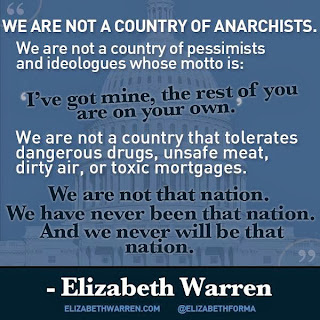
So, I'm now seeing a meme featuring Elizabeth Warren denouncing the shutdown in these terms:


There's actually been some pushback against this one.  Some anarchists (and fellow-travelers like me) have pointed out that anarchism does not mean something like "every man for himself" (that would be free-market capitalism, as it's laughingly known), and that Warren is simply using the word to mean something like "uppity troublemakers I don't like," which is hardly a contribution to reasoned discourse.   (She doesn't like real anarchists anyway: she fell into the corporate elite line on the Occupy movement, for example.  But then so, in the end, did most mainstream Democrats.)

An old friend linked to a rant by a Methodist minister somewhere, and added his own layer of froth to it:
This is EXACTLY right. So much bull shit propaganda is speed out to the public as "facts". These are the real facts. The moderate - and trainable - on both sides need to come together to permanently oust these tea party legislative terrorists. It's time to take back our country with reason and compromise. These are NOT bad words and what WILL get our government working again.
"Moderate" is a "bad word," in my opinion, for reasons I've given before.  "Trainable" is even worse.  Just off the bat, who's going to do the training?  Our government wasn't founded to "train" us, or our elected representatives.  "Reason" is an okay word, but there's no reason in my friend's words.  "Compromise" is a bad word, since in practice what it has meant during the Obama administration is that the Republicans have been handed much of what they want, and are thereby emboldened to demand the rest of it later.  And it's hilarious of my friend (and he's far from alone among pious Democrats) to demand compromise, when both sides here are refusing to compromise.  That is not necessarily a bad thing, because there are times when one must not give in.  Obama and the Democrats have decided not to compromise any further on the Affordable Care Act.  Their supporters agree that they shouldn't.  So this time, right now, compromise is a bad word.

After a few snarling comments between us, my friend wrote exactly that: "There is no compromising on this issue," he wrote. Wait a minute, didn't you just demand compromise a few minutes ago?  Compromise isn't a bad word, and all that?  It's convenient, if not exactly gratifying, to have such a blatant textbook example of doublethink in action.

Then I got in e-mail a link to a Daily Kos post, "President Obama NAILS IT in one sentence," by a writer using the pixelname MinistryOfTruth.  Once again reality leaves satire gasping in the dust, since in Orwell's 1984 "The Ministry of Peace concerns itself with war, the Ministry of Truth with lies, the Ministry of Love with torture, and the Ministry of Plenty with starvation. These contradictions are not accidental, nor do they result from ordinary hypocrisy: they are deliberate exercises in doublethink."  And credit where credit's due: the Daily Kos writer seems to have mastered doublethink in that pseudonym -- there's no indication that he or she is aware of the irony in that choice of name.

But I digress.  What is Obama's one sentence that NAILS IT?  "The American people elected their representatives to make their lives easier, not harder."  Okay, I know I'm like hypercritical, but I'm not impressed.  But Minitrue thinks it's so nice it should be quoted twice:
This is what a dying Republican party looks like. I'm glad President Obama has brought out the BIG STICK.

President Obama: The American people elected their representatives to make their lives easier, not harder
... though in neither case does that sentence, as quoted, end with a period.  As for "BIG STICK" -- no, I shouldn't, but I will anyway.  But I knew Sheriff Bart, and President Obama is no Sheriff Bart.  MinistryOfTruth returned to the BIG STICK in comments, again with remarkable unselfconsciousness.

"Millions of Americans voted for a government that makes our lives better, not harder," wrote Ministry of Truth.  But instead they got a government that entrenched health care in the hands of private corporate insurance companies, that refused to hold Wall Street accountable for the crash of 2008, continued and escalated wars that killed and injured more people of various nations and made the US more hated and therefore insecure, that capitulated in advance to the Republicans by extending upper-bracket tax cuts before negotiations on the stimulus had even begun (via), so that the economy continues to stagnate -- except for the very rich.  But then, the One Percent elected their representatives to make their lives easier, not harder; and President Obama is their representative, all that stands between them and the pitchforks and torches.

Though I'm the first to point out the limits of reason, reason is important to me.  When the Right mounts its deranged campaigns, I look to evidence and reason to try to keep my balance.  The Democrats, all too often, join the Republicans in hysteria and irrationality.

"The two aims of the Party are to conquer the whole surface of the earth and to extinguish once and for all the possibility of independent thought," Orwell also wrote in 1984.  Which party?  Both parties.  And they're winning.

Wednesday, March 23, 2011

Just Your Average Run-of-the-Mill Satan

I meant to write tonight, but I read instead. (Mary Lasswell's third Suds book, One on the House!) But I did send this to RWA1 today (no response), and wanted to share it further. It's a flowchart of possible Republican reactions to Obama's attack on Libya. Being a party loyalist like RWA1 is hard. Traditionally Republicans oppose wars started by Democratic presidents, which seems a bit unfair since Democrats will usually support Republican wars. As Adam Clark Estes Pareene wrote,
Just a few weeks ago, prominent GOPers like John McCain and John Bolton insisted that a no-fly zone would be the best action the United States could take in the warring North African nation. When Obama committed to the no-fly zone with U.N. support, the same camp was quick to scold the President for his lack of leadership in gathering support for a no-fly zone.
It takes a very disciplined memory, in the Ingsoc sense, to cope with this kind of cognitive dissonance, and I sympathize not only with RWA1 but with other Republicans caught in the same bind. They hate Obama, but they love war, but Obama is a Democrat so they have to oppose anything he does, but they hate Qaddafy (who was rehabilitated and armed by the Bush administration), but they also fear the Muslim hordes who seek to overthrow Qaddafy and other dictators. What's a Republican to do? Wring one's hands and lament that "this is an issue without an obvious right or wrong." At least some Democrats disagree, and oppose Obama's Operation Odyssey Dawn. So do at least some of the actual Left. Even Jon Stewart of the Daily Show is cautiously critical of Obama's new war.

Alex Pareene informs us that the first Republican to declare himself a candidate for the Presidency in 2012 is a gay man. He's already been blocked from one debate by the RNC. As Pareene says, candidate Ray Barger "will hopefully continue annoying the Republican party by forcing them to demonstrate, repeatedly, their increasingly unpopular bigotry." Don't worry, though, the corporate media will keep it under wraps.

And finally, this paean to real American values from The Onion.


Patriotic Teen Fails Spanish

Thursday, May 6, 2010

Defending the Indefensible

I knew there was something else I meant to write about here, but it kept slipping my mind.

I've always liked Doonesbury, though since I don't regularly read newspapers there have been prolonged periods when I didn't follow the strip closely. For a few years in the 1980s I would just buy each collection as it was published. Now that it's available online, I've done a little better. It was fun to watch certain right-wingers fume when he started up some plots about the Iraq War, with very sympathetic and intelligent portrayals of the troops. When longtime character B.D. lost a leg and his football helmet, a lot of people took notice, but Trudeau has also given serious story time to Leo aka Toggle, an Iraq vet who returns to college after his medical discharge, where he becomes romantically involved with Mike Doonesbury's daughter Alex. Leo lost an eye and has trouble speaking due to Traumatic Brain Injury; he's also a heavy-metal fan who drives a pickup truck. Not exactly the kind of character the Right (or many liberals, alas) would expect to get sensitive kind of treatment in Doonesbury. Which only goes to show how little they know. Sure, Trudeau is a liberal, but he's the kind of liberal that gives liberals a good name.

In last Sunday's strip, Alex and Leo go out for coffee. Alex makes some slighting remarks about some men carrying guns, "open-carry yahoos" as she calls them. (Do such men regularly kick back at Starbucks?) Leo intervenes in the argument: "Listen, dude," he tells one of the men, "I spent two years behind an M60 machine gun defending, among other things, your right to be a moron about guns!" Alex exclaims in delight over Leo's unexpectedly getting out a full sentence.

It's a cute little story, but one thing jumped out at me. Leo was not defending freedom in Iraq. No Iraqi was a threat to Americans' right to be morons about guns. No Iraqi was a threat to American rights or freedoms. It was, and is, our government that is the biggest threat to American rights or freedoms -- remember the Patriot Act, which was passed under Bush but was originally a Clinton-era project? -- and it was in the service of that government that Leo and thousands of other soldiers went to Iraq.

I know, I know, what he said was in character. For that matter, the latest Doonesbury collection, Signature Wound, has a Foreword by retired US Marine Corps General and Joint Chiefs of Staff Chairman Peter Pace, who hails "all who have stepped forward and volunteered to protect the freedoms we hold dear." Such talk is a conditioned reflex, not only in the military but among most people who can't quite bring themselves to object to any war the US starts. I must respectfully but firmly differ with the General, and with Leo, and with Garry Trudeau if it comes to that. The United States has not fought a defensive war in my lifetime, and I was born in 1951. With all proper sympathy and empathy for those who feel the need to rationalize and justify their participation in the wars of aggression we have fought and are fighting now, I can't go along with them on this point. As far as I can see, until Americans can recognize what their government and their armed forces are doing, we will continue to get involved in these wars, and that will mean more young people getting chewed up and spat out by the military, with more or less support from their society. (Not to mention the vastly greater numbers of innocent foreigners who suffer.) But the best way -- the only way, really -- to support them is not to damage them in the first place.

P.S. May 9, 2010: Oh, dear, here's another one. (Via)

I am a homosexual American citizen and while I fight to defend the rights of free speech and a democratic legislature process, I suffer because these very same freedoms are denied to me as a gay Sailor.
Again, this is mere rhetoric (read the whole letter for his account of the highlights of his service). Which, as I've said before, doesn't mean the ban on gays in the military shouldn't be lifted, only that it has nothing to do with defending anyone's rights.

P.P.S. May 16, 2010: This one from the Give a Damn Campaign's website, an open letter to President Obama from a gay soldier on leave from deployment in Iraq:

When serving in a war zone, you learn quite a bit about yourself and what’s important to you. I’ve had the chance to work on a close and personal level with the people of Iraq, and in doing so, I have realized more than ever that the freedoms we enjoy as Americans should not be taken for granted – we must protect them at all costs. These freedoms are essential to the very foundation of our society. Yet so many men and women who fight for these freedoms aren’t allotted their own. Our freedom to love and be loved by whomever we choose. The freedom to live of a life of truth and dignity.
I wonder if it's possible to talk about an issue like this without relying on such pious garbage. But this young man isn't protecting my freedoms, or your freedoms, or anyone else's freedoms. If anything, he's fighting for a state that is dedicated to taking freedom away. (In an exchange on the Campaign's Facebook pages, one guy inadvertently came closer to reality: "I'm gay, and I would love to serve my military..." (But then I noticed that "Serving the Military" is the thread topic; I can't even give this poor kid credit for the Freudian slip.)

Thursday, April 22, 2010

Bringing the Two Together

Glenn Greenwald writes:
As several people noted in comments, Obama's rationale for threatening to veto an anthrax investigation (investigations would undermine the State's credibility and thus dilute its authority) is very similar to the Catholic Church's explanation for why it concealed reports of so many abusive priests (disclosure would undermine the Church's credibility and thus dilute its authority). See, for instance, here, as well as here (Cardinal Christoph Schönborn: "the appearance of an infallible church was more important than anything else"). That was also the same rationale invoked by Justice Scalia when enjoining the Florida recount during the 2000 election (Scalia: a recount would "irreparably harm" Bush "by casting a cloud upon what he claims to be the legitimacy of his election"). Common to all of these suppression-justifying claims is the notion that preventing the truth from being examined and known is necessary to preserve institutional credibility and power.
I wonder if Richard Dawkins will decide to make a citizen's arrest of Barack Obama? Or George Bush? The scale of the crimes involved in the case of US Presidents is far greater than even Popes.

For more double standards and hypocrisy, see also this one.