Showing posts with label social construction. Show all posts

Wednesday, March 10, 2021

Cue the Laugh Track

Richard Dawkins, the Clown Prince of the New Atheism, is at it again.  I suppose he's always at it, but I don't follow him on Twitter and only notice some of his wackier performances.  This past weekend he posted this:
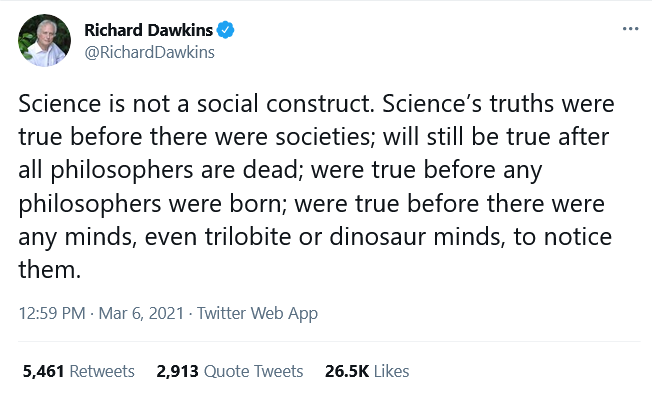
Followed a day later by this one:

The first thing to notice about these tweets is that they are not examples of "science's truths," not produced by the Scientific Method <genuflect>, not science or scientific at all.  They're just Dawkins in his familiar idiotic hawker mode, ranting about issues he doesn't understand.

Let's begin with the first tweet.  Typically for him, Dawkins equivocates.  "Science" does not only mean "science's truths."  It means science, and for Dawkins that means Western science, which is a historical and social construct that did not always exist and may not always exist in the future.  Western science originated as a form of magic, seeking not only knowledge but personal power for the practitioner.  Notoriously, some crucial figures saw Nature as a woman to be forcibly disrobed, her private parts probed.  (The metaphor of Nature as the [male, of course] scientist's female adversary, trying to keep her secrets covered, is still very much with us.)  As a historical phenomenon, Western science has often been wrong.  Far from being disinterested seekers after "truths of the real world," scientists have always served the state and the military.  None of this has any eternal, independent existence: it's shaped by human (again, mostly male) hangups and other limitations.

A day after the first tweet, having realized or been told that he hadn't made his point well, Dawkins returns to the fray.  "OBVIOUSLY", he begins, proceeding to pontificate things that aren't obvious at all.  And then he talks like a religious apologist, which is what he is: you can't blame Science for what are now considered bad doctrines, they are the result of human frailty and error.  The trouble with those "scientific beliefs during any particular era - phlogiston, etc." is that in their era they were not "beliefs" but "science's truths," "objective reality."  And scientific progress is not impeded only by religious institutions, perhaps not even mostly by them; it's resisted by scientists, like the Ptolemaic astronomers who rejected Copernicus, or the biologists who rejected Darwin; partly for scientific reasons, such as his lack of a theory of heredity or the fact that his theory required longer periods of time than science's truths at the time allowed.  Another reason for scientific resistance to Natural Selection was that many biologists wanted to believe in evolution as a linear, goal-directed process rather than the messy non-linear one Darwin theorized.  Einstein's resistance to quantum mechanics didn't even pretend: he just didn't like the kind of universe it presupposed.

That's why that bit about "the truths about the real world that science aspires to find" is so funny: Dawkins is canny enough to qualify his claims a bit, and he knows that the "truths" scientists claim to have found often turn out to be false.  (By the way, there is no "science," only scientists.)  Even when scientists' claims hold up for a while, it is never certain that they won't have to be rejected later.  But more important, and more unsettling, it's never certain that the truth about the real world will be found.  Take the extinction of the dinosaurs: the theory that it was caused by an asteroid striking the earth looks pretty good for now, but there are other candidates.  We may never know what happened, and it's not science's truth until science has actually found it. I'm reminded of the "Princeton Bible" postulated by certain Biblical scholars a hundred years ago: the text of the original autograph manuscripts of the Bible, which are irrecoverably lost and therefore can't be appealed to.

As for "objective reality," what is it?  It's one of those terms, like "science," "religion," "truth," or "beauty," that people love to throw around without defining them because OBVIOUSLY, everybody knows what they mean and only "post-modern pseuds" pretend otherwise.  Phlogiston used to be objective reality; so was eugenic sterilization.  I regret having to harp on the latter, but it's still with us, and you may remember that Dawkins recently tried to defend eugenics as a coherent scientific program.  Even if he rejects sterilization of the "unfit", as I suppose he does though for non-scientific reasons, his sputtering efforts to validate eugenics last year showed that he thinks that "improving the species" has some kind of agreed-on meaning, which it doesn't.

I'm a social constructionist myself, though I disagree vehemently with many other social constructionists.  I'd even answer to "postmodernist," for some versions of the term -- it's like "faggot" in that regard, it's meant to refer to people like me, even though it may or may not fit.  But I haven't found that many self-identified postmodernists do any better with the concept than someone like Dawkins does.  But I also concede the validity of "objective reality," as the nutcase Philip K. Dick defined it: "Reality is that which, when you stop believing in it, doesn't go away."  The trouble, whether you're a philosophical naif like Dawkins or a quasti-Gnostic mystic like Dick, is that even though "objective reality" is right there in front of us, we can't quite get at it.  Science is, among other things, the attempt to make models of and describe that reality, but models are not reality and descriptions aren't reality either, so they are always incomplete at best.  At best they're good enough that there aren't very dire consequences from using them; but you never know in advance where or when they'll fail you.

The discussion, to put it loosely, that followed Dawkins's tweets was entertaining.  Several of his crew claimed that Science is like Mathematics.  One declared that pi is science, true before the foundation of the world and true after it.  But pi isn't out there in objective reality, like phlogiston or the Selfish gene: it's an irrational number, and that irrationality has always frustrated those who wanted the world to make sense.  The relationship between mathematics and science is contested, to put it gently, but Pythagoras didn't produce his theorem by studying thousands of right triangles in the lab and producing a theory about them.  Mathematical proof is not remotely like science, and though scientists like to concede the point, insisting that scientific proof is totally different from mathematical truth, they find it difficult to remember their concession for long.

Even if Dawkins were right about the nature of scientific knowledge, that wouldn't mean that his statements about society, religion, women, philosophy, or any other subject, should be taken seriously.  None of them are the result of scientific research, and they seem to spring from nothing but his personal neuroses.  From that point of view Dawkins might merit our sympathy (forgive him, for he knows not what he does).  Even in his field he can't be trusted, as in his incoherent use of "selfish" in his best-known work The Selfish Gene.  His popularity in certain circles can't be because he's right, since he isn't.  His burblings must have some emotional appeal, just as religion does.

Tuesday, February 28, 2017

Social Construction Workers

Dan Savage's sex-advice column for February 8 was a compendium of brief answers he gave to questions submitted by live audiences recently.  This one caught my attention.
Why are liberals okay with people self-identifying their gender but not their race? Aren’t both considered social constructs?

“If race and gender are both social constructs,” Evan Urquhart writes at Slate, “and if both have been built around observable biological traits, then what is the crucial difference that makes a felt gender identity a true one, but a felt racial identity fraudulent? The short answer is that most trans people and their allies suspect that transgender people are born that way.” (Read the rest of the essay here.)
The full trifecta: neither the questioner, Savage, nor Evan Urquhart, know what they are talking about, especially with regard to "social construction."  Urquhart gets a point or two for recognizing that social constructs are "built around observable biological traits," and also for not freaking out over comparisons between "racial identity" and "gender identity," but goes wrong from there.  And even "observable biological traits" is wrong, come to think of it.  Social constructs include language, religion, nationality, etc., none of which are built around observable biological traits.  I'm not sure how sexual orientation would fit in there either; probably it doesn't.  (It involves observable external biological sex -- whether one is male or female, and whether one's desired sexual partners are male or female -- and there's a common mythology about homosexuals as physiological sexual variants, to which I'll return.  But you cannot always or even usually tell a person's sexual orientation by looking at them; false positives and false negatives abound.)

As for "most trans people and their allies suspect that transgender people are born that way," well, it may be that this is what most trans people and their allies suspect (!), but there is no evidence that it's true, and Urquhart knows it:
I say that we “suspect” trans people are born that way because the science isn’t in, yet. When Caitlyn Jenner spoke vaguely of female brains in male bodies it was because there isn’t any clearer terminology that can be employed to speak about this hunch, but it persists in the minds of many trans people and their allies anyway. We do have increasing evidence for specific genetic and epigenetic differences between gay men and straight men that result in homosexuality, but so far scientists have yet to investigate the rest of the letters in LGBTQ as thoroughly.   For now, even those who are most familiar with this topic can’t say for sure what being transgender is, and what might cause it. There are, however, circumstantial reasons to believe it may also have a genetic and/or epigenetic basis. For one thing, many trans people report feeling that their assigned gender didn’t match their inner conception of their gender from earliest childhood. We also have evidence of individuals who dressed, acted, or passed as the opposite sex across many cultures and many historical eras. This, paired with the evidence that sexual orientations are innate, not learned, leads us to hypothesize that gender identities function similarly.
Urquhart is wrong about the evidence for a biological basis for homosexuality; he's also evidently ignorant of the history of "female brains in male bodies," which used to be a popular conception for male homosexuality.  (He presumably hasn't noticed either that the scientific "evidence" about inborn homosexuality is about sex/gender, not sexual orientation.)  Despite the ongoing scientific efforts to prove otherwise, however, there aren't "female brains," and a fortiori there aren't female brains in male bodies: the brain in a male body is a male brain.  Whatever differences have been claimed have been differences of degree, not of kind, just as with racial differences.  To assert otherwise is like claiming that a tall woman has a male height in a woman's body.  (Given the amount of hassle that tall women get, though, many people might accept that metaphor.)

Urquhart says that "science continues to be done that supports the idea of gender differences within the human brain, while the possibility of such differences existing between races has been roundly rejected."  This isn't true either.  Scientists continue to try to prove innate racial differences no matter how consistently such work is discredited, and popular media (and the public) are just as fond of the idea as they are of the idea of innate gender differences.  That scientists continue to try to find innate sex/gender differences, even though they consistently fail, says more about scientists' culturally-inculcated prejudices than it does about the validity of the idea, just as with race.

As it happens, the word Jenner used was "soul," not "brain," which is even less helpful for Urquhart's argument.  People do talk casually about the soul as if it were something that is known to exist, independently of the body, but it's not a scientific concept (for what that's worth).  Even if there is such a thing as the soul, we know nothing about it, and can't assign it a sex/gender, a race, a nationality, a political party, or any other trait.  It's not illegitimate to use the word as a metaphor, but it can't be used to prove anything.  As with height, just because there's a word for it, that doesn't prove it's a Thing.

Probably most gay people and our allies do believe that sexual orientation is inborn, but they're wrong too, so the same belief among trans people and their allies isn't evidence for anything.  In general, a conviction that one was born with a certain trait doesn't prove that it was in fact inborn. Nor, contrary to the equally widespread and equally false belief spread by Dan Savage and others, do civil rights depend on whether a given status is inborn, learned, or freely chosen.  (Or a social construct, a term which plays no role in civil rights legislation.)

Dan Savage's questioner probably was just trolling, though the troll was effective because it pinpointed basic incoherences in what trans people and their advocates say about gender.  Urquhart's article addressed chosen "racial" identity, occasioned by the controversy over Rachel Dolezal, a white woman who passed as black for several years.  As far as I can tell, though, Dolezal has not claimed that she was truly, essentially black (a black brain or soul in a white body?), or applied the other rhetoric typical of the transgender community and its allies; Urquhart doesn't, at any rate, report that she did.  (According to Richard Seymour, "Dolezal did not claim to be ‘trans-racial’; she claimed to be black, and still does.")  Trans people aren't claiming to choose their gender identities: as Urquhart says, they see their identities as innate and unchosen, forced on them by their genes or brain structure.  The term "self-identify" is unfortunate, though, since it does imply that some kind of choice is being made.  Yet the verb "identify as" has become normative, even epidemic, in LGBTQ discourse.  It's all very well to "identify as," but what are you really?  Are you Betty Jo Bialowsky, or are you Nancy?

So what about "racial identity"?  I can't see how it could be inborn, any more than any identity could be.  Identities are labels, names, and as such are cultural products.  However, many people do believe in inborn racial identities, and that someone's "felt" racial identity can be considered inauthentic.  There was controversy during Barack Obama's first presidential campaign, over whether he was really African-American because despite his Kenyan father he wasn't descended from slaves or because he was raised in African-American communities.  (He grew up with his white mother and her white parents.)  Leave aside the merits of these claims; I want to point out that they separate biology from racial status and identity as radically as transgender separates biological sex from sex/gender status and identity.  It would follow from these criteria that a white-appearing descendant of Thomas Jefferson's slave Sally Heming who grew up in an African-American community would be African-American, regardless of what she looked like, while a first-generation black Nigerian immigrant would not.  If you add to that a belief in the existence of the soul as a distinct and separate substance, then a person could plausibly claim to have a black soul in a white body.  And what about "mixed-race" people?  Do they have black brains and white brains in their bodies, fighting for supremacy?  Do they have "mixed-race" brains?  Or what?

People who invoke social constructs in these debates overlook something important in "social construction," namely the first word in the term.  "Social construction" doesn't mean that an individual can choose an identity (or whatever) at will.  If anything, it means the opposite.  "Social construct" means that there is more or less a consensus in your society about what it means to be (for example) a man or a woman.  There is a very great range of variation among actual individuals, so the social construct is often at odds with reality, and people learn to overlook the variation in order to maintain their stereotypes and the cultural solidarity those stereotypes support.  But the whole point of social construction theory is not that people "choose" identities, but that much of what feels natural to them is really learned, acquired, accepted -- not by conscious choice but by absorption of what they see around themselves as they grow up.  Which, come to think of it, undermines Urquhart's argument that gay or trans people's conviction that we can't remember having been otherwise, can't remember learning or choosing to be the way they are, constitutes evidence in favor of the conviction.  The whole point of social construction theory is that what feels natural and innate very often is not.

What this means is that recognizing that a trait is a social construct doesn't license individuals to choose another one.  Consider language.  Though the language I speak is a social construct, my inability to understand a language I don't know is not the result of false consciousness or a closed mind.  Though there is a great deal of variation within any given language, an individual speaker can't stray too far from the socially constructed norms of the language without becoming incomprehensible to others.  One can move around within the realm of one's language, passively acquiring or actively adopting variants that signal class, locale, gender, or other difference.  But that is exactly the point: by doing so, one signals the social meanings associated with those variations.  We can, and should, challenge the prejudices that devalue certain linguistic variants, but in doing so we'll come up against powerful essentialist beliefs about the nature of those variants.  If you say "ain't," for example, you are signaling to language bigots that you are an ignorant, uneducated, low-class person.  By nature.

As far as I know, though, no one has so far claimed a 'felt racial identity' at odds with the one assigned them by society.  It doesn't appear that Rachel Dolezal did.  Quite a few people are claiming a 'felt gender identity' at odds with the one they were assigned, but as we've seen, their rationales are not convincing.  There's no reason to believe that any gender identity is inborn.  This doesn't have to be a problem, just as it doesn't matter whether sexual orientation is inborn.  It seems that people react differently to claims about racial identity than they do to claims about gender identity, and that's an interesting problem in itself.

It seems pretty clear to me that people generally invoke biology and culture, social construction and essentialism, as expediency requires.  But that's not unusual when vexed issues are being discussed.  Perhaps it's a mistake to take them literally, since they aren't interested in rationality or evidence: they 'reason' backwards from their conclusions, to put a sheen of reasonability on what they believe for no reason, or for bad reasons.

I'm not sure that social construction theory is compatible with the political needs of trans people, or of gay people.  To assert an identity is essentialist, even when the identity is clearly not genetic or epigenetic: nationality, religion, etc.  This doesn't mean that trans people are wrong, nor that they must prove that gender identity is inborn before they can affirm the identities they have constructed and chosen.  But it is wrong to make claims about nature or cause that have no evidence to back them up; making false statements isn't good on general principles, and it's imprudent to hang political demands on grounds that don't exist and may be disproven, let alone on bad science that has already been discredited.

Saturday, May 21, 2016

This Way to the Regress

I just bought a digital copy of Conversations about Psychology and Sexual Orientation (NYU Press, 1999), by Janis S. Bohan, Glenda M. Russell, and several other contributors.  I've read it before, and found it useful enough (if only to criticize) that getting the ebook felt worthwhile once the price dropped to a reasonable level.

This time I went first to Leonore Tiefer's contribution, "Don't Look for Perfects: A Commentary on Clinical Work and Social Constructionism."  Tiefer is a psychologist, a sex therapist, and a professor of psychiatry, and author of Sex Is Not a Natural Act (2nd edn, Westview Press, 2004), which I liked.  (It's about time to reread it, I guess.)  I was disappointed by the opening, under the header "Sexual Orientation: Oppression or Identity?"  (Don't you love false antitheses?)
Writing this commentary raises a great irony for me.  As a deep social constructionist, I see sexual orientation as an idea that emerged near the end of the nineteenth century as part of the new profession of psychiatry's effort to busy itself segmenting the behavioral and intrapsychic world into neat little boxes of normal and abnormal.  In my mind, the categories of heterosexual and homosexual cannot be separated from their historical origins -- everything else is rationalization and a more or less disguised fulfillment of that original psychiatric phase.

Fast-forward to 1998.  I am writing this commentary as a clinician, that is, a person who must and does think in terms of normal and abnormal (or else be a total hypocrite) in her or his work.  People consult me and listen to me because they have confidence that I can offer insight and advice based on some understanding of normal and abnormal.  The social changes of the past third of a century have erased the normal/abnormal dichotomy from sophisticated discussions of "sexual orientation."  Now, the term is merely descriptive -- whom does one love and desire, a person of the same sex or a person of the other sex (or both)?  The reality of the categories is taken for granted, and the big controversies are about etiology (which some might argue is a sign that the normal/abnormal dichotomy has not really been erased from sophisticated clinical discussions!) [77].
Tiefer does attempt in the succeeding pages to think of ways people might deal with their problems without the normal/abnormal dichotomy or a belief in an individual's "true sexual nature," ways which turn out to be fairly simple, intuitive and non-paradoxical.  They involve careful listening (a client-centered approach that is hardly new) and critical thinking.  I approve of these ideas wholeheartedly, but they don't have a lot to do with social constructionism.

Being a social constructionist, deep or shallow, doesn't by itself commit you to any particular historical narrative or to any specific construction of a category.  Tiefer's opening reminds me of a biologist I debated in the 90s, who said that his training caused him to seek biological explanations for every aspect of human behavior.  I responded that his training was, on his account, unscientific if science is supposed to seek knowledge without preconceptions; ruling out non-biological explanations in advance of the evidence is as invalid as ruling out biological ones.  It seems to me that Tiefer is taking the latter tack here, motivated by the same kind of binary she's trying to reject, and by an essentialist notion of "psychiatry." 

I think her account is also inaccurate historically, for the same reason.  "Sexual orientation" as a concept didn't originate in the nineteenth-century, so Tiefer appears to be assuming that the concept has a nature that persists through changes of theory and terminology.  "Homosexuality" has always been an incoherent concept, and the advent of the term "sexual orientation" hasn't made it any more coherent.  As I've pointed out before, "sexual orientation" is formally defined as the direction of one's sexual desires, but in use it refers to gender inversion, and overlaps confusingly with "gender identity" and other incoherent ideas.

Nor do categories and classifications necessarily involve any assumptions about "the realities of the categories," though it's true that clinicians, like most people, tend to forget this.  Consider a hypothetical categorical division, "people shorter than six feet tall" and "people six feet or taller."  The differences between the classes are "real" for some understanding of "real," but they aren't absolute. This classification might be useful for some purpose or other, and it would be perfectly valid to use it -- until the clinician or researcher began thinking of the two groups as mutually exclusive and different from each other by nature.  In practice that doesn't seem to take very long.  The same is true of commonly used dichotomies like "masculine/feminine," "Catholic/Protestant," "theist/atheist," or "bisexual/monosexual."  Alfred Kinsey tried to use "homosexual" and "heterosexual" in this neutral way, and encountered fierce resistance not only from clinicians attached to the essentialist use but from later sex researchers who saw themselves as working in his tradition but moving "beyond Kinsey."

"Normal/abnormal" is a prime example of this confusion.  If "normal" simply means something like "what most people do" and "abnormal" means "what most people don't do," there's nothing invidious or harmful in the binary.  You can be part of a minority, even a small one, and that's just fine.  But most people, "sophisticated" or not, have trouble sticking with that construction.  Sooner or later, they figure that if you're not jumping off the bridge with everyone else, you're a loser, a freak, uncool, sick.  If there weren't something wrong with you, you'd be hanging with or at least admitting the superiority of the cool kids.  It's worth remembering of course that the normal-as-normative is often a trait of the few.  The cool kids are always a minority, often a small one.  People are ambivalent about this, and their attitude is driven by factors other than numbers.

Anyone who wants to assume "the realities of the categories" needs to remember that in the real world, categories tend to be porous, often with very wide variation among the members.  Kinsey, who can be classified as an "Aristotelean," cut his professional teeth by studying gall wasps.  This brought him face to face with the problems of classification, and he brought that approach to human sexuality, intending to map the variation in sexual behavior rather than locate essences in it.  This latter approach, which can be classified as "Platonic," dominated the sciences in his day as it still does.  Kinsey's critics argued that he should have looked for essences of human sexuality (the "normal") rather than being distracted by range and variety, which they saw as surface distractions from the Real.  (See Peter Hegarty's Gentlemen's Disagreement: Alfred Kinsey, Lewis Terman, and the Sexual Politics of Smart Men [Chicago, 2013] for an intelligent discussion of aspects of this controversy.)  But from what I know of him, I don't think Kinsey himself, any more than Aristotle, was a social constructionist.  Recognizing and studying variety is perfectly compatible with believing that the variety is a feature of the "real" world.

Consider a case Tiefer mentions later, "a patient who recently came to me when he was increasingly preoccupied with sexual fantasies about (as well as a budding sexual relationship with) his secretary." Tiefer notes that "sexual identity was not an issue for him," though there is an identity available for such a person, namely "adulterer."  "[But] the idea of 'true sexual nature" was..." (81).  As with the transsexual patients Tiefer discusses, it's possible for a clinician to be useful to a patient without invoking "normal" or "abnormal," which really aren't useful categories most of the time anyway.  If your patient is, say, hearing voices that urge her to kill herself, normality and abnormality are beside the point.  But ditto for a benign or neutral situation, like a person who doesn't conform to official gender norms.  It was surely "abnormal" in various senses for men to grow their hair long in 1960s America (and remember that "long" was highly subjective when a military buzz cut was the standard), but there was nothing wrong with it, nor did it really say anything about their "gender identities."

There probably is no correct answer to a question like "Should I have an affair with my secretary?" or "Should I leave my husband?" or "Should I seek sex/gender reassignment surgery?"  ("Sex reassignment" and "gender reassignment," by the way, express different conceptual understandings, though the procedure involved is the same.)   Patients asking these questions may be looking for an authority figure to make their choices for them.  According to some constructions of authority, that may be what such figures are for, but that shows just how uneasy many people are about the idea of choice.  They want to believe that outcomes are predictable -- if you do this, you'll be happy; if you do that, you'll be unhappy -- and that someone (God, a priest, a doctor) knows which one to seek.  But there are no guarantees, and this, again, has nothing to do with social constructionism in itself, even if you want to believe, as many of its proponents clearly do despite their disavowals, that social construction gives a true picture of reality.

Monday, August 17, 2015

Così Fan Tutte

I've been having frustrating computer problems, still not completely solved, or I'd have written here sooner.

A regular reader sent me a mail message recently, saying that he's "a LITTLE more in favor of [the] 'some people have always been gay' argument" than I am.  I found this baffling.

"Some people have pretty much always been gay" isn't an argument, it's a claim.  Depending on what it's supposed to mean, I agree with it.  That is, I think it's as certain as any historical claim can be that there have always been some people who were interested erotically only in their own sex.  There's documentation of that from many cultures over a couple thousand years, and I see no reason to suppose that it's not true at almost all times and almost all places.  I think it's also pretty clear that same-sex eroticism isn't limited to such people, that many people have had sexual experience with partners of both sexes in varying proportions.

What I don't agree with is the other claims some people make around this one.  It's not surprising, because most people bring cultural and personal baggage with them, myself not excluded.  There's no agreement what being gay, or being homosexual, or being bisexual, means.  I didn't exaggerate too much in my Gay Christians Say the Darnedest Things post, when I wrote sarcastically that because Leonardo had no Madonna CDs and (shame!) didn't go to Judy's Carnegie Hall concert, many scholars doubt that he was really gay.  In the first place, not all gay people are alike nowadays in the US, and I see no reason to suppose that that's a new development limited to the US.  Nor, of course, does it follow that because there have always been people who were interested erotically in their own sex, that exclusive interest is therefore inborn, or genetic, or biological, or whatever.

Related to these notions, I believe, is the excuse often made for stereotyping, that "stereotypes have some truth in them" because some people do fit the stereotypes.  This line came up at the discussion group I attended last week in San Francisco, and I wish I'd thought to ask what now seems to me the obvious question: So what? What follows from it?  It certainly doesn't follow that everyone is obliged to conform to the stereotypes just because some people do.  That seems to be what is meant, however: that inside every gay man, however butch he may pretend to be, is a screaming queen trying to claw her way out, and that every self-styled bisexual is just a closet case who, if he were honest with himself, would have sex only with other males.  In his book on male prostitutes in the Dominican Republic, for example, Mark Padilla reports that local gay men told him:
“I hope you’re going to prove what we already know: they’re all closet cases [son unos tapa’os].”  This implies the existence of a deeper, more authentic sexual identity that is being actively repressed by the bugarrón, who fails to recognize his own fundamental sexuality and public mark himself in terms of his presumed same-sex erotic preference [33].
There are numerous ironies here, aside from Padilla's own frequent cluelessness.  One is that these Dominican gay men subscribe to a trade/queer model of male homosexuality, though (as always seems to be the case) with plenty of slippage.  If all the bugarrones dropped their pretensions and came out as flaming travestís, there'd be no tops to supply the all-important dick to Dominican gays.  As Padilla also pointed out of a Dominican bar's quixotic attempt to exclude bugarrones,
The policy was doomed to fail from the beginning. First, it seemed entirely incongruous with the erotic integration – and in many ways, the economic interdependence – of bugarrónes and gay-identified men. Local bugarrón-gay or bugarrón-travestí relationships frequently entail an economic arrangement in which the gay/travestí mantiene a su bugarrón (supports his bugarrón), an inversion of the typical gender division of labor in heterosexual relationships.  Further, despite the occasional tensions between them, bugarrónes still represent the erotic ideal for a significant proportion of gay-identified [Dominican] men, reflecting what [Stephen O.] Murray ... has described as the sexual system of “homosexual exogamy” in Latin American homoeroticism. Thus, in their attempts to “clean up” the bar, the owners of Tropicalia were planning to purge a primary source of gay men’s attraction to the business: bugarrónes. As many local gay men commented to me, “So, if they keep bugarrónes out, why would we go there?” [32-3]
In much the same way that many heterosexual men will try to get "nice" girls to have sex with them, in order to prove that all women are essentially whores, the Dominican gays, like the norteamericano tourists, will try to get bugarrones to dar culo, or give ass: if they succeed, they can scorn them, their stereotypes have been vindicated.  The aim is probably not to move toward a more "egalitarian" mode of homosexuality, where either partner may penetrate or be penetrated, but simply to validate their erotic cosmology.  So, as Annick Prieur observed in her study of Mexican vestidas, they despise those mayates (equivalent to bugarrones -- men who penetrate other men) who let themselves be penetrated, even when it is the vestidas who penetrate them. This connects to a fantasy entertained by some gay men, who insist that there are no straight men, that every man can be had if you go about it correctly.  Taken to its logical conclusion, this would mean that every man is, at bottom, a bottom.) If these gays really succeeded, though, and exposed all bugarrones as closet cases who really, deep down, want only to be penetrated, who would penetrate them?

This is only a problem if you insist on eliminating the middle ground, but that is what people are doing when they stereotype: there are no differences, there is no variation, everyone is alike, even if they pretend otherwise.  It's not an empirical description but a principle that overrides observation and evidence, and can't be refuted because any observation that seems to contradict the principle can be dismissed as false consciousness, misunderstanding, or failure to grasp the essence that underlies mere appearances.  (So it's related to belief in biblical inerrancy: any seeming error is due to the interpreter's misunderstanding or lack of sufficient faith -- the Bible's lack of error is the first principle of interpreting it.)  It's true that some people can be found who fit any stereotype you like, and that's not problematic.  The trouble arises when the stereotype is postulated as the underlying truth about all individuals.

*The Caribbean Pleasure Industry (Chicago, 2007.)

Tuesday, May 20, 2014

The Magic Gene

Oh, my head hurts.  First my friend A linked to this article from a Canadian magazine decrying the growing anti-intellectualism of American life.  As far as I can tell, the differences between the US and Canada in that area are a matter of degree, not of kind.  And while it's perfectly okay for the People's Republic of Canuckistan to criticize America, the Chomsky/King principle would prioritize criticism of one's own country before lashing out at others.

There's a funny story about that, in fact, from Understanding Power: The Indispensable Chomsky (The New Press, 2002):
Now, when I go to Canada, I do get asked onto mainstream national radio and television a lot, as distinct from here -- a lot.  But see, that's because I criticize the United States, and in Canada they like it when people come up and dump on the United States -- because the United States is always pushing them around all the time, so it's nice if somebody comes and says how rotten the United States is once in a while.  On the other hand, I got sick of this a couple of times, and I started talking about Canada -- and I was off so fast you couldn't even see it ...

There's this nationwide talk radio show in Canada which everybody tunes in some time in the morning, and every time I'd go into Toronto they would invite me to come on that show.  So we'd have whatever it is, fifteen minutes, and this guy would ask me some leading questions, I'd tell him how rotten the United States is, big smile.

Well, one time I got really sick of this, and I started talking about Canada ...

Then I said something about Canada and the Vietnam War -- Canada was always denouncing the United States during the Vietnam War for its criminal actions, meanwhile Canada was probably the leading military exporter in the world per capita, enriching itself on the destruction of Indochina.  So I mentioned some of this stuff.  He went off into kind of a tantrum.  I actually thought it was sort of funny, but apparently his listeners didn't -- when I left, about ten minutes of listening to this harangue, the producer, quivering, stopped me and said: "Oh my god, the switchboard's lighting up, we're getting thousands of phone calls from all over Canada."

And apparently the phone calls were just about the fact that this guy Gzowski was being impolite -- I don't know if people agreed with me particularly, but there were a lot of people who were very angry about the way he was going about it.  Like I said, I thought it was comical, it didn't bother me ... 

Anyway, they made a big effort, they called me up in Boston, and we went through another show -- in which Gzowski was very contrite and quiet, just to make it up to the audience.  But that was the last time I ever heard from them; I've never been asked on that show with him again.

And that's happened to me elsewhere in Canada too, I should say -- I mean, I've been invited to universities in Canada where they've literally refused to pay my plane fare after I gave talks in which I denounced Canada.  So you know, Canada's very nice as long as you're criticizing the United States -- try going after Canada and see what happens to you [289-90].
Notice that Chomsky isn't complaining here about people being mean to him; he's just pointing out that "the media system works the same in both countries" (290-1).  You can get on mainstream US television and denounce other countries, especially official enemies, to your heart's content, with no requirement of factual accuracy or rationality.  You can even denounce the US government, if you're a Republican, and you'll get airtime and sympathetic treatment, which tells us something about the actual orientation of our corporate media.  But certain criticisms may not be uttered in their precincts.

This doesn't in itself mean that the criticisms by Jonathan Gatehouse, the article's author, are necessarily inaccurate, only that he's not sticking his neck out.  As far as I can see, some of his accusations are accurate, others are not.  Much of what he complains about has nothing to do with intelligence or the intellect.  For example:
The cost of a simple appendectomy in the United States averages $33,000 and it’s not uncommon for such bills to top six figures. More than 15 per cent of the population has no health insurance whatsoever. Yet efforts to fill that gaping hole via the Affordable Health Care Act—a.k.a. Obamacare—remain distinctly unpopular. Nonsensical myths about the government’s “real” intentions have found so much traction that 30 per cent still believe that there will be official “death panels” to make decisions on end-of-life care.
True, the US health care system is not in good shape.  But it's false that "efforts to fill that gaping hole" are "distinctly unpopular."  As has often been pointed out, the majority of Americans favor a universal single-payer system -- like Canada's -- or a national health service like Britain's, despite a determined propaganda campaign against them.  (And those socialistic systems are themselves under attack, so far unsuccessful but determined and unrelenting, in their own countries.)  The enemies of real health care reform in the US are not the general population, but our elites, like President Obama, who jeer at the idea of turning the US into Canada.  The ACA is basically a negotiated treaty between the American people and the health insurance industry and Big Pharma.  And despite the right's propaganda campaign, the ACA has evidently been pretty successful so far.  This is not exactly news unless you rely for your information on the usual suspects, namely the US corporate media and certain liberal outliers.  It appears that Gatehouse did exactly that, which doesn't speak well for his intellectual capacity.

The rest of the article is more of the same: Oh noes!  Many Americans don't believe in Evolution!  American students are falling behind the rest of the civilized world!  George W. Bush and Sarah Palin drop their G's!  Even Obama does!  The NSA!  Soundbytes!  Twitter!  LOLcats!  Oh noes!  Most of this is either false, dubious, or irrelevant.  Gatehouse has simply gone to the same well as those he criticizes:
Most perplexing, however, is where the stupid is flowing from. As conservative pundit David Frum recently noted, where it was once the least informed who were most vulnerable to inaccuracies, it now seems to be the exact opposite. “More sophisticated news consumers turn out to use this sophistication to do a better job of filtering out what they don’t want to hear,” he blogged.
It should be remembered where David Frum originally flowed from: Canada.  And he's hardly a reliable source, considering his participation in the American Right from the Reagan administration to Bush II.  From time to time he'll pull himself up short and weep great remorseful tears over what he has wrought, such as his 1995 jeremiad Dead Right (Basic Books), but then he goes back and does some more.  And given the history of American wack, I am skeptical of Frum's claim, seconded by Gatehouse, that "it was once the least informed who were most vulnerable to inaccuracies."  Frum may not be aware of American elites' fondness for end-times Christianity (search for Boyer in that post), but he should know about their anti-Semitism, which kept Jewish students and faculty out of Ivy League and other elite institutions.

Then today I got a link to this article at In These Times.  It's more of the same, a review of a recent book that attempts to rehabilitate scientific racism yet again.  But the durability of scientific racism, whatever you can say about it, is simply not a sign of anti-intellectual or anti-science heresy.  Quite the contrary: it means that people like science and respect it and want its support and prestige for their beliefs.  Does Jonathan Marks, the reviewer, realize just how intimately entwined scientific racism has been with Darwinian theory, historically speaking?  It doesn't look like it.

Not too surprisingly, Marks is an anthropologist.  Anthropologists have been among the most consistent critics of scientific racism, from the great Franz Boas onward, so they have been accused by proponents of scientific racism of (what else?) hostility to science, trying to make reality conform to their fuzzy-brained hippy-dippy politically-correct fantasies.  (The very first comment under Marks's review takes this tack, I see.)  This has been such a satisfying tactic that proponents of scientific racism use it even on fellow biologists, geneticists, and other lab-oriented scientists.

This doesn't mean that all humanities-oriented critiques of scientific racism have been well-made.  (The enemy of my enemy is not necessarily my friend.)  I wonder what Marks thinks of the attempts to prove a genetic basis for homosexuality, for example.  Many people who vehemently reject scientific racism applied to "race" and gender will embrace it when it "proves" that homosexuality is a biological condition, and those who attack that project mostly content themselves with babble about "social construction," a concept they don't seem to understand.  This isn't always true -- the anthropologist Roger Lancaster did a fine job dismantling scientific racism in The Trouble With Nature: Sex and Science in Popular Culture (California, 2003), for example -- but it seems to be the hegemonic response nowadays.  That's not anti-intellectualism, of course: such people are the very model of a modern intellectual.  They just don't do intellectualism very well.  But few people ever have, and Jonathan Marks and Jonathan Gatehouse aren't exceptions to the rule.

Here's an interesting observation from Lancaster's The Trouble with Nature (196):
Far from providing the occasion for self-evident truths or stable understandings, the question of reproduction actually seems ripe for mythical thinking and magical investments.  (In a place no more exotic than my native North Carolina, for example, I have met many people – some of whom work in hospitals, are familiar with medical models of reproduction, and understand how ultrasound works – who believe that a child’s sex is not fixed until moments before birth, and who thus urge expecting mothers to eat certain foods and to avoid engaging in certain activities so as to influence the sex of the child.)
In other words, magical thinking and scientific training are not mutually exclusive.  Magical thinking is part of our evolutionary heritage, after all, and magic isn't incompatible with the intellect -- indeed, intelligent and intellectual people constructed elaborate systems of magic in all cultures.  You don't achieve intellectual consistency by disavowing magic, crossing your fingers, spitting over your shoulder, and sprinkling salt on a bird's tail.

The weird thing, and another example of magical thinking, is that both Marks and Gatehouse talk as though there was a time when the intellect was universally respected, when all educated people were rigorously logical, and everyone sought a good scientific education.  I don't know of any such time; this frame for their arguments indicates that what drives them is not intellect or science, but a very common, non-rational nostalgia for a Golden Age that never was.  It quickly became clear as I read their diatribes that they called any idea they didn't like "anti-intellectual"; it's hard to imagine a clearer case of anti-intellectualism at work.

Going back to Gatehouse: Are Canadians anti-intellectual or pro-intellectual?  By Gatehouse's standards, it would appear that they're intellectual when their insecurities are being stroked by criticism of the Great Satan to the South, and anti-intellectual when they refuse to countenance criticism of their own country.  Maybe "anti-intellectualism" isn't the right conceptual tool for the job.

Wednesday, February 19, 2014

All Along the Kinsey Continuum

This weekend I reread Conversations about Psychology and Sexual Orientation (NYU Press, 1999), by Janis S. Bohan, Glenda M. Russell, and several other contributors.  The book is an attempt to sketch out a social-constructionist approach to sexual orientation in clinical practice and in public policy; I first read it soon after it was published, and remembered that some of it was interesting and useful.  I decided to reread it to see how it looked to me now, especially after having read a lot more on the subject in the past fifteen years.  I'll probably have more to say about it later, but for now I want to lament that the authors have made the same error about Alfred Kinsey's work that so many other writers on sexual orientation have made.

Bohan and Russell write:
Perhaps more striking is the persistent plausibility of this dichotomous portrayal given that, even within this culture, its inadequacy was established more than forty years ago, when Kinsey and his colleagues demonstrated that this binary depiction of sexual orientation is flawed.  Their work revealed, instead, a range of self-reported sexual orientation described not by discrete categories but by a seven-point continuum, ranging from exclusive homosexuality (six on Kinsey's scale), through varying degrees of bi- or ambisexuality (scores of five to one), to exclusive heterosexuality (zero on the scale)...

Kinsey's work also suggested that sexual orientation is not entirely defined by sexuality per se; an individual's placement along the continuum reflected both overt and "psychic" reactions.  In addition, Kinsey's findings indicated that people's self-defined positions along this continuum may change over time and that many subjects identified periods in their lives when their sexual orientation was quite different from how they later identify themselves.  Thus, sexual orientation is portrayed by Kinsey's work is composed not of discrete categories, whatever the number, but of vague, permeable, and potentially shifting "locations" along a continuum [86-87].
Kinsey's work does not "portray" sexual orientation, self-reported or otherwise.  The Kinsey continuum represents sexual experience or "outlet" (to use Kinsey's term), overt behavior or "psychic" response.  I remember that his colleague Wardell Pomeroy wrote later about someone (who may have been his client rather than someone whose sexual history he took for Kinsey in the 1930s and 1940s) who thought of himself as homosexual until Pomeroy pointed out that he had more heterosexual experience than homosexual, but I don't recall Kinsey addressing this sort of thing in his big books.  He did, as I've mentioned before, refer once to "orientation" in Sexual Behavior in the Human Male, when he referred to "younger males" who "may even have all of their overt experience in the homosexual" because they "have not ventured to have actual intercourse with girls, while their orientation is definitely heterosexual" (641).  But that's the only time he uses the word in the book, and in context it's clear that by "orientation" he means something like "predominant interest."  The Kinsey continuum refers only to sexual experiences, not to sexual orientation as it's talked about today.

I have no idea where Bohan and Russell got that bit about "many subjects [who] identified periods in their lives when their sexual orientation was quite different from how they later identify themselves."  I suspect it's because of the way Kinsey and his colleagues organized their data, for example, that 10 percent of the male subjects' experience (again: not "orientation") was more or less exclusively homosexual for at least three years between the ages of 16 and 55.  That's not the subjects talking, it's the researchers.  And since the data refer to experience, whether overt expression or conscious attraction and desire, it doesn't necessarily indicate a change in "sexual orientation": it may indicate a change in circumstances, opportunity, environment, or something else.

For example, a friend was shocked to find that while his father was stationed near San Francisco in the military before he married, he had some sexual experience with other men.  Being 1) young, 2) in uniform, 3) unattached and 4) located near a gay mecca made him accessible to gay men who are attracted to military trade and cultivate them, often generously.  When he was discharged and moved back to the rural Midwest, such opportunities dwindled.  He could have begun seeking out male partners -- they can certainly be found here -- but apparently he didn't.  It appears that he viewed his experiences with men in the Bay area as something that didn't count, since he was far from home and the military was a temporary gig; think of him as a sexual tourist.  He married heterosexually and raised two sons, one of whom turned out to be gay.  So my friend's father could have been a 4 or 5 on the Kinsey continuum based on his youthful experiences -- it's compatible with having a lot of homosexual experience for three years, followed by decades of exclusively heterosexual outlet -- though without getting his full sexual history it's impossible to know.  Did his "orientation" change?  There's no way to tell, because we have no way to measure sexual orientation.

True, the kind of experience a person has over time may tell us something about his or her "sexual orientation," but only a part of it.  Maybe it's like a student's grade point average as a sign of "intelligence" (another murky concept): chances are an intelligent student will have a high GPA, and a less intelligent student a lower one.  But the actual number will depend on various factors: which school he or she attends, for example.  A highly intelligent student may do badly in school because of stress, the inability to focus because of the distracting diversions of campus life, having chosen the wrong major, and many other factors.  A less intelligent student can still have a high GPA through working hard and consistently, choosing one's courses strategically, and so on.  And -- rather like the Kinsey continuum -- a student's GPA can move up or down the scale, but it's not likely to move from a 1 to a 4 GPA in four years, just as one's position on the Kinsey scale is not likely to move from 6 to 0 or vice versa.  One's declared identity can change that drastically (for equally diverse reasons), but one's sexual history is cumulative, and not directly a measure of one's inner nature any more than average grades are.

Perhaps some reader will ask me how I can claim I'm right about this, when all these other smart, credentialed people get it wrong.  I read the damn book, that's how.  I do wish I understood how so many smart, well-trained people can get Kinsey's work so wrong.

Sunday, February 16, 2014

The Social Construction of Social Construction; or, This Is Just Dumb Critical Theory

I actually meant to write about something else on Saturday, namely "social constructions."  I got into an interesting exchange in comments under the link my friend posted.  One of her friends, presumably an academic also, commented on the story, first:
who cares because this is just dumb science. these people need to put down their microscopes and study critical theory
and then:
i mean even neurobiology shows there's no good reason to believe in two sexes only; so how the hell is some gene going to tell you who to go out and fuck?
You don't even need neurobiology: gross external anatomy is enough to cast doubt on a simplistic two-sexes model, though that is a relatively recent development even in 'The West."  A one-sex model is older and persists in folk psychology to this day.  The newer social construction of "intersex" is built on mostly visible differences between bodies that have been known for millennia.  Since sex in this sense (as opposed to copulation) is a social construction, science (dumb or otherwise) can't settle the question of how many sexes there are, any more than critical theory can settle how many genders there are.  What anatomical differences constitute a sex?  Among the more chilling examples of medical malfeasance that I know of is the treatment of infant males born with a "micropenis" by cutting off the inadequate appendage and trying to raise them as girls, or the corresponding removal of supposedly oversized clitorises from females.  At what point does a relative difference became an absolute one?

And if science is "dumb", what is the relevance of neurobiology here in the first place?  (In fairness, I don't know whether the other commenter meant that all science is dumb, or just the kind of science that seeks to explain sexual orientation.)

Going from here, it makes no sense to ask "how the hell is some gene going to tell you who to go out and fuck?"  For one thing, as the article under discussion admitted, the scientists involved do not claim to have found a single gene for homosexuality, nor do they believe there is such a thing.  But that doesn't mean that sexual desire and preferences in sexual partners have no relation to the body.  What that relation is, or if there is one, no one has any idea.

The same person added:
and there's that pesky problem of "homosexuality" being a historically constructed category...
At this point I indulged in an intervention.
but then, "neurobiology" [and, I might have added, critical theory] is a historically constructed category too; so how can it, really, "show" us anything? So is just about everything that human beings interact with, think about, talk about. I'm really beginning to think that there should be a moratorium on the use of terms like "social construction" and "historical construction." For one thing, they imply another bogus binary, namely that there is a clear dividing line between social constructions and 'real' things (FSVO of 'real'). They also tend to be used, as you seem to be doing, to imply that social constructions are unreal, trivial, illusory, etc. None of this follows, and it just adds to the general confusion.
The constructions of critical theory would have to be viewed with as jaundiced an eye as those of "dumb science", but that doesn't seem to be the table here.  The other commenter replied:
to suggest that the idea of historical construction implies a distinction from "the real" would be a very serious misunderstanding of the concept
I intervened:
Yes it is, but many people who deploy the term misunderstand it in just that way. But "social constructions" like sex and race certainly have biological aspects: social constructions are constructed of/with bodies.
To which the other commenter answered:
lol so in other words you want a moratorium on one of the most powerful, foundational concepts of twentieth-century thought because some straw men might possibly misunderstand it? hahaha good luck with that
Appeal to authority and to what everybody else is doing; she loses.  Of course, biological determinism is one of the other most powerful, foundational concepts of twentieth-century thought, most often tied to Darwinian evolution misunderstood as a linear progression from primitive to advanced organisms.    So I wrote:
Oh, I don't expect any luck at all; but it's not "straw men" who "possibly misunderstand it" -- the misunderstandings are endemic among the academics who use it, to say nothing of non-academics who've picked it up and used it without understanding it. (The use of Foucault as Scripture is also a real problem in the US academic queer theory I've read, and I've read a lot of it.) It's this confusion that makes me wonder whether something wouldn't be gained by not using the term for awhile, so that people would have to say more explicitly what they mean, rather than merely gesturing at it.
It's not clear to me that this person doesn't "possibly misunderstand" social construction herself.  She did, after all, offer up "a historical construction" as a better explanation of "homosexuality" than the biological determinism of Dean Hamer and Michael Bailey. "Social/historical construction" is not an alternative to "born that way," any more than the Big Bang Theory or Natural Selection are alternative Creation Myths.  When the gay neuroscientist Simon LeVay said that his friends dismissed his interest in finding a biological cause for homosexuality by asserting that 'we know it's socially constructed', I wondered if it was he or they who had misunderstood the concept.  Both, probably.  "Born this way" and "socially constructed" are answers to (at least) two different questions.

A third commenter criticized me, rather more cogently, but still (I think) missing the point:
Social constructions are patently not made from bodies. They are made from -perceptions- of bodies. Race, for example, has no biological aspects that can be used to meaningfully understand morphological and genetic differences between humans. The reason for that is simple -- the genetic diversity expressed by people currently living on the continent of Africa actually subsumes the rest of the genetic diversity in the world. An African will be more different genetically from another African than a European will be from an aboriginal Australian. Humans are radically homogeneous as a primate species anyway...and any differences we want to see as racial are uniformly better explained because of clinal variation, or historical, social and cultural context.
Without bodies there are neither perceptions in general nor perceptions of bodies.  "Race, for example, has no biological aspects that can be used to meaningfully understand morphological and genetic differences between humans."  This is probably true, but that begs the question of what race 'is.'  It's not as if it was ever a well-defined concept, and its history mainly shows people who are convinced that it must mean something, and try tirelessly to get the evidence to justify that conviction.  The number of races increases, and then decreases.  (Rather like genders.)  A century ago, there were numerous "races" in Europe: the Celt, the Teuton, the Mediterranean, the Slav, and so on.  No one takes these seriously anymore.  Past classifications are dismissed as self-evidently misconceived but their replacements are no better.  And these classifications -- much like gender and erotic ones -- are the successors to older categories that are just as essentialist.

"... and any differences we want to see as racial..." Who's "we"?  I don't particularly want to see any differences as racial; I don't see it as a useful concept.  I feel the same way about "gender," though I don't get the impression that most social constructionist theorists of gender would agree. "... are uniformly better explained because of clinal variation, or historical, social and cultural context."  Again, I'd agree.  But that doesn't really affect my point.  She was quite right about the differences within groups opposed to differences between groups, but the tendency to turn average differences into absolute ones is not confined to essentialists -- social-constructionist scholars of gender can't seem to shake it, for example.  Whether biological, cultural or historical differences are significant, or how much or in what way, is also open to dispute. That people think they're significant is a datum in itself, of course.  And "better explained" according to whom?  The kind of academic, systematic approach this person invokes, which I also find valuable and useful, is still a social and historical construct, a product of a very specific and limited social and cultural context.  There is no approach that isn't.

None of this means I reject social constructionism, least of all in favor of essentialism.  I've argued before that essentialism is how social construction happens, and I still think that's true.  Perhaps more attention needs to be paid to the border that tenuously and porously divides them.

Friday, June 21, 2013

The Question Is, Which Is To Be Master -- That's All

As I continue to read Graeme Reid's How to Be a Real Gay, I sympathize with his difficulties in trying to make sense of the styles of sex between males that he encountered in small-town South Africa.  I'm struggling with the same problem myself, and I don't pretend to have solutions.  Still, I think other writers have done a better job of describing the complexities of the subject -- Annick Prieur, for example, writing about cross-dressing feminine homosexuales in Mema's House.  Where Reid writes about a South African lady changing from his respectable church-lady outfit ("a bottle-green dress and a white shirt, headscarf and a matching belt", 98) into informal hair-salon wear ("tight-fitting white pants, stylish boots, earrings that were long enough to brush his shoulders and a delicate pink blouse that cascaded down his left thigh, offset with an orange jacket"):
There would be nothing remarkable about women church members changing from formal to informal wear, but because Nathi was not a woman, but a lady, his clothing was part of an ongoing and self-conscious performance of femininity.  In both churches and hair salons, gays frequently presented themselves as feminine, but in these two different spaces there were, of course, completely different styles [98].
Like many writers who refer to performativity, Reid seems to think that only drag queens and fairies are performing femininity.  As I understand it, though, that approach recognizes that even the born-female, XX-chromosome born-female church lady is "performing" femininity just as self-consciously.  She, or her daughter, may well dress in "completely different styles" in other spaces.  (Note to self: read Gender Trouble before the summer is quite over!)  Femininity and masculinity are not single, monolithic constructs.  But even so, changing outfits for different environments is part of the normative femininity that ladies aspire to.

Prieur, by contrast, writes:
So the jotas have considerable scientific support when they claim to have been born both feminine and homosexual. Still it seems a paradox that these persons who so actively go about forming their femininity, through makeup, dressing, and bodily transformations, at the same time insist that they are born feminine and are merely undertaking the necessary adjustments. Even if I am open to the belief that there are some innate or early founded differences that orient some more toward a heterosexual and other more toward a homosexual preference, some toward a rather masculine and other towards a rather feminine personality, I also believe that the actors' own essentialist interpretation of these differences accentuates them, polarizes them, and creates binary oppositions out of a continuum. A theory of innate factors cannot offer an exhaustive explanation of homosexuality [115].
Again, she is skeptical of the vaunted femininity of her informants:
Others, like Lupita, told me they liked housework. ... Having lived with some of them, however, I have good reason to doubt that they really like housework that much. Confronted with a stack of dirty dishes their femininity evaporates, and they start to resemble lazy teenagers. Not that this is any proof that their femininity is superficial - I suspect their sisters are not always fond of doing the dishes either. But their sisters can refrain from liking without much ado. (That they lack the same possibilities to escape it is another question) [176].
Prieur and Reid are writing about analogous milieux, though her vestidas live in Mexico City, not a small town (the country/city binary plays a major role in Reid's analysis).  The odd thing, though, is that Reid has so far been claiming that ladies are social women,  just as their gents are socially men, because in their culture gender trumps bodies and sexual orientation is determined by gender rather than sexual object choice.  (As I've argued before, if gender really did trump body configuration in this construction, effeminate men would pair up at least sometimes with butch women. but it doesn't work that way.)  On this logic, there should be no cultural difference between a lady with a penis and a woman with a vagina.  But there definitely is.

So, for instance, Reid writes about
a context where transgression of moral and social norms appeared to be determined not so much by sexual acts, but rather through the respect or transgression of gender boundaries. In other words, a heterosexual man could have sex with an effeminate gay without ruffling many feathers in the ambit of social decorum or jeopardizing his status as heterosexual. What does this way about the boundaries between (in Fuss’s formulation) the heterosexual ‘inside’ and the homosexual ‘outside’? Homosexual acts, per se, do not constitute homosexuality and same-sex practices can and do form part of heterosexual experience [39-40].
This is congruent with the common picture of Latin American activo/pasivo sex between males, where a man's manliness supposedly isn't compromised by penetrating another male, especially an effeminate one.  (However, "heterosexual" is as foreign a term and concept in this context as "homosexual.")  In practice, it's a bit more complicated than that:
The most pervasive [generalization] is that being gay in these environs is almost invariably synonymous with being effeminate or, in local parlance, a lady or sisButi. According to jolly-talk, ‘straight’ men can be ‘somehow bended’. Bhuti explained to me that in ‘location language’, the phrase ‘somehow bended’ refers to ‘straight’ men known or suspected of being available as sexual partners to gays. Those who are ‘somehow bended’ are also referred to as gents.
So it seems that there is a difference, or a distinction, between being a man and being a gent. And that distinction indicates sexual object choice as distinct from gender. Which is not quite what Reid has been saying.
These are important categories, as ‘straight’ men remain the primary object of desire for gays. Injonga also refers to a ‘gay butch’, someone who is attracted to and involved with gays, but who maintains a male social and sexual role in a same-sex relationship.
Sexual object choice again.
This term is almost the same as a gent, but the subtle distinction is that the term suggests a primary, albeit not exclusive, attraction or sexual involvement with gays [who are males, even if they are ladies - DM], whereas a gent is primarily heterosexual, in orientation, if not in practice.
Wait a minute. I thought the idea of ‘orientation’ (meaning ‘sexual object choice’) was utterly foreign to these kids. What I see here is a blurring of those clear boundaries, and it indicates an imagined distinction that may not really be a difference. It indicates that the ladies, at any rate, know the difference between a man who’ll have sex with feminine males on the side, because he's been "somehow bended," and a man who prefers to have sex with feminine males out of desire.
A lady is a femme, who ideally maintains a female social and sexual role in relation to a gent, a ‘somehow bended’ or a butch. This gender binary is respected and adhered to by both ladies and gents. It is an orthodoxy that was constantly confirmed and reinforced [or simply enforced] on daily practice and through gossip, banter and rumour. People were characterized and allocated a gender role according to this gender binary and usually the allocation seemed so self-evident that it was not worthy of comment: a lady was obviously a lady; a gent clearly a gent [60].
It also appears that non-gays in South Africa can tell the difference between gender and object-choice.  (Compare the Dominican girlfriend of the Dominican hustler I mentioned in my previous post, who wasn't convinced by her boyfriend's insistence that only the maricón he was living with was queer.)
Brian’s girlfriend discovered that he was seeing someone else when she found condoms in his room in Richard’s Bay on the KwaZulu-Natal coast. She confronted him about it. At first he told her it was another woman, but she was already suspicious. She took their child and left him, telling his mother that her son was gay. His mother denied this, saying, ‘No, I know Brian is a boy.’
But by local terms, he isn’t gay, he’s a man. So that much may be true.
But later she told Brian that he would have to ‘pack his things and go’ if he did not change his ways. Brian said that with the exception of his younger sister (whose husband also had sex with gays) his family did not accept him and spoke badly about gay people.
Hey, no problem, because Brian’s not gay. Right? Right?
However, after a short separation, Brian’s girlfriend returned. Brian said, ‘The mother of my child said no, she wants to go on with me because she loves me. So we are back together and we are still lovers. And now she is pregnant with our second child.’ He remained involved with his girlfriend, but he moved to Ermelo to put some distance between himself and his family. In Ermelo he had a primary gay partner, known amongst others as his ‘senior wife’, as well as various other gay partners. While his girlfriend knew that he had male lovers, she did not want to see them. His gay partners knew about each other. The protocol involved was that the ‘senior wife,’ Zithembe, would grant Brian permission before he took another gay lover. Zithembe was deferential to Brian, declining to be interviewed, for example, until he had received permission from his ‘husband’, Brian [64-65].
Nevertheless, "Family members can play an important role in domestic disputes.  When Wandile's boyfriend assaulted him, his family intervened and his boyfriend vowed never to beat him again" (90).

It sounds to me as though the idea that gent/lady sex is culturally indistinguishable from man/woman sex doesn't hold true for the whole culture; it holds sway mainly in gay circles, and it takes a lot of work to keep shoring it up, even there.  I'd say it's more wishful thinking than a real cultural norm; I think that distinction holds up because writers like Reid talk as though South African gay social constructions are determined by overall South African gender norms.  And just as one finds in Mexican vestida circles or among twentieth century inverts, "It is accepted as a truism that 'straight' men inevitably end up with women" (90): the invert's quest for true love, which requires a 'normal' partner, is doomed because a 'normal' partner can never really be satisfied with a partner of the same sex, even if he (or she) is of a different gender.

I also suspect that Reid may be overstating the dominance of the lady/gent model in South African homosexual practice.  Ladies are easy to study because they are visible and have a social presence in their communities; insofar as they are small-business entrepreneurs, they aim to stay in one place, unlike their often unemployed boyfriends.  As many researchers have found around the world, getting their gent partners to talk about themselves is a lot harder.  Since they insist, and their lady partners insist, that they are just regular men, they have no basis for building a community.  Reid brushes up against other models, also down-low, of sexual interaction between males.  His informant Clive, for example, also a country boy, "was first introduced to gay life in KwaThema, although he was no stranger to having sex with men. Since he was twelve he had had thigh sex with older male farm workers who brought him gifts or small amounts of cash. ‘We never kissed,’ he told me and they never spoke about it. Sometimes Clive dressed up a bit, in ‘ladies things’ (80).  No one has any idea how many such men there are, because they retreat into the shadows as soon as the sex is over.  If you're looking for "identities", as Reid is, such men may not be of much interest.

Reid also comes across evidence that the penetrator/receptor binary isn't absolute, but he relegates it to an endnote and an informant's remark that "There are things that happen behind closed doors" (96 note 22).  HIV transmission, a very serious matter in South Africa, would indicate that gents aren't as impenetrable as they or the ladies want to claim.  Some men are gents in one locale, ladies (in bed, at least) in another.  The cross-cultural evidence indicates that getting gents to talk about being penetrated is going be very difficult.

South Africans who don't fit comfortably into the lady/gent model don't have an easy time of it.  There's no indication, and probably no way to find out, how common they are, but Reid talked to several of them.  Things weren't very different in the pre-Stonewall (but still "modern" and "Western") United States, where people were pressured to fit into existing community categories.  One famous rebel was Audre Lorde, who resisted defining herself as either butch or femme, and so was regarded with distrust by other New York City lesbians.  This is why I've always been wary of "community": I quickly learned that, far from being an environment where I could Be Myself, it was a place where a different group of people would tell me who to be.  Some of Reid's informants come up against the same constraints, and they don't like them any more than I did.  What Reid calls the 'gay activist' model of homosexuality, tainted by association with the City, Modernity, and the West, can be a useful tool for carving out space in a gay community that is not much more tolerant of difference than the straight world is.

Friday, April 12, 2013

The Social Construction of Social Construction

Alexis Madrigal has posted at the Atlantic about his project to "reassemble an RSS feed filled with a very specific kind of blog.  I'm looking for researchers, scholars, and academics who don't post more than once per day."  Sounds like a good idea to me, and I'll watch to see where it goes.

I decided to click through to Mind Hacks, a blog Madrigal considers "exemplary."  It looks good, all right, and something in the most recent post caught my eye.  The blogger (actually one of the co-bloggers, I guess), Vaughan Bell, links to his own article at the Observer on developments in the diagnosis of mental illness: "some of the best evidence against the idea that psychiatric diagnoses like ‘schizophrenia’ describe discrete ‘diseases’ comes not from the critics of psychiatry, but from medical genetics.  I found this a fascinating outcome because it puts both sides of the polarised 'psychiatry divide' in quite an uncomfortable position."
The “mental illness is a genetic brain disease” folks find that their evidence of choice – molecular genetics – has undermined the validity of individual diagnoses, while the “mental illness is socially constructed” folks find that the best evidence for their claims comes from neurobiology studies.
I wonder about this, because I've learned to be suspicious when people from within the sciences start throwing around the term "social construction."  Generally they have no idea what social construction means (though in fairness nobody really does), and I'm afraid Bell seems to fit the generalization.  In the first place, I think he's confusing social constructionists with the anti-psychiatry movement of the 1950s and 1960s.  No doubt there's some overlap there, and it may be that some social constructionists are indeed "uncomfortable" when they "find that the best evidence for their claims come from neurobiology studies."  But while I've found plenty to criticize in much social-constructionist work, it is generally misread and/or misrepresented by outsiders.

I'll own to being a social constructionist, though I'm not terribly invested in the label.  I'm not an academic, though, and I'm not representative of anybody.  But I'm not at all uncomfortable about citing evidence from the sciences against scientists who take positions I dislike.  It's not the only way to debate them, but I don't see how being a social constructionist excludes the use of science, as Bell seems to believe.  (There's also a popular tendency to assume that any scientist who criticizes biological-determinist dogma -- Stephen Jay Gould, Anne Fausto-Sterling, Richard Lewontin, et al. -- must necessarily be a social constructionist.)

In the case of race, for example, there's no significant doubt that skin color and certain other traits associated with people of sub-Saharan African descent are determined by the genes.  (Which genes, we don't know.)  But those are the traits out of which race is socially constructed.  The constructions can be very different, so that a person who is classified as "black" in the United States would be classified as "white" in Haiti or other countries.  In the US, racial classifications have polarized in the past century: we used to have "white," "black," and "colored," with a number of discrete gradations in between.  "Mulatto" used to be a category in the US census, but it's gone now: you're either black or you're white, and though mixed-race people challenge this, the US officially operates on an uncomfortable racial binary.  Other races fit into the picture rather uneasily, because "race" (like "civil rights') has come to mean black/white first of all.  At the same time, while many people insist with liberal goodwill that skin color is just skin-deep, most people seem to think that language, customs, styles of dress, art forms, and other cultural traits are in some way tied to race, or at least ethnicity -- whatever, they're innate, tied obscurely to skin color and hair texture.

As I've argued before, the current (though older than most people realize) scientific construction of homosexuality is of the invert, the soul of a woman trapped in the body of a man and vice versa.  The science is confused, to put it gently.  This leads to confusion as to whether a man who puts his penis into another man's body is a homosexual, because the theory would dictate otherwise: only the partner who plays the "woman's role" is the real homosexual.  Yet scientists are unclear about this problem, partly because most of them seem not to have thought about it.  As with race, it comes down to a matter of definition, not science.

So as far as I can tell, science is perfectly compatible with social constructionism where mental illness is concerned.  This also ties to homosexuality, since science used to tell us authoritatively that homosexuality was a mental illness -- until suddenly it wasn't anymore.  That the categories and diagnoses of mental illness keep changing needn't be an embarrassment to science.  It only means that scientists and clinicians need to adopt a becoming modesty about their categories: they aren't final, they aren't set in stone, and they may change -- they almost certainly will, in fact.  But in order to maintain their authority, scientists are "attracted by the durability of stone", as Sartre put it.

Oddly (or maybe not), I've had the same trouble getting scientists to grasp this as I've had getting religionists to grasp it about their own magisterium: it makes them very uncomfortable to recognize or admit just how much doctrine has changed over the centuries, and that their own firmly-held beliefs are historically situated and shaped.  That's one of the paradoxes of being a thinking human being.  As the psychologist Sheldon Kopp wrote in his "Eschatological Laundry List":
We must live within the ambiguity of partial freedom, partial power, and partial knowledge.
All important decisions must be made on the basis of insufficient data.
Yet we are responsible for everything we do. 
Some people find it very hard to live with this, not because they don't act or decide, but because they hate to acknowledge that their acts and decisions are constrained by incomplete information.  One way to evade acknowledging it is to deploy false binaries and straw men, as Bell did in his post and his article: the only alternative to Science is blank-slate "social constructionism," a total rejection of science and rationality.  Which means ignoring the fact that their critics often are scientists.  When this becomes impossible to ignore, you just affect bemusement that your science-hating critics are using science to argue against you: how embarrassing for them!  But it's not embarrassing for them, not at all.
