Showing posts with label roy edroso. Show all posts

Thursday, July 26, 2018

This Is Fine; or, Mnyeh - It's a Living


Roy Edroso's alicublog is still a useful resource for keeping up with the antics of the American Right, and I admire Roy's fortitude in following their media, performers, and apologists so that I don't have to.  I don't condemn him for avoiding whataboutism with respect to what is laughingly known (or should be) as the center.  He's got his mission statement, it keeps him busy, gives him an audience; nobody can cover everything.  Whataboutism with respect to the center, the right, and the left is, or should be, part of my mission statement.  But now and then he drifts close to the precipice of Demon Doubt, as he did yesterday:
Conservatives have been asked to believe nonsense for a long time -- that tax cuts for the rich trickle down and pay for themselves, that we'll be greeted as liberators, that there's no more racism, etc. These were tough lifts, but they had the help of intellectuals, or magazine writers who passed for them, to give them a line of gab that made these things sound reasonable, at least to themselves.

Recent years have not been kind to these beliefs, and Trumpism kind of blew the whole scene -- not just by being so mind-bendingly, outlandishly at variance with observable reality, but also by  presenting them with unitary Republican control of the government, thus making American politics a perfect playground for their fantasies.
True enough; I don't dispute his analysis.  But that little Duncan with horns, pitchfork, and red suit on my shoulder whispered in my ear: Not meaning to make trouble, you know, but suppose you substituted a few terms for Roy's in there?
Liberals have been asked to believe nonsense for a long time -- that Barack ended the wars, that Hillary was the most qualified, progressive candidate in human history, that when Bill Clinton lied nobody died, that Barack's election dealt a death blow to racism, that voting will bring about change, etc. These were tough lifts, but they had the help of intellectuals, or magazine writers who passed for them, to give them a line of gab that made these things sound reasonable, at least to themselves.

Recent years have not been kind to these beliefs, and Obamamania kind of blew the whole scene -- not just by being so mind-bendingly, outlandishly at variance with observable reality, but also by presenting them with unitary Republican control of the government, thus making American politics a perfect playground for their fantasies.
Make some substitutions of your own; it's fun.

The liberal Democratic fantasies that are most current today are Russia Russia Russia, all Trump all  the time, Trump is Putin's boyfriend, and so on and on.  I long ago recognized the absurdity of the liberal claim to be reality based, but it used to be a little funnier.

Tuesday, April 17, 2018

Gag the God

It seems that just about everybody, liberal and conservative alike, is disappointed by Trump's failure to start World War III. Well, at least he brought them together. You know there's a problem when Roy Edroso has to tie himself in knots like this. One of his commenters did better:
I’m having a helluva hard time trying to explain to my non-American wife why the U.S. cares enough about Syria to take sides.
ME: Well, it is a genuinely awful, murderous regime.
HER: [stares at me silently for several seconds].
ME: OK, seriously, though, it’s mostly because Assad is supported by Russia and Iran.
HER: And Trump will do anything to spoil PUTIN’s day??
ME: Well, forget Russia, it really comes down to Iran. We don’t want Iran to come out of this with a win.
HER: What exactly do they win, then, if the Syrian regime survives?
ME: Ummm, mostly they get to give the Saudis the finger.
HER: [stares at me silently for several seconds].
ME: Look, that’s how I understand it. It has all these balance-of-power, proxy war ramifications.
HER: So is it something like... if Russia and Iran get credited with the “win,” then the U.S. loses international ranking points? Like when Federer went out early in Miami?
ME: Exactly.
Anybody who can explain it better, please chip in. Thankfully, she didn’t marry me for my geopolitical savvy.
Meanwhile, the US and our dear clients continue to kill civilians in Yemen and elsewhere, showing our government's regard for the sacredness of human life.

Wednesday, May 24, 2017

But Some of My Best Friends Are Cock Holsters!

Just as I was about to let Stephen Colbert's unfortunate "joke" about Trump and Putin sink slowly into the past, various people kept kicking it back to the front of my consciousness.  So, for example, Roy Edroso dismissed US Representative Jason Chaffetz last week as "a little bitch who remained lashed to his great white Hillary whale long after everyone else abandoned ship because pretending to be a tough guy is all he knows how to do."  Edroso got his metaphors a bit mixed up there, but these are troubled times and we've got to do something.  Then, yesterday, Edroso mocked country singer Toby Keith, who performed for an all-male audience in Saudi Arabia during Trump's visit there:
I like to imagine Keith getting a call: "Hey Tobe! It's me, Faisal. How'd you like to pick up a quarter mil easy money? All you have to is change some lyrics -- you know, 'Pellegrino for My Horses, Mango Nectar for My Men.'" Or maybe it's not that kind of relationship, and Keith came wrapped in a rug?
The link goes to a clip from the 1963 Hollywood blockbuster Cleopatra, in which Elizabeth Taylor has herself delivered to Rex Harrison wrapped in a rug, thereby signaling her sexual availability or something.  So Edroso wants us to think of Keith as Faisal's little bitch.

Then this morning liberal tweeter Yes You're Racist invited Senate Majority Leader Mitch McConnell to "eat my entire ass."  YYR is a better person than I am; being rimmed by McConnell would just make me feel dirty.  (Or as the lesbian cartoonist Alison Bechdel had a character say in one of her early strips, "I thought sodomy meant having sex with a Republican.")

These examples, which of course could be multiplied, are useful partly because they disprove the straight-liberal-guy protestation that calling somebody a faggot is not a reference to gay sexual practices, that they are totally cool with gays boning gays, they totally support gay marriage, they just don't like "Servants of power.  You know - faggots."  But as Colbert and Edroso and YYR show, they equate being a servant of power with being penetrated sexually, which they regard with visceral repulsion.  So how do they think of the women in their lives?  I probably shouldn't ask.

Another reason I almost didn't write about all this was that Brandon U. Sutton wrote an excellent piece about the controversy at Progressive Army.  Sutton said most of what I'd intended to say.  For example:
First, and while this may seem churlish, what Colbert said was not even particularly clever or funny. Arguably, it was barely even a joke, since jokes have a certain structure from which they derive some of their humor. Colbert saying that the only thing Donald Trump’s mouth is good for is as a “cock holster” was just an insult that people found funny.
"Funny" is in the eye of the beholder, of course, but I think he's right.  "Cock holster" is the kind of epithet sixth-grade boys consider hilarious: not because they have any personal experience of fellatio from either end, but because they're extremely anxious about bodies.  Which reminded me of a couple of sketches from Colbert's show during last year's campaign, in which a young boy played Trump's "nickname strategist."  It appears that Colbert took the boy on as one of his writers.

That many conservatives objected to Colbert's insult was unsurprising -- not because it was "homophobic," which they would normally consider a good thing, but because it targeted someone on their side.  If, during the 2008-2016 period, some comic had called Barack Obama a cock holster for Benjamin Netanyahu, would liberal Democrats have considered it just a joke?  For that matter, I recall Colbert himself adopting a stance of unironic submission to then-President Obama, who ordered him to get a military buzz cut to show his solidarity with Our Troops in Iraq. "Servant of power" would have been a perfect characterization for Colbert in those days, and depending on whom he's bending the knee to, it still is.

I don't want Colbert fired.  I just want to name what he's doing.  His liberal defenders have had to resort to right-wing insults against his critics, such as "virtue signalling."  But virtue-signalling is Colbert's stock in trade.  One Colbertista on Twitter responded to me in those terms: "Thanks for another example of our virtue signaling culture where everyone is perpetually offended."  To which I replied, "I'm not 'offended' by his homophobic insults; I'm a faggot, they just roll off. They just undercut his signalled virtue."

But there's another thought: one reason we're not supposed to say such naughty things is that they'll drive gay kids to suicide.  So why does Colbert get a pass on it?  Because he's on Our Side, one of the Good Guys, and anyway, liberals are happy to use homophobic / misogynist rhetoric against their enemies.  (Don't imagine that kids wouldn't hear about what Colbert said, even if it weren't freely available the next day on YouTube.  That's another right-wing fantasy, that children will know nothing of homosexuality if we can just keep Teh Gay out of the media.)  I'm not seriously worried about Colbert affecting youth-suicide rates, of course: I'm just savoring the smell of hypocrisy in the morning.

Thursday, November 19, 2015

Only Nixon Could Go to China

It was really just a tactical rhetorical move, I know, but I was slightly surprised by Roy Edroso's decision yesterday to speak ill of the Only President We've Got:
I realize that, as circumscribed as he's been, Obama has accomplished some good things for the country. The trouble is, they're mostly half-measures. Take Obamacare. We only have this shaky Rube Goldberg system because the insurers and the AMA had to get paid off or national healthcare would never fly -- Senators and Congressmen have to get their contributions from somewhere, y'know! Single payer has been and remains the choice of the American people, but in the name of prudence and moderation we have instead a system nobody's entirely happy with, and because they're not happy Republicans get to exploit it while scheming to bring back their preferred Pay or Die healthcare system.
Okay, maybe not ill but less than the adulation that is mandatory for the faithful.  I mean, how can Edroso undermine POTUS like this?  If Barack is defeated by Ann Coulter in 2016, we'll know who to thank.

Edroso's mild critique followed on praise of Obama for criticizing Republicans who wanted to block Syrian refugees from our shores.
Naturally I am very pleased to see this, not only because Obama is usually much too nice to these assholes, but also and mainly because it's a refreshingly strong defense of common sense in the normally common-sense-free War on Whatever. When was the last time you heard any other top-tier elected official call bullshit like this?
Better late than never, I suppose.  As I've said before, it would have been better to anticipate the Republican hysteria before Obama was even elected, instead of whining that no one could have foreseen that the Right would be so mean.  But you'd have to be mighty gullible to think that Obama really will follow through when he talks tough.  I don't deny that he faces a vicious, obstructionist opposition -- "art of the possible and all that," as Edroso says -- but it seems to me that in such a case it's better not to make threats or promises you can't keep.  In Obama's case, I doubt he even intends to do so.  These remarks are meant to excite his fans, who will spread them all over the social media and pump their fists and hoot derisively like the Bandur-log they are.

I decided to look at the comments to see if any of his regulars would attack Edroso as a turncoat stealth Republican and Trump-lover.   So far (I'm not up to wading through all 350-plus comments), no.  What there was was funnier.  The first comment is from the blogger Susan of Texas, whose Hunting of the Snark is even more specialized than alicublog: most of her posts for the past several months have been devoted to jeering at Megan McArdle.  Here's Susan of Texas's opening volley:
When somebody starts talking about reality and common sense, run for the hills. They're about to do something stupid and they want you to tell them that they are being smart.
Okay, I agree with this too.  But Ms. Texas seems to have missed Edroso's invocation of common sense in his post.  Did she mean that he was about to do something stupid and wanted his readers to tell him that he was being smart?  Of course not: she was attacking the centrist writer Kevin Drum for expressing his commonsense concern about letting thousands of Ayrabs into our country.  Several other commenters defended Drum, and I quit scrolling through the comments when one of them accused Drum's critics of "purity of rhetoric."  It's entertaining to see conventional liberal-Democrat invective turned back on its usual deployers, though.

For what it's worth, Ms. Texas herself has been known to call on the name of Common Sense in her critiques of the Right ("Stupid people think they are following their ideology to its logical conclusion. They ignore common sense, logic, reason, and empathy because they they have an ax to grind."  So has Barack Obama.  So does just about everybody, including sophisticated moral philosophers who ought to know better.  It's almost always a sign that someone is arguing in bad faith.

And what's wrong with talking about "reality"?  That used to be popular among Democratic loyalists as it is on the Right.  Am I the only person who remembers liberals casting themselves and their positions as "reality-based"?  The very Republicans supposedly conceded that they were, by contrast, "faith-based."  But since then, Democrats gained Hope, and they're clinging to it fiercely, until you pry it from their cold, dead fingers.

Monday, October 13, 2014

Nearer My Obama to Thee

Sitting in the airport, waiting for my flight, I have nothing better to do than nitpick a reality-based Obama loyalist like Roy Edroso, who writes today:
Not mentioned: The $3 trillion Iraq war which, if Republicans get their way, will soon be going for 4.
You'd think that Obama, the reluctant warrior, had nothing to do with the resumption of that war.

Monday, September 1, 2014

Low-Hanging Fruit, Fish in a Barrel, and Roosting Chickens

It's another one of those days.  Roy Edroso's latest post at alicublog promotes his Village Voice column collecting right-wing nutbaggery, which of course is easy work provided you wear protective apparel against the flying spittle.  He sums it up as follows:
The brethren's current fist-shaking reminds me that, had Al Gore been elected President -- excuse me, had he been inaugurated President -- we might not have had the clusterfuck we wound up with in Iraq; and if Romney had been elected in 2012, we might already be running back there full-strength. I know what George Wallace said, but to paraphrase Spencer Tracy in Adam's Rib, hurrah for that dime's worth of difference. 
At least Edroso allows that Al Gore might not have invaded Iraq -- most Democrats I know are quite sure that he wouldn't have, that 9/11 wouldn't have happened, the 2008 financial crash wouldn't have happened, etc.  All of this is speculation at best, a declaration of faith at worst.  Gore was hawkish on Iraq while he was vice-president, and wouldn't have needed the cover of the September 11 attacks to invade had he become President.  (Neither did Bush, really.)  The Clinton-Gore regime waged a low-intensity war against Iraq throughout its course, with almost daily bombings and sanctions that killed at least half a million Iraqis with hunger and disease.  And that was just one of Clinton-Gore's wars.  There was very little domestic opposition to any of these adventures, least of all from Democrats.  They'd have celebrated President Gore's invasion of Iraq as joyously as most of them did President Bush's at first, and defended it as they defended Clinton's wars.

The comments by Edroso's brethren are more of the same.  This except from one regular is especially entertaining, in its own perverse way:
3.) If only we'd listened to John McCain and Lindsey Graham, we would now have troops on the ground and fighting in:
Libya
Syria
Iran
Iraq
Chad
Nigeria
Sudan
Ukraine
Afghanistan
And probably China and Korea as well.
Look at that list, and remember Obama's record.  We already have troops on the ground in several of those countries -- including South Korea, where 28,500 are currently stationed, and the government is building a major naval base which will be used by the US navy to threaten China.  Obama has initiated hostilities in several others.  And Afghanistan?  The true believer will of course forget that Obama escalated US combat there, and tried to extend our occupation of Iraq.  Mostly, like any prudent American executive, he's preferred to keep American troops off the ground, relying on air power to keep US casualties low.  He wanted military action against Assad in Syria but had to back off, and now he's siding with Assad.   (Oceania has always been at war with Eurasia.)  US belligerence has not diminished under Obama, whose repellent embrace of war as he accepted the Nobel Peace Prize was typical American deceit and hypocrisy.  But when you're defending your team and its coach, facts are inconvenient and dispensable.  And surely, comrades, you don't want Bush back?

I looked again at then-Senator Obama's 2007 op-ed piece on Iran, and noticed this amusing bit: "the Bush administration's policy has been tough talk with little action and even fewer results."  This is what now-President Obama's hawkish critics are saying about him, to the great indignation of the faithful.

Friday, June 13, 2014

What Could Possibly Go Wrong?

It's almost funny, in a horrible way.  Of course you all know that there's trouble in Iraq.  Last night my Right-Wing Acquaintance Number One was fretting over it, linking to an article from the Christian Science Monitor, which is a better source than NRO or The Daily Caller.  The "original invasion," RWA1 conceded, "was very badly handled," rather like an Obama cultist admitting that the President has in some ways been a "disappointment."  One of RWA1's friends advocated another US invasion of Iraq and of Iran and Turkey, to divide them by ethnicity and bring peace to the region; this, he said, would be "the best way we could help."  What could possibly go wrong?  It's good to be reminded that there are people even farther out of touch with reality than RWA1.

This morning I saw that liblogger Roy Edroso was having another hearty laugh at the Right's expense on this issue.  And true, there's plenty to laugh at.  Edroso quoted Slate columnist Reihan Salam, who wrote:
So why did the U.S. leave Iraq at the end of 2011? Part of it is that many within the Obama administration simply didn’t believe that U.S. forces would make much of a difference to Iraq’s political future.
Edroso invoked the Status of Forces Agreement negotiated by the Bush/Cheney junta in 2008, which was the main reason the US left Iraq at the end of 2011, more or less, if you overlook the remaining American troops and mercenaries.  In other words, it was the Bush administration, if it was anyone, who "didn't believe that U.S. forces" blah blah blah.  But Edroso neglected to mention that Obama tried to modify the SOFA to allow US forces to remain in Iraq past the negotiated date.  (I looked over the first 70 comments on Edroso's posts, and none of his readers mentioned the facts either.)  The Iraqi government refused to grant "legal protection" to US troops who committed atrocities and other crimes, so Obama had to keep his campaign promise to end the war, which must have been painful for him.

The facts are unpalatable to either party.  Obama fans have made much of his supposedly ending the war, trying hard to forget that the end was negotiated by the Bush administration.  Republican Obama opponents have tried to forget that the end of the war was Bush's doing, not Obama's.  As in so many other areas, the parties have constructed a fantasy version of recent US history.  We live in the United States of Amnesia, darlings.

Richard Seymour posted his take on the matter:
I see it's time to get back into Iraq. It's been a while and, let's be honest, we've all felt the absence of imperial omnipotence registered in daily beheadings deeply. Last time, the US promoted some Iranian clients, installed them into a new patrimonial state, trained up their death squads - and then complained like fuck when Iran seemed to make some strategic gains in the situation.
True.  I guess things have been too quiet lately, or something.

At The American Conservative, Daniel Larison did a neat dissection of one writer who called for immediate US intervention in Iraq:
Jeffrey leans very heavily on creating the impression of impending catastrophe, but that appears to be alarmist exaggeration aimed at scaring people into endorsing the very dubious idea of sustained military action in Iraq for months and perhaps years to come. Once we think through what Jeffrey is proposing, we should all be able to see that an air campaign would be just the sort of stupid, knee-jerk reaction to a crisis that the U.S. should strive to avoid.
Of course we should, but will we?  Our rulers are looking desperately for another chance to use our superb military, which requires ginning up popular alarm.  It's a harder sell than it used to be, but sooner or later they'll find a workable pretext.  ISIS is an imminent threat to America!  If we don't act now, these scary Islamic terrorists will pour across the undefended US/Iraq border and conquer us, raping our cattle and stealing our women! These dirty pacifists don't care how many innocent people are massacred by the bad guys (as opposed to the good guys, namely us). We've got to do something! 

I'll be back home in the morning, after an overnight flight from San Francisco.  I don't know how long it will take me to get back in the groove, but I'll do my best.

Sunday, April 20, 2014

The Multi That Owns Us

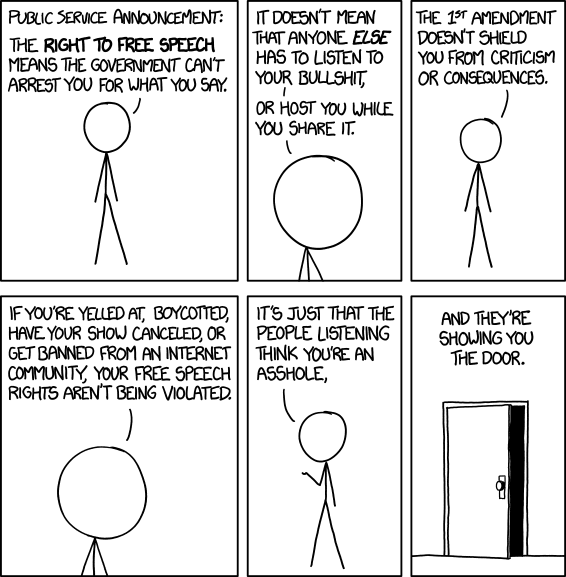
http://xkcd.com/1357/

So I guess I'd better write something about the Great Mozilla Flap of 2014.  In case you haven't heard, Brendan Eich, the recently-elevated CEO of Mozilla, which produces the Firefox browser, came under attack because in 2008 he donated a thousand dollars to support the anti-same-sex-marriage Proposition 8 in California.  After a little more than a week of controversy, including calls to boycott Mozilla products, Eich stepped down.  Which was a relief for me, because after checking the main alternatives, I wasn't sure I was willing to switch to another browser; I have some problems with Firefox, but I'm used to it and I don't much like Chrome or IE.

Conor Friedersdorf summed up the controversy reasonably well here; I also liked this post by Ampersand at Alas, a Blog, which helped me sort out my own position.  It reminded me that I'd written much the same things in this post right after the success of Prop 8 at the polls in 2008. Entertainingly, Andrew Sullivan got upset over Brendan Eich's departure, though he helped lead the attack on the liberal gay-marriage supporter Alec Baldwin for using homophobic language, even unto Baldwin's losing his TV program. (Maybe because Baldwin is a high-profile Hollywood liberal and Eich is a right-wing libertarian who supported Ron Paul?)  Baldwin singled out Sullivan for contumely as part of the "fundamentalist wing of gay advocacy." And the fuss hasn't died down yet, as shown by xkcd's latest cartoon, linked above, which has been getting shared widely on the Intertoobz, including sf writer John Scalzi's blog.

For a computer/math geek and science cultist, xkcd has wandered off into irrationality with this cartoon. Part of what he says is fair enough, I guess: I agree that the First Amendment only applies to government censorship, so being fired for your political or other views is not a violation of your First Amendment rights.  This has been brought home repeatedly in the controversies over Paula Deen, Juan Williams, Phil Robertson, and others lately.  (Oddly, when the racist writer John Derbyshire was fired from the National Review two years ago for his expressed views, few right-wingers came to his defense.)  Nor is it a violation of your freedom of speech to be kicked out of an Internet forum, or if your letter to the editor of a newspaper isn't published, or if you're attacked in the "mainstream media" for attacking your political opponents.  So far so good.

But xkcd made some odd statements, starting with "It doesn't mean that anyone else has to listen to your bullshit" and climaxing with "It's just that the people listening think you're an asshole, and they're showing you the door."  On a narrow literal level, the first statement is also true, but "bullshit" is perniciously irrelevant, as is "asshole."  It doesn't matter whether what you say or write is "bullshit," but the question arises: Who gets to decide that what you've said is bullshit, or that you're an asshole?  At Scalzi's blog I posted a comment, asking whether Phil Donahue was fired from MSNBC in 2003 because he was an asshole?  And how many people who are grimly celebrating the fall of Brendan Eich now, threw hissyfits over Donahue's losing his TV show because he gave a forum to opponents of the Bush-Cheney invasion of Iraq?  Many liberals and progressives did at the time, and they're still upset a decade later; I'll cite Chris Hedges for special notice because of his overwrought claim that "TV news died" when Donahue was shown the door.  As if the corporate media had ever given a platform to critics of US wars; Hedges surely must know better.

Another commenter at Scalzi's blog bit.  They wrote:
@Duncan, more like MSNBC’s viewers were letting MSNBC know they thought he was an asshole, and MSNBC decided that it did not want to present programming by someone their viewers thought was an asshole. Unless you’re implying that he lost his show because the government applied pressure to MSNBC?
No, I wasn't implying anything of the kind; as far as I know, the government applied no pressure to MSNBC.  There was no need to.  The decision to get rid of Donahue seems not to have had anything to do with "viewers" thinking Donahue was an asshole; it came from the upper reaches of management, as revealed by a leaked internal memo which warned that Donahue presented a "difficult public face for NBC in a time of war.... He seems to delight in presenting guests who are anti-war, anti-Bush and skeptical of the administration's motives."  The decision was framed in commercial terms, that at a time when MSNBC wanted to "reinvent itself", Donahue might put off an "anticipated larger audience who will tune in during a time of war" by linking pundits to war coverage, "particularly given his public stance on the advisability of the war effort."  So far I haven't seen any of Donahue's advocates acknowledging that a corporate network has the right to determine the face it shows to its audiences, and to dismiss employees like Donahue who don't fit its plans to reinvent itself.  But that was last year, after all.

There are other examples I could give.  Michael Moore, who is widely regarded as an asshole by conservatives and liberals alike, publicly opposed the Iraq war before it became safe to do so, and endured death threats, vandalism of his home, and (unsuccessful) physical attacks as a consequence.  (He was also harshly criticized by liberal heroes and Iraq war supporters Keith Olbermann and Al Franken, whom I consider assholes.)  But while I doubt that those who've justified the firing of various right-wing bigots would be comfortable defending the response Moore faced because of his 'bullshit,' I wonder how many of them are even aware of it?  And it's true, death threats and bomb plots go way beyond what xkcd is talking about.  But c'mon, the audience at the Academy Awards had every right to boo Moore because they didn't want to hear this asshole spout his bullshit, right?

I hope this points to the problem not only with xkcd's specific point about bullshit and assholes, but to the broader defense of private businesses demoting, firing, and otherwise showing the door to people whose opinions and political stances rile others.  After all, John Scalzi has been called an asshole often enough, and though he runs his own blog he doesn't own the Internet hardware that stores and transmits it -- it's in the hands of private companies, who then could reasonably give him the boot if enough people complained that he was an asshole and they didn't want to read his bullshit anymore.  A common argument used about Internet forums is that if your comments get deleted or you get banned from the comment section, you can always start your own blog.  And that's true, but what if you can't find a host for your bullshit?  This happened to Wikileaks a few years back, for example; and why not, since Julian Assange is widely considered an asshole by right-thinking people?  Why should they have to listen to his bullshit?  They were just showing him the door.

Throwing around words like "asshole" and "bullshit" in this situation is a rejection of rational debate.  I've pointed before to the way many people all over the political spectrum confuse a person's opinions with their style of presentation, which are separate issues.  And while it's convenient (which is to say, lazy) to dismiss free-speech issues by characterizing the offending speech as "bullshit," it's irrelevant.  It seems to me to echo the distaste for critical thinking I've seen exhibited by many good liberals and progressives, who want to impose, with varying degrees of force, their opinions on the benighted troglodytes who aren't as rational as they like to believe they are.  (And no, this has nothing to do with being "open-minded."

Many of Eich's critics argued that his offense went beyond speech into action: he donated a thousand dollars to support the campaign for Proposition 8 in 2008, to ban same-sex civil marriage in California.  I've seen quite a lot of GLBT people say that because he tried to take away their rights, he had no right to be CEO of Mozilla.  (I would agree that he doesn't have a right to be CEO of Mozilla, but that doesn't seem to be what these people meant -- I think it's more like the person who wanted Paula Deen to "lose everything.")  I suppose that case could be made, but matters of principle must apply across the board, not just to specific cases, so let's consider some analogous possibilities.  Can a company fire an employee who contributes to an organization seeking to raise taxes on businesses, or on the top income brackets?  Such an employee could reasonably be accused of trying to deprive businesses or rich individuals of their right to keep as much of their income as possible.  How about union organizers (to say nothing of strikers), who also seek to limit the power of business owners and management, thereby affecting them in their pocketbooks?  Though labor law has limited the freedom of workers to organize and strike, our society and the law recognizes at least in theory that people have the right to assert their rights at what may be the expense of their opponents.  Not all freedom is a zero-sum game, where one person gains only if another loses, but sometimes it is.  People have the right to advance themselves at others' expense in such situations.  It's certainly not true that a person who does so has automatically forfeited his freedom of speech or action.  And contrary to another liberal-left claim I've often seen, freedom of speech does extend to "hate speech" and advocating the diminution or removal of other people's rights.  Those others have the corresponding freedom to respond with more speech, including hateful speech as they often do.  That's part of the messiness of living in a free society.

I guess I should clarify that I'm not displeased that Brendan Eich stepped down; I think that the criticism of Mozilla and the pressure it produced were legitimate.  But I do think that some of those who agree with his demotion are not clear about what the issues are, what they were doing, or how the same tactics can and will legitimately be turned against people they support.

I don't think there's an easy answer to this problem, but I do think that the power corporations and other private, ostensibly non-government entities, can exercise over people's expression is a matter that ought to concern those who care about public debate.  It appears to me that many liberals and "progressives" and even leftists are all too accepting of corporate power over corporate employees, because it's not government power.  lt's just not possible to separate the public and the private that neatly.  And what these recent controversies -- not just Eich, but Deen and Robertson and others -- indicate to me is that for many if not people, their positions on any given case are determined by where they stand on the issue.  If they approve of the opinions of the person fired, they get indignant; if they don't, they celebrate and justify the firing.  Which is their right, of course; but it doesn't bespeak a principled commitment to freedom of expression.

Tuesday, September 24, 2013

You're Stupid, Therefore I'm Smart Q.E.D.

Roy Edroso decided to make fun of the right-wing legacy blogger Jonah Goldberg yesterday.  He couldn't decide whether "the key line" of the Goldberg post he was mocking was its celebration of the TV show Breaking Bad as true conservative entertainment, or "And that is why great novels are, by nature, conservative."

This, of course, set off a wave of parodies from Edroso's commenters, rewriting the opening lines of various famous works of literature.  Not all of them were novels, and I suspect that a similar blurring of form and genre by right-wing writers or commenters wouldn't get a pass from this lot.  Anyway, because Edroso's fans, like all liberals, are bold independent thinkers, they followed his lead predictably.  Most of the parodies were constructed by putting in references to Goldberg's mother (because Goldberg probably got his start in right-wing punditry thanks to his connection with her), flatulence (Edroso's standard punchline for his mockery of Goldberg), and Cheetos (another standby in Edroso's comic arsenal).  Because, as we all know, the most devastating reality-based criticism you can make of your political opponents is to call them fat.  It's the vital common ground between American liberals and conservatives.
For a long time I used to go to through a 32 oz bag of Cheetos quickly. Sometimes, when I had put my hand in the bag, its contents would vanish so quickly that I had not even time to say “I’ve eaten another goddamn bag of Cheetos!”
But none of them, not Edroso and not his commenters, thought to notice that Goldberg had an arguable point in that claim about the conservatism of novels.  Better minds than either Goldberg or Edroso have claimed as much, and it's not exactly surprising.  The literary canon is conservative in the strict sense of the word, because it's designed to expose students to the normative works of the past, and despite right-wing hysteria about liberal professors, the canon was generally chosen by political as well as artistic conservatives, and they've traditionally been taught to minimize whatever thoughtcrime they contain.  (George Orwell, for example, remained a socialist all his life, but 1984 and Animal Farm are usually taught as pro-capitalist because they're anti-Communist.  And so they are, but they are vehemently anti-capitalist too.)  There might very well be great works of literature that could be labeled liberal or even radical, but they were usually not taught to children or even college students.  Schooling was primarily intended to mold the young to obedience, not to critical thought.  Proust's Remembrance of Things Past, for another example, doesn't need to be rewritten with the Cheeto in the place of the madeleine to make it a conservative work.  Jonah Goldberg was probably just cribbing someone else's cliché, and he doesn't seem capable of developing an argument to defend his beliefs anyway, but he might not be totally wrong in that sentence.

Even if I grant Goldberg that much, though, neither he nor Edroso and his merry band notice that "conservative" in the sense I've been using it here has nothing to do with what's known as American political conservatism.  Richard Hofstadter pointed out fifty years ago that American right-wingers like William Buckley, Barry Goldwater, and Ronald Reagan who styled themselves "conservatives" were really radical reactionary statists who wanted to overturn the American system of government: real conservatism, in the sense of wanting to conserve the good things in one's society, would in the 1950s have meant New Deal "liberalism."  Older American conservatives were generally put off by the vulgarity and belligerence of the New Right, which is not really a point against the latter; it's a matter of class and style, not of content or policy.  Pointing out that today's conservatives aren't really conservatives is as much a cliché as Goldberg's truism about "great novels."  But that's why I'm mostly referring to people like Goldberg as right-wingers here, not conservatives.

As I've noticed before, Edroso's take on art is pretty "conservative" in the sense of hanging on to the New-Critical stance which denies or ignores the political content of art and entertainment in favor of close readings of the texts -- usually short forms like lyric poetry, which can be covered in a single class period or journal-length article.  (Even the New Critics, if I remember correctly, admitted that their approach didn't work well with long poems or novels, but they thought that just counted against the value of those longer works.)   He loves to mock his right-wing counterparts' obsession with finding right-wing content everywhere they possibly can, but he (and even more, his fans) clearly wants to believe that good art is liberal if it's anything.  This, you may recall, was the lot who were comfortable with claims like "Political philosophy is almost entirely a liberal project" (which is false no matter how you define "liberal" and "conservative"), and had to be reminded that "Marx, Alinsky, Debs, Chomsky, Ilich, Mills, Zinn, Sinclair, Gorz and the like" were not a liberal canon but a left-wing one.  Just as the Right wants to claim various dead heroes as real if unbaptized conservatives had they only known it, liberals love to claim those heroes for liberalism, even when they were explicitly hostile to liberalism.

One commenter today wrote:
Wait a second, isn't this the guy who just wrote a piece on how liberals try to bring politics into everything? Geez, Jonah, you couldn't have let a week lapse in between those observations?
And another lamented, "They just can't let us have anything to ourselves, can they?"  (Reminiscent of heterosexuals who see gay readings of works they like as "appropriative."  If gay men love Bette Davis, normal people can't love her.)  Resistance to "political" criticism of art or entertainment is a bipartisan bugbear, of course.  That's partly because it's not easy to do it well, partly because many people persist in understanding literary "criticism" as purely destructive rather than analytical, and partly because it often uncovers aspects of popular and beloved works that their fans don't want to think about.  Laura Miller's book on fantasy, The Magician's Book: A Skeptic's Adventures in Narnia (Little, Brown, 2008), falls into this trap, even though Miller recognizes the value of criticism generally.  Yet she also writes:
The traditional, reverential study of canonical literature that prevailed in Lewis’s day, and the revolution-mongering of the 1960s and 1970s that supplanted it, gave way to poststructuralist and postmodern theory. Books that past generations regarded as eternal monuments of genius were dragged into the courts of theory and indicted for their ideological inadequacies. Their authors’ personal lives and political beliefs served as evidence against them. Racism, sexism, classism, and homophobia lurked everywhere, often in disguises that required expert decoding. If you wanted to know why the world proved so resistant to the utopian designs of a fading radicalism – and that’s exactly what many academics, having seen such dreams die, wanted to do – you could point to the poisonous bias embodied in even the most celebrated pillars of our culture [170].
Compare this to Joan Acocella's fervid defenses (which is how she saw them) of Willa Cather against "theory" which leveled the "accusation" of lesbianism against Cather.  Both Miller and Acocella are probably liberals, but they both treat any discussion of authors' "personal lives and political beliefs" as scandal-mongering -- even though they both root around in the knickers of their chief subjects themselves, Cather in Acocella's case and C. S. Lewis's in Miller's.  I suppose there must have been writers who fit Miller's caricature of postmodernist theorists, but I can't remember ever having read any myself, and I've read a fair amount of postmodernist theory.  Probably the chief work of this kind is pre-postmodernist, a classic of feminist scholarship: Kate Millett's Sexual Politics, published in 1970.  Millett focused on three iconic male modernist writers: D. H. Lawrence, Henry Miller, and Norman Mailer, with an envoi on Jean Genet, but she included a historical overview that, among other things, introduced me to (and induced me to read) Charlotte Bronte's Villette.  Millett was attacked for demonizing Lawrence, Miller, and Mailer, though in my opinion her analysis was nuanced and didn't demonize the great men; I'd say she drew fire simply for criticizing them at all.  Ironically, Miller too was attacked by Lewis fans who thought she didn't cut the great man enough slack, though I think she cut him plenty, and wrote about him with affection and compassion.  To the true devotee, of course, no acknowledgment of the hero's clay feet is acceptable.

But all this pretty much misses the point of political (or "political") criticism.  In the first place, the "traditional, reverential study of canonical literature" was fully compatible with destructive criticism of non-canonical work, to justify its exclusion.  Read male critics' denigration of female writers, and you'll see what I mean; Joanna Russ collected and analyzed critical misogyny in her How to Suppress Women's Writing (Texas, 1983); and as Robert K. Martin argued in The Male Homosexual Tradition in American Poetry (Texas, 1979), mainstream critics generally agreed that a great artist must be a Truly Good Person, so they had to decide whether Walt Whitman (for example) couldn't be homosexual because he was a Great Poet, or he couldn't be a great poet because he was a homosexual.  Biographical criticism of this kind is traditional; perhaps what changed in the 1970s was some critics' insistence on confronting the question, and it infuriated the traditionalists.

But biographical criticism of this kind is not really political criticism.  As Miller argued,
Of course, it’s absurd to speak of the “politics” of Narnia. These are children’s fantasies, not designed to address such adult concerns as class systems, nationalism, and economics. They take place in a dream world where talking beavers bake marmalade rolls despite having no surplus goods to trade for oranges and sugar, commodities that can only have been imported from a warmer land. Who raises and slaughters the pigs to make the bacon and sausages gobbled up at almost every Narnian meal? Who grows the wheat and grinds the flour for bread, and who imports the tea and coffee? Even Tolkien, who labored for countless hours to make Middle-earth a consistent, coherent alternative world, never made it entirely plausible economically, and he thought Narnia a disgracefully slapdash creation [158].
I disagree that it's absurd to speak of the politics of Narnia, and Miller shows right here why it isn't.  It's just not all that relevant, since as Miller goes on to say, Narnia isn't a real world but a fantasy creation where political economy isn't involved, any more than it is in a dream.  But notice that J. R. R. Tolkien, hardly a poststructuralist critic, objected to the Narnia books because they weren't realistic in this sense, the sense he tried to realize in The Lord of the Rings.  That would indicate that it's not improper to point out flaws in Tolkien's execution of his aim to make Middle-earth "a consistent, alternative world," though doing so is probably as much beside the point as it is for Narnia.

What political criticism does properly do is analyze the assumptions that underlie art and entertainment.  As Joanna Russ argued, "it seems absolutely impossible to write anything without immediately making all sorts of assumptions about what human nature is, what good and bad behavior consists of, what men ought to be, what women ought to be, which states of mind and character are valuable, which are the opposite, and so on. Once fiction gets beyond the level of minimal technical competence, a reviewer must address these judgments of value." (Quoted at greater length, with sourcing, here.) Myself, I don't really draw a distinction between art and entertainment, but I'm thinking here of people who get their pants in a bunch over academic criticism of commercial entertainment and culture.  They hardly consider Madonna or Barbie or I Love Lucy to be Great Art, so they don't see the point of analyzing it (though they don't really approve of analyzing Great Art either, as I've already mentioned).  I think that commercial entertainment is just as full of assumptions about "what human nature is", etc., as Shakespeare, and it's interesting and worthwhile to figure out what those assumptions are and to see how they work in practice. 

As for sexism and racism and other bigotry in canonical art, I've argued before that conservative critics don't want to confront them because they consider bigotry acceptable, a cultural norm.  "Liberals" tend to defend their favored works and and artists by declaring that in the old days it hadn't yet been discovered that people of color, or homosexuals, or women, were people, though they're unclear as to when this great discovery was made.  (Notice that Orson Scott Card has tried to use this argument to oppose a boycott of the upcoming movie of Ender's Game: "Ender’s Game is set more than a century in the future and has nothing to do with political issues that did not exist when the book was written in 1984."  Gay issues hadn't been discovered yet in 1984, and won't exist in the future!) Of course, it's not easy to evaluate the significance of bigotry in works from the past, which is why academics are still hotly debating whether The Merchant of Venice is anti-Semitic, for example.  But I don't see why it's unfair to raise the question.

I realize that going off in this direction takes Jonah Goldberg more seriously than he deserves; and probably Roy Edroso, too.  But I think that both of these boys are playing with serious (if not necessarily important) matters that deserve better, more thoughtful treatment than either can give to them, or cares to.

Thursday, August 16, 2012

Canons to the Left of Me!

How Goes the Culture War? Roy Edroso asked sarcastically today, referring to some more conservatives who are whining that their side gets no respect, and in particular:
And at Power Line, Steven Hayward asks, "WHY IS THERE NO LIBERAL AYN RAND?" He's taking off from Beverly Gage who, slightly less stupidly, asks, "American conservatives have a canon. Why don’t American liberals?" Sure we have a canon -- it's called Western literature. And it beats the snot out of the sad, long-form political pamphlets wingnuts like to name-check. You will learn more about the human condition from the works of novelists, playwrights, and poets than you ever can from a thousand power freaks' blueprints for the mass production of Procrustean beds.
I don't think this works, but then I have to remember that Edroso's mission is to make fun of the monkeyshines of the Right in a Democratic-Party-friendly fashion, not to do any serious thinking.  Once in a while he tiptoes toward the precipice of criticizing Obama, but never goes too close.  Most obviously, the canon of Western literature is also claimed by conservatives, and rightly so, since that canon is a conservative product.  (As well as something of a fantasy: the canon looks different in each European country, both in its content and in how it's read, and the content changes over time within each national tradition.)  Edroso also has this hobbyhorse about art not being political, which would seem to conflict with his implication that the canon is more liberal than conservative.  He's right to make fun of the contemporary American Right's attempts to read their views into art and pop culture, but that's because the writers he's citing are sloppy thinkers.  As Joanna Russ once wrote, "To apply rigid, stupid, narrow, political standards to fiction is bad because the standards are rigid, stupid, and narrow, not because they are political." I admit it's tempting to believe that there's a connection between sloppy thought and the Right, but I've read too many sloppy liberals and leftists to take the idea very far.

For example, in an update to the post, he approvingly quotes a commenter:
Political philosophy is almost entirely a liberal project. In some sense liberal political philosophy fuckin' created Western political culture. Human rights grew entirely out of liberal institutions consciously advancing specific liberal political conceptions...
I suppose that "almost" saves the claim from being completely false.  Political philosophy in the West begins with Plato and Aristotle, neither of whom was what you'd call a liberal, and proceeds through centuries of thinkers who drew on them.  Perhaps what the commenter meant was "modern Anglo-American political philosophy," but even there, I think it would be more accurate to say that human rights grew out of individuals struggling to get institutions to advance their political conceptions, not all of which were "liberal" in the sense that Edroso and his regulars use the word.  Parochialism isn't limited to the Right, you see.

American universities, the guardians and gatekeepers of the canon in the US, were quite conservative institutions until after World War II, when the GI Bill funded higher education for a flood of people who'd never have been allowed in before, certainly not in such numbers.
Speaking at the annual meeting of the American Historical Association (AHA) in 1962, President Carl Bridenbaugh lamented the changes he saw occurring in the academic world. Himself from Protestant Middle America, Bridenbaugh deplored “the great mutation” in Clio’s profession that was occurring as the post-World War II GI Bill ushered into the undergraduate and graduate programs people who could not have gone to college in the Depression. “Many of the young practitioners of our craft, and those who are still apprentices,” Bridenbaugh lamented, “are products of lower middle-class or foreign origins, and their emotions not infrequently get in the way of historical reconstructions. They suffered from an “environmental deficiency” because they were urban-bred, rooted in the Old World traditions of their parents’ homelands, and therefore lacking in the “understanding … vouchsafed to historians who were raised in the countryside or in the small town.…They find themselves in a very real sense outsiders on our past and feel themselves shut out. This is certainly not their fault, but it is true.”

Almost everyone who heard or read Bridenbaugh’s references to urban, foreign-born outsiders, mutants tarnishing a noble profession, understood that he was talking about Jews. This was far from the last lamentation about the wholesale change in the recruitment of historians in a period of extraordinary growth in higher education. Bridenbaugh’s discomfort was shared widely because before World War II the history profession had been drawn overwhelmingly from the ranks of middle- to upper-class white Protestant men [Gary B. Nash et al, History on Trial (Knopf, 1998), p. 54].
Stuff like this is a reminder why American academia underwent such upheavals in the 1960s, and the canon was opened to such abominations as Women's Studies and African-American Studies.  (Do I need to caption "abominations" for the irony-impaired?  If so, consider it captioned.)  Edroso's a lot younger than I am, so he may not be aware of the changes that occurred.  His politics-neutral claims about art indicate that he absorbed some reactionary rhetoric along the line, though detached from its earlier context.

Another commenter not quoted by Edroso wrote:
I am sure that if one were to cite as a liberal canon the works of Marx, Alinsky, Debs, Chomsky, Ilich, Mills, Veblen, Zinn, Sinclair, Gorz, and the like, Hayward wouldn't call them a commie or anything like that.
But as another pointed out, "that's a left canon, not a liberal one; the two concepts are somewhat different."  The same is true of George Orwell, whose anti-totalitarian stance has often been confused with pro-capitalism, especially by the Right.  A good many heroes and heroines of today's liberals don't seem to have been liberals, and were often vilified by liberals in their day.  It's as dishonest to claim Martin Luther King Jr., for example, for liberalism as it is to claim him for conservatism.  But both those factions want to bask in King's prestige: the best (or at any rate safest) role model is a dead role model.

Monday, May 14, 2012

The Orientation of My Preference

Roy Edroso covered the Right blogosphere's reaction to Obama's endorsement of same-sex marriage in this week's Village Voice column, with a sample quotation on his blog.  I won't give a link to the source, you can find it easily at alicublog, and anyway, it's right-wing boilerplate -- thousands of people could have said or written the same thing, and probably have:
They are actually comparing race to sexual preference? Yes, I said preference. Unlike skin color, there is NO evidence to support the idea that babies are born gay. People want to believe it’s innate but it’s just that, a belief. And a well crafted belief to elevate the idea of being gay far above preference into something that can tear at the fabric of the institution of marriage.
One of the major battles over gay rights in the US has been over whether to speak of "sexual orientation" or "sexual preference."  That has been a major waste of time for the movement but not for our opponents, which is why this writer throws down the gauntlet over "preference," knowing that many gay people and their allies will froth at the mouth over the word.  At some point -- in the 1980s, I believe, perhaps during the struggle to pass an antidiscrimination ordinance in Denver -- it became taken for granted that the word "preference" implies that "it's a choice", while "orientation" means that homosexuality is innate.  If homosexuality is merely a sexual preference, then gay people could be forced to change, so we must never say it's a preference.

I first encountered this claim in other online forums in the 1990s.  It made no sense for various reasons, and no one was able to point to any basis for the distinction.  I was baffled partly because in the early 1990s when Bloomington amended its human rights ordinance to include "sexual orientation," the religious opposition didn't object to the word "orientation."  Rather they argued that if homosexuals were protected, the next inevitable step would be to protect pedophiles.

They weren't totally irrational about this, because numerous well-meaning authorities on human sexuality had said that pedophilia was a separate "sexual orientation."  The idea was to deny the claim that homosexuals were disproportionately likely to be child molesters by arguing that pedophiles were usually attracted to children as such, rather than to male or female children, so it was distinct from homosexuality or heterosexuality.  The authorities involved were using "sexual orientation" illegitimately, because children aren't a sex.  Sexual orientation doesn't mean "orientation to a particular form of sexual activity," but "orientation to a particular sex."  The Bloomington ordinance defined "sexual orientation" very specifically as homosexual, heterosexual, or bisexual, so even if someone had argued that it also covered pedophiles, the ordinance would have had to be amended again.  Still, the sex research establishment bears some responsibility for this confusion. 

At some point I stumbled on a paper by the sex researcher John Money, included in a Kinsey Institute publication, Homosexuality / Heterosexuality: Concepts of Sexual Orientation, edited by David P. McWhirter, Stephanie A. Sanders, and June Machover Reinisch (Oxford, 1990).  In his article, "Agenda and Credenda of the Kinsey Scale," Money wrote:
In the human species, a person does not prefer to be homosexual instead of homosexual or to be bisexual instead of monosexual.  Sexual preference is a moral and political term.  Conceptually, it implies voluntary choice, that is, that one chooses, or prefers, to be homosexual instead of heterosexual or bisexual, and vice versa.  Politically, sexual preference is a dangerous term for it implies that if homosexuals choose their preference, then they can be legally forced, under threat of punishment, to choose to be heterosexual [43].
Given the glacial pace of academic publishing, I'd bet this paper was written sometime in the 1980s.  It shows that the position I'm discussing already existed in pure form that long ago.  What still strikes me very forcefully is how irrational it is from start to finish.

The most useful thing about it is that Money says explicitly that the preference / orientation distinction isn't scientific, it's "moral and political."  Many people with whom I've debated this matter have insisted that it's based in scientific terminology, though when Alan Bell, Martin S. Weinberg, and Sue Kiefer Hammersmith published a book called Sexual Preference: Its Development in Men and Women (Indiana) in 1981, they used "preference" to refer to both homosexuality and heterosexuality, with no suggestion that either was a "voluntary choice."  Indeed, Weinberg had embraced a biological determinist position on the cause of homosexuality by the time the book was published.  The fact that they treated heterosexuality as a "sexual preference" also counts against Money's claim (it's not an argument).

Money goes right off the rails, though, when he writes that "sexual preference" implies "that one chooses, or prefers, to be homosexual."  This would mean that "sexual preference" denotes, not the direction of one's sexual desires and their expression, but one's feelings about that direction: a closeted homosexual who wishes he were heterosexual would, by Money's definition, have a heterosexual "sexual preference."  He also says that a preference is something someone can choose.  No one uses the term with that meaning, but that's what Money wrote about it.

Even though many people have repeated the claim, it's equally absurd to say that "if homosexuals choose their preference, then they can be legally forced, under threat of punishment, to choose to be heterosexual."  The absurdity emerges clearly when you remember (as Money forgot) that, on this assumption, heterosexuals also choose their preference, so they could also be legally forced to choose to be homosexual.  It wouldn't happen, of course, because heterosexuals are the overwhelming majority of the population.  Majorities can try to impose their will on minorities regardless of the law, but in the US there's no legal authority to force people to change their sexual preference or sexual orientation, which is a good thing because there's no known way to do it.  Change therapy doesn't work.  Even if it did, though, I'd be no more obligated to become heterosexual than I am, as an atheist, to change my "spiritual orientation" and learn to believe in gods.  I think people who assume otherwise reveal a lot about their own values: they believe that no one should be different from the majority, and that if you can change, you must change.  It worries me that so many gay and pro-gay people make such assumptions; it bodes ill for their feelings about human freedom.

(I dug out some old notes to find the Money quotation a week or so back, when another gay blogger referred to Money as one who believed that gender was "socially constructed," probably because of Money's involvement in the case of David Reimer, the Canadian twin whom Money tried to reassign to female when his penis was destroyed in a botched medical circumcision.  In fact Money was extremely hostile to social construction theory, claiming falsely that social constructionists "align themselves against biology and medicine."  However, the blogger evidently revised his post after I read it, removing the reference to Money, so I'm not giving a link here.)

Back to Roy Edroso's antigay rightblogger.  He's right, as it happens, that there is no reason to believe that homosexuality is innate, and that the claim that it is innate is a statement of "belief," or faith. (The same applies to the rightblogger's own beliefs about sexuality and marriage, of course.)  I don't need to compare race (which isn't equivalent to "skin color" in the first place) to sexual preference; I'd prefer to compare sexual preference to religious affiliation, which is not innate and yet is a choice that people are allowed to make in this country.

A number of commenters at alicublog declared that "born gay" is the "liberal position."  I don't think so.  Gay rightist Andrew Sullivan thinks being gay is inborn, and the official position of the Roman Catholic Church is that at least some of us are "congenital" homosexuals, and while that doesn't entitle us to have sex with each other, it does mean that the Church doesn't regard being gay, in itself, as sinful.  Which only goes to show little good that concession does us.  Insofar as "born gay" is a position held by many pro-gay liberals, it shows the limits of liberalism that it ties its toleration for gays to a factually false claim.  (One of alicublog's regular commenters claimed that the science on sexual orientation is "all over the place."  The same could be said about the science on race and intelligence, or sex/gender, but most liberals reject that kind of science -- more from reflex than from knowledge, most of the time.  Anyway, if there's no agreement about the science on sexual orientation, then we can't base a political program on it.)

Edroso comments, "Clear thinking makes clear writing, and the obverse is also true ... I suppose it's elitist of me to say so, but when your opponents argue like this, you can be reasonably certain you've picked the right side."  If that were true, it would apply no less to the pro-gay side: since they make so many false statements, since they resort to temper tantrums when they encounter disagreement, does it follow that their antigay opponents have picked the right side?  Of course not.  It's not enough for our opponents to be wrong: we have to be right.

Wednesday, January 4, 2012

The Perfect Is the Enemy of the Good

My Tabloid Friend on Facebook posted the above cartoon to his feed today. I've been wondering why. Does the cartoonist believe that voting constitutes all the 'doing anything about it' a citizen ought to do? Possibly. I took it as one more Democratic whine about the professional leftists who do nothing but complain about what we think Obama didn't do, and made all the voters stay home in November 2010. I wish I had such power, but it can't be repeated too often that it was Obama and his fellow Democrats who discouraged the voters. I voted, even though I knew it was an empty gesture, except to enrage Obama loyalists who took for granted that as an Obama critic, I must be a lifelong nonvoter. What can you do with such irrationalists except infuriate them?

Certainly Tabloid Friend doesn't think that simply voting is enough. We should all be out there working for Barack, who if we just give him the chance will change our lives. We should be doing fund-raisers, working phone banks, canvassing door to door, and especially not criticizing the President in any way. For the past couple of weeks, especially, TF has been working himself into a lather of fury against all infidels (for they are many, ranging from the antichrist Ron Paul to enemies of the faith like Glenn Greenwald. Predictably, he (and many many other Obamaphiles) misread Greenwald's Saturday column on Ron Paul as an endorsement, but I can excuse that since he was no doubt too blinded by tears at Greenwald's iniquity to read the actual text.

TF also accused Greenwald of "concern trolling," which means he either doesn't know what concern trolling is, misread Greenwald or -- quite possibly -- both. Such misreading is a pattern: TF wailed last summer that Greenwald wanted to impeach Obama and "wanted a Republican President instead" (as though Joe Biden, who would become President if Obama were removed from office, was a Republican), and more recently put up a fury of links to Obamarista attack sites which misrepresented the bill (here, for example) and claimed falsely that Obama threatened to veto the National Defense Appropriation Act because he opposed indefinite detention; but the White House's own statement of reservation (which these sites incautiously linked to) complained that the bill would limit the Executive's ability to decide whom to detain by imposing due process on him. Even Jon Stewart, a longtime Obama fan, understood what that meant.

TF also doesn't seem to think that organizing and campaigning and voting for the candidate of your choice is a good thing, unless that candidate is Barack Obama. Do the devotees of Paul and Santorum and Bachmann and Perry and Cain get credit because they didn't just sit around and whine and complain, like some people? Of course not. They're stupid and vicious and gullible, unlike the Obama loyalists, who are skeptical and critical but can't you see that there's a campaign going on and we have to support the President or McCain will rise from the dead and invade the Oval Office and eat our brains and then where will we be? Our civil liberties will be gone and there will be endless war and a dead economy, that's where!

I haven't had much to say about Ron Paul here because I don't think he's important. He represents only part of the rightwing fringe, and I don't think there's much danger that he will get the Republican nomination, let alone win the election. If that were to change, I might write about him more, but post-Iowa it still doesn't look likely. Yes, he has some positions -- on US war, on civil liberties -- that I agree with, but so did a Stone-Age racist like Pat Buchanan, and I wouldn't endorse him either. I don't believe that Paul has really put these issues on the media radar, because most of the attention he's been getting has been focused on his worst aspects, and are we really seeing a broader range of debate in the corporate media because of Paul's modest successes on the campaign trail? Of course not; the corporate media don't work that way. And you don't have to be a Libertarian to oppose the Endless War, or the War on Drugs, or Obama's enhancement of the surveillance state. Paul deserves no particular credit for taking those stances; he certainly doesn't own them.

Besides, Paul is a Libertarian -- big L, not small l -- and that shouldn't be forgotten. Avedon Carol beat me to a number of things I was going to say about him, and said them better:
Sure, his "libertarianism" seems to be limited to a "states rights" fallacy (it's okay for individual states to destroy your freedom, it's just not okay for the federal government to do it) and then only on certain issues (obviously, not reproductive freedom, a fairly crucial one), but then, I haven't seen any evidence that Obama and his cadre of money-grubbing warmongers care about those freedoms at any level. And while Paul advocates ghastly economic policies, so do the people who currently occupy the White House. And yet, while Obama's supporters would draw the line at raping a nun on live TV (sorry, Glenn, but that's in the "dead girl/live boy" category), they are still happy to support him despite the fact that he is deliberately dismantling the American economy and every feature that might have saved you and yours from various kinds of slavery and unnecessary death. (And, you know, though I can tell you from experience that being raped is seriously unpleasant, it really isn't the worst thing that can happen. I mean, be honest: Given the choice between watching your children die because Obama managed to derail the creation of a decent health care system or seeing Obama rape a nun on live TV, which would you rather have him do?) But, you know, what really burns is that the only person saying these perfectly sane things about stupid wars is a right-wing crackpot, because there is no one in the allegedly liberal leadership saying it. And for that alone, those people deserve to be locked up someplace where they will feel forced to scream about their civil liberties and rights as Americans.
Greenwald seems to have struck a nerve with Roy Edroso, who still couldn't quite bring himself to gaze into the abyss.
In comments, Greenwald says -- very graciously, I would add -- that he did lay out the problems with Paul in his italicized "honest line of reasoning" that a hypothetical pro-Obama liberal would take. I am tempted to say that I didn't credit this because Greenwald had put it in the mouth of a fictional character with whom he doesn't agree, and so I did not consider it his own point of view; but to be honest, my eyes were too filled with blood to read carefully after I saw my own point of view characterized thus: "Yes, I’m willing to continue to have Muslim children slaughtered by covert drones and cluster bombs, and America’s minorities imprisoned by the hundreds of thousands for no good reason..." Jesus, Glenn, why not add "Mwah hah hah" and "Pathetic humans! Who can save you now?" while you're at it?
Hm. Obama loyalists have no trouble accusing Obama's critics of being willing -- indeed, eager -- to have a Republican in the White House, or accusing "progressives" who praise Ron Paul for his stances they like of embracing his other repulsive positions but they blanch at the thought that they are also stuck supporting Obama's most monstrous actions. "Muslim children slaughtered by covert drones and cluster bombs, and America's minorities imprisoned by the hundreds of thousands for no good reason" isn't a caricature of America under Obama: it's an understatement of the reality, and one that Edroso spends very little time on. (But then his blog is dedicated to mocking the Republican fringe, not to covering the news.) This is the same syndrome I've so often noticed with right-wingers I've known: they like to think of themselves as hard-nosed realists, but when their noses are rubbed in the horrors their government is committing with their tax dollars, they turn green and look away, and by the next time I see them, they've forgotten everything and have to be reminded all over again.

(By the way, under that same post at alicublog, two different commenters objected to the term "Obama loyalists," denying that they were any such thing. One of them is new to me, but the other was the same person who writes things like:
Whatever my feelings about Obama's centrism I've got to say that he and Michelle really adorn the White House. As a couple they are just...well...magnificent and the children are fucking adorable (same age as my two so I really feel for them). The huffpo lineup of former first ladies and their dresses at these state dinners was like the evolution of humanity from grotesquely old and billowy faux victoriana to blooming, statuesque, youth.
I've never seen her actually criticize anything Obama has done, except in the dismissive way she brushes aside "Obama's centrism." I'd hate to see what a loyalist would sound like, if she isn't one.)

Not that I entirely blame them, or Edroso. I don't like to think about innocent people being killed and maimed and tortured either. Nor am I claiming moral superiority here, an ability to confront evil without flinching. I flinch all the time. But I can't seem to make myself forget or ignore these things. (Just as I don't read alternative media because I have self-discipline and lots of free time: it's because I don't have enough time to spend much of it on the corporate media.) Call it my weakness; I've been called worse.

Greenwald and Avedon also pointed out that we're seeing the consequences of a permanent campaign season. Back to Avedon:
It's now almost permanent election season, which means that we always have to be in partisan mode and never discuss actual issues. We can never acknowledge that maybe a guy on Our Side is promoting bad positions because to do so would give aid and comfort to the Bad Guys on The Other Side. Almost from the moment he got into office, we've been told we can't criticize Obama because it would help the Republicans. We also can't ever admit that someone who isn't a Democrat might actually have a better position on some issue than Obama does. We can't be honest about what's really going on because it might help the Republicans. But it's true that, no matter how wrong and repugnant (and dishonest or stupid) he is on many other important issues, Ron Paul is the only one who seems to have sensible positions about the war and secrecy regime.
To repeat: to say this is not to endorse Ron Paul. It's to recognize that a lot of people are deeply invested in squelching the discussion of "actual issues" because it's all about Our Side and the Other Side. It's probably not a coincidence that Tabloid Friend and Roy Edroso and many other Obamaristas are big sports fans, though TF spends more time flogging sports than Roy does. You cheer for your team/candidate/party because it's your team/candidate/party, and you boo the other team/candidate/party because it's the other team/candidate/party. There's a difference, though: you can criticize TF's favorite teams and he won't freak out as much as he will if you criticize Obama. Before long we're going to see fans on both sides lamenting that the media and the bad guys on the other team/party are reducing everything to personalities, that they refuse to address the issues. And they'll be right, except for their refusal to see that they're also talking about themselves.

Anyway, it seems to me that Ron Paul is a distraction. The Obama loyalists love that distraction; I'd rather not make it easy for them to evade the issues.

Thursday, August 4, 2011

These Foolish Things Remind Me of You

Yesterday afternoon Roy Edroso put up a post mocking Stanley Kurtz, whom I always confuse with Howard Kurtz, the same way liberals keep confusing Naomi Klein with Naomi Wolf. Kurtz had claimed in a National Review Online post that President Obama, "still every inch the Alinskyite organizer, ... talks about uniting, even as he deliberately polarizes. He moves incrementally toward radical left goals, but never owns up to his ideology. Instead, he tries to work indirectly, by way of the constituencies he seeks to manipulate."

Edroso wonders, reasonably enough, "how, in the situation just concluded, Obama was a more polarizing force than the Republicans who used the debt ceiling to force a crisis, and how his capitulation to them manipulates constituencies to realize a radical-left goal." True, but Obama has certainly been a polarizing figure, even within the Democratic party. Maybe he's using Alinskyite organizing principles to destroy the Democrats. That the Republicans are a polarizing force seeking to realize a radical-right goal doesn't mean that Obama isn't one too.

But I noticed something else, in line with my own preoccupations: just like so many of Obama's faithful supporters, Kurtz believes that Obama is playing eleven-dimensional chess with his hapless opponents, letting it appear that he is a centrist serving out George W. Bush's third term with extra embellishments, when in fact he's a true progressive; and the day will come when he will throw off the mask and reveal his glory, casting his enemies beneath the wheels of his chariot, etc. etc. In fact, of course, the opposite has proven to be true. If Obama is playing eleven-dimensional chess with anyone, it's the liberal wing of the Democratic Party. He marketed himself as a progressive-leaning liberal who would take on the entrenched powers that have hurt the American "middle class," though you have to remember that Rome wasn't built in a day, this country was built on compromise, and his campaign was built on massive contributions from the insurance and financial sectors. I say "marketed as" rather than "campaigned as," because the liberal theme was always balanced by Obama's expressed admiration for Reagan and his own record.

One of Edroso's commenters made a few changes in a passage from Orwell's 1984, and voila!
As usual, the face of Saul Alinsky, the Enemy of the People, had flashed on to the screen. There were hisses here and there among the audience. The little sandy-haired woman gave a squeak of mingled fear and disgust. Alinsky was the renegade and backslider who once, long ago (how long ago, nobody quite remembered), had been one of the leading figures of the Party, almost on a level with Big Brother himself, and then had engaged in counter-revolutionary activities, had been condemned to death, and had mysteriously escaped and disappeared.
This is cute, but it works just as well if you imagine a Two Minutes' Hate for the Obama faithful, and substitute someone else for Alinsky. George W. Bush, say. (Hissssss!) Or Sarah Palin. (Hisssss!) Or best of all, Ralph Nader. (Swine! Swine! cried out the dark-haired girl behind Winston, and she flung a heavy copy of "The Audacity of Hope" at the screen). Jane Hamsher and Glenn Greenwald would do about as well; Obama fans consider them major thought criminals and enemies of the Party. (By the way, I read Alinsky's Rules for Radicals a few years ago and remember now only that I hated it. I don't remember any details, so maybe I should look at it again and see if it bears writing about.)

So, it seems to me that tactics like the Alinsky meme are useful to the Right as ways of trying to explain away Obama's collusion with the Right and his enactment of their policies; and useful to liberals as ways of using the wackiness of the Right as a distraction from Obama's collusion with the Right and his enactment of their policies.