The media haven't yet found something to distract them from the horror of Sarah Huckabee Sanders being refused service at a little restaurant in Virginia, and far be it from me to wander away from the fold.
I'd wondered if any of my Facebook friends would have anything to say about it yet, but so far most of them haven't, as far as I've seen. My Right Wing Acquaintance did not disappoint: he weighed in with a lament about the lack of "civility" in our society today, and the divisiveness we face. I pointed out that Sanders was treated civilly by the owner of the Red Hen, and that refusing service is not in itself considered incivility by the Right as long as the right people are refused service; in that case, it's objecting to the refusal of service that is uncivil. I also pointed out a couple of instances of RWA1's own incivility, along with the example of Ronald Reagan: a bigot and recreational liar much like Trump, whose attacks on the poor and other safe targets delighted his base in his day. We haven't gone beyond that yet.
As for divisiveness, Jon Schwarz tweeted yesterday that the Right "never imagined that their all-out attack on America might one day have the most mild consequences imaginable." Conservatives have been at war with most of their fellow citizens, sometimes literally, for most of American history. When Fred Hiatt, editor of the Washington Post editorial page, tweeted "Breaking up families is repugnant. But hounding public servants in their private life isn't the right response," among the replies he got were these:
Invoking "consequences" is slippery, though. It's a popular move on the forced-birth Right, when they say that a woman who has sex needs to take responsibility for the consequences of her sin. I put it ambiguously there because, though they prefer to forget it, most women who get abortions are married and already mothers. Just having sex, in their eyes, is the offense for which a woman must be punished.) It was also popular at the height of the AIDS epidemic: if you engage in dirty sodomitical sex, you must live with the consequences. They never imagine that their own actions might have consequences that make them uncomfortable.
At the same time, I'm wary of using their own move against them, because it relies on the fallacious assumption that "consequences" are always a natural result of someone's action, rather than something imposed on them by the judgment and choices of others. (It's a variant of the mind game "See What You Made Me Do," identified by Eric Berne.) Those who want to impose consequences on Sarah Huckabee Sanders or other Trump team members must remember that they (we) are deciding what the consequences ought to be, and take responsibility for their (our) choices. I can say, more in anger than in sorrow, that I'm not seeing much of that.
It's like karma, which despite all the caveats and disclaimers, seems always to be invoked for other people. If I understand the concept correctly -- of course there are many formulations -- it includes not only what other people bring on themselves, but on how we choose to respond to their actions. If I burn down your house because you're a bad person, I might be an agent of your karma, but I'm also building up bad karma for myself. One could, I think, make an excellent case that the presidency of Donald Trump is the karma not just of America generally, but also specifically of those Democrats who arrogantly assumed that such a loser could never beat Hillary.
With that in mind, and with considerable fear and trembling, I agree that it's appropriate to put the GOP in the hot seat. Which doesn't mean I'm approving in advance every sadistic or violent "consequence" liberals and progressives decide is appropriate for the Trump team. Nor should we forget that Trump and his base will strike back. That's the trouble with starting a fight: your opponent will hit back. You need to think about how you'll conduct yourself after that happens, and it seems to me that few people do, especially among those who are nominally on my side.
Still, it's worth remembering that the American Right has been at war, sometimes literally, with most of their fellow citizens for a long, long time. There are many possible responses to them, but it must be remembered that verbal "combat," even pretty heated, is acceptable. So are shunning, exclusion, refusing service or fellowship. I wrote yesterday that if Sarah Huckabee Sanders were starving, I would feed her -- but she's not starving. If she were homeless and living rough, I would favor giving her shelter and proper clothing -- but she's not homeless; she's all too comfortable. If Donald Trump were lying in the gutter on fire, I would not piss on him: I would try to put out the flames and call an ambulance -- but he's not (alas?) on fire in the gutter. I think it's important not to trade in irrelevancies, like mocking people's appearance -- but even if someone did, it's not as bad as separating children from their parents and putting them in cages. I would deplore fat-shaming Sanders, for example, but I'd still have a sense of proportion in my criticism of the tactic.
And I'm worried about the panicky and yet weirdly complacent irrationality I see among many liberals and progressives, even leftists. It seems that they feel that Trump's crimes license them to do anything in retaliation, without any bounds. I've quoted before Walter Kaufmann's paraphrase of Freud, "Not only is the criminal a human being like you, but you, alas, are like the criminal." I don't have my copy of Without Guilt and Justice at hand now, but that sentence occurs in the context of a discussion of the human impulse to punishment. The law of talion, "an eye for an eye," not only demands punishment, it limits it: no more than an eye for an eye. Kaufmann noted that historically and cross-culturally, this limitation has often been needed, that people delight in inventing and executing baroque, sadistic tortures on people as a "consequence," as what they "deserve." He also critiqued the very concept of "deserving," though not only with regard to punishment. Given some of the gleeful fantasizing I've been seeing in social media the past few days about what Trump, Sanders, and other people "deserve," I worry about my putative allies' lack of self-awareness and its consequences. This is not because I believe that we should be nice and give warm fuzzies to the Nazis (the straw man so beloved of many), but because failing to think about what we're doing will result in innocent people getting hurt. We've had enough collateral damage already, thank you very much. I can believe all this while rubbing RWA1's nose (figuratively) in the dirt and reminding him that Sanders got (a much milder version of) the same kind of behavior she defends and supports for other people.
It's pointless to squabble about "who started it." I attack the Right for what they say and do, and I won't let them cast themselves as victims. At the same time, the Mom's response to "He started it!" is "And I'm ending it." We also need to think about ending this. We won't get a better society merely by punishing, trampling, humiliating the Right. Again, this has nothing to do with warm fuzzies, though there's nothing wrong with warm fuzzies per se: the point is that punishing and humiliating your enemy won't work. You just get a punished, humiliated enemy who will plot revenge, waiting until your back is turned to restart the fight. (Paradigm cases: the US Civil War and World War I.) It's even open to question whether humiliating your enemy will make you feel better in the long run. But leave feelings out of it -- the real challenge is how to end a conflict without just setting up the pieces for the defeated enemy's payback game.
I also remember that any pushback against our not-so-Shadowy Overlords is unacceptable to them and their lackeys. Conor Friedersdorf of the Atlantic is busy chiding the uncivil on Twitter right now: "If civility were more highly valued in our political culture Donald Trump would not be president. If it becomes significantly less valued in the next two years he is a shoe-in [sic] for reelection." When challenged he replied "on the 'civility works better' side I cite Ghandi [sic] and MLK and Nixon’s re-election. What would you cite for 'incivility gets it done'?"
Friedersdorf is conveniently confusing civility with an avoidance of conflict. Civility is how you handle conflict. Granted, the Civility Police prefer it that our rulers never face repercussions or any kind of pushback at all, but they shouldn't get their way. He's also buying into the confusion of moderation of tone with moderation of substance, which is beloved of apologists for harmful policies. E.g., it's okay to kill children with drones as long as you do it politely as Obama did, not nastily like Trump does. Since Friedersdorf's a Christian, he should remember a saying that goes "Because you are lukewarm, I will vomit you out of my mouth." Or look at MLK's remarks about extremism in the letter from Birmingham jail, addressing white moderates who sounded a lot like Friedersdorf does today.
His citation of Gandhi (why is that name so difficult for many people to spell, by the way?) and King is actually absurd. Both men were radical troublemakers whose activism was seen as extremely uncivil by the nice, moderate public servants they opposed and by their servants in the media. The civil disobedience King practiced was deplored by reasonable moderates while he lived -- I mean, the sit-ins, interfering with Bidness, so extreme and uncivil! I feel sure that if he'd been active then, Friedersdorf would have lectured him on it. King embraced the label of "extremist" in his letter from the Birmingham jail, and his rhetoric there, while free of "fuck" and "cunt," was anything but conciliatory. It's only in retrospect, with considerable deliberate amnesia, that King and Gandhi can possibly seen as "civil" by Friedersdorf's standards. It might be possible to make a good argument against the Red Hen owner's ejection of Sarah Huckabee Sanders, but so far I haven't seen one.
Showing posts with label conor friedersdorf. Show all posts
Monday, June 25, 2018
Friday, May 27, 2016
First They Came for the Politically Correct ...
Now, this is interesting; an exchange between Atlantic blogger Conor Friedersdorf and an anonymous 22-year-old Donald Trump supporter from San Francisco. But this bit from Friedersdorf's correspondent seems to say a
lot:
What's bitterly funny is that this twerp believes that Trump is more tolerant than the people he calls "PC," and he likes the idea that if Trump became President he'd be safer from PC (which is white-person politically-correct jargon for disagreement). He's talking about a guy who encourages vigilante violence in his rallies, remember. "... I think Trump would likely do what he can to protect free speech" is merely delusional, much like the fantasies many Democrats had about Obama in 2008. I think this whiner might find that he won't be as safe as he likes to think in a Trump America. He has an Asian-American girlfriend, for example, and Asian-Americans have been targets of racist violence by nativist thugs in the recent past; they could be again. I think things would likely get worse, but he doesn't mind as long as someone else is the target: "Admittedly," he writes, "I do not focus on the human cost either." I do, and I'd rather not find out what it will be. Things are bad enough already.
This doesn't mean I'm not hostile to the authoritarian tendencies among many liberals and "progressives," including the gay movement alas. I've often written and spoken out about it. The typical "Oh how can you say such awful things!?" liberal reaction to offensive statements deserves scorn, and I give it. We need more and better debate and discussion, and people need to inform themselves, and we all need to speak out more without trying to punish those we disagree with, even when we think they're badly wrong.
In my first job, I mentioned that I enjoyed Hulk Hogan to a colleague who also liked the WWE. I was not aware at the time, but Hogan had recently made news for his use of some racial or homophobic slur. I was met with a horrified stare. By simply saying I liked his showmanship, I was lumped into saying I too was racist or homophobic.I've noticed that PC Cryers, whether they're Republican or Democrat or something else, are very fragile snowflakes. Notice that it's not clear that he even got more than a "horrified stare," but he knows that he was "lumped into saying [he] too was racist or homophobic." Maybe I'm wrong, but I can only go by what he wrote. So even a "horrified stare" (also his interpretation) makes him "feel like I have to hide my beliefs." Wow. Even if his interpretation was correct, I've always gotten such lumpings from the Right. (Oh, you don't think we should invade Iraq? I bet you want Osama Bin Laden for President!) Now, think of the good old days (which are still with us in most of the United States) when you could lose your job for being gay, and you couldn't even get certain jobs or go to certain schools if you weren't white. Think of the physical attacks that targeted civil-rights demonstrators, or school kids who had to be guarded by armed soldiers to enter a previously white-only public school. And even then they weren't safe. But this guy is too tender to cope with political disagreement. He talks as though he shouldn't encounter any expression of disagreement at all.
I feel like I have to hide my beliefs.
What's bitterly funny is that this twerp believes that Trump is more tolerant than the people he calls "PC," and he likes the idea that if Trump became President he'd be safer from PC (which is white-person politically-correct jargon for disagreement). He's talking about a guy who encourages vigilante violence in his rallies, remember. "... I think Trump would likely do what he can to protect free speech" is merely delusional, much like the fantasies many Democrats had about Obama in 2008. I think this whiner might find that he won't be as safe as he likes to think in a Trump America. He has an Asian-American girlfriend, for example, and Asian-Americans have been targets of racist violence by nativist thugs in the recent past; they could be again. I think things would likely get worse, but he doesn't mind as long as someone else is the target: "Admittedly," he writes, "I do not focus on the human cost either." I do, and I'd rather not find out what it will be. Things are bad enough already.
This doesn't mean I'm not hostile to the authoritarian tendencies among many liberals and "progressives," including the gay movement alas. I've often written and spoken out about it. The typical "Oh how can you say such awful things!?" liberal reaction to offensive statements deserves scorn, and I give it. We need more and better debate and discussion, and people need to inform themselves, and we all need to speak out more without trying to punish those we disagree with, even when we think they're badly wrong.
Friday, September 5, 2014
Seeing What the Church Will Do Unbullied, There's No Occasion To
I'm not sure what to make of Conor Friedersdorf's latest venture into the turmoil over same-sex marriage. The title and opening are especially problematic: "Will Christians Ever Bless Gay Marriage?", with the subhead "Some writers think that even as society changes, orthodox believers will stick to traditional beliefs."
Insofar as the title and subhead seem to equate "Christians" and "orthodox believers," they depend on a faulty assumption, albeit one often used by reactionary believers when convenient: "Christianity" means only those who fit a narrow and unrepresentative range of what I'll call the spectrum of Christianities, except when it doesn't. (So, for example, fundamentalists will point to the fact that the vast majority of Americans identify themselves as Christians in order to advance their theocratic agenda, even though they don't consider the vast majority of Americans to be real Christians and will denounce them as apostates, etc. Reactionary writers like Rod Dreher have drifted toward the label "traditional" Christians instead, but as Dreher himself admitted in one of his better pieces, it's surprisingly difficult to define what a "traditional" Christian believes. In practice, at least for people like Dreher, it mainly seems to boil down to opposition to same-sex marriage. But Dreher also is willing to recognize that "traditional" Christians as he imagines them are a dwindling minority among American Christians, though he exaggerates slightly so as to indulge the traditional paranoid delight in persecution -- or rather, the fantasy of persecution -- that so many Christians cherish.
Friedersdorf himself, to judge from this article, doesn't subscribe to this confusion. He recognizes the range of beliefs and values held by Christians, and does a good job answering a writer, Pascal-Emmanuel Gobry, who argues against the "false premise" that Christianity does change its values and will abandon its opposition to same-sex marriage. I will concede that some Christians never will accept it, just as some Christians cling to theologically based anti-Semitism, sexism, and other forms of bigotry. Hell, there are some Christians who still want the Catholic Mass to be celebrated in Latin only. There's no reason why all believers, or all churches, should agree on any issue. And it might bear reiterating that the legal recognition of civil marriage between same-sex couples in no way obliges a denomination to recognize them, any more than it must sanctify heterosexual civil marriages involving spouses of different denominations, or a divorced spouse in denominations that don't recognize divorce, or any number of other pairings. Catholic churches are not, as far as I know, being burned down or priests lynched or jailed for refusing to marry such couples in church.
I'll add something to Friedersdorf's discussion, though. He quotes the writer he's rebutting, who's much given to straw men and false antitheses:
Gobry also whines that the proponents of same-sex marriage believe that "if you just bully Christianity enough, it will find a way to change its view of homosexuality ..." Like many traditionalists, he assumes that advocates of same-sex marriage are not Christians (see the confusion I addressed above), though as Friedersdorf points out, the pressure to change Christian understandings of homosexuality (and of sex generally) has mostly come from within the churches, from Christians rather than unbelievers. If it were up to me as an atheist, I would resist putting any external pressure on religious believers in this regard at all, if only because external pressure only gets believers' backs up. But again, I think it will be mostly Christian or other religious GLBs who'll be having tantrums when their churches refuse to bless their marriages, and will want to throw out the First Amendment in the interests of their God-given right to have a church wedding.
I have my disagreements with Friedersdorf on many aspects of this controversy, but he did a good job this time in answering Gobry, and he quotes some useful arguments from comments under a Rod Dreher post that cited Gobry. Even so, I object to his conclusion: "It's hard to imagine that Jesus wouldn't prefer that to the previous arrangement." I think that anyone who reads Jesus' many antisexual teachings in the gospels should find it easy to imagine that Jesus would not accept same-sex marriage or openly gay followers. Friedersdorf talks a lot in this piece about "love" as a reason for accepting same-sex marriage, but any conception of Christian love that appeals to Jesus as a model must account for such dominical teachings as "Depart from me, ye cursed, into everlasting fire." As an atheist I don't have to reconcile Love and Hellfire, but Christians do.
Insofar as the title and subhead seem to equate "Christians" and "orthodox believers," they depend on a faulty assumption, albeit one often used by reactionary believers when convenient: "Christianity" means only those who fit a narrow and unrepresentative range of what I'll call the spectrum of Christianities, except when it doesn't. (So, for example, fundamentalists will point to the fact that the vast majority of Americans identify themselves as Christians in order to advance their theocratic agenda, even though they don't consider the vast majority of Americans to be real Christians and will denounce them as apostates, etc. Reactionary writers like Rod Dreher have drifted toward the label "traditional" Christians instead, but as Dreher himself admitted in one of his better pieces, it's surprisingly difficult to define what a "traditional" Christian believes. In practice, at least for people like Dreher, it mainly seems to boil down to opposition to same-sex marriage. But Dreher also is willing to recognize that "traditional" Christians as he imagines them are a dwindling minority among American Christians, though he exaggerates slightly so as to indulge the traditional paranoid delight in persecution -- or rather, the fantasy of persecution -- that so many Christians cherish.
Friedersdorf himself, to judge from this article, doesn't subscribe to this confusion. He recognizes the range of beliefs and values held by Christians, and does a good job answering a writer, Pascal-Emmanuel Gobry, who argues against the "false premise" that Christianity does change its values and will abandon its opposition to same-sex marriage. I will concede that some Christians never will accept it, just as some Christians cling to theologically based anti-Semitism, sexism, and other forms of bigotry. Hell, there are some Christians who still want the Catholic Mass to be celebrated in Latin only. There's no reason why all believers, or all churches, should agree on any issue. And it might bear reiterating that the legal recognition of civil marriage between same-sex couples in no way obliges a denomination to recognize them, any more than it must sanctify heterosexual civil marriages involving spouses of different denominations, or a divorced spouse in denominations that don't recognize divorce, or any number of other pairings. Catholic churches are not, as far as I know, being burned down or priests lynched or jailed for refusing to marry such couples in church.
I'll add something to Friedersdorf's discussion, though. He quotes the writer he's rebutting, who's much given to straw men and false antitheses:
"Christianity's view of sexuality isn't some encrusted holdover from a socially conditioned patriarchal era on its way out, but is instead deeply connected to its understanding of who God is and what human beings exist for."It's interesting to me that Gobry qualifies his claim somewhat by referring to Christianity's "understanding of who God is and what human beings exist for." That concedes the debate right off the bat. I'd expect a traditionalist Christian to insist that he is enumerating God's understanding. From there I need only point out that "some encrusted holdover from a socially conditioned patriarchal era" and "its understanding of what who God is and what human beings are exist for" are not mutually exclusive -- indeed, that it's quite thinkable that a traditional Christian understanding could also be an encrusted holdover from a patriarchal era, etc. I think the burden of argument lies on Gobry to show why it isn't, and he doesn't do so.
Gobry also whines that the proponents of same-sex marriage believe that "if you just bully Christianity enough, it will find a way to change its view of homosexuality ..." Like many traditionalists, he assumes that advocates of same-sex marriage are not Christians (see the confusion I addressed above), though as Friedersdorf points out, the pressure to change Christian understandings of homosexuality (and of sex generally) has mostly come from within the churches, from Christians rather than unbelievers. If it were up to me as an atheist, I would resist putting any external pressure on religious believers in this regard at all, if only because external pressure only gets believers' backs up. But again, I think it will be mostly Christian or other religious GLBs who'll be having tantrums when their churches refuse to bless their marriages, and will want to throw out the First Amendment in the interests of their God-given right to have a church wedding.
I have my disagreements with Friedersdorf on many aspects of this controversy, but he did a good job this time in answering Gobry, and he quotes some useful arguments from comments under a Rod Dreher post that cited Gobry. Even so, I object to his conclusion: "It's hard to imagine that Jesus wouldn't prefer that to the previous arrangement." I think that anyone who reads Jesus' many antisexual teachings in the gospels should find it easy to imagine that Jesus would not accept same-sex marriage or openly gay followers. Friedersdorf talks a lot in this piece about "love" as a reason for accepting same-sex marriage, but any conception of Christian love that appeals to Jesus as a model must account for such dominical teachings as "Depart from me, ye cursed, into everlasting fire." As an atheist I don't have to reconcile Love and Hellfire, but Christians do.
Thursday, April 24, 2014
Extremism in Defense of Liberty Is No Vice, Unless It's the Wrong Liberty
Where Christian martyrs were in fact driven to disobedience by sincere religious objections to the actions demanded of them, pagan authorities could see only contumacia, a stubborn and treasonous contempt for the emperor’s lawful command. Ironically, as we shall see, the same disconnect would prevail under the Christian empire when secular authorities and establishment bishops looked at those they called “heretics” or “schismatics.” They, likewise, preferred to characterize religious dissidence as a result of pride, obstinacy, or philoneikia (“quarrelsomeness” or “love of controversy”) rather than sincere belief.*I've been trying to figure out what principles, if any, are involved in the matter of Brendan Eich and other right-wingers who've taken heat for their political beliefs lately. I must say that the Right is tenacious: they're still yowling about the unfairness of it all, three weeks later, with no signs of fatigue. I don't think the Left, let alone liberals, would still be setting the airwaves aflame with their indignation for such a long time, though in fairness the Left doesn't have the corporate-media access the Right has.
So, for example, the right-wing columnist Charles Krauthammer just published a piece, "The Zealots Win Again," calling for an end to transparency in political donations. (It was Brendan Eich's $1000 donation to the Proposition 8 campaign, you'll recall, that led to his removal as CEO of Mozilla.) Conor Friedersdorf discussed it at TheAtlantic.com, quoting Krauthammer's conclusion:
If revealing your views opens you to the politics of personal destruction, then transparency, however valuable, must give way to the ultimate core political good, free expression. Our collective loss. Coupling unlimited donations and full disclosure was a reasonable way to reconcile the irreconcilables of campaign finance. Like so much else in our politics, however, it has been ruined by zealots.
What a pity.You see, this is why we can't have nice things: the zealots ruin them. Something's wrong here, though. First, when did the Right begin to object to "the politics of personal destruction"? Only when it began to hurt them, apparently: the Right has a long history of trying to destroy their political opponents. (Analogously, liberals only object to it when it hurts them.) Often they have relied on fabrications to do so, and professional liars who build careers on false accusations against their political enemies are considered heroes, not embarrassments to the faction.
Second, Krauthammer's argument makes no sense, because "free expression" means little if you have to hide your identity to express your views. This makes me skeptical about the notion that campaign donations should count as free, protected "speech" in the first place, but even if they should, people should take responsibility for their speech and expect to be accountable for it. By "accountable" I mean willing to give an account of the belief and their reasons for it, not that they should be fired.
I should acknowledge that I began writing this blog under a pseudonym (connected to my persona as a book reviewer for the gay press), partly because of concerns about repercussions against me in my workplace from other gay people. There had been several attempts by gay managers and administrators in the University to shut me up around campus, though I had numerous allies as well, so those attempts came to nothing. What worried me was that I might not be allowed to talk back to my critics. But I soon put my real name on the blog. (Or I thought I had; I must have changed it back. My name is connected to the blog in many places on the Internet. I've just edited my profile to put my real name back on it.) Which feels odd, I admit, because before the Internet I wrote for the radical gay press under my own name, posted on listservs, Usenet, and electronic bulletin boards under my own name, and wrote opinion columns for the student newspaper under my own name. I also spoke publicly to classes on GLB panels under my own name. I knew that anyone who wanted to could track down my identity as a blogger; I just thought I'd put a small barrier up, which would only confound those who weren't determined. And I do see it as a contradiction in my practice, and a failure of nerve.
Still, when you (or I) make a campaign donation under a regime of transparency, your name is on it, and you should be ready to stand by it. Eich apparently was not. When the controversy arose he issued a typical non-apology apology promising, or "committing," to continue the same Mozilla inclusivity you all know and love. He preferred not to defend his support of a referendum initiative intended to attack the civil rights of same-sex couples, who already were marrying legally in California. Just out of personal curiosity, I'd like to know how he justifies that in his own mind.
And here's a curious declaration in Eich's post: "And I will not tolerate behavior among community members that violates our Community Participation Guidelines or (for employees) our inclusive and non-discriminatory employment policies." Oh, really? So Brendan Eich himself is intolerant of intolerance, and is prepared to impose Touchy-Feely, Politically Correct standards of behavior on Mozilla "community members" and employees? Compare the current backtracking in some prominent sectors of the Right from support of the rancher and welfare moocher Cleven Bundy, now that he's made some classically racist remarks. Conor Friedersdorf wrote a post explaining why opponents of same-sex marriage should not be treated like racists. But why should even racists be "treated like racists"? Why is it okay to stigmatize and penalize one set of political beliefs but not others? There has, after all, been a lot of fussing when white racists got into trouble for expressing their views. Even debating the issues is considered unfair by many. Okay, maybe these people shouldn't have been "stigmatized," to use Friedersdorf's term, but this is why I find a lot of the defense of Eich problematic: the goalposts keep moving. First we shouldn't pick on racists, then we should or at least we may pick on racists, but not on antigay bigots.
So it appears that even defenders of Brendan Eich (and of Paula Deen, Alec Baldwin, Phil Robertson, and others) think it's okay under some circumstances to penalize someone for his or her political views and actions. I'm having a hard time sorting out what those circumstances are, however, and I think they need to be defined. In practice it appears, as I suggested before, that the exact circumstances are defined by the partisan position of the critic: freedom of political views for me, but not for thee. Which is certainly a familiar stance, but it's not a principle.
*Michael Gaddis, There Is No Crime for Those Who Have Christ: Religious Violence in the Christian Roman Empire (California, 2005), 34.
Sunday, April 20, 2014
The Multi That Owns Us
So I guess I'd better write something about the Great Mozilla Flap of 2014. In case you haven't heard, Brendan Eich, the recently-elevated CEO of Mozilla, which produces the Firefox browser, came under attack because in 2008 he donated a thousand dollars to support the anti-same-sex-marriage Proposition 8 in California. After a little more than a week of controversy, including calls to boycott Mozilla products, Eich stepped down. Which was a relief for me, because after checking the main alternatives, I wasn't sure I was willing to switch to another browser; I have some problems with Firefox, but I'm used to it and I don't much like Chrome or IE.
Conor Friedersdorf summed up the controversy reasonably well here; I also liked this post by Ampersand at Alas, a Blog, which helped me sort out my own position. It reminded me that I'd written much the same things in this post right after the success of Prop 8 at the polls in 2008. Entertainingly, Andrew Sullivan got upset over Brendan Eich's departure, though he helped lead the attack on the liberal gay-marriage supporter Alec Baldwin for using homophobic language, even unto Baldwin's losing his TV program. (Maybe because Baldwin is a high-profile Hollywood liberal and Eich is a right-wing libertarian who supported Ron Paul?) Baldwin singled out Sullivan for contumely as part of the "fundamentalist wing of gay advocacy." And the fuss hasn't died down yet, as shown by xkcd's latest cartoon, linked above, which has been getting shared widely on the Intertoobz, including sf writer John Scalzi's blog.
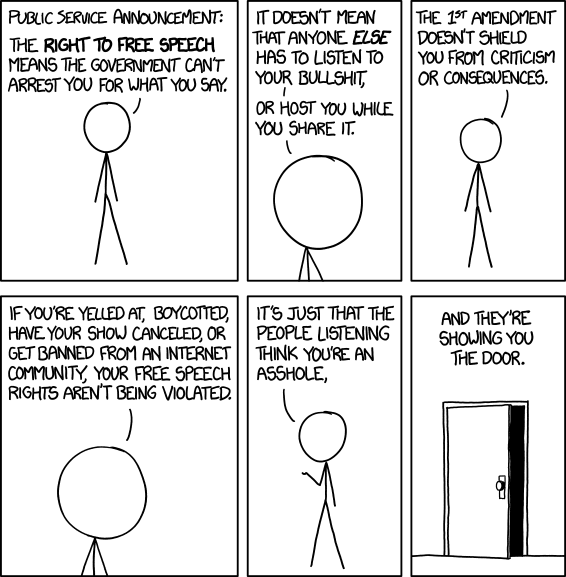
For a computer/math geek and science cultist, xkcd has wandered off into irrationality with this cartoon. Part of what he says is fair enough, I guess: I agree that the First Amendment only applies to government censorship, so being fired for your political or other views is not a violation of your First Amendment rights. This has been brought home repeatedly in the controversies over Paula Deen, Juan Williams, Phil Robertson, and others lately. (Oddly, when the racist writer John Derbyshire was fired from the National Review two years ago for his expressed views, few right-wingers came to his defense.) Nor is it a violation of your freedom of speech to be kicked out of an Internet forum, or if your letter to the editor of a newspaper isn't published, or if you're attacked in the "mainstream media" for attacking your political opponents. So far so good.
But xkcd made some odd statements, starting with "It doesn't mean that anyone else has to listen to your bullshit" and climaxing with "It's just that the people listening think you're an asshole, and they're showing you the door." On a narrow literal level, the first statement is also true, but "bullshit" is perniciously irrelevant, as is "asshole." It doesn't matter whether what you say or write is "bullshit," but the question arises: Who gets to decide that what you've said is bullshit, or that you're an asshole? At Scalzi's blog I posted a comment, asking whether Phil Donahue was fired from MSNBC in 2003 because he was an asshole? And how many people who are grimly celebrating the fall of Brendan Eich now, threw hissyfits over Donahue's losing his TV show because he gave a forum to opponents of the Bush-Cheney invasion of Iraq? Many liberals and progressives did at the time, and they're still upset a decade later; I'll cite Chris Hedges for special notice because of his overwrought claim that "TV news died" when Donahue was shown the door. As if the corporate media had ever given a platform to critics of US wars; Hedges surely must know better.
Another commenter at Scalzi's blog bit. They wrote:
@Duncan, more like MSNBC’s viewers were letting MSNBC know they thought he was an asshole, and MSNBC decided that it did not want to present programming by someone their viewers thought was an asshole. Unless you’re implying that he lost his show because the government applied pressure to MSNBC?No, I wasn't implying anything of the kind; as far as I know, the government applied no pressure to MSNBC. There was no need to. The decision to get rid of Donahue seems not to have had anything to do with "viewers" thinking Donahue was an asshole; it came from the upper reaches of management, as revealed by a leaked internal memo which warned that Donahue presented a "difficult public face for NBC in a time of war.... He seems to delight in presenting guests who are anti-war, anti-Bush and skeptical of the administration's motives." The decision was framed in commercial terms, that at a time when MSNBC wanted to "reinvent itself", Donahue might put off an "anticipated larger audience who will tune in during a time of war" by linking pundits to war coverage, "particularly given his public stance on the advisability of the war effort." So far I haven't seen any of Donahue's advocates acknowledging that a corporate network has the right to determine the face it shows to its audiences, and to dismiss employees like Donahue who don't fit its plans to reinvent itself. But that was last year, after all.
There are other examples I could give. Michael Moore, who is widely regarded as an asshole by conservatives and liberals alike, publicly opposed the Iraq war before it became safe to do so, and endured death threats, vandalism of his home, and (unsuccessful) physical attacks as a consequence. (He was also harshly criticized by liberal heroes and Iraq war supporters Keith Olbermann and Al Franken, whom I consider assholes.) But while I doubt that those who've justified the firing of various right-wing bigots would be comfortable defending the response Moore faced because of his 'bullshit,' I wonder how many of them are even aware of it? And it's true, death threats and bomb plots go way beyond what xkcd is talking about. But c'mon, the audience at the Academy Awards had every right to boo Moore because they didn't want to hear this asshole spout his bullshit, right?
I hope this points to the problem not only with xkcd's specific point about bullshit and assholes, but to the broader defense of private businesses demoting, firing, and otherwise showing the door to people whose opinions and political stances rile others. After all, John Scalzi has been called an asshole often enough, and though he runs his own blog he doesn't own the Internet hardware that stores and transmits it -- it's in the hands of private companies, who then could reasonably give him the boot if enough people complained that he was an asshole and they didn't want to read his bullshit anymore. A common argument used about Internet forums is that if your comments get deleted or you get banned from the comment section, you can always start your own blog. And that's true, but what if you can't find a host for your bullshit? This happened to Wikileaks a few years back, for example; and why not, since Julian Assange is widely considered an asshole by right-thinking people? Why should they have to listen to his bullshit? They were just showing him the door.
Throwing around words like "asshole" and "bullshit" in this situation is a rejection of rational debate. I've pointed before to the way many people all over the political spectrum confuse a person's opinions with their style of presentation, which are separate issues. And while it's convenient (which is to say, lazy) to dismiss free-speech issues by characterizing the offending speech as "bullshit," it's irrelevant. It seems to me to echo the distaste for critical thinking I've seen exhibited by many good liberals and progressives, who want to impose, with varying degrees of force, their opinions on the benighted troglodytes who aren't as rational as they like to believe they are. (And no, this has nothing to do with being "open-minded.")
Many of Eich's critics argued that his offense went beyond speech into action: he donated a thousand dollars to support the campaign for Proposition 8 in 2008, to ban same-sex civil marriage in California. I've seen quite a lot of GLBT people say that because he tried to take away their rights, he had no right to be CEO of Mozilla. (I would agree that he doesn't have a right to be CEO of Mozilla, but that doesn't seem to be what these people meant -- I think it's more like the person who wanted Paula Deen to "lose everything.") I suppose that case could be made, but matters of principle must apply across the board, not just to specific cases, so let's consider some analogous possibilities. Can a company fire an employee who contributes to an organization seeking to raise taxes on businesses, or on the top income brackets? Such an employee could reasonably be accused of trying to deprive businesses or rich individuals of their right to keep as much of their income as possible. How about union organizers (to say nothing of strikers), who also seek to limit the power of business owners and management, thereby affecting them in their pocketbooks? Though labor law has limited the freedom of workers to organize and strike, our society and the law recognizes at least in theory that people have the right to assert their rights at what may be the expense of their opponents. Not all freedom is a zero-sum game, where one person gains only if another loses, but sometimes it is. People have the right to advance themselves at others' expense in such situations. It's certainly not true that a person who does so has automatically forfeited his freedom of speech or action. And contrary to another liberal-left claim I've often seen, freedom of speech does extend to "hate speech" and advocating the diminution or removal of other people's rights. Those others have the corresponding freedom to respond with more speech, including hateful speech as they often do. That's part of the messiness of living in a free society.
I guess I should clarify that I'm not displeased that Brendan Eich stepped down; I think that the criticism of Mozilla and the pressure it produced were legitimate. But I do think that some of those who agree with his demotion are not clear about what the issues are, what they were doing, or how the same tactics can and will legitimately be turned against people they support.
I don't think there's an easy answer to this problem, but I do think that the power corporations and other private, ostensibly non-government entities, can exercise over people's expression is a matter that ought to concern those who care about public debate. It appears to me that many liberals and "progressives" and even leftists are all too accepting of corporate power over corporate employees, because it's not government power. lt's just not possible to separate the public and the private that neatly. And what these recent controversies -- not just Eich, but Deen and Robertson and others -- indicate to me is that for many if not people, their positions on any given case are determined by where they stand on the issue. If they approve of the opinions of the person fired, they get indignant; if they don't, they celebrate and justify the firing. Which is their right, of course; but it doesn't bespeak a principled commitment to freedom of expression.
Wednesday, September 18, 2013
Come, Let Us Reason Together
I'm starting to notice a certain pattern in Conor Friedersdorf's writings on gay issues. To his credit, he does broaden somewhat the "national conversation" on "gay rights" (two phrases that set my teeth on edge), by giving a forum to people with opinions that ordinarily might not be published by the Atlantic, like that closeted young gay Christian who opposed same-sex marriage. Friedersdorf does this in the name of reminding his readers that there are arguments against same-sex marriage that aren't rooted in bigotry, but so far he hasn't succeeded in finding any. So the pattern I'm noticing is a reluctance to call bigotry by its name unless it's really virulent and overtly expressed.
Last Friday Friedersdorf wrote about an antigay "college football analyst" from whom "Fox Sports Southwest has withdrawn a job offer" because of his expressed opinions:
I'm inclined to agree with Friedersdorf that James's antigay opinions needn't be relevant to a job as a sportscaster. But I stress needn't, because as more GLBT athletes come out, it's going to be hard for a sports analyst to avoid weighing in on the subject. (One commenter on Friedersdorf's article asked: "Would you, or anyone be comfortable with Fox Sports hiring an outspoken virulent racist as a broadcaster, even said broadcaster had never said anything racist during a broadcast? I don't see how this is different." Maybe it's not, but sports broadcasting is full of racist commentators, as the Jeremy Lin brouhaha reminded us.)
But I have some quibbles with the rest of what Friedersdorf said in that paragraph. He is free to believe that homosexuality is inborn, just as he's free to believe that Yahweh created the world in six days if he wants. (Disclaimer: I have no reason to think he does believe the latter.) But both beliefs are highly dubious. Whether homosexuality is inborn is also irrelevant to the moral status of homosexuality -- and also, as I've argued before, to its legal status: choices are not trivial, and many important ones, like religious affiliation, are protected by civil rights laws. Suppose scientists definitively proved that homosexuality was a "choice" (whatever that means): would Friedersdorf withdraw his opinion that it is "natural" and looked on indulgently by his god? And how does he know that his god "looks on gays and lesbians no more or less favorably than heterosexuals? Wait, let me amend that, since many pro-gay Christians I've challenged on this pretend that they don't claim to know what their god thinks; so let me ask, what makes him believe that his god looks on gays and lesbians no more or less favorably than heterosexuals? Given the Christian god's dim view of any sexuality, according to the New Testament, maybe Friedersdorf isn't making such a grand claim. Maybe he, like Jesus, thinks that gay people no less than straight people should become eunuchs for the kingdom of heaven; or, like Paul, that the married man -- straight or gay -- cares for what will please his wife, while the single man cares for what will please the Lord. In any case, Friedersdorf chose to marry, not to burn.
Friedersdorf is critical of Christians who are "willing to dismiss large parts of the Old Testament, but not the parts about homosexuality. They treat boycotting a gay wedding as if their faith compels it, but don't think twice about attending the nuptials of serial divorcees." I first misread this as an assertion that the Old Testament forbids divorce, but while it's ambiguous I'll give him the benefit of the doubt on that point. (The Hebrew Bible, aka the Old Testament, permits and regulates heterosexual divorce; in the gospels, Jesus explicitly rejects that teaching.) But he also seems to imply that only the "Old Testament" deals with homosexuality; the New Testament also does, and though Jesus never explicitly mentions eroticism between persons of the same sex, he is not a sexual liberal according to the gospels.
Friedersdorf goes on:
I also wonder what difference it makes to Friedersdorf, if we're going to talk about what's just and prudent, if a sportscaster or other commentator makes bigoted remarks on the job. Does he believe that such people check their freedom of speech at the studio door? Evidently he doesn't:
I too would like to see more "persuasive rebuttal." But I'm not sure I believe that Friedersdorf really is committed to that, since he's willing to toss out commentators who express views he considers too controversial, in what he considers the wrong context ("during an entertainment telecast that had nothing to do with the subject"). Why not have someone rebut them? Because the corporate media aren't interested in that kind of debate, of course. Nor are most Americans, I believe, including those who call for national conversations and more use of critical-thinking skills.
I'll go halfway with Friedersdorf in disavowing an "effort to stigmatize and coerce." I'm against coercion in matters of controversy; I'm not against stigmatizing. I feel the same way about people with views I more-or-less share -- atheists, gay people, and the like -- but also with views I don't -- people who don't want to be called feminists or liberals or Muslims, for example. People have the right to be bigots and to express bigoted views, but they don't have the right to demand that they not be called bigots. They can avoid the stigma by changing their bigoted views. They're also welcome to try to engage in some persuasive rebuttal, but their record in that area isn't encouraging.
Last Friday Friedersdorf wrote about an antigay "college football analyst" from whom "Fox Sports Southwest has withdrawn a job offer" because of his expressed opinions:
The arguments against gay marriage have never persuaded me. Christianity's insistence on treating homosexuality as a sin strikes me as a tragic, historic mistake. When I read that college-football analyst Craig James, formerly an SMU player, believes homosexuality is "a choice," that homosexuals will "have to answer to the Lord for their actions," and that even civil unions ought to be opposed, all positions he took during a 2012 U.S. Senate run, I couldn't disagree more. My belief is that homosexuality is both natural and inborn; that God, in whom I believe, looks upon gays and lesbians no more or less favorably than heterosexuals; and that opposing even civil unions is a morally objectionable position.Just for context, Friedersdorf also thinks that Andrew Sullivan is "eloquent." Well, we'll have to agree to disagree on that, though I hope it's not an article of Friedersdorf's faith.
I'm inclined to agree with Friedersdorf that James's antigay opinions needn't be relevant to a job as a sportscaster. But I stress needn't, because as more GLBT athletes come out, it's going to be hard for a sports analyst to avoid weighing in on the subject. (One commenter on Friedersdorf's article asked: "Would you, or anyone be comfortable with Fox Sports hiring an outspoken virulent racist as a broadcaster, even said broadcaster had never said anything racist during a broadcast? I don't see how this is different." Maybe it's not, but sports broadcasting is full of racist commentators, as the Jeremy Lin brouhaha reminded us.)
But I have some quibbles with the rest of what Friedersdorf said in that paragraph. He is free to believe that homosexuality is inborn, just as he's free to believe that Yahweh created the world in six days if he wants. (Disclaimer: I have no reason to think he does believe the latter.) But both beliefs are highly dubious. Whether homosexuality is inborn is also irrelevant to the moral status of homosexuality -- and also, as I've argued before, to its legal status: choices are not trivial, and many important ones, like religious affiliation, are protected by civil rights laws. Suppose scientists definitively proved that homosexuality was a "choice" (whatever that means): would Friedersdorf withdraw his opinion that it is "natural" and looked on indulgently by his god? And how does he know that his god "looks on gays and lesbians no more or less favorably than heterosexuals? Wait, let me amend that, since many pro-gay Christians I've challenged on this pretend that they don't claim to know what their god thinks; so let me ask, what makes him believe that his god looks on gays and lesbians no more or less favorably than heterosexuals? Given the Christian god's dim view of any sexuality, according to the New Testament, maybe Friedersdorf isn't making such a grand claim. Maybe he, like Jesus, thinks that gay people no less than straight people should become eunuchs for the kingdom of heaven; or, like Paul, that the married man -- straight or gay -- cares for what will please his wife, while the single man cares for what will please the Lord. In any case, Friedersdorf chose to marry, not to burn.
Friedersdorf is critical of Christians who are "willing to dismiss large parts of the Old Testament, but not the parts about homosexuality. They treat boycotting a gay wedding as if their faith compels it, but don't think twice about attending the nuptials of serial divorcees." I first misread this as an assertion that the Old Testament forbids divorce, but while it's ambiguous I'll give him the benefit of the doubt on that point. (The Hebrew Bible, aka the Old Testament, permits and regulates heterosexual divorce; in the gospels, Jesus explicitly rejects that teaching.) But he also seems to imply that only the "Old Testament" deals with homosexuality; the New Testament also does, and though Jesus never explicitly mentions eroticism between persons of the same sex, he is not a sexual liberal according to the gospels.
Friedersdorf goes on:
Twenty years ago, when gay equality was an outlying position and prejudice against gays was the norm, I would've regarded it as imprudent and unjust to fire a college football analyst because he favored gay marriage or declared homosexuality not sinful. Today, I am every bit as convinced that it's imprudent and unjust to fire someone for calling gay marriage unwise and homosexuality sinful. These aren't remarks that he made on air, while doing his job.And concludes:
As much as I disagree with James' particular thoughts, I prefer to live in a country where the consequences of expressing them is a persuasive rebuttal, not an effort to stigmatize and coerce. For those saying that Fox Sports should have known about these statements before hiring him, do we really want a country where employment is predicated on an investigation of one's political and religious beliefs to make sure that, on matters totally unrelated to the job, you've never said anything deemed unacceptable? In that sort of society, the weak and marginalized, whose views are generally least protected, would be hardest hit, and we would all be hurt.I want to agree with this, and I have uttered similar thoughts myself in the past. But statements made during a campaign for national political office, just a year ago, are hardly obscure or trivial. It's not as if private remarks James made decades ago at a college fraternity party were being dredged up. Of course, it's possible that James was merely pandering to his prospective constituents, as some notable white Southern politicians did on racial issues back in the day. But that doesn't mean he shouldn't be held responsible for his pandering. And "the weak and marginalized" are already vulnerable in their lives and have trouble finding corporate-media venues to express their opinions and plead their case. If only as a devil's advocate, I can see a point to letting the Right feel some of that pain.
I also wonder what difference it makes to Friedersdorf, if we're going to talk about what's just and prudent, if a sportscaster or other commentator makes bigoted remarks on the job. Does he believe that such people check their freedom of speech at the studio door? Evidently he doesn't:
A network would be justified in firing a sports broadcaster for expressing controversial moral or political views during an entertainment telecast that had nothing to do with the subject. But to not hire someone for prior remarks made amid civic debate, and that are indistinguishable from the position taken by almost half of all Americans at the time?Why does Friedersdorf think this? As I've already noted, gay issues do not have "nothing to do with the subject" of sports, especially with more and more athletes coming out, and the controversy over the upcoming Winter Olympics in Russia. His willingness to dispose of sportscasters for expressing "controversial moral or political views" seems to me to be at odds with his argument that "the consequences of expressing them" should be "a persuasive rebuttal," not termination. So, which is it? After all, quite a few Americans (and even more people elsewhere in the world) disapprove of homosexuality; the issues Friedersdorf sees as settled are not settled. He also seems to think that Craig James is entitled to a job offer, to a job he doesn't yet in fact have. No one, however qualified, is entitled by right to that.
I too would like to see more "persuasive rebuttal." But I'm not sure I believe that Friedersdorf really is committed to that, since he's willing to toss out commentators who express views he considers too controversial, in what he considers the wrong context ("during an entertainment telecast that had nothing to do with the subject"). Why not have someone rebut them? Because the corporate media aren't interested in that kind of debate, of course. Nor are most Americans, I believe, including those who call for national conversations and more use of critical-thinking skills.
I'll go halfway with Friedersdorf in disavowing an "effort to stigmatize and coerce." I'm against coercion in matters of controversy; I'm not against stigmatizing. I feel the same way about people with views I more-or-less share -- atheists, gay people, and the like -- but also with views I don't -- people who don't want to be called feminists or liberals or Muslims, for example. People have the right to be bigots and to express bigoted views, but they don't have the right to demand that they not be called bigots. They can avoid the stigma by changing their bigoted views. They're also welcome to try to engage in some persuasive rebuttal, but their record in that area isn't encouraging.
Thursday, February 28, 2013
One Ring to Rule Them All
I know Conor Friedersdorf means well; his writing positively oozes well-meaningness. He's concerned, he says, that "the news media does a terrible job reporting on the people whose opposition to gay marriage isn't rooted in bigotry." I wouldn't be surprised if that was true, since the corporate media generally do a terrible job of reporting on almost everything. The piece is a marvel of liberal false-equivalence, that one wouldn't want to say that one side in a dispute is simply wrong; that wouldn't do. The trouble is, Friedersdorf doesn't give any examples of arguments against same-sex marriage that aren't rooted in bigotry. He does gesture toward a New York Times column by Ross Douthat, which I'll consider here as I proceed.
Friedersdorf is too young to remember the glory days of Jim Crow in the United States, which is probably why he misses the raging irony in this recollection:
No doubt there were many white moderate journalists in the 1950s and 1960s who felt the same dilemma: how to cover the struggle of black people for equal treatment under the law without, at the same time, treating those who opposed that struggle as bad people? This is especially difficult if you've defined "racist" to refer only to ugly, big-bellied Alabama cops and sneering old men with thick Southern accents who flaunt their subhumanity with pride
Friedersdorf is certain that people like Douthat or Dreher are "all as horrified as anyone by bigotry, persecution, and violence directed at gays." I'm certain of that too, but how often do they write columns in which they declare that horror assertively, instead of as a prelude to opposing any action against "bigotry, persecution, and violence directed at gays"? I don't follow these writers, but I've often been in a position to ask self-styled non-bigots what kind of countermeasures they propose against bigotry, persecution, and violence against gays. They never have any answers beyond some vague feel-good, airy-fairy hand-waving: Let people know that they'd better not pick on each other for any reason, or else.
When I consider what Friedersdorf considers a non-bigoted argument against same-sex marriage -- the Ross Douthat column linked above -- I find it even harder to take Friedersdorf seriously. Douthat begins by dismissing the "commonplace arguments" about the supposedly millennia-old "definition" of marriage as one man and one woman, "These arguments have lost because they’re wrong," Douthat says. "What we think of as 'traditional marriage' is not universal. The default family arrangement in many cultures, modern as well as ancient, has been polygamy, not monogamy." Good enough. What does he have to offer instead of these commonplaces?
Something else peeks out from Douthat's argument, something that is visible in many arguments against "redefining" marriage. Douthat especially leaves himself open to to demolition, since he disavows any claim that other kinds of relationships are valueless, or that only heterosexual couples can raise children successfully. He gives no evidence that "the domestic life that can be created only by such unions, in which children grow up in intimate contact with both of their biological parents, as a uniquely admirable approach to child-rearing", probably because there isn't any. If, as he claims, monogamous heterosexual marriage "is worthy of distinctive recognition and support," then he ought to be more vocal about the current economic conditions that make this model increasingly insupportable, though it was always at best an ideal, not a living reality for most people.
But the important thing is that legalizing civil marriage between same-sex couples does not withdraw support and recognition from mixed couples: it does not abolish heterosexual marriage. Nor is the Washington Post carrying attacks on the legitimacy of monogamous heterosexual marriage: if it now includes announcements of the coupling of same-sex couples, it has not banished heterosexual couples' announcements of their engagements and weddings and anniversaries. When opponents of same-sex marriage talk about it "redefining" marriage, this is what they mean as subtext: marriage will be "redefined" as homosexual marriage, and heterosexuals will be forced to gay-marry. (A similar dog-whistle underlay opposition to "interracial" marriage, back in the day: racial equality will lead inexorably to a "conglomerated mulatto mongrel class of people"; see the Klan member quoted above.) Same-sex marriage won't devalue monogamous heterosexual marriage; if anything, most advocates of same-sex marriage naively gloss over the pitfalls and disadvantages of heterosexual marriage. Despite his disclaimer, Douthat can't imagine that different forms of family and marriage can coexist in one society: even to permit any alternative, in his mind, is to exalt that alternative over all the others. That makes no sense, but it reveals his unspoken assumptions.
This is why I prefer Nancy Polikoff's argument, in Beyond (Straight and Gay) Marriage (Beacon, 2008), that a wide variety of family types should receive social support, not only marriage-based families. (One of the negative aspects of the "marriage equality" movement is its disdain for people who choose, for whatever reason, not to marry.) It's not the place of the State to give exclusive, or even preferential, support to one kind of family, especially for purely religious reasons. But even if the State decides to exalt monogamous heterosexual marriage as the ideal relationship, that's no excuse to refuse support to other relationships. (Denying support and recognition to children who 'chose' unmarried parents is especially inhumane.) But that is what the "conservatives" want. If some subgroups of citizens choose monogamous heterosexual marriage as their lifestyle, nothing will prevent them from doing so. If it really is superior to other kinds of family, that superiority should become apparent soon enough. But Douthat and his ilk won't settle for that: they want everyone to be forced to recognize their preferred lifestyle as the best and therefore only option. Maybe that's not bigotry, but it'll do until real bigotry comes along.
Friedersdorf is too young to remember the glory days of Jim Crow in the United States, which is probably why he misses the raging irony in this recollection:
How would I defend the proposition that gay rights are a civil-rights issue? As a kid at a mostly white elementary school with a few Latinos and Asians but no blacks, I was taught about MLK and Rosa Parks, who were presented as heroes on the order of George Washington. The Cosby Show shaped my notion of what black people were like. Racists were synonymous with bad people. It would've been unthinkable for one of my classmates to use the n-word.It appears that Friedersdorf thinks "civil rights" means "black people's rights." Well, he's far from alone in that. But since he begins from that popular but fundamental error, it's no wonder his article makes little sense.
No doubt there were many white moderate journalists in the 1950s and 1960s who felt the same dilemma: how to cover the struggle of black people for equal treatment under the law without, at the same time, treating those who opposed that struggle as bad people? This is especially difficult if you've defined "racist" to refer only to ugly, big-bellied Alabama cops and sneering old men with thick Southern accents who flaunt their subhumanity with pride
KLAN SPEAKER: They want to throw white children and colored children into the melting pot of integration, through out of which will come a conglomerated mulatto mongrel class of people ... Both races will be destroyed in such a movement. I, for one, under God, will die before I’ll yield one inch for that kind of a movement.If people like that are what you mean by "racists," then you'll have no idea how to deal with nice people who want everybody to get along, who deplore those low-class rednecks, but who insist silkily that The Negro isn't ready for his rights. Maybe he will be someday, but it would just overturn the foundations of Western civilization if we pretended he's equal when he's ... well ... not. And we'd be doing The Negro no favor by pushing him prematurely into a forced equality he just isn't ready for. I can't tell from his column what, specifically, Friedersdorf would consider real antigay bigotry. I'm sure it would include the Westboro Baptist Church and similar safe targets, the kind of awful, hateful people that even bigots like Jerry Falwell and Pope Benedict could denounce.
Friedersdorf is certain that people like Douthat or Dreher are "all as horrified as anyone by bigotry, persecution, and violence directed at gays." I'm certain of that too, but how often do they write columns in which they declare that horror assertively, instead of as a prelude to opposing any action against "bigotry, persecution, and violence directed at gays"? I don't follow these writers, but I've often been in a position to ask self-styled non-bigots what kind of countermeasures they propose against bigotry, persecution, and violence against gays. They never have any answers beyond some vague feel-good, airy-fairy hand-waving: Let people know that they'd better not pick on each other for any reason, or else.
When I consider what Friedersdorf considers a non-bigoted argument against same-sex marriage -- the Ross Douthat column linked above -- I find it even harder to take Friedersdorf seriously. Douthat begins by dismissing the "commonplace arguments" about the supposedly millennia-old "definition" of marriage as one man and one woman, "These arguments have lost because they’re wrong," Douthat says. "What we think of as 'traditional marriage' is not universal. The default family arrangement in many cultures, modern as well as ancient, has been polygamy, not monogamy." Good enough. What does he have to offer instead of these commonplaces?
It’s a particular vision of marriage, rooted in a particular tradition, that establishes a particular sexual ideal.This ideal, Douthat claims, is "a particularly Western understanding, derived from Jewish and Christian beliefs about the order of creation, and supplemented by later ideas about romantic love, the rights of children, and the equality of the sexes." Of course, as he is careful not to acknowledge, the Jewish part of those beliefs was not monogamous, and the Christian part came from pagan Roman customs of marriage, nothing specifically Christian. (Even more fun, "romantic love" has its roots in Greek pederasty.) And it's "later ideas about ... the equality of the sexes" that have undermined traditional marriage, paving the way for the serial monogamy punctuated by no-fault divorce that Douthat deplores elsewhere in his column. "Traditional" stability of monogamous heterosexual marriage depended on depriving women of other choices, and usually an explicit sexual double standard. Once women had the freedom to get out of bad marriages, they voted with their feet in great numbers. Which connects to something else: Douthat ignores the denigration of marriage that has characterized much of the Western Christian tradition, since the New Testament. It hasn't been obvious that marriage was an ideal estate for human beings at all.
This ideal holds up the commitment to lifelong fidelity and support by two sexually different human beings — a commitment that involves the mutual surrender, arguably, of their reproductive self-interest — as a uniquely admirable kind of relationship. It holds up the domestic life that can be created only by such unions, in which children grow up in intimate contact with both of their biological parents, as a uniquely admirable approach to child-rearing. And recognizing the difficulty of achieving these goals, it surrounds wedlock with a distinctive set of rituals, sanctions and taboos.
The point of this ideal is not that other relationships have no value, or that only nuclear families can rear children successfully. Rather, it’s that lifelong heterosexual monogamy at its best can offer something distinctive and remarkable — a microcosm of civilization, and an organic connection between human generations — that makes it worthy of distinctive recognition and support.
Something else peeks out from Douthat's argument, something that is visible in many arguments against "redefining" marriage. Douthat especially leaves himself open to to demolition, since he disavows any claim that other kinds of relationships are valueless, or that only heterosexual couples can raise children successfully. He gives no evidence that "the domestic life that can be created only by such unions, in which children grow up in intimate contact with both of their biological parents, as a uniquely admirable approach to child-rearing", probably because there isn't any. If, as he claims, monogamous heterosexual marriage "is worthy of distinctive recognition and support," then he ought to be more vocal about the current economic conditions that make this model increasingly insupportable, though it was always at best an ideal, not a living reality for most people.
But the important thing is that legalizing civil marriage between same-sex couples does not withdraw support and recognition from mixed couples: it does not abolish heterosexual marriage. Nor is the Washington Post carrying attacks on the legitimacy of monogamous heterosexual marriage: if it now includes announcements of the coupling of same-sex couples, it has not banished heterosexual couples' announcements of their engagements and weddings and anniversaries. When opponents of same-sex marriage talk about it "redefining" marriage, this is what they mean as subtext: marriage will be "redefined" as homosexual marriage, and heterosexuals will be forced to gay-marry. (A similar dog-whistle underlay opposition to "interracial" marriage, back in the day: racial equality will lead inexorably to a "conglomerated mulatto mongrel class of people"; see the Klan member quoted above.) Same-sex marriage won't devalue monogamous heterosexual marriage; if anything, most advocates of same-sex marriage naively gloss over the pitfalls and disadvantages of heterosexual marriage. Despite his disclaimer, Douthat can't imagine that different forms of family and marriage can coexist in one society: even to permit any alternative, in his mind, is to exalt that alternative over all the others. That makes no sense, but it reveals his unspoken assumptions.
This is why I prefer Nancy Polikoff's argument, in Beyond (Straight and Gay) Marriage (Beacon, 2008), that a wide variety of family types should receive social support, not only marriage-based families. (One of the negative aspects of the "marriage equality" movement is its disdain for people who choose, for whatever reason, not to marry.) It's not the place of the State to give exclusive, or even preferential, support to one kind of family, especially for purely religious reasons. But even if the State decides to exalt monogamous heterosexual marriage as the ideal relationship, that's no excuse to refuse support to other relationships. (Denying support and recognition to children who 'chose' unmarried parents is especially inhumane.) But that is what the "conservatives" want. If some subgroups of citizens choose monogamous heterosexual marriage as their lifestyle, nothing will prevent them from doing so. If it really is superior to other kinds of family, that superiority should become apparent soon enough. But Douthat and his ilk won't settle for that: they want everyone to be forced to recognize their preferred lifestyle as the best and therefore only option. Maybe that's not bigotry, but it'll do until real bigotry comes along.
Subscribe to:
Posts (Atom)