Monday, November 30, 2009

Department of Unintentional Irony?

Homo Superior Curates the Web quoted the closing paragraph of last Thursday's post, and credited it thusly:

Department of Back-Handed Compliments or How To Blog When Your Ego is Too Big to Allow Comments

I'm still not going to enable comments, for reasons I've given before, which I don't think have anything to do with my big, big ego. (Size queen!) I do confess to being so contrary that people trying to shame me into enabling comments just gets my back up more. But -- funny thing. I can't find any provision at Homo Superior Curates the Web for comments, or even contact information for e-mail.

(image credit)

Sunday, November 29, 2009

Political Correctness Run Amok


Eighty-four percent of people think Political Correctness has gone mad, and you don't want one of those people coming up to you after a gig and going, "Well done, mate! ... Y'know, you can't even write racial abuse in excrement on someone's car without the Politically Correct Brigade jumping down your throat."
I've been meaning to put this clip up here for a few days now. (Via Lenin's Tomb, with thanks.) I'd thought that Political Correctness had mostly dropped out of use, until a recent e-mail exchange with an old acqaintance who used it, denied that he used it anymore, and then defended at length his use of it; so I appreciated Stewart Lee's satirical take. Except for the final punchline, which I still think misses the mark, and was debated at length in comments. Political Correctness has gone mad, Stew!

Indian Country

I'm listening to Earthsongs, a program of Native American music that airs each Sunday morning on our local community radio station. (There's also a locally-produced program an hour earlier, which is now run by the Native American student organization at the university. I've been listening to both of these for several years now.) This week's guest is the Muskogee poet Joy Harjo, my almost exact contemporary, whose work I've encountered here and there over the years. I liked the first books of hers I read, She Had Some Horses and The Woman Who Fell from the Sky, but the third, A Map to the Next World, was full of pomposity, racial stereotyping, and bad writing. Harjo is also a musician, with several albums out, and on the program she sang, unaccompanied, a new song she was working on. It included the following line:

Remember that a nation is a person with a soul ...

This is fascist nationalist crap, and I'm using "fascist" carefully and deliberately. A nation is an invented abstraction, an "imagined community" as the political theorist Benedict Anderson famously dubbed it. The corporate (from the Latin word for 'body') concept of nationhood (or of any group of people, like a religion) is highly dangerous and must at best be balanced by an emphasis on the individual members of the body; otherwise individuals become mere cells to be brushed off like dandruff when they're no longer needed. It can't even be defended as a specifically Native cultural heritage, since it has been a feature of modern European nationalism as well, which reached its epitome in blood-and-soil fascism in Europe and elsewhere.

Harjo then explained to the host of Earthsongs:

We were a hundred percent of the people in what is now America, and now we're one percent.


Hey, Joy, I know what you mean -- that's why so many Euro-Americans are worried about our demographics, what will happen to our gene pool if we let in too many "immigrants" -- we remember what happened to you guys when you let illegal immigrants swarm onto your shores! No doubt the first wave of people who came into the western hemisphere tens of thousands of years ago felt the same way about the later waves of foreigners, though we'll never know. (One of the benefits of oral, traditional culture is that it erases the past into an eternal present.) Harjo referred to other minorities in the US, such as Asian-Americans, but I don't think she's really thought about what she said today.

In saying this, I am neither denying nor minimizing the genocide of the American Indian by European invaders. But even accepting the largest estimates of the pre-Columbian population of the western hemisphere, the floods of Europeans and others from the eastern hemisphere who then bred like rabbits are also responsible in large part for the fact that Indians are no longer one hundred percent of the population here. Harjo is veering into nativism here.

Which may have something to do with the increase I've noticed of a familiar style of American patriotism among Native American artists and speakers over the past several years, an insistent claim to be, like, Americans. The latter, to an anti-essentialist like me is just fine, as an appropriation of the invaders' label. (I wish I really believed that was the intention behind the tendency.) The patriotism part, not so much. It's like the "gay American" trope in which the Human Rights Campaign advised Jim McGreevy to drape himself when he was in political trouble. (Patriotism is, as always, the first refuge of scoundrels.) The Cree singer Buffy Sainte-Marie, for instance, famous for her songs attacking the European invasion of the Americas and its consequences (which led to her being blacklisted by the Johnson and Nixon administrations), has recorded "America the Beautiful" for her new album. She wrote some new verses for it, and told Amy Goodman the other day on Democracy Now!,
It’s about America the country, not America the nation state. It’s about the real America that so many people, regardless of their political associations, really feel in their hearts—you know, this beautiful, beautiful place. So, it’s yet another take on “America the Beautiful.” People seem to enjoy it.
Of course, America is not a country, and never was. It's a large landmass which had many peoples, languages, cultures in it before the European invasion; the United States of America is just one country among many, and it's an annoyance to people in those other countries to see their existence disappear when "America" refers only to the big bully of the upper portion. Earlier in the same interview, Sainte-Marie referred carefully to "the North American public," but now she forgot that there's a lot more to the America than the USA. (Even speaking of "the North American public," perhaps because she was born in Canada and still has ties there, seems to lump in Mexico, which has a different history. Ethnocentrism is hard to avoid, even for the indigenous.)

But I digress. Back to Joy Harjo, who also said on Earthsongs:

We have a lot of veterans, people going over there to defend our country.

It's true, and should not be forgotten, that American Indians have contributed substantially to the body count of the American war machine, much as other oppressed groups have done, to the present day. But I guess I have to keep repeating, American forces "over there" in Iraq and Afghanistan are not "defending our country" -- they are attacking other countries. I wonder if Harjo talked the same way during the Vietnam era? (Subject for future research.) I don't see how anyone can deplore the US treatment of the Indians while being so complacent about US aggression against other peoples.

(image credit)

Friday, November 27, 2009

Poetry Friday - The Greater Yield

The Greater Yield

The male disease, the power strategem,
the way of sacrifice, the love that kills.
If something has to give, it won't be them,
men hope, as they engage their phallic wills.
Some say they'd rather be a soldier than
a cripple -- there's a difference?  They believe,
as Wilde did, in appearance, but the man
they praise must wear his balls upon his sleeve.
Be hard, my dear: until you break.  Be brittle,
so when your facade has fallen, then
the tenderness you struggle to belittle
and repress can be exposed again.
Your armor isolates as well as shields.
Some you'll realize the greater yields.

----
(Late 70s or 1980.)

Thursday, November 26, 2009

The Rule 3 - The Naked Kitchen

I've been working on a review of Hong Ji-Yeong's 2009 release The Naked Kitchen, which seems not to have received much attention despite its quite bankable cast. (The Naked Kitchen is a misleading tease of a title; the Korean title is simply the English word Kitchen, transliterated into Korean. From here I'm just going to call it Kitchen.) Darcy didn't even list it in upcoming releases at Koreanfilm.org as far as I can tell, and he's usually quite thorough. One thing that struck me when I watched it was how well it conformed to the Alison Bechdel / Liz Wallace Rule for movies, which requires that they have at least 1) two women characters, who 2) talk to each other about 3) something other than a man.

Kitchen meets the requirement with ease, perhaps because writer-director Hong is a woman. Ahn Mo-rae (played by Shin Min-a, left in the photo above) lives happily with her financier husband Sang-in (played by Kim Tae-woo, right), and has her own shop which sells parasols decorated with her own painted designs. Her friend Kim Sun-woo is a photographer, still unmarried, and they talk to each other a great deal during the movie, not just about men (Sun-woo thinks Mo-rae married too young and needs more experience) but about their work. Early in the movie, for example, Sun-woo drafts Mo-rae to help her photograph a wedding, so they talk about the work they're doing and about Mo-rae's pay for the gig. Sun-woo is a familiar type, the slightly older, tough, brassy working female buddy, but she has a good-sized role in the story, and I find her very sympathetic. (I couldn't, however, find any photos online of the two women together.)

Other than that, Kitchen is pretty conventional. Sang-in quits his job to pursue his lifelong dream of being the chef in his own restaurant, and brings from France a young cooking prodigy, Park Du-re (played by Joo Ji-hoon, center in the top photo), to coach him and help work out the menu. Du-re and Mo-rae start an affair (Sun-woo was right, Mo-rae needed more experience) and things get complicated. Kitchen flirts, ever so delicately, with male homoeroticism -- there seems to be a hint that Sang-in and Du-re also had an affair when they met in France, which Du-re would like to rekindle in Korea; but the flirtation seems more fashionable than sincere. The 2006 hit The King and the Clown proved young Korean women to be as susceptible as young women elsewhere to the fantasy of pretty young men smooching each other, but Kitchen doesn't pursue the theme beyond the aforementioned hint. Too bad -- it might have improved the box-office.


"The Thankful Receiver Bears a Plentiful Harvest" (William Blake)

Today on Thanksgiving, I give thanks to Homo Superior Curates the Web, JaySays, and LGBTLatest Science for irritating me into posting after a week of procrastination. Like Easter and Yule, the Thanksgiving season evidently depresses IQs and brings the mushbrained out of hibernation. (And if they see their shadows, we'll have six more weeks of winter.) Homo Superior linked to posts at the latter two sites, which I followed and read, till smoke began coming out of my ears.

"Common sense tells me that God did not put pen to paper," writes geekgirl at JaySays in her meditation on the Bible and love; this is what Homo Superior quoted. Oy! Common sense tells me that the earth is the center of the universe, and that God created Adam and Eve not Adam and Steve. To see a scientist invoke common sense, which is rightly undermined by so much of science, makes my brain hurt. In any case, fundamentalist Christians don't believe that Yahweh "put pen to paper", they believe that he inspired the biblical writers to do so, and preserved them from error in some obscure way. There's an old rabbinic story, quoted by the philosopher Walter Kaufmann in one of his books, in which Moses encounters Yahweh fashioning little decorations for the letters in the Hebrew alphabet so that, centuries later, Rabbi Akiba could come up with interpretations of their use in the Torah. But the rabbis didn't take this story literally; it was a loving joke about a revered, martyred teacher.

Geekgirl begins by lamenting that "I can’t recall a year, in my adult life time, where religion has been used so much as a tool for discrimination and lies." Since she has been married for 32 years, she and I must be more or less of an age, so I suspect she simply hasn't been paying attention. During the struggle for African-American civil rights, for example, the Bible was used on all sides, for as geekgirl also writes, "The Bible can be used to support or dismiss almost any point of view." Opponents of racial equality appealed to biblical teaching to justify racial inequality and segregation, and of course many prominent leaders of the Civil Rights movement were Christian ministers. Since then we've seen the religious campaign against abortion, and the 1980s saw a flood of polemics against "Secular Humanism."  Then there's the use of the Bible to support anti-Semitism, the displacement and elimination of aboriginal Americans, internecine quarrels among Christians themselves, and of course Crusades against both infidel and heretic. And need I mention the Religious Right campaign against gay people, which began 30 years ago with Anita Bryant?  (Who, like the Lord Jesus, is with us always.)  The Bible itself, both Testaments, contains plenty of material witnessing to (sometimes literally) bloodthirsty attacks by believers on outsiders.

Geekgirl continues:
The Bible is a collection of writings, mostly found through archaeological means, written in ancient languages such as Hebrew, Greek and Aramaic, over centuries. It has undergone translation and censorship. It has been studied by many people intensely for years at academic institutions. Common sense tells me that God did not put pen to paper. ...
Those who've read much of this blog may notice echoes here of other foolish things that liberal Christians say about the Bible. This time I was struck by geekgirl's remark that the Bible is "mostly found through archaeological means." While ancient biblical manuscripts have been found by archaeologists among the Dead Sea Scrolls and some other finds, the Bible has been in continuous use by Christians and Jews for around 2500 years. The ancient copies are useful for the scholarly study of the Biblical text, but they're not necessary; the Bible would still be with us if none of them had ever been discovered. I can't imagine what geekgirl thought she was saying, but on its face it's absurdly false. Further, while Greek, Hebrew, and Aramaic have been used since ancient times, all three of them are still in use as first languages today: they are every bit as modern as they are ancient. If geekgirl (who "believes in Buddhism and attends the United Church of Christ") wants to write about the Bible, she should set her common sense aside and do some studyin'.

Next geekgirl picks out one bit of the Bible that she likes, chapter 13 of Paul's first epistle to the Corinthians, his celebrated celebration of love. "If one reads the writings of St. Paul in Corinthians, it’s almost as if he is bipolar. There are passages regarding slavery, women shaving their heads, not speaking in church, and the list goes on. Yet, we have a passage that has remarkable insight." Her reference to "Corinthians" as if it were a book is a minor but telling confirmation of her ignorance about the Bible. There are two epistles to the Corinthians, and scholars believe that there were more; some may have been lost, or perhaps parts of them were incorporated into the canonical versions you'll find in a Bible today.

Diagnosing the mental health of a person who's been dead for almost two thousand years is rarely a good idea. Why does geekgirl suggest that Paul was bipolar? Is it because he expresses views on "slavery, women shaving their heads [another indication that she hasn't read Paul with even minimal care], not speaking in church" that she disagrees with, while expressing other views with "remarkable insight"? It's not necessary to look at other ancient writers to find similar behavior -- indeed, today's gay Christians and their allies are capable of prattling about love and then switching to hateful stereotyping of other, less sanctified homosexuals. I wonder if "bipolar" is replacing "schizophrenic" as a pseudo-medical label for people with erratic personalities -- or who simply make other, "nice" people uncomfortable.

As for what Paul wrote on love, I don't find it particularly interesting. "Love" is a buzzword now, and reading the New Testament indicates that it also was in Biblical times. One of my favorite examples, aside from Paul or Jesus himself, are the epistles of John. The famous slogan "God is love" appears in one of these, 1 John 4:8 and 4:16. In the second epistle, the writer warns, "If there come any unto you, and bring not this doctrine, receive him not into your house, neither bid him God speed; for he that biddeth him God speed is partaker of his evil deeds" (10-11, KJV). But in the third epistle, the writer complains that he has been treated as he treated others: "I wrote unto the church: but Diotrephes, who loveth to have the preeminence among them, receiveth us not. Wherefore, if I come, I will remember his deeds which he doeth, prating against us with malicious words: and not content therewith, neither doth he himself receive the brethren, and forbiddeth them that would, and casteth them out of the church" (3 John 9-10, KJV). By geekgirl's criterion, John the Elder must also have been bipolar.

Next we move to geekgirl's own blog, LGBT Latest Science. In the post linked by Homo Superior, she takes on the argument against same-sex marriage that "Marriage is for procreation." She doesn't provide any links to people who actually say this, however; at most it is a shorthand for a more complex position, like "Marriage is about love." What I've seen in this regard is something slightly different, that the (or at least, one) marriage is to provide a stable environment for children to grow up in. Earlier today, for example, I saw an article at the Advocate online, quoting former presidential candidate Mike Huckabee to the effect that "the basis of marriage is procreation; children ideally need a man and woman as parents he said." (Huckabee also brought up polygamy, inexplicably treating it as a bad thing instead of a return to traditional biblical values.)

On this point, however, Huckabee isn't that far from advocates of same-sex marriage, who also often claim that children need parents who are married to each other. In Beyond (Gay and Straight) Marriage (Beacon, 2008) Nancy Polikoff wrote:
The marriage movement uses one refrain to push its agenda: that marriage is good for children and that raising children outside marriage damages both them and society.

It’s especially troubling when marriage-equality advocates make similar assertions. The constitutional mandate and law reform of efforts of the late 1960s and 1970s reflected the understanding that children are not supposed to suffer harm as a result of having unmarried parents. The lifelong disabilities of “illegitimacy” have been erased. If a law discriminates between a child born to married parents and a child born to unmarried parents, it is subject to heightened scrutiny under the equal protection clause of the U.S. Constitution.

… Some who urge marriage as the solution to children’s needs fail to distinguish between consequences of marriage and consequences of parenthood. For example, a National Gay and Lesbian Task Force publication refers to the lack of educational assistance for the children of deceased public safety officers “who lack legal recognition of the parent-child relationship due to the lack of marriage rights of their parents.” But a child does not need his parents to be married to get these rights; the child needs his parent to be legally recognized as his parent. The same is true for children of heterosexual parents.

…For those advantages linked to parenthood, marriage is not necessary for the children of either same-sex or different-sex couples. For those requiring marriage of a child’s parents, all children with unmarried parents suffer. All the costs to children of what the Human Rights Campaign Foundation calls “marriage inequality” would be eliminated by building on the changes started in the 1970s to eliminate the disadvantages that children of unmarried parents experience [pages 100-1].
Though geekgirl disavows the intention of getting into religion in this post, she can't quite stay away from it. "For years, conservative religions have encouraged abstinence. The Catholic Church went so far as to say that couples should have sex only when they want sex." (I think she meant to end that sentence, "... only when they want children." I don't think she disagrees that couples should have sex only when they want sex.) "Conservative religions" have indeed "encouraged abstinence" for years: the New Testament is at best ambivalent about marriage, with Jesus encouraging his followers to become eunuchs for the Kingdom (Matthew 19:12) and forbidding divorce, which his disciples took as discouraging marriage in the first place (Matthew 19:10). Paul discouraged marriage in 1 Corinthians 7, where he argued that although marriage provides a licit outlet for sexual desire, a married man cares about pleasing his wife while a single man cares about pleasing the Lord, so it's better to remain single if possible. This remained the ideal of the Christian churches for centuries afterward.

I have no quarrel with geekgirl's observation, quoted by Homo Superior, that "Our desire for sex is a desire for sex, not a desire for children," nor with the Darwinian framework in which she put it. I suspect that our desire for marriage is also a desire for an fairy-tale wedding, not a desire for children. But I do think that geekgirl needs to inform herself a little before engaging in debate as a GLBT ally. As I've said before, gay people and our allies shouldn't spread misinformation -- that's what bigots are paid to do.

And now, I'm going out for a walk. I hope it's not raining too hard.

(image credit; and thanks, seriously, to the teachers I had who inspired and encouraged me to be the reading, thinking person that I hope I turned out to be, even if not in the way they might have wished)

Saturday, November 21, 2009

The Edge of Night

Last weekend I reread Christopher Isherwood's 1964 novel A Single Man, about a day in the life of a man grieving for his younger lover who has died in an auto accident. It was at least the fourth time I've read it over the past thirty-odd years. Ex-Gucci fashionista Tom Ford's new film version has been getting positive reviews, and there's been some noise in the blogosphere because the trailer has been re-edited to eliminate gay content. (Apparently the same was done with the trailer for Brokeback Mountain.) I'm not going to say anything here that I haven't seen in published articles about the movie, but if you want to see it or read the book without knowing anything about it, you should stop reading here.

What prompted me to reread the book just now was that some reviews said that the protagonist, George, was planning to commit suicide. I was pretty sure that wasn't in the book, but it had been awhile since I'd read it, so I got it out of the library and settled down to read.

Nope, there's nothing in the novel about suicide. That's director/writer Ford's touch. According to this fawning interview at The Advocate,
Ford’s imprint on A Single Man includes his decision to have George walking through his day planning to commit suicide at the end of it; the revolver he removes from a drawer is almost fetishized throughout the film.
Ford also decided to make George six years younger than he was in the novel, dropping his age from 58 to 52, a lot closer not only to Ford's age (forty-eight) but that of the actor, Colin Firth, who plays George. This is understandable, though it changes the situation of the story drastically. In the novel, George is on the verge of old age and he knows it; his future at 58 is markedly less hopeful than it would be at fifty-two, let alone forty-eight -- which also happens to be the age at which Christopher Isherwood met his partner Don Bachardy, whom he shared the rest of his long life with. It's not unheard of to remarry at George's age or older, of course, and maybe it's just because I'm 58 myself that I think it's a bit whiny to feel that your life is over at 52. It was a pleasant surprise to discover that I'd chosen to reread A Single Man at just the age of its protagonist; but then, as Ford says in the interview, he identifies with George too.

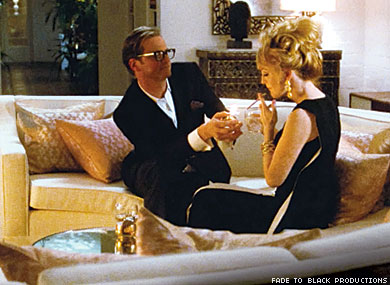
Which is why, apparently, he decided to make George's house more chic than the cramped rabbit warren of the novel (and judging from the photo in the article, also the house of George's fellow expat Charlotte, played by Julianne Moore). He decided the same for George himself. (And -- a minor detail -- to give George a last name for the film, the same surname as Ford's first serious boyfriend.) Well, it's the Hollywood mentality. Have you ever seen the atrocious gowns and accessories plastered onto the actresses of the studio system's golden age? Of course you have. And Ford is a fashion designer after all; as he says in the interview, "If I were working in a different period, I would have been working at MGM." I think the introduction of a drama-queen plan for suicide is a much more telling detail than the production design.

In the novel, George is a 58-year-old expatriate Englishman who teaches at a small college north of Los Angeles in 1962. Since I haven't yet seen the movie, I kept comparing George to Isherwood, a 58-year-old expatriate Englishman who also taught at a small college during at this time. George was a sort of smaller version of his creator, who was also a world-famous novelist who'd lived and worked in Hollywood. A number of readers have speculated that the novel was a thought-experiment for Isherwood: what if I were single again at my age? It struck me, not for the first time, that killing off the lover instead of having him leave was a (subconsciously?) hostile move on Isherwood's part. As Don Bachardy said in this joint interview from 1985:
I always suspected he was imagining what it would be like if we split up because I remember that period was a very rough time for us, and I was making a lot of waves. I was being very difficult and very tiresome ... Just by being very dissatisfied. I was approaching thirty, and thirty for me was the toughest age of all. I started suffering from it around twenty-eight, and I didn't really get over it until about thirty-two.
A Single Man's Jim is not Don Bachardy, though: he's older, for one thing. George and Jim met in 1946, when Jim was just being mustered out of the military at the end of World War II; Isherwood and Bachardy, who never served in the military as far as I know, met in 1953 on the beach near Isherwood's home, and Isherwood had previously dated Bachardy's older brother. (Bachardy was twelve years old in 1946, so Jim is at least ten years older.)

Making George a widower also heightens the reader's sympathy for him. He chooses not to tell any of his straight neighbors (except Charlotte) or coworkers that Jim has died, rather that he chose to stay in Ohio while visiting his family there. At the same time George is prickly, not always likable; as much because of Isherwood's religious faith, I suspect, as because of his novelist's instincts, he refused to make George a suffering saint. And this is a very religious novel, not merely "spiritual": Isherwood's Vedantic beliefs are often explicit, though unnamed, in the text.

Ford is, I think, totally wrong when he says,
If you said name 10 things that define me, being gay wouldn’t make the list. I think Isherwood was like that too. There are many gay characters in his works because his work is so autobiographical, but their gayness isn’t the focus. The one thing I liked about Isherwood’s work—especially when I was younger and grappling with my sexuality—is that there was no issue about it in his writing. That was quite a modern concept back during the time when he was writing. Quite honestly, I just don’t think about my sexuality. But maybe this has to do with being a part of the first generation to benefit from all the struggles of the gay men and lesbians that came before us.
I'll give him credit for that last admission, though, which I think is more correct. Isherwood talked in later years about the constraints he faced as a writer, not just from publishers but from readers. In his Berlin Stories, which ultimately inspired the musical Cabaret, he didn't make the narrator queer partly because he knew that it would make him more prominent than the impersonal, almost invisible "camera" Isherwood wanted him to be. There seems to have been more openness to gay characters and narratives in Europe and Britain than in the US in those days, and it's important to remember that much of the inexplicitness of American gay writing before Stonewall was due to necessity, including government censorship of 'immoral' representations.

In that context, A Single Man stands out for me because it strains against those limits. George muses on his straight neighbors:
Mr. Strunk, George supposes, tries to nail him down with a word. Queer, he doubtless growls. But, since this is after all the year 1962, even he may be expected to add, I don't give a damn what he does just as long as he stays away from me. Even psychologists disagree as to the conclusions which may be reached about the Mr. Strunks of the world, on the basis of such a remark. The fact remains that Mr. Strunk himself, to judge from a photograph of him taken in football uniform in college, used to be what many would call a living doll.

But Mrs. Strunk, George feels sure, takes leave to differ greatly from her husband; for she is trained in the new tolerance, the technique of annihilation by blandness. Out comes her psychology book -- bell and candle are no longer necessary. Reading from it she proceeds to exorcise the unspeakable out of George. No reason for disgust, she intones, no cause for condemnation. Nothing here that is willfully vicious. All is due to heredity, early environment (Shame on those possessive mothers, those sex-segregated British schools!), arrested development at puberty, and-or glands. Here we have a misfit, debarred forever from the best things of life, to be pitied, not blamed. Some cases, caught young enough, may respond to therapy. ...


But your book is wrong, Mrs. Strunk, says George, when it tells you that Jim is the substitute I found for a real son, a real kid brother, a real husband, a real wife. Jim wasn't a substitute for anything. And there is no substitute for Jim, if you'll forgive my saying so, anywhere. [from the 1987 Farrar Straus Giroux trade paperback edition, 27-29]
Even better, as George drives along the freeway to his teaching job, he begins to fantasize about organizing a terrorist campaign against antigay bigots and crusaders.
No. Amusing is not the word. These people are not amusing. They should never be dealt with amusingly. They understand only one language: brute force.

Therefore we must launch a campaign of systematic terror. In order to be effective, this will require an organization of at least five hundred highly skilled killers and torturers, all dedicated individuals. The head of the organization will draw up a list of clearly defined, simple objectives, such as the removal of that apartment building, the suppression of that newspaper, the retirement of that senator. They will then be dealt with in order, regardless of the time taken or the number of casualties. In each case, the principal criminal will first receive a polite note, signed "Uncle George," explaining exactly what he must do before a certain deadline if he wants to stay alive. It will also be explained to him that Uncle George operates on the theory of guilt by association. [page 38-39]
I remember enjoying this fantasy when I first read it, oh, thirty-five years ago. It's remarkably ahead of its time, and I still enjoy it. (There's some interesting comment on this passage in the Paris Review interview from 1974, pages 18ff., and on the gay movement and homosexuality in literature.) I also enjoy Isherwood/George's disdain for psychobabble, which as A Single Man shows is not a new development but was well-established in the early 1960s. But I think it belies Ford's reading: Isherwood, like any reasonably mature adult, was more than his sexuality (though how many heterosexuals, especially men, recognize that about themselves?), but he had a sophisticated understanding of the situation of people who love their own sex in American society. He saw bigotry and condescending contempt as the problem, not homosexuality, and this is still a pretty advanced view even today. Reading A Single Man reminded me, as it should remind everyone, that such understandings didn't arise out of nowhere during the Stonewall Riots of 1969.

There's another feature of A Single Man that was common in its time and hasn't died out yet. When Isherwood taught at Los Angeles State College, he may have been relatively isolated from gay friends and social life, as George is. The only other gay character in A Single Man is a young student in his lecture class. (Though George met Jim at a gay bar on the beach, we're told discreetly.) But Isherwood had many gay (and straight) friends, among them fellow writers W. H. Auden, Stephen Spender, and Tennessee Williams. His relationship with Don Bachardy, though controversial because of their thirty-year age difference, was known to everyone, and if Bachardy had been killed in an accident, Isherwood would not have mourned alone as George does. (I should say "nearly alone" there, since George's fellow expatriate, the heterosexual Charlotte, knows about the relationship and Jim's fate.) To this day, though, it's relatively rare in gay fiction and films to show gay men in gay society, let alone gay community. Those who read A Single Man nowadays should remember that George's comparative isolation has a dramatic function in the novel, and wasn't the universal condition of gay men then or now.