Showing posts with label terry pratchett. Show all posts

Saturday, April 11, 2020

To Be of Use

I'm surprised I haven't quoted this exchange from Terry Pratchett's Witches Abroad before:
'A witch doesn't know the meaning of the word “failure”, Gytha.'

They shot up into the clear air again. The horizon was a line of golden light as the slow dawn of the Disc sped across the land, bulldozing the suburbs of the night.

'Esme?' said Nanny Ogg, after a while.

'What?'

'It means “lack of success”.'

They flew in chilly silence for several seconds.

'I was speaking wossname. Figuratively,' said Granny.

'Oh. Well. You should of said.'
It came irresistibly to my mind when I listened to some remarks by Noam Chomsky in conversation with Amy Goodman of Democracy Now:


Here's the relevant part:
Suppose Biden is elected. I would anticipate it would be essentially a continuation of Obama - nothing very great, but at least not, uh, totally destructive, and opportunities for an organized public to change what is being done, to impose pressures. 

It's common to say now that the Sanders campaign failed  I think that's a mistake.  I think it was an extraordinary success, it completely shifted the arena of debate and discussion.  Issues that were unthinkable a couple of years ago are now right in the middle of attention.  The, uh, worst crime he committed in the eyes of the establishment is not the policies he's proposing, but the fact he was able to inspire popular movements, which had already been developing: Occupy, Black Lives Matter, or many others, and turn them into an activist movement which doesn't just show up every couple of years to push a lever and then go home, but applies constant pressure, constant activism, and so on.  That could affect a Biden Administration.
I love Chomsky, but once again I disagree with him.  He's moving the goalposts in a way that I don't think many progressives would accept from anyone else.  (Many on the left, of course, deride him as a collaborationist meliorist, which in many respects he is, but that's only surprising if you ever believed he was a revolutionary.)

Sanders's campaign in 2016 was even more of a long shot than it was this time, and it did succeed in pushing certain issues into mainstream debate that had been easy to dismiss before.  But this time the goal was to win the nomination and put Bernie Sanders into the White House, and this the campaign failed to do.  Claiming that winning the primaries and the general election was not the aim, that changing the acceptable realm of discussion is the important thing, is at best an attempt to rouse the troops with inspiring oratory - and Chomsky has never been good at doing that.  That's not an accusation, or even a criticism: he has always been proud of his lack of charisma, and mobilizing emotion has never been his role.  In this case, though, it just leaves the bareness of his claim naked to the critical eye.

I can sympathize with the desolation a lot of Sanders's supporters and volunteers, especially the younger ones, must be feeling as a result of his suspension of the campaign.  Maybe you can't invest so much energy into a movement without building up false hopes in yourself.  There have been a lot of recriminations, such as an accusation that Barack Obama somehow pressured Sanders into suspending his campaign, with the implication that Sanders sold out to the Man.  As far as I know, that's nuts, but who knows?  If not for the coronavirus pandemic, which blocked the on-the-ground door-to-door, face-to-face campaigning Sanders relied upon, I suppose he would have fought to the end.  But "if" and a dollar will get you on the bus.  As it is, I presume that he recognized that even if he could continue such campaigning, it would put his volunteers at risk, which he wasn't going to do; and it wasn't an option anyhow.  Biden, you'll recall, had no compunction about making voters line up to vote for him in Wisconsin, though he changed his mind three days after that debacle.

Yes, the campaign failed in its primary task, and I won't play with words to make it seem otherwise. (I think Chomsky indulged there in the kind of obfuscation he'd deride in mainstream thinkers.)  But Chomsky is correct that the movement isn't over, and to that extent he's right.  Sanders is keeping his name on the ballot in states whose primaries haven't happened yet, pushing for voting by mail.  The more delegates he wins, the more clout he'll have at the convention, and that matters. It might translate into influence within the party if by some miracle Biden wins in November, and that's important too.

Sanders's movement can also, as Chomsky says, put pressure on governments, especially if Biden wins, but possibly even if he doesn't.  It's certainly time to pay more attention to the down-ticket races Clinton and Obama neglected to use the money for their own narcissistic purposes.  The astroturf organization Obama built in 2008 and then downgraded largely defanged social movements that could have put more pressure on him.  He didn't succeed entirely, and he was very displeased when activists held his feet to the fire.  He also tried to crush, with considerable success, the movements that rose up anyway, independent of his control.  Sanders has always worked with his base to put pressure on the political process, and I expect he'll continue to do that.  I've already contributed happily to the donation process he set up for other organizations through his campaign structure.  If his followers drop him, they're the ones who are failing the people.  Again, I sympathize with them, but if they really believe the movement is about Us rather than Me, I hope they'll pull themselves together.

One thing I haven't seen among Sanders's fans is any consideration of what he must feel, and characteristically he doesn't seem to have made a big deal of his own disappointment, which must be very great.  Maybe I've just missed it, but I see a lot of Sanders people online, and I'm surprised that his fans haven't had much to say in sympathy for his loss or his courage in pushing forward.  He's still a Senator with work to do in one of the greatest crises this country has ever faced -- very possibly the greatest -- and he's still doing his work.  Which brings to mind another literary reference, by another left-wing Jew, Marge Piercy's poem "To Be of Use":
I love people who harness themselves, an ox to a heavy cart,
who pull like water buffalo, with massive patience,
who strain in the mud and the muck to move things forward,
who do what has to be done, again and again.

Tuesday, July 2, 2019

Let the End Times Roll

I just finished watching Good Omens, the Amazon Prime miniseries based on Terry Pratchett and Neil Gaiman's 1990 fantasy novel about the Antichrist.  I was never a fan of the novel, which I began reading with rather high hopes that were soon dashed, and I don't understand why so many people love it.  The miniseries is a competent adaptation, with an excellent cast and decent production values.  It seems to be pretty faithful to the book, though I should probably wait until I've reread it to say that.  And, of course, it sparked a rather limp controversy when a fundamentalist Christian group started an online petition begging Netflix to cancel it, sparking amusement in the secular humanist media.

My lack of enthusiasm for Good Omens comes partly from the thinness of the story.  It's basically a parody of The Omen, a horror-movie franchise about the life and hard times of the Antichrist.  (According to the Wikipedia article, the authors didn't seem to recognize the similarities.)  I saw it with friends when it was released in 1976, and hated it because its scariness relied on shock editing: I'd be frightened for a moment, then disgusted for being manipulated.  When a friend made me watch it again thirty years later, I liked it no better but noticed how little sense the story made on its own terms.  It relied on the New Testament mythology of the end times, and the title character's supposed fulfillment of end-times "prophecy."  But there's no real suspense when the prophecy you're fulfilling ends with your ignominious defeat.  The biblical Antichrist is just a cog, not an agent, set up to be knocked down.

Gaiman and Pratchett took The Omen's premise, the son of Satan born to ordinary human parents, and switched him at birth so that both the angelic and demonic hosts lost track of him for eleven years. Because he never gets the training in Evil he was supposed to get, he grows up to be a normal boy, and the heavenly Plan goes awry.  The main characters in the story are the angel Aziraphale and the demon Crowley, who've been working on the same cases since the Creation and have become buddies if not exactly friends.  Both are alienated from their Organizations and go native, becoming so fond of human culture and foibles that they decide to try to stop Armageddon from happening, and (spoiler? nah) succeed, so everything turns out all right.  The world is saved.

I had a creepy feeling as I watched the final episode that it left space for a sequel, which seems not impossible since Amazon has already turned Philip K Dick's The Man in the High Castle into a multi-season series.  Not impossible, but not likely since Pratchett's dead, and Gaiman wouldn't want to mess with a classic - would he?  I don't think the fans would object, though, to seeing more of Aziraphale, Crowley, and Good Omens' other lovable characters; Adam the Antichrist is only eleven years old, and has a lot of growing up to do (Young Antichrist in Love - His First Kiss!); the angelic and demonic hosts have been frustrated in their wish to destroy the world, but not really defeated.  Yes, lots of room for a sequel there.  Luckily for me, I'm not a fan, and will have little interest in watching it if it ever is produced.

I have other quibbles with Good Omens' ... well, call it theology.  An old friend shared this meme on Facebook yesterday, of some screengrabs and dialogue from the program.  Azirophale and Crowley are at the foot of the cross:

.
This might not annoy me so much if other people hadn't come up with similar takes. Kurt Vonnegut, if I recall correctly, wrote something similar in Slaughterhouse-Five.  It's ironic, though not at all unusual, when clever people who despise fundamentalists for their ignorance get something so fundamentally wrong.  Of course Pratchett and Gaiman were entitled to make up any Jesus they find appealing, but it's significant that their Jesus is such a cliche.

For what it's worth, according to the gospels Jesus was not crucified for telling people to be kind to each other.  He was crucified because it was God's plan, determined before the creation of the world and leaked to the Hebrew prophets, that he should die for the sins of humanity.  That's the story, and Pratchett in particular was very aware of the importance of stories, though he tended to forget it when he had an ax to grind.  It can be argued that the Romans who executed him didn't know they were puppets on the divine hand, but fairness demands that we attend to what they thought the reasons were.  The gospels give us that, and it's plausible in light of what crucifixion was for: all four canonical gospels agree that Jesus' cross bore the legend "King of the Jews."  According to Matthew, that was exactly what he was, and Pontius Pilate, Caesar's agent in Judea, was supposed to keep little Anticaesars in check.  It's not clear, though, where the charge came from; it's not mentioned in any of the gospel accounts of Jesus' trials.  Certainly "He said we should be kind to each other" didn't figure when Jesus was brought before Pilate.

Remember the story, set just before Jesus' arrest, of Jesus' witticism "Give Caesar what is Caesar's, and God what is God's." Many interpreters have been sure they knew what secret message Jesus meant to send with that ambiguous bon mot.  It's common to argue that he couldn't have said straight out to defy the Roman occupation of Eretz Israel because the Romans would have arrested and executed him as a rebel.  But they did arrest him and execute him as a rebel, and that was, after all, his mission: to be crucified.  The exact charge was almost immaterial.  Perhaps, going by the motif that "his time had not yet come," Jesus didn't want to be executed yet: he had to die, as the gospel of John has it, as the sacrificial Passover lamb, and not a minute sooner.  (Unfortunately, the other gospels have a different chronology.)

Nor did it come up earlier, when Jesus was brought before Jewish officials for interrogation.  According to the gospel of Mark, there were false accusations (which may have been true) that Jesus had threatened to destroy the Jerusalem temple.  Finally the High Priest asked Jesus point blank, "Are you the Messiah, the son of the Blessed?"  Jesus replied, "I am, and you will see the Son of Man sitting at the right hand of Power and coming with the clouds of Heaven."  The High Priest tore his robes, denouncing Jesus' "blasphemy," and the council agreed that Jesus deserved to die.  Like most of the Passion story, this makes little sense: as far as we know, claiming to be the Messiah was not blasphemy, nor was it an offense in Judaism, let alone a capital one.

There are other possible reasons for Jesus' execution, such as the conflicts between him and other Jewish teachers on aspects of Torah, which would have stirred up a lot of bad feeling but were normal in first-century Judaism, and not capital crimes either. But teaching love and kindness -- which was where Jesus and other Jewish teachers agreed -- never comes up in the gospels as a reason for his death.

Something else that occurred to me as I watched Good Omens was that the Four Horsemen of the Apocalypse were depicted as agents of Satan, sent by him to initiate and lead the forces of Evil against the Hosts of Heaven in their final conflict.  That seemed off, so I looked at the Revelation of John, which is the source for most of this mythology.  Sure enough, the Four Horsemen are agents of Heaven rather than Hell, sent by the Lamb to soften up the earth by slaughtering millions. Only after a third of humanity has been killed will "the beast that comes up out of the abyss ... make war with them" (Revelation 11:9).  Admittedly the chronology here is confused, but it seems that the Antichrist hasn't even been born yet.

Not that Pratchett and Gaiman were obligated to follow John's convoluted narrative.  But it's significant that they decided (if they were even aware they were making a change) to change the  Four Horsemen's team colors.  They also tried to distance the angels (depicted as soulless, vicious bureaucrats) from God, who narrates the TV version as the wise, soothing voice of Frances McDormand.  Maybe, they suggest urgently, all this Armageddon stuff isn't God's ineffable plan after all but just the mischief of Her underlings who have somehow slipped the leash?  Devout Christians, trying to exculpate their omnipotent, omniscient deity of all responsibility for his actions and those of his organization, could go along with that.  And it does leave room for a sequel, the which may Hell forbid. 

Think, for some more examples, of Philip Pullman's His Dark Materials trilogy, in which it turns out that the guy everybody thought was God wasn't God after all but some elderly loser.  The same copout is used in Star Trek V: The Final Frontier, featuring a quest for God at the center of the galaxy; once again, the being who claimed to be God is a fraud, not the real God. It's an admission of inability, which is reasonable enough, to imagine how human beings would engage with, let alone defeat, an omniscient, omnipotent being.  But it's still a copout, a step away from "And then he woke up and it had all been a dream."

It's a familiar pattern to me: ostensible unbelievers still insist that as bad as his followers have been, Jesus was a really nice guy who just wanted us all to get along and be nice to each other.  Maybe he was; nobody knows.  But there's no basis, except some sort of strange wishful thinking, for dogmatically declaring so.  More important, it seems to me, is a powerful desire to imagine themselves on the side of the really good guys, and to be able to look down in safety on the eternal torment of the really bad guys. And that's no improvement on the hatefulness of standard Christianity; it just reshuffles the name tags of the players.

This is why Good Omens disappointed me when I read it almost thirty years ago.  I'd really like to see some fiction which radically reimagined Christian mythology without trying to save some remnant of orthodoxy, and challenged unbelievers (including me) as much as it challenged believers.  I'm not calling for a negative, villainous Jesus (though I'm fine with that in principle), but for a neutral one.  I doubt such fiction would go over well with the people who like books like Good Omens, though.  They (fans and, I think, the authors) want to dispose of the God and the Jesus of orthodox Christianity, but they still want to believe that there's a fond sky Daddy who's on their side against the world, and who'll protect them from all harm.  They're entitled to wish for that, but I'm not obligated to give their wish any more respect than I give other forms of religious belief.

Tuesday, January 5, 2016

Lo, I Am With You Always, To The End Of The Age

The late Terry Pratchett's final Discworld novel was published last year, and I read it last month.  I must say, with regret, that I'm glad I didn't buy it.  If you haven't read it and intend to, be forewarned of Spoilers to come.

In an Afterword to the novel, one of his assistants explains that Pratchett wrote -- or rather dictated -- The Shepherd's Crown while his health was failing rapidly and he knew it.  I admire his determination to go on writing to the end, but the struggle shows.  I didn't read the Afterword until I'd finished the novel, but I could tell as I went along that The Shepherd's Crown was not merely one of his lesser efforts, but noticeably inferior to everything else I've read by Pratchett.  I'm not blaming him, mind you, just saying that it often doesn't even feel like Pratchett's writing.  (According to the Afterword and various online sources, the series will not be outsourced posthumously, not even to his daughter, who's also a writer; so I don't suspect that anyone else is responsible for the inadequacies of The Shepherd's Crown.)

So: Tiffany Aching, the young witch who's been the protagonist of several Young-Adult Discworld books, some of which I enjoyed well enough, is back.  She's still learning her job (as healer / midwife / etc.) as a witch, and when the great witch Granny Weatherwax dies, she names Tiffany as her successor, leaving her house and territory to her.  This complicates Tiffany's life considerably as she tries to cover both her own Ramtops territory and Granny's in Lancre; she begins by commuting between the two regions, but that stretches her too thin.  To provide the requisite narrative complication, the Elves (defeated by Granny in Lords and Ladies) are starting to invade Discworld again.  Of course Good triumphs and Evil is defeated; that is what fiction means.  I don't object to the outcome, but to the path which takes the reader to the outcome.

I've noticed before that each Pratchett book contains a brief passage I feel compelled to copy out and ponder.  In The Shepherd's Crown I found several, though less because they were ponderable than because they were annoying.  Tiffany's countrymen, Pratchett editorialized on page 107,
had a dialect that creaked, and they knew the names of all the songbirds throughout the valleys, and every snake and every fox and where it could be found, and all the places where the Baron's men generally didn't go.  In short, they knew a large number of things unknown to scholars in universities.  Usually, when one of them spoke, it was done after some cogitation and very slowly, and in this interlude they would put the world to rights until a boy was sent to tell the men their dinners were going cold if they didn't hurry.
That final sentence undercuts the anti-intellectualism of the one I emboldened, and maybe I should read that sentence as Pratchett's report of the countrymen's view of themselves, rather than his own view.  I think it's a combination of the two.  Pratchett's Unseen University, the wizards' academy, has always served to mock the ivory-tower cluelessness of academics, and it continues to play that role in The Shepherd's Crown.  Pratchett's often mocked the foibles of his farmer folk, but there's less of that balance here.  I've often criticized academics, but I never forget that they also know a large number of things unknown to the people of the land, the common clay of the Ramtops.  And what they know is not always irrelevant to the lives of most people.

Would that this passage were as annoying as it gets.  An important thread in the book is its "repulsive whiny sexism," as I put it in my notes, basically a version of Men's Rights Activism with elements of the Mythopoetic Men's Movement of the 1990s.  Pratchett had Nanny Ogg mock this tendency gently in Lords and Ladies: "I always reckon a man's got to be a man, even if it is sissy."  In The Shepherd's Crown it's all about men -- mostly older men -- suffering the petticoat tyranny of their wives as they prepare to fight the elves.
They had spent most of the evening carousing and telling stories of the days when they were all young and handsome and healthy and didn't have to pass water far too often.  They had managed to make their wives give them a ticket of leave, and said wives had been given to believe that their husbands were just in the barn for a few drinks and reminiscences.  The wives, as wives do, had festooned their menfolk with big scarves, mittens on strings, and woolly hats with, alas, pompoms on the top [243].
Oh, the humanity!  True, Pratchett mocks them gently, but of course it is unthinkable that men could take care of themselves, let alone that they might grow up instead of insisting that their wives play the role of surrogate mother.  (I remembered Tasha Robinson's justified grumble, in her review of one of the Long Earth books by Pratchett and Stephen Baxter, about their "expressed belief that women run society and most men haven’t figured it out yet.") 

It gets worse.  After one geezer echoes Winston Churchill ("We shall fight them on the mountains", etc.), we get the big Lancre battle scene, fought by the old men and the witches against the elves.  In its glorification of war and bloodshed, it doesn't sound like Pratchett at all.  I'm not the first to notice that a benefit of fantasy fiction is that you can have bad guys who really do deserve to be killed without compunction.  Pratchett's elves are evil personified and therefore fair game; they were driven back in Lords and Ladies too.  But this part of the book goes beyond that into an old-fashioned pulp glamorization of war itself, the sort of thing I associate with someone like Rudyard Kipling.  "On this day of days, the old boys were younger than they felt" (247).  And even the most obnoxious of the witches redeems herself.
"This lady is not for turning!" Mrs. Earwig boomed.  She rose among them like a whirlwind, and as they were floored, Long Tall Short Fat Sally became very fat and heavy and sat on them, bouncing up and down...

When it came to it, the battle for Lancre was over quite swiftly.  Queen Magrat had all the surviving elves brought before her.  "Even the goblins are smarter than you -- they work with us these days," she told them, standing tall and strong in her spiked armor, the wings on her helmet silvered in the moonlight.  "We have had enough of this.  You could have had it all.  Now, go away to your forlorn spaces.  Come back as good neighbors -- or not at all." ...

Nanny Ogg said seriously, "It seems to me, girls, that it goes like this. We fight the elves at every turn, and they is always comin' back. Perhaps it might be a good thing? To keep us on our toes, to stop us from gettin' lazy. To put us on the anvil, so that we remember how to fight. And at the end of time, living is about fightin' against everything" [247-9].
The old men come "marching down the lane.  And they had a new song now, one that began, 'Ar-sol, ar-sol, a soldier's life for me!'  And with each verse, with each step, they were standing straighter and stronger."  Not for the first time I notice the curious erotic obsession many straight boys have with buttholes.  "And those who had wives, kissed them -- the wives hadn't seen their husbands so frisky in years -- and then they set off down to the pub to tell their mates all about it" (260).

I'll spare you the battle Tiffany fights for the Ramtops.  In the end, she resolves her problems and realizes that Granny Weatherwax, though dead, "was, in fact, and always would be, everywhere" (269).  So Granny becomes a Christ figure, with her disciples until the end of the age.  Odd for a Village-Atheist type like Pratchett.  I've pointed out before that in his disdain for the Christian Bible, he overlooks its power as story -- odd in a writer so obsessed with Story himself.  But it seems that as he lay in his deathbed, the Christian myth crept up behind him and imposed itself on his tale.  Which doesn't reassure me.  Granny Weatherwax is one of my favorite characters in literature, one of Pratchett's most powerful creations, but I'm not interested in seeing her deified.  Once again Pratchett had forgotten one of my favorite exchanges between Granny and Nanny Ogg, from Lords and Ladies:
"I don't hold with paddlin' with the occult," said Granny firmly. "Once you start paddlin' with the occult you start believing in spirits, and when you start believing in spirits you start believing in demons, and then before you know where you are you're believing in gods. And then you’re in trouble."

"But all them things exist,” said Nanny Ogg.


"That's no call to go believing in them. It only encourages 'em."
I don't hold Pratchett fully responsible for this book.  He was dying, his powers were failing, and as his assistant writes in the Afterword, he wasn't able to finish revising it as he'd have liked to do.  I wonder, though, how different the book would have been if he'd had more time and strength; he'd become progressively preachier in his later years.  Luckily for me, Pratchett's best work will always be there; having unburdened myself this time, I don't have to concern myself with his worst.

Friday, May 1, 2015

Two Million and Counting

I'm about two-thirds of the way through The Long War, the second novel in a series by Stephen Baxter and the late Terry Pratchett, which I'm reading out of sequence.  I read the first one, The Long Earth, and then the third, The Long Mars; as I commented in a previous post, it was only after I was well into the latter book that I realized I had skipped one, so I'm now remedying that.  It appears that Pratchett and Baxter planned and contracted to write a series of five books, of which the fourth will be published later this year.  How Pratchett's recent death will affect the completion of the project I don't know yet.

There are a few aspects of The Long War that I feel deserve comment, including its scientific triumphalism and what seems to me a misunderstanding of Darwinian evolution.  Maybe I'll write about those later on.  But today I want to focus on some smaller issues.

One is that in the previous post I noticed a lack of gay / lesbian / bisexual / trans characters in the series, and in Pratchett's books generally.  I noticed something in The Long War that made me reconsider.  Sally Linsay and Monica Jansson are traveling together through the Earths on a mission driven by Sally.  They stop on one Earth where they encounter a community of stereotypical computer / tech nerds, engaged in building a spaceship.  After they talk to one of the main guys, Sally tells Monica (page 190 of the NOOK e-book),
"Distract this guy.  Let him show you his toy spaceships, or whatnot.  I think he has his eye on you, by the way."

[Jansson replies:] "Garbage.  Also, let me remind you, my personal rocket ship takes off from a different launch pad."
Whoa!  I read that as a hint that Jansson's preferred "launch pad" is female.  I don't believe there was any such indication in the third book, but of course I might just have missed it.  So before beginning this post I did some looking around on the web for some background.  I found a Wiki page with a bare mention of Jansson, but no details about her.  Then I found a discussion at The Straight Dope's website on LGBT characters in Pratchett's work, and in one entry a moderator wrote that in "The Long Earth, the police officer who befriended the protagonist when he was a young boy is explicitly described as a lesbian."  I'll have to check that out (what exactly does "explicitly described as a lesbian" mean?), but for now I'll accept provisionally the accuracy of that statement.

The rest of the discussion was interesting (in the sense of living in interesting times).  Numerous characters in Pratchett's Discworld books have been taken to be queer, though with one or two exceptions this had to be inferred from stereotypical signs like costume or occupation.  The apologetic explanations offered in the TSD forum were significant, though, familiar evasions that I'm familiar with from similar discussions in various places over the years.

For example, the obvious: "Jeez, if we can have people discussing the homosexual subtext of LoTR, which doesn't exist at all, we can certainly discuss the Lesbian subtext or M[onstrous]R[egiment], which at least does exist albeit incidentally."  From the context, I suspect that the commenter doesn't know what "subtext" means.  There is a pair of female lovers in Pratchett's Discworld novel Monstrous Regiment, but since they are explicitly said to be so, it's not a subtext but part of the text.  As for Lord of the Rings, I've addressed that elsewhere.

This one is also typical, alas:
He probably hasn't felt the need to address that issue, what with every other dynamic the Disc has ... Besides, the Disc is just now getting up to the Industrial Revolution. Exactly how much of an issue was Gay Rights at that time? 
The original question was not about "Gay Rights" but gay (or queer) characters.  Sodomites and buggers and Sapphists were very much a matter of concern in late 18th-century England.  Neither I nor the poster who raised this question at TSD was asking Pratchett to include queer characters as addressing an issue.   If anything, the minor and usually transitory characters who can be identified as queer in Discworld felt to me like obligatory and self-conscious nods to the goddess Diversity.

This move reminds me of earlier science-fiction and fantasy debates on sex/gender and race, which held that a black protagonist would necessarily make a story about race, and that female characters could only be present as Love Interests.  Or the person Vito Russo overheard complaining about the protagonists of My Beautiful Laundrette: "I don't get it -- why were they gay?" This person couldn't understand why race and class were the core problems driving the story, not the protagonists' homosexuality.  (Similarly, Neil Jordan told an interviewer that the movie companies didn't mind that The Crying Game dealt with race, sexuality/gender, and Irish rebellion, but they didn't want all those issues in the same film.  That's a glimpse into the mindset that makes mainstream commercial cinema so boring.)  This discussion indicates that some elements of SF fandom are still stuck in the 1930s.

Another commenter, addressing the suggestion that homosexuality was "underground" in Discworld, countered that it was not "'underground' as much as 'none of your business.'"  Of course, heterosexuality is rampant, constantly talked about, and everybody's business in Discworld and the Long Earth.  It's not an issue, just part of the environment, as homosexuality could be.  So, again:
I continue to respect Pratchett's polite sensibilities when it comes to discussing sexual matters in his novels -- e.g., for the most part it's something that happens "off-scene", since it's a private matter. The only time I can recall an explicit sexual encounter in any of the DW novels was from Men-At-Arms, where Angua and Carrot made the Disc move without even bothering to cancel the bread and newspapers.
This is also a distractive move.  Despite the lack of "explicit" material in the Discworld novels, there are frequent comments and references to the characters' sex lives and interests.  Even the icy Granny Weatherwax turns out to have a Past with Chancellor Ridcully of Unseen University in Lords and Ladies.  But homophobes have a tendency to pretend that the only alternative to equal treatment is porn.  It's hard to say whether this move is conscious or just an involuntary expression of their anxieties, but it turns up frequently.  I, at least, am not calling for hot man2man action in Discworld or the Long Earth. I'm not even calling for more queer characters or situations, since Pratchett seems not to be all that comfortable with them; when Robert A. Heinlein tried self-consciously to be inclusive of non-heterosexual characters, the results were awkward and embarrassing.  At least Pratchett's imagination isn't overtly homophobic, with homosexuality used as a symbol of evil, degeneration, disorder, etc.  I'm not furious over the paucity of queers in his work, I'm just a bit puzzled.

[P.S.  I finished reading The Long War last night, and I now can report that the lesbian character identifies herself as "gay" to another character, the straight man who's interested in her and who hovers protectively over her for the rest of the book.  It couldn't be a woman, could it?  For that matter, the Anglican priest Nelson Azikiwe, who lives more in his mind than in the rest of his body, turns out to be barely heterosexual in one episode of the book; I think he'd have made a good gay or bisexual character myself.  Why?  Well, why not?  Monica Jansson turns out to be that staple of heterosexual mythology, the sympathetic gay character who serves and protects the straight characters but has no life or love of her own -- indeed, such characters are sympathetic because they're sexless.  This speaks very badly for Baxter and Pratchett.]

Something that bothers me more in The Long Earth books is their account of the rugged individualist pioneers who've spread through the parallel worlds.  For those who are unfamiliar with the series, the concept is that a way exists for people to move from "Datum Earth," the Earth we know, to a vast series of parallel Earths, resembling Datum Earth but different in varying degrees.  In none of the two million parallel Earths have human beings evolved, though there are humanoid species such as the "elves," "kobolds," and "trolls."  So those other Earths are rich in resources and free of inconvenient natives who might make claims of their own to the places.  Attempts have been made to exploit the helpfulness of the trolls, and when problems arise the trolls are usually able to escape from their would-be exploiters by "stepping" to another Earth.  This makes for an important difference between the colonists of the Long Earth and European colonists in the Americas: the Long Earth is largely the realization of the fantasy that Europeans had of the New World (or that Zionists had of Palestine): a world without people for people who've already kinda used up the world they had. 

The Long Earth colonists see themselves as some of the Euro-American colonists did: as bold individualists eager to escape from Gummint and from gol-danged Sheeple.  A large and significant percentage of the population of Datum Earth drained off into the Long Earth within a few years after they became able to.  The governments of Datum Earth were ambivalent about this, and in The Long War the US government is still trying to assert its dominion over colonists in the Long North America, while the colonists insist that they're independent and aren't going to pay no stinkin' taxes -- except when they get into trouble, of course, and want the government to help or even rescue them.  Pratchett and Baxter are not unaware of the irony there, but seem to come down finally on the side of the self-styled individualists.  (In a review of The Long Earth that I partly agree with, Tasha Robinson wrote that "The politics and mindset are pure Heinlein, from the near-worship of practical intellectuals to the implied belief that all politicians are sleazy charlatans to the expressed belief that women run society and most men haven’t figured it out yet.")

So, this passage, later in the book.  Nelson Azikiwe is a black South African who moved to England and became a paleontologist and later an Anglican priest.  Now he's looking for answers elsewhere, and is driving across the US in a rented Winnebago.  He stops in Wyoming:
Alas there was a shortage of cowboys nowadays, Wyoming folk having been particularly quick to head for the new stepwise worlds where land was free and government interference infrequent.  It was almost reassuring for Nelson to read on a truck bumper sticker, "In This Neighborhood We Don't Just Watch" [page 268 of the NOOK ebook].
First, Wyoming and the rest of "the West" was settled by bold individualists who didn't want Big Gummint breathing down their necks, and thought they should be able to claim the land out that way since the Indians didn't deserve it.  When the Indians had other ideas and reacted negatively to being driven off their territory and killed by the settlers, the settlers expected Big Gummint "interference" to send in the cavalry and rescue them.  It occurred to me to wonder how successful the settling of the West would have been if the settlers had been left to their own devices; maybe not very successful at all.  But Washington was perfectly happy to treat the settlers as shock troops in clearing the aborigines out of the territory the US already claimed.

Second, Nelson might not have been reassured at all in pioneer days or even later, when a lone Negro coming into a white town could have faced unpleasantness from the bold individualists of the sundown towns, which were not only in the southern states.  (In this neighborhood we don't just watch, we lynch.)  Despite Pratchett and Baxter's frequent cynicism about human frailty, they still seem to buy into the Myth of the Frontier.  In their Long Earth, where there aren't any aborigines to displace and slaughter, this problem doesn't arise -- but even there, human beings can't keep from abusing the humanoids they meet.  The authors' sympathies lie mainly with the humanoids (Sally Linsay and Monica Jansson, for example, are on a mission to rescue a troll from human mistreatment), especially the trolls, but they seem to think that the exploiters and abusers are the Bad Apples in the Barrel rather than an inevitable consequence of the expansion.

Wednesday, July 23, 2014

Don't Sit Next to Me, or They'll Say We're Taking Over

I'm reading The Long Mars, the third collaboration by Terry Pratchett and Stephen Baxter.  (I just realized that I forgot to read the second, The Long War; that explains why there seemed like such a big jump between the first one and this one.)  The premise is that people have discovered how to 'step' between parallel universes, of which there are vast, perhaps infinite numbers; some do so by innate talent, while most need a device invented by one of the characters.  The Long Mars follows two missions, one going boldly through millions of parallel Earths to see what is there, and the other stepping through an equally long series of parallel Marses.  It's an interesting premise, and the book is well written.  Maybe the collaboration has put a leash on Pratchett's growing tendency to preach; The Long Mars reminds me of Heinlein's better fiction, where intriguing concepts and expert storytelling carry one pleasurably forward.  I'm enjoying it, so what I have to say here is not really meant as a complaint, just as an observation.

About two thirds of the way through, I realized that there were no characters who weren't heterosexual.  One of the characters is recounting how some bad guys (high-IQ types who believe themselves to be smarter, wiser, an evolutionary advance over Homo Sapiens, took over another ship that had been exploring the Earths.
"And the damnedest thing is that some of us, the crew, were helping them," Sam Allen said.  "You wouldn't believe it if you saw it, Captain.  They can read you like a book -- hell, before they rose up I once tried playing poker with 'em and they cleaned me out.  Their men preyed on our women, and the women on our men.  It was like they could read your mind ..."
Maybe I should be grateful that the bad guys are apparently straight as a die?  After all, there've been enough stories of sinister pansexual seducers.  But that could have been corrected for by having non-heterosexual characters who weren't villains.  And there aren't any of them, either.

I suppose it took me so long to notice this partly because, as a longtime reader, I'm used to fiction whose characters are all exclusively heterosexual, and partly because (to their limited credit, I suppose) Pratchett and Baxter don't say anything negative about non-heterosexuals.  This won't stop me from finishing The Long Mars and reading the rest of the books these two produce, provided they remain as engaging as this one, but it does make me wonder why these two men have such impoverished imaginations.  Gay people are a minority, but we're part of the world, and surely both Pratchett and Baxter know some of us.  Other straight writers have found us in their imaginations, for better and for worse.

(I noticed a similar lacuna in Kim Stanley Robinson's The Memory of Whiteness: A Scientific Romance, which was an ostensibly science-fiction novel about a spaceship full of classical musicians traveling through the solar system, all of them heterosexual.  Ostensibly sf, but fantasy on that basis alone.)

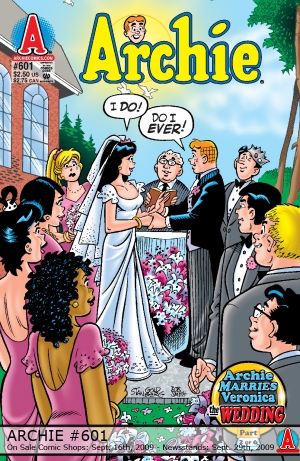
This might be a good place to mention the recent announcement that the new Life with Archie series, which has its own parallel worlds premise (in one world, Archie marries Betty; in the other, he marries Veronica) will climax with the death of Archie Andrews as he saves the life of his gay friend Kevin Keller from an assassin's bullet.  Rod Dreher, as the blogger Ampersand put it, 
upon finding out that a couple of minor supporting Archie characters are lesbian, commented “Seems like everybody is gay in pop culture today.” Yeah, because it’s so hard to find depictions of heterosexuality in Archie Comics.
It's amusing to see Dreher fall on his face like that, but he's just reacting the way most people react when they encounter a phenomenon they don't like.  The way a writer at Slate complained that "so many vampire movies [are] essays 'on the tension between a young woman's desire to mate and her partner's terror that doing so will unleash demonic forces'" (quoting David Edelstein), a generalization based solely on the Twilight movies as far as I can tell.  Or the way some critics claimed that Alice Walker's The Color Purple depicted all black men as violent abusers; later, other critics claimed that Thelma and Louise had no positive male characters.  Or the way a distinguished movie critic (Andrew Sarris, as I recall) in 1976 celebrated Woody Allen's Annie Hall as at long last a return to heterosexual romance for Hollywood.  Sarah Schulman summed up this tendency in Stage Struck, her book on gay people in commercial entertainment:  "Historically, dominant people have always been comfortable with the idea of oppressed people as secretly powerful.  The easiest example, of course, is how for almost two thousand years, dominant groups of various stripes have convinced themselves that they were ruled over by a secret cabal of Jews" (124).

But as I say, I don't mean to lump Pratchett and Baxter in with such people.  They avoid the normal tendency to cast minorities as villains; there's no queer-bashing in The Long Mars, or anywhere else in Pratchett's work that I've seen.  I know from my own experience that writers or other artists make the art they can, not necessarily the art they wish.  And I'd rather they depicted no gay characters than that they did it badly; Heinlein, for example, tried valiantly but never got them right -- I could always tell he was fundamentally uncomfortable with the idea of gay men.  At that, he did better than some other  well-intentioned entertainers did.  Nor am I accusing Pratchett and Baxter of deliberately excluding non-heterosexuals from their saga.  That's my point: I presume it just never occurred to them.

Sunday, June 8, 2014

The Permanent Wave of the Future

Two other recent reads:

Terry Pratchett's latest Discworld novel, Raising Steam, just appeared, and I read it on the bus en route to Chicago last month.  One of Pratchett's standard devices is to imagine Sphereworld (if I can call it that) technology translated to a vaguely late-Medieval / early-Renaissance environment with real magic and a variety of sentient species in addition to human beings.  It used to mean primarily magical means to parallel mechanical ones, so that Discworld cameras house tiny demons that draw pictures.  This always makes me remember the Flintstones, which used dinosaurs and stone tools for the same kind of satirical effect.  More recently Pratchett has been relying more on technology and cultural changes, as with the "clacks," a steampunk version of the telegraph crossed with semaphore.  In Raising Steam he has a young inventor develop the steam engine and the locomotive, which he parlays (with the help of a tycoon in the city of Ankh-Morpork) into railways.  This goes along with Pratchett's long-running plotline of the emancipation and integration of various non-human people: trolls, goblins, vampires, dwarfs, golems, and others.
In short, the citizens of Ankh-Morpork who might be expected to fill the heavy-lifting trades, such as the golems and the trolls, were increasingly realizing that just because they were big and tough did not mean they had to do a big tough job if they didn’t want to.  This was, after all, Ankh-Morpork, where a man walked free even if he was not, strictly speaking, a man.

The problem, if you could call it that, had been building up for some time.  Moist had first noticed what was happening when Adora Belle said that her new hairdresser was a troll, Mr. Teasy-Weasy Fornacite, and as it turned out, a pretty good hairdresser, according to Adora Belle and her friends.  And there it was: the new reality.  If all sapient species were equal, that’s what you got: golem housekeepers and goblin maids and, he thought, troll lawyers [92-3].
Don't get any funny ideas about Mr. Teasy-Weasy Fornacite, though.  Pratchett may be able to imagine the full citizenship of dwarves, trolls, goblins, et al., but his imagination still balks at queers.  That's not to say that he's homophobic -- I don't get that impression, and he has tried bravely to inject some same-sex loving and gender-variant characters into his world, but they haven't taken.  Everybody has their blind spots, and this is apparently one of Pratchett's.  I only began to notice it as the Discworld series extended to two and then three dozen books, and the paucity of non-heterosexual characters became more noticeable to me.

Tied to this is Pratchett's insistence that the locomotive is somehow female.  I guess that is okay in a magical world, but it doesn't make much sense.  Pratchett's gender mysticism in the novel sits oddly with his personal atheism and science-cultism, but maybe it makes for better fantasy fiction if he doesn't resolve it.

Mostly I don't mind this, because Pratchett is such a good storyteller, his imagined world so involving.  It's his broader politics that bother me more, particularly a persistent theme in Raising Steam: the inevitability of The Future.  For example:
It was as if there had been a space waiting to be filled.  It was steam-engine time, and the steam engine had arrived, like a raindrop, dripping precisely into its puddle, and Moist and Dick and Harry and Vetinari and the rest of them were simply splashes in the storm [212].

“Even the goblins know that you were one of the first who signed up for goblin emancipation.  They, whether we like it or not, are becoming the future, Rhys” [222].
These are from later in the book because I didn't start taking notes till then, but the theme runs throughout.

Against this triumphalism are the villains in the book, the terrorist Grags, reactionary dwarves who want to return a purer, more truly dwarfish past.  "The watchwords were 'restoring order and 'going back to the basics of true dwarfishness'" [235].  Obvious counterparts of Islamism and Christian fundamentalism, they're easy cardboard meanies.  But Pratchett stumbles a bit in sketching them out:
“Nobody has to be hurt,” they said, and it may have been too that people would murmur, “After all, it’s in his best interests,” and there were other little giveaways such as “It’s time for fresh blood,” and such things as “We must preserve our most hallowed ordinances,” and if you were susceptible to atmospheres, you could see that dwarfs, perfectly sensible dwarfs, dwarfs who would consider themselves dwarfs of repute and fair dealing, were nevertheless slowly betraying allegiances they had formerly undertaken with great solemnity, because the hive was buzzing and they didn’t want to be the ones that got stung [235-6].
After all, the railway and the progress it represents are in Discworld's best interests, and it's time for the fresh blood represented by the locomotive's technogeek inventor (let alone Moist von Lipwig, a recent arrival in Ankh-Morpork whose antics have driven several recent installments) to infuse the atmosphere.  If you're susceptible to atmospheres.

These two threads crash into each other like stray locomotives in this speech by Commander of the Watch Vimes, who has become Pratchett's equivalent to Robert A. Heinlein's Heinlein Individual: brilliant, tough, omnicompetent, and always right.
Vimes said to Moist [after interrogating some prisoners], “ … You know, I almost feel sorry for them.  Grags, delvers, whatever they call themselves, the modus operandi is to find some innocent dwarf with the right connections and let it be known to him or her that if they do not toe the line and do what they are told, then perhaps all of their family will simply disappear into the Gap.”
He smiled and said, “Come to think of it, that’s exactly what I do, but I’m a teddy bear by comparison and on the right side.” 
I'm not sure Pratchett realizes what a hole he's dug himself into here.  But hey, you can't make an omelet without breaking eggs, and the future takes no prisoners.  Those who resist will find themselves in the dustbin of history!  (Ironically, Pratchett addressed the pitfalls of being "on the right side" better in Witches Abroad, where two characters fight over which is "the good one."  That was the twelfth Discworld novel, two decades ago; Raising Steam is the fortieth.)

As I read Raising Steam I kept thinking that Pratchett has become as preachy as Heinlein was, though in a less interesting way.  Heinlein delivered lectures in his fiction from the start of his career, and become more expansive as he went along.  This could be and often was annoying, even infuriating, but I learned a lot from them, especially when I learned how to argue with them.  Pratchett keeps his preaching impulses under better control, and in a way that's part of the problem: all those references to "the future" fly by just quickly enough to annoy me, without giving me a foothold for disagreement.  Eventually they piled up to the point where I reacted, but a good old-fashioned Shavian disquisition would have been better: here's why you'd better get with the Future's program, for your own good and the good of the Life Force!

The other recent read I want to mention here also deals with time: The Guns of the South by Harry Turtledove, originally published by Ballantine Books in 1992.  It's an alternate-history story in which the Confederate General Robert E. Lee is visited by mysterious men who offer him new weapons to use against the Union.  They identify themselves as part of an organization called "America Will Break," and the weapons are AK-47s.  They offer not only the guns but an ample supply of ammunition for them, and also advise Lee on Union troop movements.  With this aid, the tide of the war is turned, Lee captures Washington, and the Confederate States of America proceeds along its own path.  But the men from America Will Break, who turn out to be Afrikaaner nationalists who have traveled in time from the year 2014 using a stolen time machine, are displeased by some new Confederate policies which they consider too soft on blacks, and try to overthrow the Confederacy.

I enjoyed The Guns of the South, though I don't consider it a great book by any means.  Turtledove writes vividly about life and war in the 1860s.  It was instructive to look at customer reviews on Amazon, which offered a range of views.  Some argued, probably fairly, that even thousands of AK47s would not have been enough to change the course of the war; I can't evaluate that argument.  Others complained that Turtledove agreed with the Confederate claim that the CSA seceded purely on principle, for states' rights, and not simply to preserve slavery or white supremacy.  This seemed a misconceived criticism to me.  First, Turtledove after all was writing mostly from the Confederates' perspective, so of course his characters shared its apologetics; second, the characters themselves question the official line -- I believe Lee himself points out that as soon as the Confederacy constituted itself, it found it necessary to overrule states' rights.  Only a careless reading could ignore the debate on such issues that runs throughout the book, but a careless reading is what just what many commenters seem to have done.  Some praised the vividness of the battle scenes, but objected when the war ended and Lee and other characters had to deal with politics, the running of a state as opposed to the conduct of a war.  I think Turtledove did as good a job on the politics as he did on the battles. Some of these reviewers were happy once the men from America Will Break tried to dictate policy to the CSA, and the ultraviolence ramped up once more.  I was reminded of fans who loved Orson Scott Card's Ender's Game but hated the sequels because they weren't about interstellar war conceived as a vast videogame.  To each his or her own.

Some claimed that Turtledove did a better job with the same premise -- the CSA winning independence -- without the time-travel device, in some later novels.  Might be.  Turtledove himself wrote in an afterword that The Guns of the South originated in a very unserious way, when another sf writer complained that the cover art for one of her books was as anachronistic as Robert E. Lee holding an Uzi.  Turtledove began musing on how Lee might get access to such weapons, and went from there.  The book might be best approached as a tour de force, but then the same is true of most alternate-history fiction, or of science fiction in general.

The comparison to Raising Steam, for me, lies in the argument offered by some characters in The Guns of the South that the time for slavery had passed.  I'm not sure there was ever a time when slavery was an acceptable institution, but at least some reasons are given why slavery could no longer be sustained -- these are practical and prudential reasons, not moral ones.  At the same time, Turtledove gives his characters experiences which lead them to question the incapacity and inferiority of black Africans compared to European whites, offering a moral argument as well.  It's not great philosophy, but of course many white Americans still haven't caught up with these radical ideas.  In any case, the very notion of alternate history undermines claims for the inevitability of the future.  What if this had happened, instead of that?

I enjoyed The Guns of the South a lot more than I enjoyed Raising Steam, though like Heinlein, Pratchett is a smooth, professional storyteller who rarely bores the reader -- this reader, anyway.  But I'm less likely actually to buy Pratchett's work than I used to be.

Monday, October 3, 2011

What Do You Do With a Drunken Atheist?

A couple of weeks ago I upset a few Terry Pratchett fans in comments at another blog because I disrespected his much-reported remark that he'd rather be a rising ape than a fallen angel. Cults of personality are everywhere, so I guess that even someone like me who owns all his books (and the new one is due next week!) and has been recommending them to people for decades must tread softly, for I tread upon their dreams.

The cultists were furious when I pointed that if you're a Darwinian, you don't believe that evolution has a direction, whether forward or upward. Pratchett didn't mean it literally! they shrilled. It's a metaphor! Okay, but what does the metaphor mean? (Actually, as you can see if you watch the video below, he did mean it literally, but it's still a metaphor. Climbing a tree can be fun, it can be useful if you need to escape a ground-based predator or to look into the distance, but it's not a moral achievement, let alone a metaphysical one.  And P.S.: In fact, human beings metaphorically came down from the trees, so we are really "fallen monkeys."  Metaphorically.) The important thing, I take it, is that Pratchett is a Good Guy, hostile to fundamentalist Bible-beating Creationists; he plays on Our Team; he's not One of Them.


If I'd been in Pratchett's seat that night, I'd have answered the question about believing in gods by quoting Lords and Ladies:
"I don't hold with paddlin' with the occult," said Granny firmly. "Once you start paddlin' with the occult you start believing in spirits, and when you start believing in spirits you start believing in demons, and then before you know where you are you're believing in gods. And then you’re in trouble."

"But all them things exist,” said Nanny Ogg.


"That's no call to go believing in them. It only encourages 'em."
Anyway, back to Pratchett onstage. Granted, he's not a biblical scholar, or a professional philosopher (I'm wondering what he thinks "Einstein and Spinoza" thought about gods), but my heart still sank just a bit when he began discussing the Bible.
I have no truck whatsoever with Genesis. I was inoculated against the Christian -- the Judaic-Christian religion by reading the whole of the Old Testament through, in one go; well, apart from the "begats." And I thought, "If this is true, we are in the hands of a maniac!" But some of it made no ... there are two trees in the Garden of Eden ... go and read it someday, it'll do you good, and you'll find out. "Thou shalt not kill", but it's okay to go and kill the guys God tells you to kill. No, come on, I need something a little more definite from a deity. But I read the New Testament and I thought, once you realize that Saint Paul was -- well, basically, he should have been introduced to a good woman. So once you got rid of that, and of course ... by God, this is good red wine! ... [to the moderator] What's the one at the end?

MODERATOR: Acts.

PRATCHETT: No, not Acts!

MODERATOR: Revelation! The one at the end ...

PRATCHETT: Revelation! Mushroom dream, mushroom dream, recognized it, recognized it ... those tiny little pale brown ones. Jesus said the perfect things, which are basically "Love one another as you love yourself" ... "Do as you would be done by" ... The Golden Rule, which every worthwhile philosopher or mystic throughout the years has said. But somewhere in there is my delight.... I mean, I was a fan of G. K. Chesterton and still am, and he was a down-and-dirty Catholic convert, but I find it far more interesting and in a sense far more religiously interesting that a bunch of monkeys got down off trees and stopped arguing long enough to build this, to build that, to build everything. We're monkeys, and our heritage is in difficulty is to climb trees and throw shit at other trees. But actually, that's so much more interesting than being fallen angels. I think this is ... God help me if I ever become a Christian, because [to the audience] you lot would suffer, I can tell ya!

MODERATOR: You'd be a formidable one!

PRATCHETT: ... because, in fact, within the story of evolution is a story far more interesting than any in the Bible! It teaches us amazing things -- that stars are not important, there is nothing interesting about stars. Street lamps are very important, because they're so rare, as far as we know there's only a few million of them in the universe. And they were built by monkeys, who came up with philosophy, and gods, and this is so much more interesting, and it is so much more right!

... Well, that's enough, I think. Bearing in mind that Pratchett is obviously feeling his wine, and that he's playing to the audience, he shoulda stuck with Granny Weatherwax, and maybe the stuff in Hogfather about the function of stories. (Go read it someday, it'll do you good.) And where, by the way, did he get that bit about "fallen angels"? That's not what human beings are in Christian mythology. His dopey metaphor just doesn't work.

[P.S. There's no such thing as "the Judeo-Christian religion."  But who cares about facts?  We're being metaphorical here.]

He's entitled to his opinion of the Old Testament, though it sounds to me as if he didn't really read the whole thing. Probably he read only Genesis, and you would think that a professional storyteller would have a more intelligent reaction to Genesis as story. This, again, is the benefit of being an atheist and reading books like the Bible as an atheist: if you read the Bible as a collection of books written over two thousand years ago by fallen monkeys, rather than as a god's memoirs, it takes on a different color. Not necessarily attractive morally, of course, but the same can be said about most world literature, from the Iliad and the Odyssey to the Bhagavad-Gita to Beowulf to Shakespeare to The Naked and the Dead. (True, the "begats" interrupt the flow of narrative, but it's okay to skip them, and are they any more tedious than the list of the Greek ships in the Iliad?) I'll agree, though, that the best inoculation against Christianity is a careful reading of the Bible.

Personally, I find it hard to understand how anyone could look at the violence that permeates the natural world (Darwin was particularly horrified by the parasitic Ichneumonidae), let alone the natural disasters that have devastated this planet recently, and not conclude that "we are in the hands of a maniac." But that's just me, apparently.

Ah, but the New Testament... I've mentioned before Jubal Harshaw's decision, in Heinlein's Stranger in a Strange Land, to pick on the Old Testament rather than the New, because it upsets people less. Notice that when he gets to the New Testament, Pratchett skips past the gospels to Paul, whom he dismisses with a really embarrassing cheap shot. (The best book I've read about Paul and Christianity -- and it's written by a Christian, mind you -- is The Cost of Authority: Manipulation and Freedom in the New Testament by Graham Shaw, published almost thirty years ago by Fortress Press.) Then he jumps to the final book in the New Testament, the Revelation, which he dismisses as a "mushroom dream"; hell, it's an easy target, even most Christians don't like the Revelation.

Finally Pratchett circles back to Jesus. He cherry-picks two "perfect things" Jesus said, one of which of course is a quotation from the Old Testament, "Love your neighbor as yourself." The other, the Golden Rule, is also a moral commonplace, and hardly requires mysticism to repeat; Jesus certainly didn't invent it himself. But what about the rest of what Jesus said? He didn't need to be "introduced to a good woman," since he had so many 'bad' ones following him around, tending to his every need, wiping their tears from his feet with their hair. He was a hellfire and damnation preacher and a faith healer, he taught his followers to turn their backs on their families, he taught that you should pluck out your eye if it leads you to sin, he extolled those who made themselves eunuchs for the kingdom of Heaven, he taught the central doctrine of that mushroom dream the book of Revelation, that Judgment Day was at hand. The gospels have some interesting features as stories, but again, Pratchett seems not really to have read them. It really is a shoddy performance; maybe Pratchett should become a Christian, of the liberal Cafeteria variety.

Oddly, towards the end of the clip and of my partial transcription, he points out that we monkeys "came up with" gods, which I presume includes religions and in particular the Bible and other scriptures he considers so uninteresting. But Darwinian evolution is not a story; it's more of an anti-story, and Darwinian evolution does not hold that the stars aren't interesting or important; at most you can say that Darwinian evolution is not about the stars. (There's a very different branch of science devoted to stellar evolution, which works very differently.) Darwinian evolution doesn't consider lampposts especially interesting; it notoriously decenters human beings and our works, as heliocentric astronomy knocked the earth from the center of the universe. Whatever importance lampposts have is unrelated to their numbers; whatever importance we monkeys have is unrelated to Darwinian evolution. Pratchett, like so many self-styled champions of Darwin, is actually an exponent of the Great Chain of Being, which is all about human importance in the universe. (But hey, when you're a fan it doesn't matter what he said -- it just matters what you want to think he said!)

"There is grandeur in this view of life," Darwin wrote at the end of The Origin of Species. I agree, but it offers no palliative for the fear of death, no meaning of life for the anomic, no comfort for those who want to believe that they are, if not the Crown of Creation, then damn close to it. Recently I've been thinking about this passage from The Descent of Man (page 689 of the 2004 Penguin edition, quoted by Andre Pichot in The Pure Society [Verso, 2009].

For my own part I would as soon be descended from that heroic little monkey, who braved his dreaded enemy in order to save the life of his keeper, or from that old baboon, who descending from the mountains, carried away in triumph his young comrade from a crowd of astonished dogs – as from a savage who delights to torture his enemies, offers up bloody sacrifices, practices infanticide without remorse, treats his wives like slaves, knows no decency, and is haunted by the grossest superstitions.
It's a good thing he felt that way, because of course Darwin is descended from that caricatured "savage." As are you and I and Pratchett. There's a strong misanthropic streak in many science cultists, which bears a striking resemblance to the misanthropic streak in many other religionists.

I'm not the arbiter of atheism, but it seems to me that one test of an atheist is his or her readiness (preferably well-informed) to see Jesus as not only a human being but even a not especially attractive one. When my fellow atheists tiptoe around the Man from Nazareth and extol a few of his pretty platitudes while ignoring the bulk of his teaching, something is wrong: they aren't as liberated from religious 'brainwashing' as they want to believe. But then, no one is ever really totally liberated.

Of course, Pratchett is neither a theologian nor a philosopher; nor is he the "genius" some of his fans think he is. As an atheist, he's a typical and familiar example of the Village Atheist stereotype. (Should I have called this post "I Am the Only Atheist in the Village"? Nah, save it for another day.) What he is, is an excellent storyteller and satirist, and I'll be sad when he stops writing. And the new Discworld book will be out in a week!

Friday, October 15, 2010

Thought For the Day

In just about every book of Terry Pratchett's I find a short passage that I have to copy out and ponder. (Or ponder and copy out.) His latest, I Shall Wear Midnight (Harper), is no exception. On page 230, the young witch Tiffany Aching has been sent to the dungeon. Accompanied by Brian, the captain of the guard, she reflects:
Should I blame him for what he's been ordered to do? she wondered. After all, you can't blame the hammer for what the carpenter does with it. But Brian has got a brain, and the hammer hasn't. Maybe he should try to use it.
With the hysterical jingoism of some of my Facebook friends echoing in my virtual ears, I couldn't agree more.