Wednesday, March 2, 2011

The Trouble Isn't That People Are Ignorant

The Supreme Court has ruled, 8-1, that the Westboro Baptist Church has the right under the First Amendment to protest outside soldiers' funerals. According to Justin Elliott at Salon, Sarah Palin is among those who are outraged by the decision. She tweeted:
Common sense & decency absent as wacko "church" allowed hate msgs spewed@ soldiers' funerals but we can't invoke God's name in public square
Elliott's article is titled "Sarah Palin's bizarre view of the First Amendment," and over on his Twitter feed Glenn Greenwald asked: "Can't someone just sit down with Sarah Palin and slowly explain the First Amendment - what it does and doesn't do?"

Elliott went on to quote Palin's complaint from a radio interview in October 2008 --
If they convince enough voters that that is negative campaigning, for me to call Barack Obama out on his associations, then I don't know what the future of our country would be in terms of First Amendment rights and our ability to ask questions without fear of attacks by the mainstream media.
-- and Glenn Greenwald's rebuttal:
The First Amendment is actually not that complicated. It can be read from start to finish in about 10 seconds. It bars the Government from abridging free speech rights. It doesn't have anything to do with whether you're free to say things without being criticized, or whether you can comment on blogs without being edited, or whether people can bar you from their private planes because they don't like what you've said.
As much fun as it is to make fun of Palin's aggressive misinformation, she's not the only American who could benefit from such instruction. Greenwald alludes, for example, to pundit Maureen Dowd's "equally stupid comment when she complained that her First Amendment rights were being violated by the McCain campaign's refusal to allow her on their campaign plane." Remember Juan Williams's dismissal from NPR for making some ill-considered remarks on Fox? I agree that Williams shouldn't have been fired, but it wasn't his First Amendment rights that were infringed. (If not being allowed to say whatever you want on TV violates your right of free speech, then I should be allowed to demand regular appearances on the O'Reilly Show, or All Things Considered, or the Op-Ed pages of the New York Times.) And as Elliott pointed out in passing, Palin's remark about invoking "God's name in the public square" refers to the Establishment clause of the First Amendment and "is really a separate issue," but on that issue too she has lots of company.

But it's not only the Right who want to be spared any criticism of their views, or any public expression of views that they dislike. In online debates I've often encountered people from all over the political spectrum who regard mere disagreement with their opinions as a violation of their freedom of speech. I've written before about atheists having hissyfits over Christian billboards, even expressing pleasure at the idea of burning down or defacing them. If antigay groups distribute antigay literature, many gay people want them silenced, not refuted.

It was liberal individuals who went to court some years ago to try to prevent official prayers during commencement ceremonies at my university, on the ground that they found such observance offensive; they lost, and rightly so. In this state, they probably would have lost even if they'd objected on the First Amendment ground that state institutions should not impose religious observance in its functions, but that would have been a stronger argument.

When a right-wing Christian professor at my university posted some viciously bigoted opinions on his blog, many gay students succeeded (briefly) in getting the university to shut down his blog, and went on to argue, unsuccessfully, that he should be fired. (At that time, anyone affiliated with the university -- students, faculty, staff -- was allotted disk space for their own web pages, so his blog was on a university server, though that meant the university as a state institution couldn't abridge his freedom of speech; the university restored his blog, but by then he'd moved it to another site.) The First Amendment? Hah! they snorted, the Constitution is just a piece of paper for rich white men -- but when, a few years later, there was talk of an amendment to the US Constitution that would ban recognition of same-sex marriage, some of the same people yammered that such an amendment would be unconstitutional. Which indicates that they were just as dumb in their way as Sarah Palin. Her understanding may be "bizarre," but I suspect that millions of Americans share it.

Some of the professor's gay critics claimed that the First Amendment doesn't protect hateful or offensive speech, which is false, as the Supreme Court's new ruling reminds us. I began browsing through the university-based web pages of several of those critics, and found quite a few with hateful and offensive content; I pointed out in a public discussion that if they got their way, they too would have to be silenced. That got a few nervous giggles, but none of them took it very seriously: they took for granted that they were the ones who would silence others, ignorant of how recently gay people had had to fight for their own First Amendment rights.

The American humorist Josh Billings wrote during the 1800s, "The trouble with the world ain't ignorance, its just that people know so much that isn't so." Ronald Reagan applied the quip to liberals, but as our right-wing friends show so abundantly, it applies to them too. Not that liberals or leftists are in any position to be complacent.

Tuesday, March 1, 2011

Butcher Than Thou

John Caruso:
But the irrationality of Obama apologists doesn't end there. Consider just the last point above—that Obama launched more drone strikes in his first year in office than Bush did in eight years. To believe that this massive increase in the rate of drone attacks was not a direct result of Obama's policy, you have to believe either that 1) the military and intelligence services had wanted to ramp up the drone strikes for years, but were thwarted by well-known hippie peaceniks like George Bush and Dick Cheney who refused to go along with them, or 2) the fact that it started right as Obama became president was just a giant coincidence. Which just goes to show the depths of absurdity you can reach when your overriding goal is to explain away Democratic misdeeds.
But he's so dreamy!

Wednesday, February 23, 2011

The Decline of Western Civilization


I'm not sure exactly why or how, but this performance (via) somehow embodies how I feel this morning. Partly because I've been experiencing writer's block again.

I seem to recall someone telling me, back when this album was new (back in the early 70s, I believe), that some of the orchestras Beethoven had to cope with might have sounded like this. And for fans, Brian Eno played in these sessions.

Monday, February 21, 2011

Sharia Law for Madison, Communism for Cairo!

From Lenin's Tomb.

It's been entertaining to watch the Right going berserk over the protests in Madison, often the very same right-wingers who support the Tea Party. Someone actually complained somewhere that Wisconsin governor Scott Walker won his election, so now he can do what he wants! Someone else pointed out in reply that Obama and the Democrats won the 2008 election, so why didn't the Teabaggers welcome their every initiative? (The same complaint was made in Korea during the beef-import protests of 2008: they've got the right to vote now, so why are they protesting in the streets?)

Which reminds me, the BBC has a story up this morning that I found interesting but mildly disturbing. It's a celebration of an American academic named Gene Sharp, who has built his career studying methods and tactics of "nonviolent revolution." According to the article, Sharp's booklet From Dictatorship to Democracy, which lists 198 "techniques collated from a forensic study of defiance to tyranny throughout history", has been used by activists from Burma to Serbia to Egypt. Sharp has been accused, the writer sniffs, of being a CIA front; I wouldn't be so sure he's not, though he has one interesting item in his CV: he was jailed "for nine months in 1953-4 for protesting against conscription of young men to fight in Korean War."

What disturbed me about the article was a passing remark that "President Hugo Chavez used his weekly television address to warn the country that Sharp was a threat to the national security of Venezuela." This means that Sharp's methods can be, and perhaps are being used against properly elected governments, not just tyrants. (What disturbed me was the implication, so common in the US mainstream, that Chavez is a tyrant; it doesn't have to be supported, everybody just knows it.) Diana Johnstone wrote a few years ago, "I have written another note on that, pointing out that the United States, with its vast wealth and power, is able to use all methods, those of the powerful and those of the weak, including 'non-violence' (U.S. agents taught 'non-violence' to the well-subsidized 'Otpor' movement in Serbia to get rid of Milosevic... which did not preclude using violent groups as well)." I hope the protesters in Wisconsin are studying From Dictatorship to Democracy. It seems only fair.

Thursday, February 17, 2011

Why Don't You Reach Under and See?

I just had to put this up here. Via Another Queer Jewish Buddhist, a blog I must investigate more.

For All the Intellectual Snobs I've Known Before

(Image by the Great and Powerful IOZ.)

Salon ran a piece by Michael Lind the other day that left me ambivalent. (My normal state, of course.) Mostly it was an exercise in concern trolling, with Lind admonishing liberals and "center-left" media to spend less time mocking Sarah Palin and Glenn Beck and more time on our comatose economy and the "revolution [that] is rocking in the Middle East." I suppose I agree, but I don't pay much attention to Rachel Maddow, so I don't know how much time she actually spends on the crazy sayings and doings of Beck, Palin, O'Reilly, Coulter, Limbaugh, and the rest. The left media I do follow don't spend a lot of time on them, though of course such clowns do make entertaining copy, and heaven knows we can all use a laugh now and then. Maybe Lind thinks that any time spent mocking them is too much, but would he write an equivalent piece for Fox News or National Review Online, urging them to spend less time mocking liberals?

Some of Lind's arguments make sense to me, though I'm not sure what to do about them.
Since the '60s, conservatives have managed to recruit populist voters by claiming that the intellectual elites look down their noses at them. By theatrically sneering at less-educated politicians and media loudmouths, progressive pundits seem to prove that the left consists only of snobbish members of the college-educated professional class making fun of the errors of people who did not attend prestigious schools.
Good point, and one I've written about myself, but what to do? Should I pretend that Limbaugh, Beck, Palin, et al. are deep thinkers who should be engaged and debated seriously? The trouble with that idea is that their fans aren't interested in engagement and debate. The right-wingers I've talked to can't cope with disagreement, though they are like liberals in that respect. For most of the past two or three decades, though, I've mostly argued with educated people from a range of political positions, who tend to think they're a cut above Joe Sixpack, rather than with Joe Sixpack himself. When it comes time to talk to Fox News fans, though, I think I have to do the same thing: disagree with them forthrightly and challenge them to defend their position. I'm in an awkward position, though, since I'm a kitchen worker and a dropout from a decent but not exactly "prestigious" university on one hand, but an intellectual and a bookworm on the other. Even if I'm not Joe Sixpack, though, I'm a working-class taxpayer, which does distance me from many of my fellow leftist writers. And where does Michael Lind fall in this spectrum?

I also agree with Lind's argument that "If you're going to be an intellectual snob, at least get your facts right", but I'm not so sure about the example he gives.
A few weeks ago Chris Matthews mocked [Michelle] Bachmann for suggesting that most of the Founders were against slavery and that the three-fifths clause in the Constitution was intended to insult black people by calling each one "three-fifths of a human being." As conservatives gleefully pointed out, before it was endorsed by Bachmann, the theory that the Constitution, despite its concessions to the practice, embodies disapproval of slavery was shared by Frederick Douglass and Abraham Lincoln. The same viewpoint was held by Alexander Stephens, the vice-president of the Confederacy, who declared in his "corner-stone" speech of March 21, 1861:
The prevailing ideas entertained by [Jefferson] and most of the leading statesmen at the time of the formation of the old constitution, were that the enslavement of the African was in violation of the laws of nature; that it was wrong in principle, socially, morally, and politically. It was an evil they knew not well how to deal with, but the general opinion of the men of that day was that, somehow or other in the order of Providence, the institution would be evanescent and pass away. This idea, though not incorporated in the constitution, was the prevailing idea at that time. The constitution, it is true, secured every essential guarantee to the institution while it should last, and hence no argument can be justly urged against the constitutional guarantees thus secured, because of the common sentiment of the day. Those ideas, however, were fundamentally wrong. They rested upon the assumption of the equality of races. This was an error. It was a sandy foundation, and the government built upon it fell when the "storm came and the wind blew."
Our new government is founded upon exactly the opposite idea; its foundations are laid, its corner- stone rests upon the great truth, that the negro is not equal to the white man; that slavery -- subordination to the superior race -- is his natural and normal condition. [Applause.]
I'll try, when I have time, to track down some of the arguments that Lincoln and Douglass thought that the Constitution opposes slavery. I'm skeptical, though, because Stephens doesn't quite seem to be saying that. He thinks that most of the framers thought that slavery was wrong and if left alone would wither away by itself, but he says explicitly that this belief was "not incorporated in the constitution" and that the Constitution "secured every essential guarantee to the institution while it should last". That doesn't sound to me like a claim that the Constitution "embodies disapproval of slavery." The three-fifths clause was a compromise with Southerners' desire to have their slaves count as full human beings in the census for apportionment purposes while counting as zero for every other purpose; I think someone could oppose that desire, regardless of one's opinion of the morality of slavery, simply because it amounted to wanting to have their cake and eat it too. (Should cattle and other property also be counted in the census? The slaveowners claimed that their slaves were chattel, but they still wanted them to be represented in Congress.) If those "gleeful" conservatives' evidence for Lincoln and Douglass's positions is as good as this, then Chris Matthews (no center-leftist, he) should go on poking fun at Michelle Bachmann.

I'll speculate that Lincoln and Douglass might have claimed that the Constitution "embodies disapproval of slavery", if they did so, for the same reason that contemporary Christians assume that Jesus and the Bible, properly interpreted, also agrees with their values -- on slavery, to take an example off the top of my head: to get the support of a sacred authority for their position.

Lind even offers a constructive suggestion:
The center-left needs its own village explainers, with their own charts and their own blackboards. In the plain language used by FDR for his Fireside Chats, they could show how liberalism is rooted in American values and history, instead of being an alien transplant from socialist Europe. They could sketch the relations between today’s radical right, with its loony theories about a Muslim-leftist world revolution, and the similar conspiracy theories of the Liberty Lobby in the 1930s and the John Birch Society in the 1950s. They could put up diagrams on the screen to explain elementary Keynesian concepts and show the need for public spending, or exports, or both to make up for depressed private consumption in a near-depression like the present. They could ...

Oh, never mind. It’s easier to run a clip of Palin, Bachmann or Beck, and then roll your eyes and ask a fellow pundit to join you in snickering at those idiots.
The fault in his concern-trolling is that it's possible to do both. The Nation has a couple of good articles this week on public employees, and one of them argues:
Liberals and progressives don’t understand why, in poll after poll, Americans support Social Security, Medicare and money for their local parks and other services but oppose “big government.” If we want to close the gap in the often bimodal results of polling, we don’t need more polling: we need well-trained and highly skilled organizers who can help facilitate conversations among next-door neighbors and co-workers. We have good “framers.” We have smart policy wonks with big degrees who can write good policy. We have lawyers to defend the policy. And we have no one in any serious way out talking with Americans about this crisis. It’s organizers who help people in large numbers to come to the self-realization that things aren’t working and that it isn’t their fault. Good organizing is really the only way that workers, the unemployed and the poor can overcome the impulse to blame themselves for the crisis they face. Yet liberal foundations often balk at funding such efforts, believing that it won’t add up to policy change and channeling money instead to policy, legal and “communications” work.
Unions and progressives need to return to engaging large numbers of people in one-on-one conversations. Unions should kick-start the campaign by sponsoring and unleashing the biggest Union Summer program of all time and pay student interns, and unemployed rank-and-file workers, to work with union groups and nonunion allies in a mass education campaign that seeks to change the narrative from “We all go down together” to “It’s time to return to the American Dream we all deserve.” Unions must stop pretending to be engaging the base by setting up call centers or buying cellphones for their members. Foundations must stop pretending that unions don’t matter, and that messaging strategies can overcome America’s cultural norms of extreme individualism. Real conversations, where people have a chance to understand the war that is being waged against them and the power they must build, are the only thing that will save us.
I agree: the author is describing the kind of tactics that worked against the antigay Proposition 6 in California in 1978, and might have worked (but weren't deployed) against the antigay Proposition 8 in 2008. The commoditization and professionalization of what should be progressive, even left, organizations appears to be a large part of what has hurt the American left in the past half century or so. Maybe one small step for humanity would be to give up on "foundations" for support of anti-corporate, pro-labor activism.

But never mind! It's so much easier to roll your eyes at the stupidity of the "center-left" than to recognize that they're not quite as out of touch as you'd like to think.

Tuesday, February 15, 2011

How I Spent My Saturday Night This Time

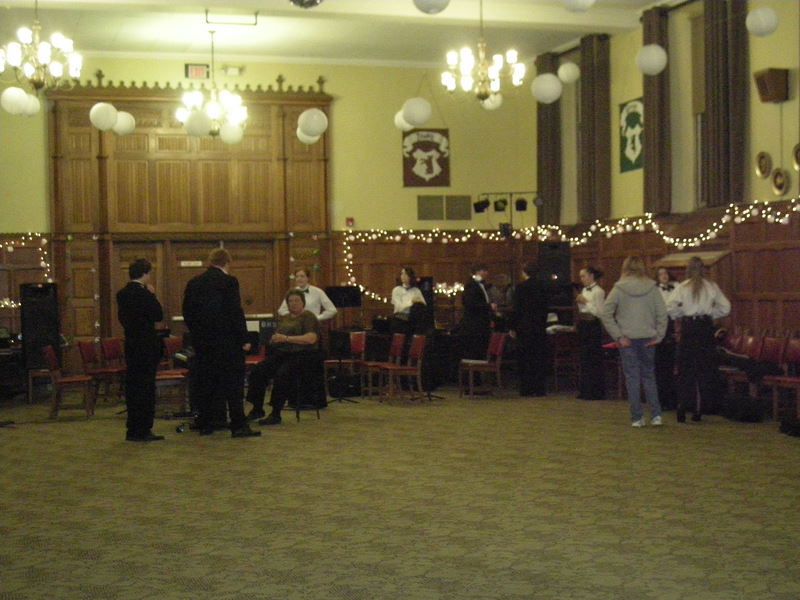
... working a dance in the dorm cafeteria again. This time it was the spring dance, timed close to Valentine's Day but not officially on that theme. I'm not sure where this year's Japanese motif came from.
The Viennese Ball theme goes back to the early 1980s, if I recall correctly, when a violinist who lived in the dorm organized an orchestra of other music majors to play waltzes for the dancers. It caught on, though for the past several years the orchestra has been made up of players from a local high school.

As always, there was an ice sculpture, made by a firm in Indianapolis, of the dorm's mascot, a gnome.

Things started off slow, as dances tend to do...

I wasn't careful enough, so most of the pictures I took of the dancers were blurred. This is the best of a bad lot, but it gives you some idea of the intended ambience: formal dress, and masks. There were several female couples, some of whom were couple couples if you take my meaning. Several (though not all) of the male-female couples consisted of that classic team, the gay man and the straight woman, while the jockiest looking boys watched from the sidelines guarding their masculinity jealously.

There were no male couples. This bothers me, and if I were forty years younger I'd have tried to find a male date to learn to waltz with me. I like watching men dance together. In the mid-Eighties, a few years after I began working in this dining hall, I went to a party there that exhibited the same pattern: jocks sitting at tables and refusing to dance with anyone, gay men dancing with straight women, women of various sexualities dancing with each other, most straight men dancing with women. Several straight (but non-macho) men invited me to dance; the other gay men wouldn't dance with me, or with each other. Things haven't changed much, even in a notoriously gay-friendly dorm. I wonder why.

The orchestra played for an hour, and then a DJ took over.

At midnight the dance ended, and we cleaned up. We carried what was left of the gnome after five hours of slow melting outside to the cold night, and put everything back into place for the next morning's meal.