Monday, September 21, 2009

It's a Bourgeois Town

The other day IOZ linked to a column by George Will fulminating against Obama's politicization of the National Endowment for the Arts. IOZ called it "truly incoherent"; I'm not sure I agree. It's highly dishonest on several fronts, but its agenda is clear enough (viz., to attack Obama). Will ignores the political wars fought against the NEA by Republicans from Reagan to Jesse Helms, Pat Buchanan and others, to force the NEA to support only the blandest work. ("Inoffensive" is not quite the word, since it all comes down to who gets to be offended.) This was not consistent, of course -- the closet Republican Bill Clinton cut funding for the NEA, while George W. Bush raised it throughout his administration, much to the indignation of his Christian-right base.

Even stranger, Will claimed (maybe tongue in cheek?):
Time was, artists were proudly adversarial regarding authority, the established order, etc. "Epater le bourgeois!" and all that. Now they are just another servile interest group seeking morsels from the federal banquet. Are they real artists? Sure, because in this egalitarian era, government reasons circularly: Art is whatever an artist says it is, and an artist is whoever produces art. So, being an artist is a self-validating vocation.
I wonder when that time was? As IOZ pointed out, "For most of recorded human history artists and performers and musicians were at best craftsmen, more often servants, and almost always worked in the service of some state or church or local nobleman." Will is also conveniently forgetting just how hostile conservatives have been to artists who produce shocking or offensive work; surely he isn't calling for government funding for these people and their work? No, of course not -- they should be left to their garrets and absinthe. Would Will support federal funding of the arts if Robert Mapplethorpe, Andres Serrano, Cindy Sherman and their ilk could be excluded? Certainly not. And both he and this rightblogger forget earlier times when American artists sought morsels from the government banquet: the 1930s, the New Deal, the WPA -- and even better, World War II, when patriotic artists and entertainers went to work for Uncle Sam. I guess Will would prefer that they'd stayed proudly adversarial regarding authority, and sat out the Good War?

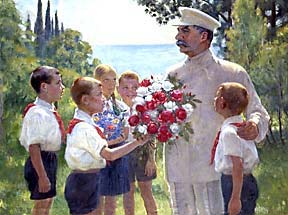
Will's "epater le bourgeois" distracted IOZ and his commenters, which brings me to the real point of this post. The matter arose of Socialist Realism in art -- the officially sanctioned style in the old Soviet Union, which influenced art elsewhere, including the United States during the 1930s. It's easy to make fun of this stuff, though it seems to me that the real issue isn't its style or its aesthetic, it's the content. A nice picture of King Edward or the Pope or Ronald Reagan instead of Stalin with schoolchildren would please most anti-Communists, depending on their particular ideology. Norman Rockwell's paintings are not so different in their style from Socialist Realism, or even in the kind of people and situations they depict; they've often been used as Americanist propaganda. The difference between what might be called "bourgeois realism" and Socialist Realism is not the manner, or even always the matter, it's the address of the artist. Consider this painting (via) of a schoolroom back in the USSR:

If you didn't know it was by Norman Rockwell, wouldn't it pass for Soviet art?

Anyway, the discussion reminded me of this passage from William H. Gass's essay on Sartre and theater (published in Gass's The World within the Word, Knopf 1978, page 200ff):
Sartre explains that Beckett’s plays are admired by the bourgeois because the bourgeois enjoy being told that man is a depraved lost vicious lonely bored but frightened meaningless creature. Such a view will justify the severe social order: the cage man is to be safely kept in. Yet the bourgeois do not like Beckett. The vast mass of the middle class like The Sound of Music. Those few self-selected members of the class who respond to Waiting for Godot are hardly characteristic of the whole. They are, furthermore, the same intelligentsia who provide Sartre with his audience and readers. It was a collection of clercs who nearly made existentialism commercial. ...

Sartre insists that “you always have a right to speak evil of the bourgeois as man, but not as bourgeois,” but I should have thought that no one spoke well of the bourgeois … not under that rubric. Of course everyone has his own bourgeois (Sartre his, I mine, you yours), but to prefer content to form – what could be more bourgeois? to be an intellectual good Samaritan – what could be more bourgeois? to dislike plays that are too gloomy and pessimistic – what could be more bourgeois? to believe that the artists holds some sort of mirror up to nature, or like Taine that a successful work must be in harmony with its era – what could be more bourgeois? and then to feel that plays ought to do you good, that the aim of theater should be “telling the truth” – what could be more bourgeois? to hector, to teach, to drag morality into everything like the worst Victorian Pa – what could be more bourgeois? above all, to put on plays which will be eaten like ice creams at intermission (and for new times there will be new plays, new plans, new truths, and new demands) – what could be more bourgeois, or more in keeping with our consumer society, where long novels burn like cigarettes, poems don’t outlast their speaking, paintings fade into the walls they hang on as though the sun were their only patron, and sculpture is made to look as if it had been thrown away? to use up the whole the present and dispose of it in history like trash thrown in a can – what could be more bourgeois, more vulgarly commercial, more nightschool, more USA?
It's hard to believe that it's been thirty years since I first read The World Within the Word. This section has stayed with me, though I'm not as impressed by Gass as I was in the Seventies. Especially I don't agree with his idea of what art should be, but I do like his smackdown of a certain kind of dismissal of this kind of art or that kind of politics. I've also read more on the history of the rise of the bourgeoisie, most notably George L. Mosse's Nationalism and sexuality: respectability and abnormal sexuality in modern Europe (Howard Fertig, 1985), and have some idea of what "bourgeois" means when it actually means something, rather than simply functioning as a term of abuse, as both Sartre and Gass use it here.

Sunday, September 20, 2009

Eunuchs to the Left of Me, Eunuchs to the Right of Me

The "Would Jesus Discriminate?" campaign (hell yeah, he would) does more than claim that Jesus "affirmed a gay couple." Two of its billboards try to claim a gay-positive early Christianity by reconceptualizing eunuchs -- castrated men -- as gay men.

The passage of Acts cited here tells of an encounter between the apostle Philip and an Ethiopian eunuch. After converting Samaria, Philip was directed by an angel of Yahweh to go to the desert road between Jerusalem and Gaza. There he encountered the eunuch, an official of the court of the Ethiopian queen, on his way home from worshipping in Jerusalem. He had stopped his chariot to read from Isaiah 53:7-8:
He was oppressed and He was afflicted,
Yet He did not open His mouth;
Like a lamb that is led to slaughter,
And like a sheep that is silent before its shearers,
So He did not open His mouth.
8By oppression and judgment He was taken away;
And as for His generation, who considered
That He was cut off out of the land of the living
For the transgression of my people, to whom the stroke was due?
(This passage has been interpreted by Christians as a description of Jesus and his mission; it's not very convincing, but that's another topic.)

Philip preached Jesus to the eunuch, converted and baptized him, and "When they came up out of the water, the Spirit of the Lord snatched Philip away; and the eunuch no longer saw him, but went on his way rejoicing" (Acts 8:39). That's a handy means of transport; the early Christians could have used a good deal more of it.

It's an interesting story. If the Queen's treasurer had gone to Jerusalem to worship, he must have been Jewish; there was, and still is, an Ethiopian Jewish community of great antiquity. Although Deuteronomy 23:1 forbade any emasculated man from entering the assembly of Yahweh, Acts is vague as to whether the Ethiopian had been allowed to worship or not. In a later interview, with Isaiah, Yahweh had promised that the eunuch who kept his covenant and his sabbaths would be given a name that would never be cut off. (Unfortunate pun, that, but it's in the text.)

So, what does this have to do with a gay man? Castrated men were often assumed to be sexually receptive to other men -- or at least sexually accessible to them. The page at Would Jesus Discriminate, apparently also excerpted from Jeff Miner and John Tyler Connoley's tract The Children Are Free, which expands on the billboard slogan first tweaks people who stereotype:
Once they find out someone is gay, it is as if that person has a neon sign on his or her forehead, flashing, “Gay! Gay! Gay!” But God sees people differently, looking past incidental labels and seeing into the core of each being.
But the writers then do exactly that. They write, "It is clear from the ancient literature that eunuchs as a class had a reputation for being attracted sexually to men, rather than women", and assume that this reputation was accurate. They support this by claiming that eunuchs were castrated because (and evidently after) they had shown a "disinterest" in women and an interest in men, and conclude:
This does not mean all were gay. But clearly, as a class, they were strongly associated with homosexual desire in the popular mind. To introduce one’s self as a eunuch in ancient times was roughly akin to introducing one’s self today as a hairdresser from San Francisco.
Evidently the writers are as invested in stereotypes as the people they criticize. (This is clear from their attack on "radical fairies," which I quoted before.) If eunuchs had a reputation for sex with men, then by golly, the Ethiopian eunuch must have been gay, and Philip knew it, and that settles it.

As far as I can tell, they have it backwards. The authorities they cite that I've been able to check don't back up their claim. At best, it appears that the idea of men who were eunuchs as it were by nature developed later in antiquity, after the time of Jesus and long after Acts of the Apostles was written. I'm hoping to look into this more before long, though as you'll see, it's not all that important to this issue.

There's another problem with their account. If Miner and Connoley were correct and eunuchs were primarily men who were not interested in women, if they were naturally impotent -- then why did anyone bother to castrate them at all? Women in the harems would have been safe from them even if their testicles were intact; they wouldn't have been interested in them, and if they were impotent, couldn't have done anything with them anyway.

Gay men, however, are generally not impotent -- certainly not with other males, and often not with females. (When I was younger and more naive, I was surprised at how many drag queens and other effeminate gay men had been heterosexually married and were fathers. There are powerful social and other reasons why this should be true, but it belies any notion that gay men's reproductive organs don't function.) It seems that Miner and Connoley are also buying into the batty, if popular, notion that "gay" men are only and always penetrated by other males, and that the men who penetrate them are not gay. This sort of confusion is hard to understand from two gay men, Christian though they be.

They confirm their confusion in their explication of the next billboard, "Jesus said some are born gay."

In this passage, Jesus forbade divorce, overturning the permission Yahweh had given to Moses. Marriage was indissoluble, and a person who divorced and remarried was committing adultery against the former spouse.
10The disciples said to Him, "If the relationship of the man with his wife is like this, it is better not to marry."

11But He said to them, "Not all men can accept this statement, but only those to whom it has been given.

12"For there are eunuchs who were born that way from their mother's womb; and there are eunuchs who were made eunuchs by men; and there are also eunuchs who made themselves eunuchs for the sake of the kingdom of heaven. He who is able to accept this, let him accept it."

This little witticism has given Christian interpreters no end of difficulty. For now, it's enough to notice that if Jesus was saying that "some" are born gay, then he was also saying that others are made gay by men, and others become gay for the sake of the Kingdom of Heaven -- in short, for "some", being gay is a "choice", an idea that is anathema to today's gay Christians and the American gay rights movement. But it's probably truer to say that, read in context, Jesus was not talking about gay men in this passage. (And where do lesbians come in? That's another post, coming soon I hope.)

I've said it before and I'll say it again: Gay people should not be spreading misinformation -- that's what bigots are paid to do. The misinformation about Christianity that gay Christians spread is their business, I suppose, but it doesn't distinguish them importantly from their opponents.

Saturday, September 19, 2009

Soundbyte Atheism vs. Soundbyte Religion

Here in Bloomington -- long-known to area evangelists as a secularist Hellmouth, which the pious enter at peril to their immortal souls -- we have an atheist bus campaign too, after a brief struggle. (Too "controversial," doncha know -- unlike, say, this!) It's the American version, "You can be good without God."
Yesterday, though, I saw a bus with another sign on its side: "You can be good without God, but you can't be saved without Jesus!"

I later overheard a couple of bus drivers talking about signs that had appeared on the buses without having been authorized, and I wonder if they were talking about these Jesus bus signs. If so, more power to the god-botherers for being a little bit more decisive (without, for once, hurting anyone) than the wishy-washy atheists and their non-committal slogans. (P.S. But evidently not.)

I'd been expecting just that kind of response to "You can be good without God." Despite the efforts of many of its adherents and its opponents, religion is not a simple thing with one function. It's not just about feeling good about yourself as you go to work in the morning, as the original atheist bus campaigner thought; it's not just about being good. It's about different things at different times, like art or science or any other complex human institution. Missionaries will switch their emphasis freely on the side issues, because what they really want is that you buy their product.

Sticking to Christian terms for the moment: On the one hand, God loves you and wants you to be happy; on the other, you're a disgusting sinner, evil to the core, and you'll burn burn burn for eternity if you don't return his love, do his bidding, and join the right church. (Last week I watched again Michael Tolkin's controversial, flawed 1991 film The Rapture. When Sharon, the lead character, enters into her personal relationship with Jesus Christ, at first she's rapturous, like a giddy schoolgirl in love. Jesus is all she needs! But after a while she realizes that Jesus isn't enough. In fact, it's another Christian who, having divined that she lost her old friends when she was saved, asks her point blank: "You're alone, aren't you?" Of course she isn't alone -- she has Jesus! But she joins a church, and when its chaste spiritual communion fails to deliver what she needs, she tracks down her old fuck buddy Randy and marries him. Christians have all kinds of excuses for giving into loneliness and other fleshly concerns, but it wouldn't be a problem if they didn't oversell their religion in the first place.)

Besides, the Christian bus sign is just a bit disingenuous. It's a longstanding and mainstream Christian doctrine that you can't be good without God. Or even with him. To quote another Christian bumper sticker: Christians aren't perfect -- just saved! The churches have struggled with the troublesome fact that Christians still sin even after they've officially died to the sinful flesh in baptism, but there's no getting around it: they do. Jesus washes away your old sins and, hopefully, forgives the new ones you commit after you've converted, but a saved Christian goes to Heaven in spite of his or her sins. Not all Christians accept this position, I know, but it's both orthodox and ancient, and compatible with the teachings of Jesus in the New Testament.

My main objection to "You can be good without God", then, is that it's really beside the point, even for atheists. As I've asked before, "And what is good? How do we know? When people disagree in their moral judgments, how should the disagreement be resolved? Not all religious people worry about going to Hell or obsess about going to Heaven; different believers believe for different reasons and in different ways. Many of them are not at all comforted by the idea that there is no god out there to take care of them, to tell them what to do, to reward them for being good and punish other people for being bad." From what I've seen, atheists aren't dealing with these questions any better than theists have; which is not surprising, because right and wrong, good and evil, are not easy to define or determine. For many people "You can be good without God" may be reassuring; for others it will just confirm them in their complacency, their feeling of superiority to people who hold different views. For still others it's simply irrelevant. I really don't think that this soundbyte atheism is going to advance the discussion much. Besides, I always want to ask, "Good at what?"

Friday, September 18, 2009

Poetry Friday -- Voodoo Doll

This poem is not unlike a voodoo doll.
See how I seek the form: I croon and coo
caressingly to it, to you. I call
it by your name. I think it looks like you.

How do you like your likeness? Is it apt?
Not flattering, unfair perhaps a hint
of malice in the lines? I have you trapped
at last: in ink, perhaps someday in print.

I knead my memories of you into the page --
such memories I have of you, my friend! --
long-simmered in my helplessness and rage,
which until now I lacked the means to end.

No matter where you go, you'll feel the twinge,
the pinch, the bite, the burn of my revenge.

---
From sometime in the late 70s. I'd been reading Sylvia Plath again, and was trying to get some of her fury into my own work. But it wasn't completely sincere -- more trying on the anger, to see if saying these things would let me know that I felt them. I found I didn't, and the poem ends up being hollow because of it. Still, I think it turned out well technically, and maybe some other person might find that it expressed his or her feelings more than it expressed mine.

Thursday, September 17, 2009

I'd Like to Join the Party, But I Was Not Invited


Actually, I was invited, but I didn't like to join the party -- either party -- that much. Here's a story which may help to explain why, from Driftglass via the Sideshow:
Once upon a time, there was a President named Bill Clinton, who was, by most historical standards, a typical Centrist Republican, although by a fluke of geography and circumstances he ran for public office with a "(D)" after his name. Under his Administration, many Conservative ideas which had long gathered dust on the shelf -- ideas such as welfare reform, a balanced budget, debt reduction, a strict 'Pay as You Go' fiscal regime, a boom in technology jobs, budget surpluses, NAFTA, GATT, official bans on gay marriage, etc. -- were finally realized. And for all of his good work on behalf of their ideology, Conservatives spent eight, long years treating Bill Clinton -- a Southern, White, Christian man -- as if he were a case of flesh eating nuclear syphilis. Because he did not run for office with an "(R)" after his name.
The writer is absolutely correct: Clinton (and now Obama) was subjected to the kind of sliming that Democrats reserve for Ralph Nader, and even then, not with the same whole-hearted dementia. Reading the whole post, I'm inclined to think that I don't rant enough.

Oh, and then there's this, from Whatever It Is, I'm Against It:
Monday, the Obama admin filed a brief in District Court arguing that prisoners at Bagram Airfield have no habeas corpus rights because it is located an active war zone, glossing over the fact that some of the prisoners were only in an active war zone because they were kidnapped from other countries and brought there. Reminds me of the 2,264 ethnic Japanese the US seized from Peru and other Latin American countries during World War II and transported to the internment camps in the US. When the US began paying reparations to interned Japanese-Americans in 1990 it excluded these internees because they had been... wait for it... illegal immigrants.
But the truly faithful (via) can overlook such small peccadilloes.

Wednesday, September 16, 2009

Thought for the Day

Do I repeat myself? Very well, then, I repeat myself.

This one from James Wolcott, thanks to Dear Leader:
Part of the crazy cognitive dissonance of this summer is the rabid conviction the tea baggers and conservative bloggers possess that Obama is a suave-talking, solid-core radical socialist who practices Chicago-thug hardball, when in fact if Team Obama was the steamroller they claim, they never would have acquired the momentum they've mustered this summer--a true Lenin would have squashed them out of the gate and hardly would have allowed this much slippage this fast. They want Obama to be ruthless and authoritarian because they want to think of themselves as a heroic resistance. They evoke Hitler not because they fear another Hitler, their very obsession with Nazi imagery betrays their attraction; no, they're longing for a Leader, a Hitler of their own. Even a Hitler in high heels, if you can picture such a lady, and I think we all can.

Tuesday, September 15, 2009

Thought for the Day

From journalist Doug Henwood, liveblogging Obama's health care speech, via Dennis Perrin:
A friend pointed out to me earlier today that the market capitalization—the value of all the outstanding stock—of the publicly traded health insurers is about $150 billion. Add a little premium to sweeten the pot and you could nationalize the lot of them for about $200 billion. The total administrative costs of the U.S. healthcare system, which are greatly inflated by all the paperwork and second-guessing of docs’ decisions generated by the insurance industry, are about $400 billion a year. Those administrative costs are about three times what a Canadian-style single payer system would cost. So that means we’d save about $250 billion a year by eliminating the waste caused by our private insurance system.

In other words, the nationalization could pay for itself in well under a year.

Will Obama propose anything like that? Of course not. Instead, he’s going to propose that Americans be required to buy insurance, probably with some government subsidies. So instead of euthanizing the private insurance industry, Obama & the Dems are going to provide them with tens of millions of new customers—compelled to by their product by law, and with some degree of public subsidy. That’s lunacy.

Sweet. Spread it around.

Just a reminder, though: Suppose for the sake of fantasy that Obama and the Democrats were not corporate collaborators, and were willing to nationalize American health insurance in this way, just because it would be more efficient and affordable. There would still be a lot of opposition to such a move, the insurance companies and the corporate media would go berserk, and the Teabaggers would be foaming in the streets. Just as they are now. Much of the reason why most Democrats and Obama are worthless is that they don't want to confront opposition, or to be an opposition themselves. (To be fair, many Republicans are the same: stand up to them, call them a few choice names, and they run for the exits, screaming "Political correctness!" But the Democrats' refusal to be an opposition party is leagues beyond this.) If a measure can't be passed by consensus ("bipartisan" in Obama's terminology), it's just too scary, it's not viable, it can't be done. The Republicans generally know better. But since the Dems are so terrified of opposition and criticism, it is going to be necessary to put them under pressure from the other side: if Obama's unwilling to do the right thing because the Republicans will be mean to him, then liberal Democrats and independent progressives and liberals must be mean to him too. There must be no shelter for him or for any other Democratic politician who wants to collaborate with the corporatists and the Republicans.

The same would apply if, by a miracle, some sort of substantial health insurance and health care reform were passed. The Republicans, with lots of corporate funding, would promptly start trying to undermine the reform and ultimately to roll it back. (Look at the history of the Right's opposition to Social Security, for example: in principle, the Right wants to get rid of Social Security, and in practice they just try to chip away at it until it's not worth saving.) This should surprise no one, yet the Democrats and a good many independents are constantly surprised when they encounter opposition. There is never going to be an America, or a world, without conflict; we might as well recognize this, and decide how to deal with the conflicts we must face.

In his What's Liberal About the Liberal Arts?, Michael Berube quoted his fellow English professor, the conservative Mark Bauerlein (page 88): "Being the lone dissenter in a colloquy, one learns to acquire sure facts, crisp arguments, and a thick skin." I'd like to think that I've acquired sure facts and crisp arguments, but that's not for me to say. I have acquired a thick skin over the years, and if Democrats want to keep Congress and the White House, they should do the same. Some sure facts and crisp arguments would help too.

That being said, back to the real world. Obama and the Democrats are, as a party, corporate collaborators. It's fair to doubt that Obama wants meaningful health care reform, any more than he wants an end to the wars in Iraq and Afghanistan, or peace in the Middle East, or ... If he did, he'd do more than the posturing he's been doing since before he took the oath of office.