Wednesday, April 23, 2014

Challenge Me Softly

I just read Alfie Kohn's new book The Myth of the Spoiled Child (Da Capo, 2014), which does a nice job demolishing the complaints about how Kids Today are overindulged, spoiled, etc.  You know the drill, I'm sure.  One of his starting points is something I've also noticed: that contempt for the young is a bipartisan affair.  Many social liberals start to sound just like right-wing frothers when they talk about children and education.  I may write more about the book and the subject later, but by happy chance I found an article online at The Atlantic.com that could have been grist for Kohn's thesis, "My Students Don't Know How to Have a Conversation," by one Paul Barnwell, identified as "a teacher, writer, and urban gardener based in Louisville, KY."

Barnwell blames it all on mobile phones.  "Recently I stood in front of my class, observing an all-too-familiar scene. Most of my students were covertly—or so they thought—pecking away at their smartphones under their desks, checking their Facebook feeds and texts."  And so on.  You can probably guess how the article progresses; I could have written it myself, just from the title. 

For example, one thing that was easy to predict was that Barnwell offers no evidence whatsoever that kids used to be more attentive in class, were able to converse, and so on.  When they get out in the real world, he fumes, with job interviews and asking for raises, they won't be able to fall back on Facebook!  And he concludes:
The next time you interact with a teenager, try to have a conversation with him or her about a challenging topic. Ask him to explain his views. Push her to go further in her answers. Hopefully, you won’t get the response [Sherry] Turkle did when interviewing a 16-year-old boy about how technology has impacted his communication: “Someday, someday, but certainly not now, I’d like to learn how to have a conversation.”
The next time you interact with an adult, try to have a conversation with him or her about a challenging topic.  Ask him to explain his views.  Push her to go further in her answers.  I do this often with my peers (I'm 63, by the way) on Facebook, all of whom have high school diplomas and many of whom have at least bachelor's degrees.  A depressing number are, or have been, schoolteachers themselves. They have no idea how to support their beliefs, and they aren't interested in doing it.  They figure that just saying what they think (or rather, feel), is all they should have to do.  Many of them express their views by posting memes that someone else concocted; they have no idea how to check, on or off the Internet, whether a claim they encounter is true.  Very few people are capable of having a conversation about a challenging topic, and as this article shows -- it's unfortunately not atypical -- that applies to people who get published on classy sites like The Atlantic. This is nothing new, however: it's as old as the hills.

Monday, April 21, 2014

Toleration for Me, But Not for Thee!

The point I was driving at in yesterday's post was not only that anyone who tries to silence someone else on the grounds that the latter is an "asshole" who utters "bullshit" has discredited him or herself as a rational person, but that allowing such complaints to affect public discussions (whether in "private" or "public" environments) will severely limit, if not destroy, free speech in our society.  You don't like what I say?  Complain to my employer or to my web host that I'm an asshole!  If enough people complain, I'll be fired and my blog deleted.  Social conservatives won't be the only ones who will be silenced; anyone who offends enough people will also be removed from the public eye, because private employers and companies aren't required to protect freedom of expression except their own, not that of their employees -- and a newscaster or a columnist or a variety show host is an employee, who's employed at the will and pleasure of his or her employer.

This evidently doesn't worry the people who try to silence others, either because they believe they have the power to protect themselves or because they don't realize that their blogs, their tumblrs, their Twitter feeds, their Facebook accounts, are private rather than "public" media -- until they run up against the limits of corporate tolerance.  Corporate tolerance is limited by public pressure, and you never know when your boss or web host will decide you're more trouble than you're worth.  (Not that it's very different in the increasingly corporate world of government: just ask Shirley Sherrod, for one.)  And it's not even necessary to construct an argument: according to that xkcd cartoon and the liberals who spread it around the Internet, it's enough that someone thinks you're an asshole and your opinions are bullshit.  Your (and my) freedom of expression consists of freedom from government action against you, limited though that is by legal restrictions but also because there are fewer and fewer venues not under corporate ownership and control nowadays.  Public sites like parks are increasingly privatized, so you have no guarantee of freedom of assembly or expression there.  The police will silence you, not because the government doesn't like you, but because the owner of the site doesn't like you; besides, you're only an asshole.

Now, granted that there is a rational case to be made against Brendan Eich as CEO of Mozilla; in yesterday's post I linked to some people who attempted to make one.  Because Eich participated by donation in the Proposition 8 campaign against same-sex marriage in California, he arguably took a step beyond speech into action against the rights of other citizens -- though as I argued, such action is and should be protected by law to some extent, an extent which can be debated but isn't clearly marked out anywhere.  And as CEO he does have a representative function where his political opinions and actions might be the concern of Mozilla.

It occurs to me, though, that the same "employees have no rights" line was used by the critics of Phil Robertson, Paula Deen, and others, though their offense was limited to speech.  Stupid, bigoted speech, true, but speech nonetheless, and it's one of the pillars of free speech doctrine that speech is not (necessarily) action.  It also occurs to me that the idea that every performer in corporate media represents the corporate owner, who is therefore responsible for their every word and thought, is very similar to the claim advanced by religious opponents of same-sex marriage, who claim that taking money to bake a wedding cake for a same-sex couple amounts to endorsement and acceptance, even celebration of their marriage.  Some writers pointed out quite simply that no, baking a cake for a wedding doesn't constitute endorsement of the coupling.  In the same way, my buying used books from the shop of a right-wing acquaintance of mine doesn't constitute endorsement of or agreement with his often fascist opinions -- just as his occasional part-time employment of me doesn't constitute agreement with or endorsement of my America-hating, Communist opinions.  I pick on him constantly, but I still do business with him.  I might consider changing that policy if he crossed some line or other, but I can't think at the moment of what the line would be.

A writer at Slate asked, rhetorically but seriously, why, if conservatives are so upset by the plight of Brendan Eich, they don't also concern themselves with ordinary Americans.  It's a good article.  But it works both ways.  The liberals who howled for Eich's removal, justifying it because he works for a private company, must also explain why they think lower-profile employees shouldn't be subject to the discretion of their private employers.  If customers complain about a salesperson's visible tattoos or piercings, for example, shouldn't that be grounds for firing her?  After all, it's not like the government is picking on her.  Or if a business loses customers (or is afraid it will lose customers) who don't want to deal with a black clerk, or a female doctor, it's not the business's fault; shouldn't employers be allowed to comply with (their fantasies about) public opinion?

As the Slate writer points out, in most of the US a private employer can discriminate in employment on the basis of sexual orientation or gender "identity."  Instead of acknowledging that private employees have no freedom in such areas, many people are working to limit the rights of private employers by passing a law forbidding such discrimination.  The excuse is largely that sexual orientation or gender identity is not a "choice" but something innate and therefore should be protected against discrimination, an excuse which is doubtful for various reasons; but the key point is that private employers do not have total license to cave in to public complaints about what the public considers unacceptable employees, and their freedom to do so is not written in stone but can change.  Where to draw the line is not clear either; it is a matter of judgment, and as such needs to be debated as rationally as possible.  That's not going to be easy, but it's necessary.  And it's odd to see many liberals and progressives suddenly so solicitous about the power businesses have over their employees.

Sunday, April 20, 2014

The Multi That Owns Us

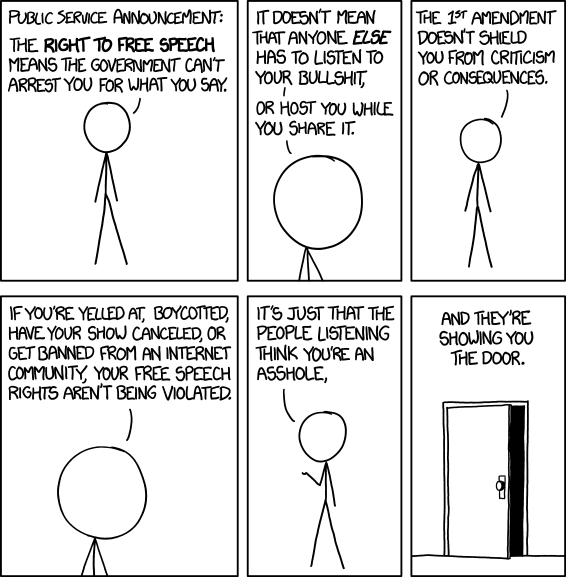
http://xkcd.com/1357/

So I guess I'd better write something about the Great Mozilla Flap of 2014.  In case you haven't heard, Brendan Eich, the recently-elevated CEO of Mozilla, which produces the Firefox browser, came under attack because in 2008 he donated a thousand dollars to support the anti-same-sex-marriage Proposition 8 in California.  After a little more than a week of controversy, including calls to boycott Mozilla products, Eich stepped down.  Which was a relief for me, because after checking the main alternatives, I wasn't sure I was willing to switch to another browser; I have some problems with Firefox, but I'm used to it and I don't much like Chrome or IE.

Conor Friedersdorf summed up the controversy reasonably well here; I also liked this post by Ampersand at Alas, a Blog, which helped me sort out my own position.  It reminded me that I'd written much the same things in this post right after the success of Prop 8 at the polls in 2008. Entertainingly, Andrew Sullivan got upset over Brendan Eich's departure, though he helped lead the attack on the liberal gay-marriage supporter Alec Baldwin for using homophobic language, even unto Baldwin's losing his TV program. (Maybe because Baldwin is a high-profile Hollywood liberal and Eich is a right-wing libertarian who supported Ron Paul?)  Baldwin singled out Sullivan for contumely as part of the "fundamentalist wing of gay advocacy." And the fuss hasn't died down yet, as shown by xkcd's latest cartoon, linked above, which has been getting shared widely on the Intertoobz, including sf writer John Scalzi's blog.

For a computer/math geek and science cultist, xkcd has wandered off into irrationality with this cartoon. Part of what he says is fair enough, I guess: I agree that the First Amendment only applies to government censorship, so being fired for your political or other views is not a violation of your First Amendment rights.  This has been brought home repeatedly in the controversies over Paula Deen, Juan Williams, Phil Robertson, and others lately.  (Oddly, when the racist writer John Derbyshire was fired from the National Review two years ago for his expressed views, few right-wingers came to his defense.)  Nor is it a violation of your freedom of speech to be kicked out of an Internet forum, or if your letter to the editor of a newspaper isn't published, or if you're attacked in the "mainstream media" for attacking your political opponents.  So far so good.

But xkcd made some odd statements, starting with "It doesn't mean that anyone else has to listen to your bullshit" and climaxing with "It's just that the people listening think you're an asshole, and they're showing you the door."  On a narrow literal level, the first statement is also true, but "bullshit" is perniciously irrelevant, as is "asshole."  It doesn't matter whether what you say or write is "bullshit," but the question arises: Who gets to decide that what you've said is bullshit, or that you're an asshole?  At Scalzi's blog I posted a comment, asking whether Phil Donahue was fired from MSNBC in 2003 because he was an asshole?  And how many people who are grimly celebrating the fall of Brendan Eich now, threw hissyfits over Donahue's losing his TV show because he gave a forum to opponents of the Bush-Cheney invasion of Iraq?  Many liberals and progressives did at the time, and they're still upset a decade later; I'll cite Chris Hedges for special notice because of his overwrought claim that "TV news died" when Donahue was shown the door.  As if the corporate media had ever given a platform to critics of US wars; Hedges surely must know better.

Another commenter at Scalzi's blog bit.  They wrote:
@Duncan, more like MSNBC’s viewers were letting MSNBC know they thought he was an asshole, and MSNBC decided that it did not want to present programming by someone their viewers thought was an asshole. Unless you’re implying that he lost his show because the government applied pressure to MSNBC?
No, I wasn't implying anything of the kind; as far as I know, the government applied no pressure to MSNBC.  There was no need to.  The decision to get rid of Donahue seems not to have had anything to do with "viewers" thinking Donahue was an asshole; it came from the upper reaches of management, as revealed by a leaked internal memo which warned that Donahue presented a "difficult public face for NBC in a time of war.... He seems to delight in presenting guests who are anti-war, anti-Bush and skeptical of the administration's motives."  The decision was framed in commercial terms, that at a time when MSNBC wanted to "reinvent itself", Donahue might put off an "anticipated larger audience who will tune in during a time of war" by linking pundits to war coverage, "particularly given his public stance on the advisability of the war effort."  So far I haven't seen any of Donahue's advocates acknowledging that a corporate network has the right to determine the face it shows to its audiences, and to dismiss employees like Donahue who don't fit its plans to reinvent itself.  But that was last year, after all.

There are other examples I could give.  Michael Moore, who is widely regarded as an asshole by conservatives and liberals alike, publicly opposed the Iraq war before it became safe to do so, and endured death threats, vandalism of his home, and (unsuccessful) physical attacks as a consequence.  (He was also harshly criticized by liberal heroes and Iraq war supporters Keith Olbermann and Al Franken, whom I consider assholes.)  But while I doubt that those who've justified the firing of various right-wing bigots would be comfortable defending the response Moore faced because of his 'bullshit,' I wonder how many of them are even aware of it?  And it's true, death threats and bomb plots go way beyond what xkcd is talking about.  But c'mon, the audience at the Academy Awards had every right to boo Moore because they didn't want to hear this asshole spout his bullshit, right?

I hope this points to the problem not only with xkcd's specific point about bullshit and assholes, but to the broader defense of private businesses demoting, firing, and otherwise showing the door to people whose opinions and political stances rile others.  After all, John Scalzi has been called an asshole often enough, and though he runs his own blog he doesn't own the Internet hardware that stores and transmits it -- it's in the hands of private companies, who then could reasonably give him the boot if enough people complained that he was an asshole and they didn't want to read his bullshit anymore.  A common argument used about Internet forums is that if your comments get deleted or you get banned from the comment section, you can always start your own blog.  And that's true, but what if you can't find a host for your bullshit?  This happened to Wikileaks a few years back, for example; and why not, since Julian Assange is widely considered an asshole by right-thinking people?  Why should they have to listen to his bullshit?  They were just showing him the door.

Throwing around words like "asshole" and "bullshit" in this situation is a rejection of rational debate.  I've pointed before to the way many people all over the political spectrum confuse a person's opinions with their style of presentation, which are separate issues.  And while it's convenient (which is to say, lazy) to dismiss free-speech issues by characterizing the offending speech as "bullshit," it's irrelevant.  It seems to me to echo the distaste for critical thinking I've seen exhibited by many good liberals and progressives, who want to impose, with varying degrees of force, their opinions on the benighted troglodytes who aren't as rational as they like to believe they are.  (And no, this has nothing to do with being "open-minded.") 

Many of Eich's critics argued that his offense went beyond speech into action: he donated a thousand dollars to support the campaign for Proposition 8 in 2008, to ban same-sex civil marriage in California.  I've seen quite a lot of GLBT people say that because he tried to take away their rights, he had no right to be CEO of Mozilla.  (I would agree that he doesn't have a right to be CEO of Mozilla, but that doesn't seem to be what these people meant -- I think it's more like the person who wanted Paula Deen to "lose everything.")  I suppose that case could be made, but matters of principle must apply across the board, not just to specific cases, so let's consider some analogous possibilities.  Can a company fire an employee who contributes to an organization seeking to raise taxes on businesses, or on the top income brackets?  Such an employee could reasonably be accused of trying to deprive businesses or rich individuals of their right to keep as much of their income as possible.  How about union organizers (to say nothing of strikers), who also seek to limit the power of business owners and management, thereby affecting them in their pocketbooks?  Though labor law has limited the freedom of workers to organize and strike, our society and the law recognizes at least in theory that people have the right to assert their rights at what may be the expense of their opponents.  Not all freedom is a zero-sum game, where one person gains only if another loses, but sometimes it is.  People have the right to advance themselves at others' expense in such situations.  It's certainly not true that a person who does so has automatically forfeited his freedom of speech or action.  And contrary to another liberal-left claim I've often seen, freedom of speech does extend to "hate speech" and advocating the diminution or removal of other people's rights.  Those others have the corresponding freedom to respond with more speech, including hateful speech as they often do.  That's part of the messiness of living in a free society.

I guess I should clarify that I'm not displeased that Brendan Eich stepped down; I think that the criticism of Mozilla and the pressure it produced were legitimate.  But I do think that some of those who agree with his demotion are not clear about what the issues are, what they were doing, or how the same tactics can and will legitimately be turned against people they support.

I don't think there's an easy answer to this problem, but I do think that the power corporations and other private, ostensibly non-government entities, can exercise over people's expression is a matter that ought to concern those who care about public debate.  It appears to me that many liberals and "progressives" and even leftists are all too accepting of corporate power over corporate employees, because it's not government power.  lt's just not possible to separate the public and the private that neatly.  And what these recent controversies -- not just Eich, but Deen and Robertson and others -- indicate to me is that for many if not people, their positions on any given case are determined by where they stand on the issue.  If they approve of the opinions of the person fired, they get indignant; if they don't, they celebrate and justify the firing.  Which is their right, of course; but it doesn't bespeak a principled commitment to freedom of expression.

Sunday, April 13, 2014

Sunday Afternoon Mashup

The comments under this meme slobbering over two celebrity scientists are about what you'd expect.  I wrote sourly that if elected they'd probably put the entire federal budget into the space program and other high-tech industry, while abolishing social services for mere humans.  The earth is already destroyed!  Who cares?  We're going to the stars! ... Well, not all of us.  Just the rational elites.

I don't really know anything about their politics in general; one commenter complained that Nye has spoken negatively about home schooling, so maybe he's a socialist.  But I know that Tyson fantasizes about a return to the Cold War space program, which indicates a willed historical ignorance that would suit a Republican very well.  I commented to that effect, and another person who'd already endorsed the ticket ("Merica would be fixed in like two minutes!") replied, "Exactly!"  I'd like to think he was being sarcastic too, but after reading the other comments I'll take nothing for granted.


Though I'm also taking time out for daily reflection with Skeletor Is Love.  The Culture of Therapy loves you.  And finally, for no particular reason:


Saturday, April 12, 2014

Jews at War

I just finished re-reading Marge Piercy's historical novel of World War II, Gone to Soldiers (Summit Books, 1987).  I'd put it off for a few months because of its length, 700 pages (and she says in the afterword that it would have been a third longer if she'd gotten a grant to do research in the Soviet Union), which stopped my project of rereading all her work in chronological order.  Once I got going, it was a pleasure and toward the end I couldn't put it down -- though of course I knew how it turned out: what I wanted to know was how her characters would fare.

I haven't read much fiction set during World War II, and far from enough nonfiction about it, so I can't really compare Gone to Soldiers to anything except Sherri L. Smith's Flygirl (Putnam, 2009), about a young African American woman who passed as white to become a WASP.  I started to read Norman Mailer's The Naked and the Dead a couple of years ago but only did a couple of chapters; maybe it's time to go back to it.  And I really should read From Here to Eternity and other of James Jones's works.  Piercy's characters are mostly Jewish, both in the Europe and in the US, and often lower-middle class, and as always her perspective is feminist, anti-racist, and pro-labor, so she covers the anti-Semitism that American Jews faced at home as well as what European Jews faced at the hands of the Third Reich and its collaborators.  She describes the harassment that women faced in the factories, and that the women fliers of the WASPS had to deal with.  Her account of the Detroit race riots of 1943 is chilling. White racists were using the same folklore they use today:
The buses and trolleys were overloaded with people jammed into each other, after waiting half an hour or longer. The whites said the colored belonged to bump clubs and sought opportunities to jostle whites [275].
Today it's called the "knockout game," and though according to this article the Justice Department says "there have been similar incidents dating as far back as 1992", Piercy's research turned up the same basic idea from fifty years earlier.  (She declares in the afterword that although the novel is fiction, she wanted everything in it to have really happened to someone.)

Another striking bit: the Nazis "opened the sea war by sinking an unarmed passenger liner, the Athenia, and then claimed the British had blown it up themselves for propaganda" (109).  That's familiar too.  Very familiar.  (Ironically, the best-documented case I know of where something like this actually happened was when US Special Forces soldiers killed three Afghan women -- two of them pregnant -- and dug the bullets out of their bodies, trying to make it look like an honor killing by the Bad Guys.)

Gone to Soldiers isn't a novel I'll reread often, because of its length and because much of it is so emotionally painful, but I'm glad I reread it this time.

I can't say the same for Veronica Roth's Divergent (Katherine Tegen, 2011), now a major motion picture but even more of a drag, as far as I'm concerned, than Suzanne Collins's The Hunger Games.  Partly because it's longer: the first volume is 500 pages long.  I picked up Divergent at the library a couple of days ago and am now about halfway through it.  For awhile I wasn't sure I'd read it all, but I think I can finish it in two days so I might as well.  The writing is adequate (she at least uses the verb "diffuse" correctly, which is more than I can say about many pop writers these days) but thin.  I don't think she's built her world very well, and her characters are cardboard. Roth's imagined dystopian future just doesn't make much sense to me.  Maybe I'm just too old for it.

Sunday, April 6, 2014

The Stupid Is Strong in This One

The Stupid is strong in this one, liked today on Facebook by a friend who ... well, probably I can't expect him to know any better.  My answer, which I posted as a comment, is that I'm fine with displaying the Ten Commandments in public, as long as it's the work of churches, synagogues, and private citizens.  Governments are another matter.  And people who try to confuse the issue, as many would-be theocrats do, are another matter as well.  I have to admit, though, that many of them don't know they're confusing the issue.  They clearly can't grasp the principles involved.  Even more dispiriting, neither can many of those who would oppose the public display of the Decalogue, or other public displays of piety by private citizens.  How to implement freedom of religion and the separation of church and state would be messy enough with the best will in the world, and unfortunately, many of the loudest kibitzers don't have the best will in the world.

Tuesday, April 1, 2014

My Way, Which Is God's Way


The other day I had one of the more unpleasant cinematic experiences I've had in years: I saw Evan Leong's documentary Linsanity, about Jeremy Lin, the Chinese-American pro basketball player who exploded into fame like a supernova a couple of years ago.  Because Leong began working on the film before Lin became famous (while he was playing for Harvard, if memory serves), I hoped it would be intelligent, serious, thoughtful.  It turned out to be the sort of thing you'd expect to see on ESPN, a hagiography about a young American of humble origins, seeking and finding his dream.  The main difference, I think (I don't watch enough TV to say for sure), was Linsanity's stress on Lin's Christian faith. That wasn't news to me, of course, but it quickly became obnoxious, combining fundamentalism with Culture of Therapy and Sports Cult jargon for a truly toxic mix.  It culminated in a sequence of Lin making a shot on CGI water, which ought to be blasphemous (JL = JC?); it was followed by Lin himself saying that with enough faith he could walk on water.

Leong and Lin both had to grapple with the inconvenient fact that God had made Lin's career pretty rocky.  When he broke his ankle before his senior year of high school, which stopped his team's progress toward the state championship, he explained the injury as divine chastisement for his pride and ego.  Couldn't it have been a stumbling-block put in his way by Satan to frustrate God's plan and keep Jeremy from his messianic destiny?  In any case Lin remained sure that God was watching his every move, and had a plan for him, but it didn't necessarily involve a successful career in basketball, however much Lin tried to convince himself it did.   At one point he said that he wanted to play basketball "my way -- which is God's way."  Funny how often believers tend to equate the two.  "God's way" apparently turns out to be a return to obscurity, as the New York Knicks gave him up to the Houston Rockets, where his performance was less than stellar.

After Lin began his hot streak, Satan (or God) threw another stumbling block in his path, when his opponent Kobe Bryant of the Lakers was asked by reporters what he thought of Lin.  Bryant replied that he had no idea who Lin was.  So the game was framed as a one-on-one between the two titans, and after the Knicks' victory, a reporter asked Lin what he had to say to Bryant.  Lin tells Leong that he'd thought about what he would say, and considered something like "Has he heard of me now?" but then asked himself what Jesus would do, and decided to go with something milder.  ("You'll have to ask him," or words to that effect.)  This made me giggle.  Jesus, according to the gospels, loved snarky comebacks to his opponents when he didn't merely threaten them with hellfire.  "Has he heard of me now?" sounds quite Christlike to me.  One of my favorite examples is Luke 13:31-33: 
31 At that very hour some Pharisees came, and said to him, “Get away from here, for Herod wants to kill you.” 32 And he said to them, “Go and tell that fox, ‘Behold, I cast out demons and perform cures today and tomorrow, and the third day I finish my course. 33 Nevertheless I must go on my way today and tomorrow and the day following; for it cannot be that a prophet should perish away from Jerusalem.’"
If Lin were really serious about his faith, he'd ask himself whether Jesus would play professional basketball; I think it's a safe bet he wouldn't.

And hey -- isn't Kobe Bryant a Christian too?  Turns out he's Catholic.  I imagine most professional athletes in the US are at least nominally Christian, even if they don't all flaunt their religiosity as publicly as Tim Tebow.  And that's why I find the story of Lin's faith so obnoxious: in order for him to achieve his dream, someone else has to fail, to lose, to be defeated.  Lin's god takes sides in the vast corporate multibillion dollar world of professional sport, and that's not a god I'd want to encourage.  Nor do I think much of those who worship such a god.

The university cinema was almost full that day, mostly with Asian and Asian-American students and families.  That saddened me.  Sure, in one narrow sense it's good that Lin broke through to professional basketball.  Every stereotype should be broken, and watching the movie boggled my mind all over again at the racism of American sport, which found it surprising that a Chinese-American kid could play basketball at the highest level.  (To say nothing of Chinese in general.  It occurred to me as I watched Linsanity that Yao Ming had already broken that stereotype, and to my surprise, Leong actually interviewed Yao for the film.)  If I'd thought about it before, I'd have guessed that Asian Americans had better things to do with their time and energy, but it never would have occurred to me that they couldn't play well if they worked at it.  But Lin's rise to notoriety shocked the sports world, and typically, many Asians celebrated Lin's success as their own.