Showing posts with label julian assange. Show all posts

Sunday, April 20, 2014

The Multi That Owns Us

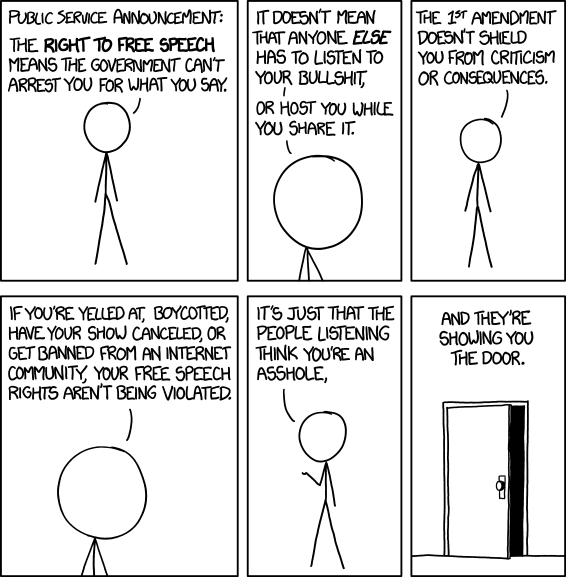
http://xkcd.com/1357/

So I guess I'd better write something about the Great Mozilla Flap of 2014.  In case you haven't heard, Brendan Eich, the recently-elevated CEO of Mozilla, which produces the Firefox browser, came under attack because in 2008 he donated a thousand dollars to support the anti-same-sex-marriage Proposition 8 in California.  After a little more than a week of controversy, including calls to boycott Mozilla products, Eich stepped down.  Which was a relief for me, because after checking the main alternatives, I wasn't sure I was willing to switch to another browser; I have some problems with Firefox, but I'm used to it and I don't much like Chrome or IE.

Conor Friedersdorf summed up the controversy reasonably well here; I also liked this post by Ampersand at Alas, a Blog, which helped me sort out my own position.  It reminded me that I'd written much the same things in this post right after the success of Prop 8 at the polls in 2008. Entertainingly, Andrew Sullivan got upset over Brendan Eich's departure, though he helped lead the attack on the liberal gay-marriage supporter Alec Baldwin for using homophobic language, even unto Baldwin's losing his TV program. (Maybe because Baldwin is a high-profile Hollywood liberal and Eich is a right-wing libertarian who supported Ron Paul?)  Baldwin singled out Sullivan for contumely as part of the "fundamentalist wing of gay advocacy." And the fuss hasn't died down yet, as shown by xkcd's latest cartoon, linked above, which has been getting shared widely on the Intertoobz, including sf writer John Scalzi's blog.

For a computer/math geek and science cultist, xkcd has wandered off into irrationality with this cartoon. Part of what he says is fair enough, I guess: I agree that the First Amendment only applies to government censorship, so being fired for your political or other views is not a violation of your First Amendment rights.  This has been brought home repeatedly in the controversies over Paula Deen, Juan Williams, Phil Robertson, and others lately.  (Oddly, when the racist writer John Derbyshire was fired from the National Review two years ago for his expressed views, few right-wingers came to his defense.)  Nor is it a violation of your freedom of speech to be kicked out of an Internet forum, or if your letter to the editor of a newspaper isn't published, or if you're attacked in the "mainstream media" for attacking your political opponents.  So far so good.

But xkcd made some odd statements, starting with "It doesn't mean that anyone else has to listen to your bullshit" and climaxing with "It's just that the people listening think you're an asshole, and they're showing you the door."  On a narrow literal level, the first statement is also true, but "bullshit" is perniciously irrelevant, as is "asshole."  It doesn't matter whether what you say or write is "bullshit," but the question arises: Who gets to decide that what you've said is bullshit, or that you're an asshole?  At Scalzi's blog I posted a comment, asking whether Phil Donahue was fired from MSNBC in 2003 because he was an asshole?  And how many people who are grimly celebrating the fall of Brendan Eich now, threw hissyfits over Donahue's losing his TV show because he gave a forum to opponents of the Bush-Cheney invasion of Iraq?  Many liberals and progressives did at the time, and they're still upset a decade later; I'll cite Chris Hedges for special notice because of his overwrought claim that "TV news died" when Donahue was shown the door.  As if the corporate media had ever given a platform to critics of US wars; Hedges surely must know better.

Another commenter at Scalzi's blog bit.  They wrote:
@Duncan, more like MSNBC’s viewers were letting MSNBC know they thought he was an asshole, and MSNBC decided that it did not want to present programming by someone their viewers thought was an asshole. Unless you’re implying that he lost his show because the government applied pressure to MSNBC?
No, I wasn't implying anything of the kind; as far as I know, the government applied no pressure to MSNBC.  There was no need to.  The decision to get rid of Donahue seems not to have had anything to do with "viewers" thinking Donahue was an asshole; it came from the upper reaches of management, as revealed by a leaked internal memo which warned that Donahue presented a "difficult public face for NBC in a time of war.... He seems to delight in presenting guests who are anti-war, anti-Bush and skeptical of the administration's motives."  The decision was framed in commercial terms, that at a time when MSNBC wanted to "reinvent itself", Donahue might put off an "anticipated larger audience who will tune in during a time of war" by linking pundits to war coverage, "particularly given his public stance on the advisability of the war effort."  So far I haven't seen any of Donahue's advocates acknowledging that a corporate network has the right to determine the face it shows to its audiences, and to dismiss employees like Donahue who don't fit its plans to reinvent itself.  But that was last year, after all.

There are other examples I could give.  Michael Moore, who is widely regarded as an asshole by conservatives and liberals alike, publicly opposed the Iraq war before it became safe to do so, and endured death threats, vandalism of his home, and (unsuccessful) physical attacks as a consequence.  (He was also harshly criticized by liberal heroes and Iraq war supporters Keith Olbermann and Al Franken, whom I consider assholes.)  But while I doubt that those who've justified the firing of various right-wing bigots would be comfortable defending the response Moore faced because of his 'bullshit,' I wonder how many of them are even aware of it?  And it's true, death threats and bomb plots go way beyond what xkcd is talking about.  But c'mon, the audience at the Academy Awards had every right to boo Moore because they didn't want to hear this asshole spout his bullshit, right?

I hope this points to the problem not only with xkcd's specific point about bullshit and assholes, but to the broader defense of private businesses demoting, firing, and otherwise showing the door to people whose opinions and political stances rile others.  After all, John Scalzi has been called an asshole often enough, and though he runs his own blog he doesn't own the Internet hardware that stores and transmits it -- it's in the hands of private companies, who then could reasonably give him the boot if enough people complained that he was an asshole and they didn't want to read his bullshit anymore.  A common argument used about Internet forums is that if your comments get deleted or you get banned from the comment section, you can always start your own blog.  And that's true, but what if you can't find a host for your bullshit?  This happened to Wikileaks a few years back, for example; and why not, since Julian Assange is widely considered an asshole by right-thinking people?  Why should they have to listen to his bullshit?  They were just showing him the door.

Throwing around words like "asshole" and "bullshit" in this situation is a rejection of rational debate.  I've pointed before to the way many people all over the political spectrum confuse a person's opinions with their style of presentation, which are separate issues.  And while it's convenient (which is to say, lazy) to dismiss free-speech issues by characterizing the offending speech as "bullshit," it's irrelevant.  It seems to me to echo the distaste for critical thinking I've seen exhibited by many good liberals and progressives, who want to impose, with varying degrees of force, their opinions on the benighted troglodytes who aren't as rational as they like to believe they are.  (And no, this has nothing to do with being "open-minded.") 

Many of Eich's critics argued that his offense went beyond speech into action: he donated a thousand dollars to support the campaign for Proposition 8 in 2008, to ban same-sex civil marriage in California.  I've seen quite a lot of GLBT people say that because he tried to take away their rights, he had no right to be CEO of Mozilla.  (I would agree that he doesn't have a right to be CEO of Mozilla, but that doesn't seem to be what these people meant -- I think it's more like the person who wanted Paula Deen to "lose everything.")  I suppose that case could be made, but matters of principle must apply across the board, not just to specific cases, so let's consider some analogous possibilities.  Can a company fire an employee who contributes to an organization seeking to raise taxes on businesses, or on the top income brackets?  Such an employee could reasonably be accused of trying to deprive businesses or rich individuals of their right to keep as much of their income as possible.  How about union organizers (to say nothing of strikers), who also seek to limit the power of business owners and management, thereby affecting them in their pocketbooks?  Though labor law has limited the freedom of workers to organize and strike, our society and the law recognizes at least in theory that people have the right to assert their rights at what may be the expense of their opponents.  Not all freedom is a zero-sum game, where one person gains only if another loses, but sometimes it is.  People have the right to advance themselves at others' expense in such situations.  It's certainly not true that a person who does so has automatically forfeited his freedom of speech or action.  And contrary to another liberal-left claim I've often seen, freedom of speech does extend to "hate speech" and advocating the diminution or removal of other people's rights.  Those others have the corresponding freedom to respond with more speech, including hateful speech as they often do.  That's part of the messiness of living in a free society.

I guess I should clarify that I'm not displeased that Brendan Eich stepped down; I think that the criticism of Mozilla and the pressure it produced were legitimate.  But I do think that some of those who agree with his demotion are not clear about what the issues are, what they were doing, or how the same tactics can and will legitimately be turned against people they support.

I don't think there's an easy answer to this problem, but I do think that the power corporations and other private, ostensibly non-government entities, can exercise over people's expression is a matter that ought to concern those who care about public debate.  It appears to me that many liberals and "progressives" and even leftists are all too accepting of corporate power over corporate employees, because it's not government power.  lt's just not possible to separate the public and the private that neatly.  And what these recent controversies -- not just Eich, but Deen and Robertson and others -- indicate to me is that for many if not people, their positions on any given case are determined by where they stand on the issue.  If they approve of the opinions of the person fired, they get indignant; if they don't, they celebrate and justify the firing.  Which is their right, of course; but it doesn't bespeak a principled commitment to freedom of expression.

Sunday, January 22, 2012

Alien vs. Predator?

The image above has begun making the rounds on Facebook, and while I appreciate the point, it's mistaken in some important ways.

Most important, I think, is that Wikileaks has primarily published information on governments, not corporations. Oh, there was a flurry of corporate panic at the end of 2010 when Assange announced that Wikileaks would release a trove of documents on corporate malfeasance, but nothing seems to have come of it. The big story about Wikileaks is and has always been the government secrets -- military, diplomatic -- that it has put on the table. The fact that the person who constructed this image got things so far wrong indicates that he or she doesn't really understand what Wikileaks has done; the intent seems more to bash Facebook and Zuckerberg rather than to praise Assange.

Was the information Wikileaks released "private" in the first place? No, except in the narrow and circular sense of "secret." It was public in the truest sense of the word: it concerned events that were paid for by the public dime, and then concealed from the public by public agencies. Governments do not have a right to privacy, especially when they are engaged in criminal enterprises; nor do government officials in their role as government officials. Whether Barack Obama wears boxers or briefs, for example, is a matter I'm happy to leave private, though it's just the kind of fact that many Americans, and the corporate media, would claim that the public has a right to know. (I suspect that Obama would address the boxers vs. briefs question more readily than questions about dead Afghan or Pakistani children, however.) But what our government is doing with its weapons and its troops and its vast amounts of money is what the public has not only a right but an obligation to know. I would include the world, not just Americans, since so much of our crimes are committed on foreign soil.

The original meaning of the word "private" is "secret," and it still often has secrecy as a connotation. Much of what is considered private nowadays is not secret: one's marital status (registered at the courthouse), one's birth date (ditto), the number and names of one's children, and so on. Most people, I think, never consider what they're agreeing to when they join a social network like Facebook, nor despite all the ballyhooed tech-savvy of today's teens do they have any idea how such a system works, or what "privacy" means as a technical term on the Web. But then, neither do most Americans. Even most tech geeks in the 1980s, when I first got online, knew how data packets worked on networks but had little idea what privacy meant on the Net. I shocked the (gay, heterosexually married, closeted) SysOp of a bulletin board system in those days by registering under my own name and posting as an openly gay man; but I knew what I was doing. Other people I knew were outraged to discover that their e-mail wasn't protected by Federal law as their Postal mail was, and that the administrator of a system could read any "private" messages he or she chose to; whatever protection existed was internal to the system.

In the good old days, not so very long ago, anyone could walk into a public library and look through a published street directory, which contained such information as who lived at each address, including children. These directories had many uses, but prominent among them was marketing. A marketer or salesman could check out a neighborhood prior to trying to sell things there. It looks to me as though Facebook and other Internet businesses are just vastly bigger versions of those directories, with all the information organized and searchable by computers. That's just one of the wonders of our Electronic Age, and much of the "privacy" people seem to think they've lost to Facebook's commercial interests was lost long ago; never mind that they themselves freely gave the information to Facebook when they signed up and filled out their profile. Or when they clicked "Like" on this or that corporate product.

Apparently they believe their personal likes and dislikes are "private", hidden in the dark depths of the Intertoobz. But why do they think that all those corporate products are there to be "liked" on Facebook? Nothing is free, and certainly not a vast technological network with hundreds of millions of members. You can't have it both ways, though I suppose in our world you can't even choose the other way. If you want your online "privacy," then you'll need to find another way to pay for the servers and the storage and the programmers; they don't come cheap, especially not on the scale of Facebook. If you want Facebook to be free of charge, then how do you propose to meet its costs? If you want your privacy, then what kind of fool does it take to believe that you can post pictures of you passed out drunk on a global information network and still have any privacy at all?

In another sense of the word, of course, Facebook is private: it's privately owned by Mark Zuckerberg and other shareholders, including its employees. You didn't think it was "public," did you? Like Zuccotti Park? You didn't think it just grew into existence all by itself, like the flowers in the park, available to be picked and/or peed on by anyone who comes along? Truly, the thoughtlessness of many people about the public and the private boggles my mind. But then, it's probably no coincidence that my Facebook friends from Teabag Nation are the ones who always fall for, and pass along, the urban legends about Facebook starting to charge for its services.

Sunday, December 26, 2010

To the Sweden Station

Damn, this guy is smart. Richard Seymour has written the single best piece I've seen on the Swedish sex allegations against Julian Assange, and the discussion in comments is worth looking over too: in addition to Seymour's debates with some of his readers, it contains a lot of useful links. (And for Cthulhu's sake, will people stop confusing Naomi Wolf with Naomi Klein?) Now I don't have to try to write about it; he's said what I would have, and done it better.

Though I want to mention also this post from the FAIR blog, in which the Washington Post's insufferable Obama flack Dana Milbank functions as metonym for every media fool who has assumed that Julian Assange is Wikileaks, and that his personality is the important thing -- that by calling him an egoist or an egomaniac, they've discredited all the material that Wikileaks has published. (I hope to spend more time later on a fatuous article by sf writer Bruce Sterling on Wikileaks, Assange, and accused leaker Bradley Manning, though it has been pretty well shredded just in its own comments.)

Wednesday, December 22, 2010

Housekeeping


I've been waiting for a two-males version of this song for a long time. (Our community radio station often plays whole sets of heteros doing it. Give it a rest, it's been done!) And this is a good one, though as Avedon says, they fall down on the harmonies, and as I'm saying, there's a bit too much camera movement; were they hoping to distract the frothers from Teh Gey flirtation going on? It's great to have a sympathetic sissy character on TV, though I'm put off personally by the way Chris Colfer's upper lip won't uncover his front teeth. I'm not sure why it bothers me, but it does. I'll live, though. We old queens are surprisingly tough, as the grizzly bear discovered.

Ahem. I recently made some changes in the "What I Read Online" sidebar, which is not really a blogroll (I suppose I need one) and isn't even strictly accurate, since I hardly ever read some of the sites listed anymore; I most often use it myself, especially when I'm not using my own computer, so I can jump right to sites I'm likely to need. I should update it more often, but I'm lazy.

With that in mind, I'm adding Finally, A Feminism 101 Blog (h/t to a Random Link at Corrente Wire), because it looks like something I'll find useful for links. (This post pointed me to Derailing For Dummies, which also looks useful.) I wish I'd had this post on rape culture to hand when I wrote these posts, for example. I'll probably turn to this FAQ on "slut-shaming" the next time I have to deal with someone who complains about immodest females. Feminism 101 might come in handy when certain subjects come up on blogs by liberal males, who just can't see why some women don't think it's "extremely funny" to suggest that a man seeks the US Presidency because his DNA drives him to do it, in hopes of connecting with some hot female DNA once he's arrived.
But here's what Obama's DNA did not foresee: HE CAN'T. As the first Democratic president since Bill Clinton was impeached, HE ABSOLUTELY MUST NOT.

I think most men can appreciate that being in this situation must be its own unique form of torture. So when I see Obama letting torturers walk, I enjoy the fact that at least he's suffering himself. I'm not kidding or making light of it when I say that if I myself had to choose between the two situations, I might rather be waterboarded.
Isn't that just a scream? A manly scream, of course, we're all heterosexual males around here. Oddly, or probably not so oddly, the same blogger doesn't seem to think it's funny that Julian Assange's DNA, which presumably has the same motives, has been hoist on its own petard. But biological determinism is like any other religion -- you don't get to apply it selectively. If Schwarz were correct about the evolutionary history behind all this (though he isn't, it's just a popular fantasy among heterosexual males, perhaps especially Betas), then it's hard to see how males have survived this long: their DNA points them into rather disastrous dead-ends. If their DNA drives all males to seek power and notoriety to make them more attractive to women -- and why did Hillary seek the Presidency, I wonder? -- then we have to laugh at Julian Assange's DNA no less than Barack Obama's. Comments are closed on those posts now, or I'd be looking for some relevant links at Feminism 101. But something tells me there will be need again in the not-so-distant future.

P.S. Ellen Willis: “Humorless is what you are if you do not find the following subjects funny: rape, big breasts, sex with little girls. It carries no imputation of humorlessness if you do not find the following subjects funny: castration, impotence, vaginas with teeth.” Can't repeat that one enough.

Monday, October 25, 2010

Kid -- We Don't Like Your Kind

Back in the Sixties, in his epic Alice's Restaurant Massacree, Arlo Guthrie told how he'd been rejected for military service because of his criminal record -- for littering.
I went over to the sergeant, said, "Sergeant, you got a lot a damn gall to ask me if I've rehabilitated myself, I mean, I mean, I mean that just, I'm sittin' here on the bench, I mean I'm sittin here on the Group W bench 'cause you want to know if I'm moral enough join the army, burn women, kids, houses and villages after bein' a litterbug."
Julian Assange of Wikileaks walked out of a CNN interview yesterday (h/t) when the interviewer insisted on asking questions about "internal disputes within Wikileaks" instead of the issues raised by the latest cache of documents released by Wikileaks last week, on the US war in Iraq, as he had evidently been led to believe it would be.


This exchange increases my admiration for Assange, who remains remarkably calm and rational. He puts the interviewer on the defensive immediately and keeps her there throughout. The interviewer's performance is contemptible; no doubt she was Just Following Orders, as we used to say, and CNN's treatment of these important issues is, as Assange says, completely disgusting. "I'm going to walk," he says calmly, "if you're going to contaminate us revealing the deaths of 104,000 people with attacks against my person." And then he walks.

Also disgusting has been the conduct of the US government in response to these new documents. First there was the bogus claim, recycled from the release of the Afghanistan documents (via), that Assange and Wikileaks 'potentially have blood on their hands' because the documents put US personnel and local informants and collaborators at risk -- outrageously shameless coming from a government that is wading in the blood of thousands of innocent people in Iraq, Afghanistan and Pakistan. The claim about Afghanistan has been shown to be false, and so probably will be the current one about Iraq.

I imagine the CNN interviewer really felt as baffled by Assange's refusal to go along with her script as she claimed she was. CNN, like most American media, are basically tabloids, preferring to dodge issues in favor of personalities. In The Bush Dyslexicon Mark Crispin Miller describes at length how, after the third debate between Al Gore and George W. Bush in October 2000,
the "analysts" at CNN said not one word about the substance of the candidates' exchange but just kept harping on the general "statements" were putatively "trying" to make about themselves through their tone and body language.

Although a waste of time, the postdebate bull session was at least not strongly biased, nor was its anti-intellectualism too pronounced. On ABC there was a far more noxious session on the subject of the third debate.
This session, featuring Sam Donaldson, George Stephanopoulos, Cokie Roberts, and George Will, "captures perfectly the the barbarous synergy between the right and TV news, each feigning populism for its own elitist purposes." Roberts complained that the issue debated by the candidates wasn't "the important point there. ... Because that's not what comes across when you're watching the debate. What comes across when you're watching the debate is this guy from Washington doing Washington-speak" [pages 68-69]. The irony of four Beltway media insiders denouncing Al Gore for being a Beltway insider, while delicious, was totally lost on Roberts. It's a reminder of how little facts matter, but personalities do matter, to the corporate media. The New York Times' hatchet job on accused leaker Bradley Manning is another reminder.

But even a lot of liberals and progressives distrust Assange and Wikileaks and are willing to focus more on Assange's personality than on US crimes in Iraq and Afghanistan. When Assange was accused (inaccurately, if not outright falsely) of rape in Sweden a couple of months ago, I remember some writer (on Salon, maybe? I can't find it) saying that maybe Assange just likes "rough" sex, as some aggressively intellectual or political men do, so maybe there was a misunderstanding between him and one of his partners. This writer had, if I recall correctly, no basis for the speculation that Assange likes "rough" sex; it was as if the writer was trying to give as much benefit of the doubt as possible to the people who were trying to smear and discredit him, while technically asserting his quasi-innocence. I have no idea what kind of sex Assange likes, any more than I know what kind of sex, say, Dan Choi likes. I'm quite willing to investigate personally in both cases, but until I can do so, I prefer to refrain from irrelevant speculations.

It's also irrelevant whether Assange is "imperious," at one commenter claimed at Salon.com, linking to an article from Der Speigel. If he is, that would not diminish by even one the death toll of American and American-supported violence in Iraq or Afghanistan. It would not affect the value, for better or worse, of the documents Wikileaks has released. If Assange's motives or mental state should be subjected to such scrutiny, why not extend that scrutiny to Presidents Bush and Obama, their administrations, and their many apologists? Obama has told us at length about his father issues, in print. Why not use this information to analyze his relationship with, say, Hamid Karzai? Why not speculate about the psychic health of the Bloomberg reporters who wrote about cash from Iran being funneled to the Karzai regime but managed to avoid mentioning cash Karzai receives from the US, and reported with straight faces a State Department spokesman's rebuke that "Iran should not interfere with the internal affairs of the Afghan government"? Oh no, only the US is allowed to interfere with the internal affairs of the Afghan government. But I'm being facetious.

I imagine there's a lot of stress at Wikileaks these days. The US government, along with others, will try to exploit it. It's standard operating procedure to try to discredit dissidents by calling them crazy, delusional, paranoid. But no one should fall for their game.

Sunday, August 1, 2010

The "How Many Times Have I Heard That One Before?" Department

From the Daily Beast, via Antemedius, via Sideshow:
The US is apparently convinced that whistleblower Bradley Manning, who was arrested two weeks ago, did indeed hand over 260,000 US diplomatic cables concerning the Middle East over to Wikileaks....

American officials would not discuss the methods being used to find Assange, nor would they say if they had information to suggest where he is now. "We'd like to know where he is; we'd like his cooperation in this," one U.S. official said of Assange.

Gee, that sounds familiar. Remember when the US was apparently convinced that Saddam Hussein was in cahoots with Al-Qaeda and had Weapons of Mass Destruction that he could toss across the unfortified Iraq-US border in, like five minutes? (We'd have liked to have Mr. Hussein's cooperation in this, too.) Remember when the US was apparently convinced that the American scientist Wen Ho Lee had given our nuclear secrets to the Chi-coms? (Cooperation, Dr. Lee?) For an oldie but goodie, remember when the US was apparently convinced that Ho Chi Minh was a willing puppet of the Russkies? (It's in your own interests to cooperate, Mr. Ho.)

Right now the US is also apparently convinced that Iran has Weapons of Mass Destruction that it can toss across the flimsy, unguarded Iran-US border with nothing to protect us. (Also that Iran is moving toward a military dictatorship, which the US of course deplores.) Also that Hamas seized control of Gaza in a brutal coup against the Palestinian authority.

This doesn't mean, of course, that the US is never correctly convinced about anything. But how do you tell? Generally it's wiser to assume that the American government (like any government) is lying at the outset.