Showing posts with label michael moore. Show all posts

Wednesday, September 10, 2014

I'm Sure I'm Not the Only Person Who Saw This Coming ...

Michael Moore told an interviewer for The Hollywood Reporter that in a hundred years, Barack Obama will be remembered only as America's first black president, and that his administration has been a "big disappointment."

That's right: a disappointment, the typical regretful liberal concession that Barack has turned out to be a very good man, but a very bad wizard.  Moore's been doing his best to give Obama the benefit of the doubt all along, so I suppose I must recognize just how disillusioned he must be, to make a disapproving face and give vent to that epithet.  A disappointment.

As I wrote about this before: If your favored football or basketball team loses a game or even a championship, that is a disappointment.   If George Lucas sells his production company and its prime properties to Disney, that is a disappointment.   If the President of the United States prosecutes whistleblowers to an unprecedented extent, kills American citizens without due process, demands the power of indefinite detainment, prolongs the wars he inherited and starts several more, and gives priority to the interests of the top one-tenth of one percent of the citizenry over the interests of the other ninety and nine, he's a murderous thug and a corporate enforcer.

Of course, Moore's very cautious criticism is thoughtcrime, and Obama fans responded in comments at the Hollywood Reporter site: Oh yeah?  Well, Moore is fat.  And not only that, he's fat.  Did I mention that he's fat?  And besides, he's fat.  And Obama killed Osama, you fat f*ck!  Elsewhere, Moore is a lard ass.  And a communist.  But mostly fat.

I don't take Moore's prediction very seriously, any more than I take the true believers' predictions about Obama's legacy.  Neither they nor I will be around in a century to see how they pan out.  But Moore's verdict was so very predictable.

In other news, this quotation from John Waters (via):
My idea of rich is that you can buy every book you ever want without looking at the price and you're never around assholes.  That's the two things to really fight for in life.
I'm certainly in sympathy with that first clause, though I don't think it really describes being rich.  I'm not rich, but I am a compulsive book buyer and I'm able to buy more books than I can read; that seems like satiation to me.  If I had more money, I'd probably buy more books, but then I'd get even farther behind in my reading.  I remember Gore Vidal once saying something similar, to the effect that he felt comfortable financially because he could buy new books in hardcover.  But that too is a different kettle of fish.  When I think about it, I'd say that for me, being rich would mean I could afford the space to have all my books on shelves where I live, not packed in storage -- but I think I could do that without enough money to put me in the One Percent.

As for the second clause, I don't see how being rich would keep assholes away.  Maybe Waters meant "rich" metaphorically, like your life is rich, spiritually speaking, if you're never around assholes?  The only difference I can imagine that would come from having lots of money is that the assholes around you would predominantly be rich assholes, and I'm not sure how much different that would be.

Sunday, April 20, 2014

The Multi That Owns Us

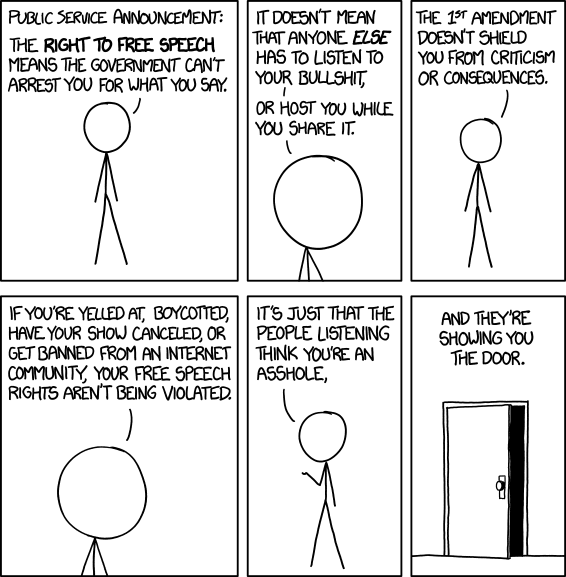
http://xkcd.com/1357/

So I guess I'd better write something about the Great Mozilla Flap of 2014.  In case you haven't heard, Brendan Eich, the recently-elevated CEO of Mozilla, which produces the Firefox browser, came under attack because in 2008 he donated a thousand dollars to support the anti-same-sex-marriage Proposition 8 in California.  After a little more than a week of controversy, including calls to boycott Mozilla products, Eich stepped down.  Which was a relief for me, because after checking the main alternatives, I wasn't sure I was willing to switch to another browser; I have some problems with Firefox, but I'm used to it and I don't much like Chrome or IE.

Conor Friedersdorf summed up the controversy reasonably well here; I also liked this post by Ampersand at Alas, a Blog, which helped me sort out my own position.  It reminded me that I'd written much the same things in this post right after the success of Prop 8 at the polls in 2008. Entertainingly, Andrew Sullivan got upset over Brendan Eich's departure, though he helped lead the attack on the liberal gay-marriage supporter Alec Baldwin for using homophobic language, even unto Baldwin's losing his TV program. (Maybe because Baldwin is a high-profile Hollywood liberal and Eich is a right-wing libertarian who supported Ron Paul?)  Baldwin singled out Sullivan for contumely as part of the "fundamentalist wing of gay advocacy." And the fuss hasn't died down yet, as shown by xkcd's latest cartoon, linked above, which has been getting shared widely on the Intertoobz, including sf writer John Scalzi's blog.

For a computer/math geek and science cultist, xkcd has wandered off into irrationality with this cartoon. Part of what he says is fair enough, I guess: I agree that the First Amendment only applies to government censorship, so being fired for your political or other views is not a violation of your First Amendment rights.  This has been brought home repeatedly in the controversies over Paula Deen, Juan Williams, Phil Robertson, and others lately.  (Oddly, when the racist writer John Derbyshire was fired from the National Review two years ago for his expressed views, few right-wingers came to his defense.)  Nor is it a violation of your freedom of speech to be kicked out of an Internet forum, or if your letter to the editor of a newspaper isn't published, or if you're attacked in the "mainstream media" for attacking your political opponents.  So far so good.

But xkcd made some odd statements, starting with "It doesn't mean that anyone else has to listen to your bullshit" and climaxing with "It's just that the people listening think you're an asshole, and they're showing you the door."  On a narrow literal level, the first statement is also true, but "bullshit" is perniciously irrelevant, as is "asshole."  It doesn't matter whether what you say or write is "bullshit," but the question arises: Who gets to decide that what you've said is bullshit, or that you're an asshole?  At Scalzi's blog I posted a comment, asking whether Phil Donahue was fired from MSNBC in 2003 because he was an asshole?  And how many people who are grimly celebrating the fall of Brendan Eich now, threw hissyfits over Donahue's losing his TV show because he gave a forum to opponents of the Bush-Cheney invasion of Iraq?  Many liberals and progressives did at the time, and they're still upset a decade later; I'll cite Chris Hedges for special notice because of his overwrought claim that "TV news died" when Donahue was shown the door.  As if the corporate media had ever given a platform to critics of US wars; Hedges surely must know better.

Another commenter at Scalzi's blog bit.  They wrote:
@Duncan, more like MSNBC’s viewers were letting MSNBC know they thought he was an asshole, and MSNBC decided that it did not want to present programming by someone their viewers thought was an asshole. Unless you’re implying that he lost his show because the government applied pressure to MSNBC?
No, I wasn't implying anything of the kind; as far as I know, the government applied no pressure to MSNBC.  There was no need to.  The decision to get rid of Donahue seems not to have had anything to do with "viewers" thinking Donahue was an asshole; it came from the upper reaches of management, as revealed by a leaked internal memo which warned that Donahue presented a "difficult public face for NBC in a time of war.... He seems to delight in presenting guests who are anti-war, anti-Bush and skeptical of the administration's motives."  The decision was framed in commercial terms, that at a time when MSNBC wanted to "reinvent itself", Donahue might put off an "anticipated larger audience who will tune in during a time of war" by linking pundits to war coverage, "particularly given his public stance on the advisability of the war effort."  So far I haven't seen any of Donahue's advocates acknowledging that a corporate network has the right to determine the face it shows to its audiences, and to dismiss employees like Donahue who don't fit its plans to reinvent itself.  But that was last year, after all.

There are other examples I could give.  Michael Moore, who is widely regarded as an asshole by conservatives and liberals alike, publicly opposed the Iraq war before it became safe to do so, and endured death threats, vandalism of his home, and (unsuccessful) physical attacks as a consequence.  (He was also harshly criticized by liberal heroes and Iraq war supporters Keith Olbermann and Al Franken, whom I consider assholes.)  But while I doubt that those who've justified the firing of various right-wing bigots would be comfortable defending the response Moore faced because of his 'bullshit,' I wonder how many of them are even aware of it?  And it's true, death threats and bomb plots go way beyond what xkcd is talking about.  But c'mon, the audience at the Academy Awards had every right to boo Moore because they didn't want to hear this asshole spout his bullshit, right?

I hope this points to the problem not only with xkcd's specific point about bullshit and assholes, but to the broader defense of private businesses demoting, firing, and otherwise showing the door to people whose opinions and political stances rile others.  After all, John Scalzi has been called an asshole often enough, and though he runs his own blog he doesn't own the Internet hardware that stores and transmits it -- it's in the hands of private companies, who then could reasonably give him the boot if enough people complained that he was an asshole and they didn't want to read his bullshit anymore.  A common argument used about Internet forums is that if your comments get deleted or you get banned from the comment section, you can always start your own blog.  And that's true, but what if you can't find a host for your bullshit?  This happened to Wikileaks a few years back, for example; and why not, since Julian Assange is widely considered an asshole by right-thinking people?  Why should they have to listen to his bullshit?  They were just showing him the door.

Throwing around words like "asshole" and "bullshit" in this situation is a rejection of rational debate.  I've pointed before to the way many people all over the political spectrum confuse a person's opinions with their style of presentation, which are separate issues.  And while it's convenient (which is to say, lazy) to dismiss free-speech issues by characterizing the offending speech as "bullshit," it's irrelevant.  It seems to me to echo the distaste for critical thinking I've seen exhibited by many good liberals and progressives, who want to impose, with varying degrees of force, their opinions on the benighted troglodytes who aren't as rational as they like to believe they are.  (And no, this has nothing to do with being "open-minded."

Many of Eich's critics argued that his offense went beyond speech into action: he donated a thousand dollars to support the campaign for Proposition 8 in 2008, to ban same-sex civil marriage in California.  I've seen quite a lot of GLBT people say that because he tried to take away their rights, he had no right to be CEO of Mozilla.  (I would agree that he doesn't have a right to be CEO of Mozilla, but that doesn't seem to be what these people meant -- I think it's more like the person who wanted Paula Deen to "lose everything.")  I suppose that case could be made, but matters of principle must apply across the board, not just to specific cases, so let's consider some analogous possibilities.  Can a company fire an employee who contributes to an organization seeking to raise taxes on businesses, or on the top income brackets?  Such an employee could reasonably be accused of trying to deprive businesses or rich individuals of their right to keep as much of their income as possible.  How about union organizers (to say nothing of strikers), who also seek to limit the power of business owners and management, thereby affecting them in their pocketbooks?  Though labor law has limited the freedom of workers to organize and strike, our society and the law recognizes at least in theory that people have the right to assert their rights at what may be the expense of their opponents.  Not all freedom is a zero-sum game, where one person gains only if another loses, but sometimes it is.  People have the right to advance themselves at others' expense in such situations.  It's certainly not true that a person who does so has automatically forfeited his freedom of speech or action.  And contrary to another liberal-left claim I've often seen, freedom of speech does extend to "hate speech" and advocating the diminution or removal of other people's rights.  Those others have the corresponding freedom to respond with more speech, including hateful speech as they often do.  That's part of the messiness of living in a free society.

I guess I should clarify that I'm not displeased that Brendan Eich stepped down; I think that the criticism of Mozilla and the pressure it produced were legitimate.  But I do think that some of those who agree with his demotion are not clear about what the issues are, what they were doing, or how the same tactics can and will legitimately be turned against people they support.

I don't think there's an easy answer to this problem, but I do think that the power corporations and other private, ostensibly non-government entities, can exercise over people's expression is a matter that ought to concern those who care about public debate.  It appears to me that many liberals and "progressives" and even leftists are all too accepting of corporate power over corporate employees, because it's not government power.  lt's just not possible to separate the public and the private that neatly.  And what these recent controversies -- not just Eich, but Deen and Robertson and others -- indicate to me is that for many if not people, their positions on any given case are determined by where they stand on the issue.  If they approve of the opinions of the person fired, they get indignant; if they don't, they celebrate and justify the firing.  Which is their right, of course; but it doesn't bespeak a principled commitment to freedom of expression.

Saturday, September 11, 2010

Sanity and Rationalism

Michael Moore just posted to his blog in support of the Cordoba Initiative, and has committed to match other people's donations up to $10,000. I made a donation myself.

The first comment to Moore's post, though, just boggled my mind:
Can I just point out that all religions are 'made up' - I actually believe stupidity on this scale should be made an offense and punishable by locking up in a mental hospital.
The world would be an awesome place without all these horrible religious people everywhere,
Why let these people build a mosque? They believe in some made up tooth-fairy-santa-clause-style tosh - I mean, THEY ACTUALLY BELIEVE IT!!!!!! Those are some dangerous people to have walking around the streets don't you think - all religious people I mean. I just can't fathom it!
Yup yup, I agree (and have insisted on the point) that all religions are made up by human beings. But from there the commenter goes batshit crazy, claiming "stupidity" to be a criminal "offense" that should be "punishable by locking up in a mental hospital." Well, he's honest enough on that point -- that commitment to a mental hospital too often is simply a form of incarceration -- but it gives his game away: he's just a religious nut hiding behind legalistic and medico-scientific terminology. The confusion of crime and mental illness here is very common; you can see it when someone spits out "sick" at another someone whose sexual behavior or mode of dress bothers him, or when gay people and their allies use "homophobia" as a moral judgment. "Homophobia" is theoretically an illness, and you can't judge a sick person morally -- though you can administer electroshock to them, or lobotomize them, or drug them into submission and lock them away for the rest of their lives in an institution. So much better than religious intolerance, isn't it?

How would the world be different, let alone "awesome" without all "these horrible religious people everywhere"? Religion, I repeat, is made up by human beings. If religious imagery and belief disappeared tonight, people would simply find new language to rationalize and justify their behavior. There's no need for concepts like "heretic" or "infidel" when you have "stupidity", criminal "offense", and "punishment." By using the barely secularized notion of punishment, this commenter showed how religious he still is.

Aside from that, the commenter has not given any good reason why the Cordoba Center should not be built. First, he joins the legions of frothers who forget that the Center will not only be a "mosque" but a community center open to all. If you must have a prayer room in a building dedicated primarily to other purposes, better something like the Cordoba Center than something like the Pentagon, whose primary purpose is the organization of aggression and mass murder. Second, what is wrong with "tooth-fairy-santa-clause[sic]-style tosh"? Again, better that than the Mordor-Sauron tosh of the Pentagon, but let me take the commenter literally. If someone wanted to build a multimillion-dollar community center dedicated to the Tooth Fairy or Santa Claus, and furnishing the same range of services proposed by the Cordoba Center, how would that be (in the commenter's word) "dangerous"? Silly, yes, but also socially useful. Would the commenter rant like this about computer nerds who study Elvish, Klingon, or Navi? Much of what human beings do is silly, fanciful, nonrational or even irrational. For example: from a "rationalist" point of view, sex without reproduction in mind, whether heterosexual or homosexual, is silly, undignified, degrading, animalistic -- which is why the medical profession and the biological sciences have mostly just carried over the worst, most irrational "religious" ideas about sex and medicalized them.

Far more dangerous is the commenter's readiness to incarcerate people for believing silly, false things. That's utterly at odds with the whole "Enlightenment" project that was supposed to put an end to the bloody-minded intolerance of Religion, but so far hasn't done so. On the contrary.

Monday, July 5, 2010

Let Freedom Ring ... But Don't Answer


I've criticized Michael Moore several times here, mainly for his initial embrace of and ongoing reluctance to criticize Barack Obama, but I still think Moore is one of the more useful Americans. Being useful doesn't exempt you from criticism, but he has been more successful in putting alternative politics before a mass audience than almost anyone else, and the fact that American liberals have attacked him so strongly and dishonestly should be a warning signal to American leftists. We don't have to agree in every respect with people who are, basically and effectively, on our side.

I haven't been following Moore's career very closely for the past several years. I keep buying the DVDs of his films, but haven't gotten around to watching them. (Which is not much of a distinction -- there are many films I've really wanted to watch that I haven't gotten around to.) So I hadn't known about the aftermath of his denunciation of George W. Bush at the Oscars in 2003, just a few days after Bush's invasion of Iraq:

We got back to Michigan. Our house was vandalized, horse manure spread everywhere, signs on the trees telling us to move to Havana, and everything else, which, when you live in Michigan in the winter, that actually doesn’t sound so bad.

And then life got—you know, I decided to say just to hell with it, and I, fifteen months later—in those fifteen months, I made Fahrenheit 9/11. And it was made during this time of constant death threats, constantly being attacked physically—and I’ve told you some of this before. I don’t really like to talk about it publicly, because I don’t want to encourage, you know, nuts to—but eventually, they had to put—I had a total of—it got up to nine bodyguards on me, three per shift, twenty-four hours a day, living with us.

You know, I mean, there was the guy in Nashville that came, jumped up on the stage with a knife. There was a guy in Portland that had a metal pipe coming at me. There was the guy in Fort Lauderdale who was just walking out of Starbucks and saw me on the sidewalk and became livid and took the lid off his hot, scalding coffee and threw it in my face. The bodyguard was so—I mean, he was so fast, he put his face in front of mine to catch it and got second-degree—we had to take him to the hospital, but not before he took the guy down on the sidewalk and handcuffed him. And then, there was the guy who was going to blow up our house. And he was making his practice bombs in Illinois, and one night one went off accidentally. He wasn’t hurt. The neighbors heard it. They called the cops, and they came there, and they saw all the materials and the list of people whose homes he was going to blow up. And it was Janet Reno, Rosie O’Donnell, Hillary and me. And how I made it on the lesbian list, I don’t know, but I—But Girlfriends Magazine, the following year, named me "Man of the Year," so—that’s the lesbian magazine. So, no, all I can—I try to laugh about it, because—anyways, he was convicted and went to the federal penitentiary.

And as I’ve said to you privately, I’ve wondered at times if I had it all to do over again, whether I actually would, because I don’t know if it’s been worth it, personally. I don’t think it’s been good for my health. I don’t think it’s been fair to my family to have to live in fear, to my eighty-nine-year-old father, who lives alone, who has to live with that fear, and all the security apparatus that has to be put in place to protect them. And the honest answer—I’d like to give you the brave answer, but the honest answer is I’m not so sure I would do it again, having gone through what I went through at that time. And I say that only because I’m human, and I’m every bit as frightened of not being able to finish my life as any of you would be.
He also mentions that Keith Olbermann attacked him ("since apologized," though, as he should), as did Al Franken, because they were in favor of the war.

It seems to me that I've seen right-wing Republicans and their apologists complaining about liberal intolerance and even threats of violence against "conservatives," which often turn out to be fabrications. So I'm writing about this here to give people, including me, a handy rebuttal to anyone who claims that liberals are exempt from death threats, physical attacks, and bomb plots.

Friday, August 21, 2009

Celebritize Me


The trailer for Michael Moore's Capitalism: A Love Story is now online, and it occurs to me that the teabaggers, the birthers, and the town hall clowns should be asked what they think about Michael Moore now. Hasn't he been saying all along what they are now saying -- that corporate America feeds like a vampire on the mass of the American people, and that the government enables them with billions in taxpayer money? That it's time to stand up and put a stop to the madness? Where have they been for the twenty years since Roger and Me was released? Why, complaining (or jeering) that Michael Moore is fat, of course.

Granted, it will be very difficult to get them to speak coherently about such things. As Roy Edroso writes,
It could be that these folks haven't thought any more deeply about it than their comments reveal. Maybe AP didn't talk to them long enough to find out what's really driving them. Or maybe message discipline has something to do with it: When the anti-Obama "tea party" movement held its first New York event back in February, many people stepped up to the bullhorn to denounce the socialism, Shariah law, and Hitlerism of the Obama administration. At the next, much larger, New York event, the few citizen-speakers who made it to the stage were carefully guided by the organizers; the more professional speakers who dominated put the ix-nay on the ocialism-say, and focused on "entrepreneurship," "out-of-control" spending, and the like.
That's my problem. I'm sympathetic to people who are critical of Big Gummint, but when all they've got to fill out their critique is the lies we've been hearing -- Kenya, Hitler, Ayatollah Obama, and death panels -- with a serene refusal to recognize just how much they love all kinds of Big Gummint programs -- not just Social Security and Medicare, but public schools, public highways, public libraries and public space in which to hold their teabag rallies -- and without much in the way of substantial criticism to balance the lies, then I'm not inclined to join their party. The people Hitler appealed to, after all, had their own good reasons for being dissatisfied; even better reasons, very possibly, like hyperinflation and unemployment rates that far outrun anything the US has to face ... yet. Still, they preferred to blame the Jews and the Communists for their problems. Sounds familiar, doesn't it?

I'm pleased to notice that Glenn Greenwald seems to be less worried than he used to be about being on the margins. Now that Tom Ridge has said aloud that the Bush administration manipulated terror alerts to keep the populace scared, nice mainstream journalists are floundering, just as they have been about the War on Terror generally. It turns out that the fringe leftist hippie conspiracy theorists were right all along, so they must have been right for the wrong reasons. Greenwald cites Marc Ambinder of The Atlantic, who
acknowledges that Bush critics were right that the terror alerts were being manipulated for political ends (he has no choice but to acknowledge that now that Ridge admits it), but still says journalists like himself were right to scorn such critics "because these folks based their assumption on gut hatred for President Bush, and not on any evaluation of the raw intelligence." As always: even when the dirty leftist hippies are proven right, they're still Shrill, unSerious Losers who every decent person and "journalist" scorns.
Ambinder has retracted the "gut hatred" bit, but left the rest of his claim intact. As Greenwald points out, "gut hatred" isn't really the problem. The trouble is Ambinder's admission that, "living as we do in a Democratic [sic] system, most journalists are going to give the government the benefit of some doubt, even having learned lessons about giving the government that benefit". In other words, despite having had their faces rubbed in government lies, most journalists are going to keep coming back for more. So, apparently, will the people who read or watch these journalists.

My only complaint about Greenwald's discussion is that he harks back to a day when "Distrusting the statements and actions of government leaders was once the central value of our political system and of basic journalism." There was not ever such a day, as far as I know. Greenwald mentions I. F. Stone and his dictum that all governments lie, forgetting that Stone was a pariah among respectable journalists -- the exception, not the rule.

Still, Greenwald is making progress. Today's post starts from a Paul Krugman column. Greenwald says:

More than any betrayal on a specific issue, it is Obama's seeming eagerness to serve the interests of those who have "run Washington for far too long" -- not as a result of what he has failed to accomplish, but as a result of what he has affirmatively embraced -- that is causing what Krugman today describes as a loss of trust in Obama from those who once trusted him most. This approach is not only producing heinous outcomes, but is politically self-destructive as well. In a superb post the other day, Digby recounted what fueled the Naderite movement in 2000 and warns, presciently I think, that the willingness of Obama/Emanuel so blatantly to disappoint those to whom they promised so much (especially young and first-time voters who were most vulnerable to Obama's transformative fairy dust) will lead them either to support a third party or turn off from politics altogether:

Rahm Emanuel believes that the key to Democratic success is a coalition in which Blue Dogs and corporate lackeys mitigate progressive change on behalf of the moneyed interests which he believes the political system must serve. Regardless of his malevolent view of how the political system should work, on a political level, I think he's living in the past. . . .

But on a political level, the left has been betrayed over and over again on the things that matter to us the most. The village is pleased, I'm sure. But the Democratic party only needs to look back eight short years to see just how destructive it is to constantly tell their left flank to go fuck themselves. . . .

At the time [in 2000] nobody believed that an incumbent Vice President in a roaring economy would have a race so close that the Republicans could steal it. But we know differently now don't we? And you would think that the Democratic establishment would also know that because of that, it may not be a good idea to alienate the left to the point where they become apathetic or even well... you know. It can happen. It did happen. Why the Democrats persist in believing that it can't happen again is beyond me. . .

Obama mobilized a whole lot of young people who have great expectations and disappointing them could lead to all sorts of unpleasant results. Success is about more than simply buying off some congressional liberals or pleasing the village. It's worth remembering that a third party run from the left is what created the conditions for eight long years of Republican governance that pretty much wrecked this country.

After 2000, what is it going to take for the Democrats to realize that constantly using their base as a doormat is not a good idea? It only takes a few defections or enough people staying home to make a difference. And there are people on the left who have proven they're willing to do it. The Democrats are playing with fire if they think they don't have to deliver anything at all to their liberal base --- and abandoning the public option, particularly in light of what we already know about the bailouts and the side deals, may be what breaks the bond.

It's really not too much to ask that they deliver at least one thing the left demands, it really isn't. And it's not going to take much more of this before their young base starts looking around for someone to deliver the hope and change they were promised.

Of course, what Greenwald and Digby are describing here is simply the Democratic Leadership Council's program to win power from the Republicans by appropriating their policies. This program gave us Bill Clinton, Al Gore, and the other Democratic Presidential candidates of the past twenty years. From a strictly Realpolitik point of view, it's unexceptionable; from the point of view of the great majority of Americans, it's totally objectionable. Someone needs to find a way to break the hold the DLC has over the Democratic Party. But national politics is a very expensive business, and the DLC's partnership with the corporate bloc means that they will be able to outspend any foreseeable challengers. Obama had gone over to the Dark Side by the time he ran for the Senate, which is why we dirty hippie leftist conspiracy theorists have not been surprised by his conduct as President. He raised a lot of money from the netroots, but he couldn't have won the election if he hadn't gotten the support of the national party and its corporate donors. Which brings me to Greenwald's other important point:
Indeed, as I've written many times, "trust" is appropriate for one's friends, loved ones, family members and the like -- but not for politicians. That's what John Adams meant when he said: "There is danger from all men. The only maxim of a free government ought to be to trust no man living with power to endanger the public liberty." "All" means "all" and "none" means "none."

But that's not how our political culture works generally. Our politics have become entirely celebretized. Political discussions typically resemble junior high chatter about one's most adored and despised actors: filled with adolescent declarations of whether someone "likes" and "trusts" this politician or "dislikes" that one. "I trust Obama" has long been a common refrain among his most loyal supporters. The fact that, as Krugman says, that is much less true now is quite significant, even if "trust" is an inappropriate emotion in the first place to feel towards any political official.

Here too Greenwald can't keep from appealing to an American lost innocence that never was. American politics has always been "celebritized," with politicians running on image more than substance. George Washington, the Father of His Country; Abe Lincoln the Rail Splitter from Illinois. But the main point, that trust is not appropriate for politicians, is gold. It's easy to entertain a healthy skepticism toward guys from the other team; what's hard, but utterly necessary, is to be just as skeptical about one's own candidate.

Tuesday, April 22, 2008

Surely, Comrades, You Do Not Want Bush Back?

I’ve heard words to this effect from various Democratic liberals over the past year, but I was surprised to hear them from Michael Moore (via):

I’m almost at the point where I don’t care if the Democrats don’t have a backbone or a kneebone or a thought in their dizzy little heads. Just as long as their name ain’t “Bush” and the word “Republican” is not beside theirs on the ballot, then that’s good enough for me.

I, like the majority of Americans, have been pummeled senseless for 8 long years…

It’s true, the past eight years have taken their toll -- so much so that Moore, like so many liberals, has trouble remembering that the Democrats in Congress eagerly helped Bush pummel him senseless. Why should they be rewarded for collaborating with him?

But Mike, Bush’s name is not going to be on the ballot this year. If he could run, I have no doubt he’d be trying, but thanks to the Twenty-Second Amendment to the US Constitution, he can only serve for two terms. And because I’m hopelessly pessimistic (about the Democrats, mind you), I’d almost be curious to see what would happen if he could run again. Given his unpopularity even among many Republicans, could he get his party’s nomination? And if he did, could the Democrats defeat him? Frankly I doubt it, but fortunately we don’t have to find out. And they’ll still have Ralph Nader to blame if McCain beats whoever the Democrats take for their lawful nominee.

I’ve been surprised when liberal Democrats have started ranting in my presence that they want to see Bush defeated this year. I gently point out that he isn’t running. I know, they pant, but I want to see him defeated. (He isn’t running.) I know, but I want to see that bastard defeated, I want to see him go down It’s like listening to a feral wino muttering about the International Space Jews who’ve put wires inside his head to control his thoughts. “Reality-based”? They flatter themselves. What seriously scares me is how out of touch with reality most Democrats are; they aren’t more or less so than Republicans in general, they just have their own separate fantasy universe, as the Republicans have theirs.

A friend asked me last weekend, a propos my post on Barack Obama’s “proselytizing” remark, what I expect from a pro-gay presidential candidate. Well, it would help for such a candidate not to use bigoted and nearly forgotten clichés about us (this was the first time I can recall having seen “proselytize” used with regard to gays in a decade or more). But as I told my friend, that remark is not why I don’t support or trust Obama. On gay issues he’s quite good, all told, for a mainstream politician. But I’m not a one-issue voter, and I have plenty of other reasons for not supporting him. If I did support him and plan to vote for him, words like “proselytize” would set off alarms in my head, and I would criticize him (I hope) in the same terms I’ve been using here.