Showing posts with label race. Show all posts

Friday, January 30, 2026

He Strictly Charged Them to Tell No One About Him

The discourse on race / ethnicity stinks to high heaven. 

A new movie version of Wuthering Heights will be released next month, and not for the first time there's controversy over the casting of Heathcliff.  It has been more than a decade since I last read the book, and I'm in no hurry to do it again, but as I remember, Heathcliff was a man of mystery, of ambiguous and unknown ancestry.  The discussion I saw on Twitter/X today agreed, but people were still trying to pin him down, while others tried to impose "modern" Foucauldianism on the story.  For example, dismissals of "people who interpret everything through contemporary American racial dynamics," or "But Heathcliff is supposed to be possibly-not-fully-white by the standards of late 18th C Yorkshire, which is not the same thing as being clearly nonwhite by modern standards... He isn't clearly described as nonwhite, but as someone who raises suspicions because of an ambiguous appearance and background."

Whose modern standards?  Which modern standards?  The new movie is a US-UK production.  British racial dynamics are different than US racial dynamics, and both sets are complex and incoherent, even leaving "mixed-race" people out of it.  Jacob Elordi, who plays Heathcliffe in this version, is Australian with a Basque father. Judging by this publicity photo, I think he looks suitably ambiguous by modern standards.


"White" and "non-white" aren't clear categories, and never have been. As I've pointed out before, in English usage "black" is applied to human beings along a continuum from black hair to being sub-Saharan African.  Here's how Heathcliff made his first appearance to the Earnshaw family:

We crowded round, and over Miss Cathy’s head I had a peep at a dirty, ragged, black-haired child; big enough both to walk and talk: indeed, its face looked older than Catherine’s; yet when it was set on its feet, it only stared round, and repeated over and over again some gibberish that nobody could understand. I was frightened, and Mrs. Earnshaw was ready to fling it out of doors: she did fly up, asking how he could fashion to bring that gipsy brat into the house, when they had their own bairns to feed and fend for? What he meant to do with it, and whether he were mad? The master tried to explain the matter; but he was really half dead with fatigue, and all that I could make out, amongst her scolding, was a tale of his seeing it starving, and houseless, and as good as dumb, in the streets of Liverpool, where he picked it up and inquired for its owner. Not a soul knew to whom it belonged, he said; and his money and time being both limited, he thought it better to take it home with him at once, than run into vain expenses there: because he was determined he would not leave it as he found it. Well, the conclusion was, that my mistress grumbled herself calm; and Mr. Earnshaw told me to wash it, and give it clean things, and let it sleep with the children.  

Children, even little blue-eyed blond-haired rosy-cheeked English children, were commonly called "it" in English well into the twentieth century, so this passage shouldn't be assumed to be racist.  Heathcliff is referred to as a "gipsy," a "a little Lascar [i.e. South Asian], or an American or Spanish castaway" by other characters in the novel.  Whatever the racial dynamics of late 18th-century Yorkshire were, they weren't clear.  Numerous people have pointed out that Liverpool was a terminus of the Atlantic slave trade, and speculated that Heathcliff might have been a slave or the child of a slave. It's less often noted that the reader has at best only Mr. Earnshaw's word for it that he found the boy in Liverpool; what was he going to say, though, "This is my son by a slave wench"?  I don't assume that Emily Bronte had a clear picture of Heathcliff's ancestry in mind, nor that she could have explained herself clearly if pressed. Intentionally or not, she gave an accurate picture of the racial dynamic in her day by showing that Yorkshire folk just threw around a salad of labels for the boy. They didn't care much what he was, only that he was Other.  (I couldn't resist thinking of the various answers the Twelve gave when Jesus asked "Who do men say that I am?" "Some say John the Baptist; others say Elijah; and still others, one of the prophets.")

On "gipsy," Roma are not a single "racial" group: see the 1993 musical / documentary Latcho Dromwhich ranges from India across Europe to Spain.  If Heathcliff could have been "a Spanish castaway," he could have been Basque; he still wouldn't have been white. Complaints about the casting of Elordi that call him white are as inadvertently entertaining as the complaints that Neo in The Matrix was played by a white actor.  (Keanu Reeves is multiethnic, to put it gently.)  The gatekeepers are as ignorant as their opponents, and contribute little or nothing to improving the discourse.

Are Hispanics white?  Hey, remember the right-wing think-tanker who thought that Spanish speakers are a "race"? But he wants you to know that he's not a racist. Remember the liberal queer diversity educators who insisted that Sunni and Shi'a are ethnicities?  Jon Schwarz likes to remind us that Benjamin Franklin said that Germans are "swarthy," that is, dark-skinned:

Which leads me to add one Remark: That the Number of purely white People in the World is proportionably very small. All Africa is black or tawny. Asia chiefly tawny. America (exclusive of the new Comers) wholly so. And in Europe, the Spaniards, Italians, French, Russians and Swedes, are generally of what we call a swarthy Complexion; as are the Germans also, the Saxons only excepted, who with the English, make the principal Body of White People on the Face of the Earth. I could wish their Numbers were increased. And while we are, as I may call it, Scouring our Planet, by clearing America of Woods, and so making this Side of our Globe reflect a brighter Light to the Eyes of Inhabitants in Mars or Venus, why should we in the Sight of Superior Beings, darken its People? why increase the Sons of Africa, by Planting them in America, where we have so fair an Opportunity, by excluding all Blacks and Tawneys, of increasing the lovely White and Red? But perhaps I am partial to the Complexion of my Country, for such Kind of Partiality is natural to Mankind. 

You see, it's okay for a Basque to play Heathcliff: they aren't white! And I remember that light-skinned African-Americans sometimes passed, or were mistaken for Mexicans or or Latins.

A similar casting dilemma affects Shakespeare's Othello. What is a Moor, in Elizabethan racial dynamics?  Othello is called "black" by some characters, and he might have been African, but probably not. Numerous commenters in those threads mentioned that in more recent adaptations, Othello has been played by black African actors.  Laurence Olivier (who also played Heathcliff in a film version of Wuthering Heights) played Othello in blackface in a 1965 movie performance. (My goodness, the whole thing is on YouTube.)  Like this:

No Professor, You Must NOT Apologize ... 

Then there was Andrea Arnold's 2011 version of Wuthering Heights, in which Heathcliff was played by an Afro-British actor.  I found it uneven but interesting, partly because the dialogue included some F-bombs. Was that "authentic"? "Correct"?  Bronte couldn't have published the novel with such language, and I have no idea whether she knew the word, but probably she did, and the expletives were in character for Heathcliff.  The English were notorious for their foul language: Joan of Arc called them "goddens," or "goddamns."

I don't intend to see the new version; I'll see how the reviews are.  But I don't love the book, so why bother? The anxiety and confusion over the casting - there's also an actor in it with an Arabic name, and a Chinese as well - drew my attention to it, that's all.  Is there even any point in trying to sort out the tangled web of race / ethnic discourse?  I don't think it can be done.

Tuesday, July 22, 2025

The Race Is Not To The Swift

A few days ago I wrote "White supremacists have historically regarded everyone who isn't 'white' as 'black,' and the N-word has been flung at people of many backgrounds."  I was a bit vague because although I knew I'd seen it, I didn't have any examples to hand.

The next day I began reading Ruined City, a 1938 novel by Nevil Shute, who's best known nowadays for his 1957 post-nuclear war novel On the Beach.  Ruined City is about a successful English banker named David Warren whose life is derailed when he learns that his wife has been having an affair with an Arab prince.  Everyone refers to the prince as "black," including Warren, who in a fit of anger drops an N-bomb but then corrects himself.  "In that he was unjust, and he knew it; among the six or seven strains that went to make Prince Ali there was no negro blood."  That's actually funny - as if it wouldn't be unjust if Ali did have "negro blood" - but I don't think Shute meant it to be.

This terminology is, I believe, more common in British writing than in American, and it's why it's often difficult to tell which race/ethnicity a character is meant to be - for example, Othello - because the writers are sloppy and don't care.  The scientifically-minded Shute (he was an aeronautical engineer and several of his novels deal with flying machines) cared enough to be exact in his labeling, but that led to comedy, as it still does.  (Are "Hispanics" a "race"?  Are Sunni and Shi'a Muslims "ethnicities"?)  Most scientists in Shute's heyday held beliefs about race/ethnicity (and sex/gender) that are considered embarrassing today, but they are still with us in slightly different forms. 

Although many people, and I include scientists here, are desperate to preserve race as a valid category, I've yet to see any persuasive case made to do that.  I can't find the public-radio program that touted BiDil, a handsomely-funded drug for heart failure that claimed to be more effective for "patients who identify as black."  It was boosted even before the FDA approved it in 2005, but it bombed, for several reasons. One, it was overpriced, and since it was just a combination of already existing generics, insurance companies substituted the generics.  Two, "in every study, however, the amount of variation within each racial group was far larger than the differences between the between the groups ... As a result, 80 to 95 percent of all black and white patients will likely have indistinguishable responses to each medication.  Although racial differences might exist, they are irrelevant for the majority of patients" (167).  "Whatever the causes of its failure, NitroMed laid off most of its workforce and stopped marketing BiDil in January 2008 [165]."

Despite this, BiDil continues to be touted as a road not taken, if only in principle; GoodRx, the drug discount site, still recommended it as late as 2023.  "Some Doctors Want to Change How Race Is Used in Medicine," this NPR podcast reported in 2022, surprised that some doctors don't want to change, because they believe that there are black kidneys and white kidneys.  It's tempting, and comfortable for many people, to see racism as a problem only among ignorant hillbillies, but that notion doesn't stand up to scrutiny.  Many highly-educated people, not all of them white, won't give up their belief in racial difference until you pry it from their cold, dead hands; and even then, a new generation takes it up.

I don't object to treating "race" as a scientific category because of "political correctness," or even from scientific correctness, though it has been debunked enough times that if you believe in Science you shouldn't rely on it.  What I want to know is how it's a useful category, and by "useful" I don't mean "useful for making a billion dollars by repackaging existing generics."  I mean something like what bearing it has on any issue of scientific significance.  (See the quotations from Noam Chomsky in this post.)  What I've seen so far is a complacent assumption that it must be significant somehow, even if no one has any idea what or how.

* David Jones, "The Prospects of Personalized Medicine," in Genetic Explanations: Sense and Nonsense, ed. Sheldon Krimsky & Jeremy Gruber (Harvard, 2013), p. 163.  Future page numbers refer to this article. 

Monday, July 14, 2025

Tuck Me into Your Procrustean Bed, Big Daddy

If you need more evidence that our discourse around "race" and "ethnicity" stinks to high heaven, look no further than the freakout over New York City mayoral candidate Zohran Mamdani and his college applications.  Corey Robin had a good post about it on Facebook today.

A couple of weeks ago, there was a blip of a story that temporarily seized the media and folks on Facebook about Zohran Mamdani's college application, where he checked off the boxes for Asian American and African American, while specifying very clearly that by African American he meant that he was from Uganda. The media, Mamdani's opponents in the race, most notably Eric Adams, and other commentators immediately used the story against him, claiming that Mamdani was trying to game the affirmative action system for his personal advantage by falsely claiming he was Black and Asian American.

In fact, Mamdani is Asian American and African-American.  His parents are South Asian by ancestry, and his father was born in Uganda, as was Zohran.  Robin continued:

Long story short: the Mamdani family, especially on his father's side, firmly identified with being African. It was critical to their identity and family story, particularly when Idi Amin kicked out people of Indian descent, claiming that because they were not Black, they were not African. (If you've ever seen Mississippi Masala, which I saw when it came out and recently re-watched, it tells that story, and of course Mississippi Masala was made by Zohran's mother and Mahmood's wife, the filmmaker Mira Nair.) Mahmood Mamdani has written at length on the importance of his, and his family, being African, creating a world for themselves in Uganda and Tanzania, not as part of an Asian diaspora, but as Africans, or as Asian-Africans, if you will.

The ethnicity boxes on college applications (and just about everywhere these days) are notoriously Procrustean, like the ethnicity boxes for the US census.  What box should young Zohran have marked, since there evidently wasn't a "South Asian" one, and as Robin says, "African" was also legitimate.  Africans aren't "racially" monolithic anyway; due to the slave trade, most black Africans in the US were from sub-Saharan western Africa.  White supremacists have historically regarded everyone who isn't "white" as "black," and the N-word has been flung at people of many backgrounds.  Racial categories on the US census have varied over the years.

Consider another complicated case: what "race" or "ethnicity" are Latin Americans?  Many have predominantly European ancestry, though Spaniards haven't always counted as whites in the US.  But Germans and Poles have also contributed to the mix.  So have Chinese, Japanese, and South Asians.  Many have predominantly "Indian" or "Native American" ancestry, and speak indigenous languages as well as or instead of Spanish, though Americans tend to limit both of those categories to North American Indians.

I've told before of the diversity training session twenty years back at the Big Ten University where I worked, whose instructors told us that "Sunni" and "Shi'a" are ethnicities.  They definitely are not, any more than "Catholic" and "Protestant" are ethnicities.  I protested, and the instructors insisted that they were so.  So I let it go.  As I've also indicated before, I don't object to university diversity programs and policies on general principles, only to the ignorance and incompetence of the people who manage them.

I've been collecting anecdotes on this topic for a long time around here, such as the white liberals who thought it hilarious that a white American woman could set herself up as a Zen master, or who mock the Bible as the work of old white guys.  (Wait, wasn't it written by illiterate Bronze Age shepherds?)  I wish I could track down the white liberals who declared that race is as real as nappy hair, but that claim seems to be lost.  If hair color or texture were "racial" markers, then my brothers and I (born to the same parents) would be of different races. 

Then there was the Congressperson who threw a tantrum when a Sikh was invited to deliver a prayer in the House of Representatives.  First she claimed he was Muslim, then when corrected she insisted that non-Christian prayers should not be allowed in Congress even though Muslims and other non-Christians have led prayer there before.  Do I really care that she doesn't have a fine-tuned knowledge of racial, ethnic, or religious difference?  No, not really.

The people who attacked Mamdani's choices on his college applications postured as good liberals concerned for the well-being of real blacks and Asians, though they showed that they didn't understand the issues involved, and didn't care.  They're just throwing any mud they can at him, in hopes that some of it will stick.  One would think that in a time of resurgent US racism, they'd be more circumspect, but of course not.

Monday, December 27, 2021

What's Sauce for the Right Is Sauce for the Left

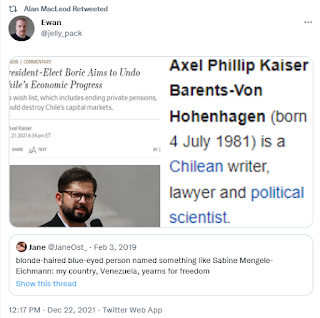
I found this tweet in Alan MacLeod's Twitter feed, and while I'm trying to be fair, I can't see any excuse for it.  By juxtaposing two images and an older tweet from another source, it aims for plausible deniability, but I think it misses the mark.

At first blush it's bluntly racist: the claims of the Wall Street Journal commentator (behind a paywall, sorry) can be evaluated by his name and ancestry.  Ditto for the person referenced in "Jane's" tweet below the images, though I confess her mockery of her target's name is mildly witty.  Remember when an American right-winger could say that you could tell that Obama is a terrorist because of his name, and we all jeered?  Remember American right-wingers' giggling that FDR's real name was Rosenfeld, nudge nudge wink wink?  But that was different.

Some of the commenters showed that Barents-Von Hohenhagen is a thoroughgoing right-winger, but he could be that while possessing black hair, olive skin, brown eyes, and a name like Guaidó or Bolsonaro or Fujimori.  What counts is his stance and his arguments, which appear to be standard corporate-media alarmism.  It also appears that he and his family have longstanding ties to right-wing circles in Germany.  I believe the local library carries the Journal, I might take a look at the piece when the library re-opens after its holiday break.

The same goes for Blanca von Buren Green, the other blond whom Jane mocked.  It's true that the great majority of Venezuelans are poor, usually brown people, and that many of the right-wing Venezuelan opposition are blond and blue-eyed.  But as the example of Juan Guaidó shows, many of them aren't.  What counts is their politics, which are determined by history, not by their "race."  So yeah, at second blush, this stuff is bluntly racist.

It's the accompanying photo of Chilean President-elect Gabriel Boric that threw me a bit off-balance.  I wondered if "Ewan" meant to contrast his dark, even swarthy appearance with Barents-Von Hohenhagen's name, as a badge of Chilean authenticity.  I remembered reading that he's Croatian by ancestry, and I was right.  According to his Wikipedia entry, his forebears arrived in Chile in the late 1800s, but they and he retain ties to relatives in Croatia to this day. He's leftish enough to give the far right conniptions (no great accomplishment), but he's no Chavez or Morales.  But y'know, he looks like he could be Chilean, as indeed he is. I doubt that Ewan or Jane or their granfalloon would defend him if he couldn't pass as non-white, at least to their eyes.  I can't say for sure, though, because the matter didn't turn up in the comments.

What Boric will actually do as President will have to be seen.  Maybe if he disappoints foreign leftists like Jane and Ewan, they'll start dragging up his Croatian ancestry to explain it.  They knew all along he wasn't really Third World.

What generally is overlooked in discourse at this low level is that colonialism in the Americas didn't begin with the US.  It began with Spain and to a lesser extent Portugal.  It's entertaining when Spanish-speaking creoles complain that they're colonized by the Yankees, but it must never be forgotten that they are colonizers themselves. (They're like colonial North American slaveholders who complained that the British Crown was enslaving them!)  The rise of indigenous movements in Latin America, exemplified by Chavez, Morales, and Castillo among others, are a reminder of this, and I'm a bit mystified by how often the US left forgets it.  But then, we have a rather limited range of attention; I'm not sure I'll ever get over how US progressives ignored the South Korean candlelight marches of a dozen years ago, even though that movement should have been on their radar.  The massive grassroots movement that led to the fall of then-President Park Geun-hye in 2017 got somewhat more attention here, but the US left still seemed not to recognize its significance.

I'm most concerned right now with the left's racialization of these issues.  People who freely deplore Trumpian deplorables still make inadvertently hilarious assumptions about religion and culture -- that the Bible was written by "white guys," for example; that there's something funny about a white female Zen master in the US; that a toxic-masculine Afro-Caribbean god is a model that white Christians should learn from; or that Muslims aren't white.  The specifics of the racism differ, but the errors that drive it stay the same.

Wednesday, July 3, 2019

Prejudice

Dan Savage has struck again.  Answering a letter from a liberal white guy about his girlfriend's sketchy comments about the attractiveness of black and Asian men --
The position that I’ve always held is that we’re attracted to individuals, not types, and it’s wrong to have expectations of people based on race—especially when it comes to sexualizing/fetishizing people. I think we should date and have sex with whomever we want and not carry prejudiced expectations into our relationships. 
The woman's remarks, as he reported them, were perhaps sketchy but not outrageous: she "has a thing for black guys" and found a Korean-American friend "handsome despite not typically being attracted to Asian guys."  It seems to me that people tend to fall back on cliches in talking about their attractions and sex lives, because that's what we learn from our culture and few people bother to think it through.  If someone is often attracted to people of color, "I have a thing for them" is likely how they'll express it in casual conversation, partly because that's how other white people will phrase it to them.  "You have a thing for black guys, huh?"  And that question expresses all sort of malignant assumptions about whom a white person should be attracted to.  I've never been asked, "You have a thing for white guys, don't you?" even though most of the men I've dated have been white, just because of the law of averages in the American Midwest.  Dating non-white men inspires comment in a racist society.  If I don't feel it's noteworthy myself, plenty of other people will make it their business to enlighten me.

Since the letter-writer has no information about how she actually treats the black men she dates, it's premature at best to say that she's fetishizing / sexualizing (!) in a way that would bother them in face-to-face, pelvis-to-pelvis interaction.  (I threw in the exclamation point because when you're attracted to an individual, you are "sexualizing" them by definition.  Liberal discourse on sex is impoverished in its own way.)  The liberal guy goes on to blurt out, all unawares, some significant "prejudiced expectations" of his own, for which Dan rightly called him out.

But Dan also wrote:
But instead of reconsidering their ideas about attractiveness, a dumb fucking white person—even one from a liberal background—is likelier to say something stupid like “I don’t usually find Asian guys hot, but your Korean friend is attractive,” rather than rethinking their assumptions about their desires. Declaring one Asian guy an exception allows someone like your girlfriend to have her racist cake (“I don’t find Asian guys hot”) and eat it too (“But this Asian guy is hot”).
I think that saying something stupid like "I don't usually find Asian guys hot, but your Korean friend is attractive," is how a person begins to rethink their assumptions about their desires.  (Except for "hot," a label that has always grated on me.)  It may not come up to Dan's or Liberal Guy's standards of enlightened discourse, but then both of them have their own cliches for discussing attractiveness.  I don't see anything racist even in Dan's (and it's his, not her) supposedly stupid way of putting it.

Dan went on:
I have to say, though, I disagree with you on one thing: People do have types, and there’s nothing wrong with having types.
This starts off well.  I agree that people have types, and there's nothing wrong with having types, though this also means that it will inspire comment when people are attracted by someone who isn't their type.  But I also agree with Liberal Guy that we are attracted to individuals.  After a certain amount of experience with attraction, however, one may notice (or others will notice for one) that some of those individuals have some traits in common, so one may speak of having a type.  That can be a box one uses to limit one's reactions and experience, though people have the right to do so; or it may just be a mildly interesting fact one has deduced from one's experience.  There are those who humblebrag that they are only attracted to a vanishingly small number of people, one more of the many ways people find to rationalize and exalt their own tastes.  I learned early on that I was pleased, even delighted, when I was attracted to someone who wasn't one of my types.  I'm also intrigued when I'm not attracted to someone who 'should' be my type.  But in both cases, it's of intellectual not practical interest.  However you react to such a discovery, there is no obligation to follow through on it, and of course (except that many people forget this) there is no guarantee that the person you're attracted to will be attracted back.  Even if you're attracted to types, you will be interacting with an individual -- an individual with his or her own types and desires, who may not be attracted to you.

Since many are fascinated by the origins of desire, it's fair to ask where these types come from.  No one knows, any more than anyone knows where the type that is standard -- sex/gender -- comes from.  Is a type a master category encoded in me, an unconscious filter that determines who I'll desire?  Is it in my genes?  Was I born with it?  I doubt it very much.  I think it's something learned, based partly but not predictably on early experience, but also shaped by later experience.  When I was eighteen, for example, men of forty seemed old and I was almost never attracted to them.  Now I'm sixty-eight, and men of forty seem young, and I'm often attracted to them.  But I'm not attracted to all forty year old males, nor to all white men, nor to all Asian men, nor to all black men.

Which brings me to Dan's peroration:
It’s a good idea to ask ourselves whether our “types” are actually ours and not just assigned to us by conventional standards of beauty (white, slim, young) or a thoughtless/fetishizing reaction to those standards (a desire to transgress with nonwhite, larger, or older folks).
I agree, it's a good idea to ask these questions, and I have the only correct answer: "Yes," to both.  Our types are both ours and assigned to us by conventional standards.  The categories and language ("hot," for example) we use to think or talk about them come from society, but we aren't absolutely bound by them.  Where did those standards come from, anyway?  We know that they change over time and vary from culture to culture.  And not everyone conforms to the assignment; probably no one conforms in every particular, or all the time.  Nonconformity produces cognitive dissonance, and people will try to explain to themselves as well as to others, why they like someone they're not supposed to like, or don't like someone they should.  Most people will do a crappy job of it.  But it's not important to do it much better.  What is important is treating the people we're attracted to with respect, which seems obvious to me (if you want something from someone, shouldn't you ask nicely?) but clearly isn't obvious to everybody.

I think these problems arise partly because erotic desire produces anxiety: it's not under conscious control, and people hate that.  We try to get control by rationalizing our desires, which won't work because they aren't rational.  So you get Liberal Guy's cliches about fetishizing/sexualizing, which he got from society but adopted, or Dan's about conventional standards and whether they're ours or society's.  Yet Dan thinks more about these questions than most people; it's his job.  The wrench in the works is that heterosexuality is both something assigned (to everybody) by society, and yet it feels like one's own.  That's what social construction means: what we have learned feels as if it's "natural." 

Notice that Dan writes as if he assumes that desire for non-whites, older or heavier folks comes from a "desire to transgress" instead of being one's own authentic wish.  (What are non-whites in America supposed to do?  Society tells them that only whites are desirable, but society also tells them they shouldn't desire whites.)  That's certainly an assumption assigned by society - I can't count the times I've been told that I'm gay out of a desire to rebel against society, not from genuine desire for males.  One reason it's absurd is that so many gay people are utterly conformist.  Another is that rebelling is hard work, and if I had sex with men in order to rebel, it would eventually get tiresome, and I'd get less and less pleasure from it.  I wouldn't be surprised if some people try to deal with disapproval of their desires by rationalizing them as rebellion, but who knows?  Which comes first, the chicken or the egg?  And if we're going to talk about assigned desires and types, heterosexuality would be more suspect than any other fetish.  Homosexuality would be a close second, even though it's officially disapproved, but then it falls under Dan's proscription of rebellion.  It's very telling that someone like Dan, who believes that sexual orientation -- fetishizing one sex or the other -- is inborn, also believes that it's so malleable under social pressure.

Underneath Dan Savage's rebellious, foul-mouthed exterior there beats the heart of the Catholic conservative he was raised to be.  The function of his strictures, regardless of his conscious intention, is to keep people corralled within the boundaries of conventional standards.  You're white and attracted to a non-white person?  First make sure you aren't fetishizing them - and you can never really be sure you aren't, so play safe and fetishize only white people.  Apparently you needn't worry about fetishizing them.  Some years ago, Dan was celebrating his own fetish (which he delicately called a "bias") for slim, hairless, athletic young guys in "tighty-whities" (a variety of fetish underwear), to the point of inviting readers to send in photos.  As he pointed out, "Because it's my column, and when you've got a column you can get away with that sort of shit. (If Miss Manners can do it, why can't I?)"  Or maybe it wasn't a fetish, because it was Dan's.  Fetish for thee, bias for me.

Tuesday, April 9, 2019

A Thousand Milliseconds of Peace

I'm actually kind of glad that Pete Buttigieg is running for President, because it gives me an answer to a question I didn't really expect to see answered.

A number of black friends have complained since 2008 that I just don't understand how much it means to them to have a black President, and that my lack of enthusiasm for Barack Obama is at least partly because I'm white.  During the 2016 campaign, a number of women I knew had the same complaint: because I'm male, I just didn't understand how important Hillary's candidacy was to them.  In both cases they regarded the candidates' policies and record as minor distractions compared to the historic significance of a black or female president: they found it irritating, even upsetting, to be pressured to think about them. 

I still think they were wrong, and that I did understand very well what it meant.  I just thought that their candidates' policies were more important than his race or her sex, and that the boost to the self-esteem of their fans was, while not completely unimportant, much less important than the lives of the many people (including women and people of color) their policies would materially harm.

Just in the past few days, a woman argued angrily on Twitter that white male contenders (Sanders, Biden, O'Rourke, Buttigieg) were once again getting all the attention, and that it was time women of color had a chance to show what they could do.  I didn't think this was entirely unfair until I remembered that similar claims were made for Obama and Clinton.  Obama did not, as far as I can tell, govern differently than a white male of his class.  Clinton was not elected, but her record of warmongering and her glee over other people's deaths does not inspire confidence in me that she'd have brought woman-wisdom and Earth-based grandmother-compassion to the Oval Office.  (See her gloating over the death of Qadafy in the clip linked here, for example.)  That doesn't mean that we shouldn't elect another black man or a woman of any color to the presidency, only that sex and race are not qualifications for the office.  I think that the examples of Obama and Clinton confirm this.

Still, I admit to some qualms about my position.  If an openly gay person became a viable candidate, would I cut him or her more slack than I have to Obama or Clinton?  Would the world-historical significance of a homosexual presidential candidate, and what that would mean to young gay kids in America and around the world, sweep away my concerns about such a person's policies and record?  I couldn't deny that until it happened, I wouldn't know for sure, and I didn't really expect to see it happen in my lifetime.  So it's mildly gratifying, for selfish reasons, to find that my faculties remain intact in the face of Pete Buttigieg's campaign.  And what I saw during the Obama and Clinton campaigns is happening again: Buttigieg's fans don't care about his policies, they care about irrelevancies (often charming ones, but irrelevancies nonetheless) and their fantasies about him.

Jacob Bacharach wrote an entertaining essay on the gayness of Mayor Pete, and while it's not his best work, nor is it as good as Nathan J. Robinson's close reading of Buttigieg's autobiography, it's worth reading.  It reminds me of Sarah Schulman's discussion of American commodification of homosexuality in her 1998 book Stagestruck: Theater, AIDS, and the Marketing of Gay America (Duke), which was brilliant then and feels prescient now.  I may return to that some other time, but for now I want to mention one other thing about Buttigieg that concerns me.

One of his selling points, one he stresses in public statements and that is echoed by many of his fans, is that people are tired of divisiveness, and that he can bring us together.  That's how Barack Obama marketed himself, and it's how many of his fans see him to this day.  And if that's what Pete Buttigieg wants to be, he should not be president, because while he wants to play nice, his Republican opponents do not.  Obama and his crew claimed to be, and maybe were, taken totally by surprise at how mean the Republicans were: You guyzzzzz!!!  This is so unfair!  Why won't you work with me instead of against me?  Obama threw staff they targeted to the wolves, rather than fight for them.  If the Republicans can't keep Pete Buttigieg out of office, they'll set out to block him from the get-go, as they did with Obama.  It'll be comforting to blame the Rethugs for the next Democratic President's failures, but it's a comfort we can't afford.  We need a president who can fight back, and it doesn't appear that Buttigieg has had to deal with that kind of total war yet, so there's no way to know how he'll cope if he's elected in 2020.  Of course, he'll also need good advisors and a Supreme Court and Democratic-controlled Congress that will work with him.  Playing board games, having a husband who's followed on Twitter by Lin-Manuel Miranda, liking Joyce's Ulysses, performing with Ben Folds -- all these are cute, but if we get a third Obama term, we are truly doomed.

Wednesday, March 20, 2019

Fetishize Me, Daddy, Eight to the Bar

A creepy Dan Savage column this morning.

Here's part of the first question.
I’m a straight white woman in my early 30s. In theory, I’ve always been into men of all races—but in practice, most of my exes are Latino and white. In September, I met this really handsome Chinese American guy, and I feel like he rewired me. I’ve been exclusively attracted to Asian guys since. I’m not writing to ask if this is racist, because I’m not asking these guys to, like, speak Korean to me in bed or do any role-playing stuff. We just date and have sex, same as my past relationships. But if any of these dudes saw my Tinder matches, they’d be like, “This woman has a thing for Asian guys.” Which I do, but it’s pretty new. Is this normal? Do people just change preferences like that?...
Here's the beginning of Dan's answer:
Here’s my general take on race-specific sexual preferences: So long as you can see and treat your sex partners as individuals and not just as objects—we are all also objects—and so long as you can express your preferences without coming across and/or being a racist shitbag, and so long as you’ve interrogated your preferences to make sure they’re actually yours and not a mindless desire for what you’ve been told you’re supposed to want (i.e., the currently prevailing beauty standard or its equally mindless rejection, the “transgressive” fetishization of the “other”), then it’s okay to seek out sex and/or romantic partners of a particular race.
There are okay things here, like "we are all also objects", and the prescription of treating one's partners "as individuals and not just as objects".  But there are problems.

For one, the demand to interrogate one's preferences "to make sure they're actually yours" etc.  Imagine how Dan would react if someone told a young gay kid to interrogate his or her preferences.   Couldn't being gay be just "a mindless desire for what you've been told you're supposed to want ... or its equally mindless rejection"?  (I was interrogated along these lines myself by heterosexuals when I first came out, in fact.)  And certainly one could demand the same of heterosexuals: are you sure your desires are yours, and not just what you've been told to want by the society, the media, et al.?

As for fetishization, that also characterizes mainstream heterosexuality, and mainstream homosexuality if there can be such a thing.  (Gay men are doing their best to make it a thing.)  Dan would cluck over it, but I don't think he's interrogated his own desires and discourse enough.  Once you start being suspicious of your or other people's motives for a pre-rational phenomenon like sexual desire, you'll find how deep the rabbit hole goes, because there is no bottom to the mind.  As I've discussed before, my own tastes in men have excited criticism from other gay men because I wasn't as excited by certain types as they were, and attracted to types they didn't like.  So, was I just "mindlessly rejecting" the norm?

It's certainly possible, and not uncommon, to treat people badly by objectifying them, but I don't think "fetishization" is the right word or idea for it.  I think there's a great deal of what we used to call puritanism in this interrogation of (usually) other people's desires: it involves a suspicion of desire and pleasure, especially other people's desires and pleasures: I like what I like because it's natural, you like what you like because it's your fetish, your paraphilia.  I've read, though I haven't checked it carefully yet, that some authoritative Christian divines postulated that the ideal, Edenic copulation would be done under control of the will, without irrational pleasure caused by the Fall.  (This distrust of pleasure is not only a Christian, or "Abrahamic" impulse, of course.)  Dan's Catholicism, even though he's left it behind, has not entirely left him.

But back to Dan.  He drags in an Asian American "writer and comedian whose work often touches on race and desire," and the guy helpfully piles on:
“It’s not uncommon for people later in life to discover that they’re attracted to something they’d never considered sexy before—full-grown adults are out here discovering they’re bi every damn day,” said Booster. “But she went 30 years before she saw one Asian man she was attracted to? And now this guy has ‘rewired’ her to be attracted only to Asian men?”
First, I don't think the lady said she'd never been attracted to any Asian men before.  Read it again: she's been "into men of all races" "in theory." Most of her exes have been white or Latino.  Since she's evidently dating around, I see no reason to suppose that she's never dated an Asian man before, let alone never seen "one Asian man she was attracted to."  (I've seen many men I was attracted to, but didn't have sex with because they weren't available for various reasons.)  But who knows?  We both might be reading too much into a query that doesn't answer every question we might like to ask.

Second, I take her claim that she's been "rewired" with a grain of salt.  She met the guy in question in September, six months ago.  Who knows when her letter was written, how long it sat around before Dan answered it?  Six months is a very short time for an adult to decide that her life has been permanently changed.  For comparison, Dan usually advises couples to live together for at least a year before they get married, because marriage is a big, quasi-permanent commitment.  And this writer is not even making a commitment.  No one, I hope, would criticize her if she starts dating non-Asian men again in another six months, or a year or two, and I wouldn't be at all surprised if she does.  My own tastes and desires have changed over the years, and I don't expect them to be permanent.  We hear a lot about the "fluidity" of desire and sexuality, but hardly anyone seems really to believe in it.

Dan's consultant is concerned that "she has shifted to exclusively fucking Asian guys and feels the need to write a letter about it. That feels like a red flag, and yet I can’t pinpoint why."  Well, maybe she feels the need to write a letter about it because she has experienced a seismic change in her attractions, which is interesting, and also because many people including Dan and his consultant would like her to feel uneasy about it, so she wants some reassurance.  I don't see any red flags in her letter myself.

What takes this particular column over the line from annoying to creepy is the second letter, from a white guy married to an Asian woman.  They have great sex, but she doesn't like to give blowjobs, and now the husband is fantasizing about getting a blowjob from a man.
How do I convince my wife to agree to this? She’s afraid I might like it; I obviously hope I do. There’s nothing I want more than to get head on the way home and then be able to tell her about it and fuck her later that night. How can I convince her to let me do this while also being able to tell her about it and be truthful?
Dan's answer focuses on an issue the writer hadn't actually raised, whether he would be bisexual or still straight.  This distracts him from what I see as a red flag, the writer's repeated wish to "convince [his] wife to agree to this" despite her anxieties.  Dan does at least say that if she says no and sticks by it, the answer is no.  I think he should have borne down a little harder on the husband's entitlement and even obliviousness.  As the first letter writer's experience shows, a good erotic experience can have a powerful effect on a person.  There is no guarantee that one hot blowjob from a guy won't lead this husband to want more of them, and as Dan would ordinarily stress, opening up a relationship increases the risks of STDs and other problems.  The wife's worries are well-founded.  (That she teased him about getting a blowjob from someone else before they were married doesn't change that.)  The trouble isn't that the husband is fetishizing anyone -- though fantasizing specifically about getting a blowjob from another man indicates that some of that is going on -- but that he's minimizing his partner's concerns and interests.  I can sympathize, Ven der putz shteht, ligt der sechel in drerd and all that, but Dan's take here lacks a certain amount of conviction.

Tuesday, August 8, 2017

Blood Will Tell, Roots Will Show

I'm reading a fascinating book by the anthropologist Circe Sturm, Becoming Indian: The Struggle over Cherokee Identity in the Twenty-first Century (Santa Fe: School For Advanced Research Press, 2010).  It's about controversies over who is and isn't Cherokee, mainly involving the federally recognized tribes in Oklahoma and North Carolina on one hand, and other tribes elsewhere, some of which are state-recognized and some of which are self-recognized.  These latter, who often claim Indian ancestry but can't always document it, are generally considered "wannabes" by federally recognized (or "citizen") Cherokees, and Sturm spends some time explaining the complicated categories involved.  She doesn't pretend to resolve any issues; what she seeks to do, and does very well, is talk to people on all sides, trying (in words she quotes from Clifford Geertz) to "figure out what the devil they think they are up to" (14).  She's not afraid to point out the contradictions and inconsistencies in everybody's positions, and to recognize how inextricable they are - not just due to bad faith, though they are often that as well.  I was deeply gratified, for example, when she criticized one Cherokee informant's gleeful account (pages 113-114) of his viciously misogynist takedown of a white woman who'd claimed to be a descendant of "a Cherokee princess."  To do this takes some guts, and my respect for Sturm went way up when I read that passage.

Becoming Indian is relevant not just to Native American cultural conflicts, but to most confusions and squabbles over "identity," drawing boundaries and gatekeeping.  I was struck by one citizen Cherokee of the Eastern Band's take on the role of "blood" and upbringing in the debate:
Consider, for example, what [Robert] Thompson said about interracial adoption: “Let’s just say I found this little white baby, and I fell in love with this little white baby and raised him as my child, and I spoke to him in Indian, and I told him the stories, and he knew my whole family history.  He played with his so-called pseudo-cousins.  When he’s all grown up, don’t tell me he’s not a Cherokee” (October 22, 2003) [144].
In an endnote, Sturm remarks:
In this hypothetical example of interracial adoption, the baby who becomes Cherokee through a family’s love and devotion begins life as white, not black or some other explicitly marked identity, such as Hispanic or Asian.  Not surprisingly, white seems to operate as the default normative category, second only to Cherokee [228 note 14].
But something occurred to me.  "Interracial" adoption is a vexed issue in many contexts, and much of the controversy involves the notion that a baby has not just an explicitly marked identity but an explicitly marked essence.  A baby is already "Hispanic or Asian" or "white" or Indian by "blood," and if it's raised outside of its ancestral culture, it will feel alienated and displaced as it grows up.  This is a recurrent theme in Becoming Indian, after all: many of the wannabes, no matter how little Cherokee ancestry they had, felt lost in white culture; and felt that their "blood" called them "home." The citizen Cherokees, no matter how dismissive they were of wannabes and "Thindians," tended to agree that if these unfortunates did have Cherokee blood, they would certainly have felt that something was wrong.  In another context, Sturm tells how, when confronted by some very white-looking Cherokee claimants at a public event, many in the audience clucked, "Well, if you've got the blood, it'll call you home" (150).

From this standpoint, wouldn't it be wrong for Robert Thompson to raise a little white baby in a Cherokee environment?  Surely when he grew up, his blood would call him back to his real people, no matter how hard Thompson tried to assimilate him.  Wouldn't that be just as wrong as taking an Indian baby and raising it white?  I don't think so, because of my white, European, postmodernist, homosexual values, and Thompson seems to be less obsessed with blood than most of the Cherokee Sturm talked to, but the idea of blood as an almost sentient racial essence runs through most of the debate about Indianness in this book, among both the wannabes and the citizens.  But so does culture: it's not enough to have the blood, you have to walk the walk and talk the talk.  Part of Sturm's achievement is that she bears down very hard on the contradictions.  (Does this remind anyone else of the debates over whether Barack Obama, who had a black father but was mainly raised by his white grandparents, was "really" black or African-American, because he wasn't a descendant of slaves and hadn't grown up in a black community?)

Yet I do have a bone to pick with Sturm.  Early in Becoming Indian she writes:
Although the term “queer” is often [!] used simply to denote same-sex desire and sexuality whether lesbian, gay, or bisexual, in this instance I borrow Eve Sedgwick’s (1993:8) definition: “The open mesh of possibilities, gaps, overlaps, dissonances and resonances, lapses and excesses of meaning when the constituent elements of anyone’s gender, of anyone’s sexuality aren’t made (or can’t be made) to signify monolithically.” If we apply this definition to the case of racial shifters and examine the way in which they narrate and construct their own Cherokee identities, then we can see how their very refusal of normative definitions of Cherokeeness might be considered queer.
I decided to look at the context of Sedgwick's "definition," which Sturm quotes from Tendencies (Duke, 1993).  First I noticed that what Sturm quotes is "one of the things 'queer' can refer to" (Tendencies, 8); there are a couple more.  Then I noticed that Sedgwick referred to "the constituent elements of anyone's gender," etc.  Which means, for everybody, pretty much all the time: Everybody's queer, including me and thee.  I believe Sedgwick was aware of this. I'm not sure any human category signifies monolithically: the differences within a category are almost always more numerous and more significant than the average differences between categories.  Having invoked queerness, Sturm never mentions it again, and I think that's just as well.  Some of the wannabes / race shifters refuse normative definitions of Cherokeeness; others want their definitions to be normative, even though they may be more inclusive than those of citizen Cherokees.  The final question might be where those normative definitions (of Cherokeeness, or of any human group) come from.  As Sturm shows, the citizen Cherokees know that their definitions don't really have a firm indigenous foundation, especially insofar as they include being recognized by the white Federal government.  The blood quantum was originally imposed by the whites, too.  As for walking the walk and talking the talk, the Ojebwe/Dakota scholar Scott Richard Lyons wrote in his brilliant X-Marks (Minnesota, 2010):
That is precisely the “problematic” part of the peoplehood paradigm.  If you do not conform to the model – land, religion, language,and sacred history , ceremonial cycle, and so on -- if you happen to live away from your homeland, speak English, practice Christianity, or know more songs by the Dave Matthews Band than by the ancestors, you effectively “cease to exist” as one of the People [139].
According to Sturm, some Indian scholars are now trying to resolve this conundrum by describing "Cherokee identity politics as 'a battle over sovereignty'" (181). The Cherokee anthropologist Michael Lambert, whose discussion of sovereignty she quotes, argues that "A sovereign people [does] not have to meet any cultural expectations" (ibid.).  I think that's a good point, but I wonder how many Cherokee will agree with him.

Tuesday, February 28, 2017

Social Construction Workers

Dan Savage's sex-advice column for February 8 was a compendium of brief answers he gave to questions submitted by live audiences recently.  This one caught my attention.
Why are liberals okay with people self-identifying their gender but not their race? Aren’t both considered social constructs?

“If race and gender are both social constructs,” Evan Urquhart writes at Slate, “and if both have been built around observable biological traits, then what is the crucial difference that makes a felt gender identity a true one, but a felt racial identity fraudulent? The short answer is that most trans people and their allies suspect that transgender people are born that way.” (Read the rest of the essay here.)
The full trifecta: neither the questioner, Savage, nor Evan Urquhart, know what they are talking about, especially with regard to "social construction."  Urquhart gets a point or two for recognizing that social constructs are "built around observable biological traits," and also for not freaking out over comparisons between "racial identity" and "gender identity," but goes wrong from there.  And even "observable biological traits" is wrong, come to think of it.  Social constructs include language, religion, nationality, etc., none of which are built around observable biological traits.  I'm not sure how sexual orientation would fit in there either; probably it doesn't.  (It involves observable external biological sex -- whether one is male or female, and whether one's desired sexual partners are male or female -- and there's a common mythology about homosexuals as physiological sexual variants, to which I'll return.  But you cannot always or even usually tell a person's sexual orientation by looking at them; false positives and false negatives abound.)

As for "most trans people and their allies suspect that transgender people are born that way," well, it may be that this is what most trans people and their allies suspect (!), but there is no evidence that it's true, and Urquhart knows it:
I say that we “suspect” trans people are born that way because the science isn’t in, yet. When Caitlyn Jenner spoke vaguely of female brains in male bodies it was because there isn’t any clearer terminology that can be employed to speak about this hunch, but it persists in the minds of many trans people and their allies anyway. We do have increasing evidence for specific genetic and epigenetic differences between gay men and straight men that result in homosexuality, but so far scientists have yet to investigate the rest of the letters in LGBTQ as thoroughly.   For now, even those who are most familiar with this topic can’t say for sure what being transgender is, and what might cause it. There are, however, circumstantial reasons to believe it may also have a genetic and/or epigenetic basis. For one thing, many trans people report feeling that their assigned gender didn’t match their inner conception of their gender from earliest childhood. We also have evidence of individuals who dressed, acted, or passed as the opposite sex across many cultures and many historical eras. This, paired with the evidence that sexual orientations are innate, not learned, leads us to hypothesize that gender identities function similarly.
Urquhart is wrong about the evidence for a biological basis for homosexuality; he's also evidently ignorant of the history of "female brains in male bodies," which used to be a popular conception for male homosexuality.  (He presumably hasn't noticed either that the scientific "evidence" about inborn homosexuality is about sex/gender, not sexual orientation.)  Despite the ongoing scientific efforts to prove otherwise, however, there aren't "female brains," and a fortiori there aren't female brains in male bodies: the brain in a male body is a male brain.  Whatever differences have been claimed have been differences of degree, not of kind, just as with racial differences.  To assert otherwise is like claiming that a tall woman has a male height in a woman's body.  (Given the amount of hassle that tall women get, though, many people might accept that metaphor.)

Urquhart says that "science continues to be done that supports the idea of gender differences within the human brain, while the possibility of such differences existing between races has been roundly rejected."  This isn't true either.  Scientists continue to try to prove innate racial differences no matter how consistently such work is discredited, and popular media (and the public) are just as fond of the idea as they are of the idea of innate gender differences.  That scientists continue to try to find innate sex/gender differences, even though they consistently fail, says more about scientists' culturally-inculcated prejudices than it does about the validity of the idea, just as with race.

As it happens, the word Jenner used was "soul," not "brain," which is even less helpful for Urquhart's argument.  People do talk casually about the soul as if it were something that is known to exist, independently of the body, but it's not a scientific concept (for what that's worth).  Even if there is such a thing as the soul, we know nothing about it, and can't assign it a sex/gender, a race, a nationality, a political party, or any other trait.  It's not illegitimate to use the word as a metaphor, but it can't be used to prove anything.  As with height, just because there's a word for it, that doesn't prove it's a Thing.

Probably most gay people and our allies do believe that sexual orientation is inborn, but they're wrong too, so the same belief among trans people and their allies isn't evidence for anything.  In general, a conviction that one was born with a certain trait doesn't prove that it was in fact inborn. Nor, contrary to the equally widespread and equally false belief spread by Dan Savage and others, do civil rights depend on whether a given status is inborn, learned, or freely chosen.  (Or a social construct, a term which plays no role in civil rights legislation.)

Dan Savage's questioner probably was just trolling, though the troll was effective because it pinpointed basic incoherences in what trans people and their advocates say about gender.  Urquhart's article addressed chosen "racial" identity, occasioned by the controversy over Rachel Dolezal, a white woman who passed as black for several years.  As far as I can tell, though, Dolezal has not claimed that she was truly, essentially black (a black brain or soul in a white body?), or applied the other rhetoric typical of the transgender community and its allies; Urquhart doesn't, at any rate, report that she did.  (According to Richard Seymour, "Dolezal did not claim to be ‘trans-racial’; she claimed to be black, and still does.")  Trans people aren't claiming to choose their gender identities: as Urquhart says, they see their identities as innate and unchosen, forced on them by their genes or brain structure.  The term "self-identify" is unfortunate, though, since it does imply that some kind of choice is being made.  Yet the verb "identify as" has become normative, even epidemic, in LGBTQ discourse.  It's all very well to "identify as," but what are you really?  Are you Betty Jo Bialowsky, or are you Nancy?

So what about "racial identity"?  I can't see how it could be inborn, any more than any identity could be.  Identities are labels, names, and as such are cultural products.  However, many people do believe in inborn racial identities, and that someone's "felt" racial identity can be considered inauthentic.  There was controversy during Barack Obama's first presidential campaign, over whether he was really African-American because despite his Kenyan father he wasn't descended from slaves or because he was raised in African-American communities.  (He grew up with his white mother and her white parents.)  Leave aside the merits of these claims; I want to point out that they separate biology from racial status and identity as radically as transgender separates biological sex from sex/gender status and identity.  It would follow from these criteria that a white-appearing descendant of Thomas Jefferson's slave Sally Heming who grew up in an African-American community would be African-American, regardless of what she looked like, while a first-generation black Nigerian immigrant would not.  If you add to that a belief in the existence of the soul as a distinct and separate substance, then a person could plausibly claim to have a black soul in a white body.  And what about "mixed-race" people?  Do they have black brains and white brains in their bodies, fighting for supremacy?  Do they have "mixed-race" brains?  Or what?

People who invoke social constructs in these debates overlook something important in "social construction," namely the first word in the term.  "Social construction" doesn't mean that an individual can choose an identity (or whatever) at will.  If anything, it means the opposite.  "Social construct" means that there is more or less a consensus in your society about what it means to be (for example) a man or a woman.  There is a very great range of variation among actual individuals, so the social construct is often at odds with reality, and people learn to overlook the variation in order to maintain their stereotypes and the cultural solidarity those stereotypes support.  But the whole point of social construction theory is not that people "choose" identities, but that much of what feels natural to them is really learned, acquired, accepted -- not by conscious choice but by absorption of what they see around themselves as they grow up.  Which, come to think of it, undermines Urquhart's argument that gay or trans people's conviction that we can't remember having been otherwise, can't remember learning or choosing to be the way they are, constitutes evidence in favor of the conviction.  The whole point of social construction theory is that what feels natural and innate very often is not.

What this means is that recognizing that a trait is a social construct doesn't license individuals to choose another one.  Consider language.  Though the language I speak is a social construct, my inability to understand a language I don't know is not the result of false consciousness or a closed mind.  Though there is a great deal of variation within any given language, an individual speaker can't stray too far from the socially constructed norms of the language without becoming incomprehensible to others.  One can move around within the realm of one's language, passively acquiring or actively adopting variants that signal class, locale, gender, or other difference.  But that is exactly the point: by doing so, one signals the social meanings associated with those variations.  We can, and should, challenge the prejudices that devalue certain linguistic variants, but in doing so we'll come up against powerful essentialist beliefs about the nature of those variants.  If you say "ain't," for example, you are signaling to language bigots that you are an ignorant, uneducated, low-class person.  By nature.

As far as I know, though, no one has so far claimed a 'felt racial identity' at odds with the one assigned them by society.  It doesn't appear that Rachel Dolezal did.  Quite a few people are claiming a 'felt gender identity' at odds with the one they were assigned, but as we've seen, their rationales are not convincing.  There's no reason to believe that any gender identity is inborn.  This doesn't have to be a problem, just as it doesn't matter whether sexual orientation is inborn.  It seems that people react differently to claims about racial identity than they do to claims about gender identity, and that's an interesting problem in itself.

It seems pretty clear to me that people generally invoke biology and culture, social construction and essentialism, as expediency requires.  But that's not unusual when vexed issues are being discussed.  Perhaps it's a mistake to take them literally, since they aren't interested in rationality or evidence: they 'reason' backwards from their conclusions, to put a sheen of reasonability on what they believe for no reason, or for bad reasons.

I'm not sure that social construction theory is compatible with the political needs of trans people, or of gay people.  To assert an identity is essentialist, even when the identity is clearly not genetic or epigenetic: nationality, religion, etc.  This doesn't mean that trans people are wrong, nor that they must prove that gender identity is inborn before they can affirm the identities they have constructed and chosen.  But it is wrong to make claims about nature or cause that have no evidence to back them up; making false statements isn't good on general principles, and it's imprudent to hang political demands on grounds that don't exist and may be disproven, let alone on bad science that has already been discredited.

Sunday, September 11, 2016

What Do We See? What Do We Not See?

Greg Tate has written some very good stuff; sometimes he's gone right off the rails into wackery; sometimes he steams boldly down the middle.  On Tuesday he posted this on Facebook:
You (incredulously) hear some folk say that they ''never see color '' or that bugaboo 'race', but you've never heard anyone say, ''I never see gender''. The former argument seems motivated by a pre-emptive guilt reflex--a knee-jerk desire to prove one isn't capable of racism because you're a magician of entitlement-- one who can make racism and yourself disappear from the world by refusing to be implicated or even see that race and difference keeps mattering, keeps producing violence against those invisible others. But gender related isms and phobias don't grant the same superpowers or superpowered delusional desires--the ability to bestow innocence on yourself by denying the existence of your own genitalia and everyone else's.
His initial claim grabbed my attention, and it has some truth in it, but only some.  I'm not sure I've actually heard or seen anyone claim that they don't "see gender," but I have seen a lot of nice liberal people claim that we shouldn't see it, for example in those memes that point out that a skeleton has no gender or sexual orientation, so we should just look past the deceptive flesh to the honest bones.  I've also heard of gay people who were told by their closeted partners that they didn't think of their sex, they just loved them.  Of course there's as much bad faith in those memes as in the claim of color-blindness.

That last quoted sentence is the wackery here.  "Gender related phobias and isms" certainly do generate entitlement and violence, not by "denying the existence of your own genitalia and everyone else's" but by creating a mythology about their vital cosmic importance, in order to "bestow innocence" on those who use that mythology to exclude, control, and punish others.  As Karen E. and Barbara J. Fields wrote in their brilliant book Racecraft:
The shorthand transforms racism, something an aggressor does, into race, something the target is, in a sleight of hand that is easy to miss.  Consider the statement "black Southerners were segregated because of their skin color" -- a perfectly natural sentence to the ears of most Americans, who tend to overlook its weird causality.  But in that sentence, segregation disappears as the doing of segregationists, and then, in a puff of smoke -- paff -- reappears as a trait of only one part of the segregated whole [17-18].
The same applies to sex/gender, which Tate seems not to understand very well.  The distinction between (biological) sex and (cultural etc.) gender, invented to express an important difference, failed for many reasons as the distinctions turned out to be difficult to draw, and nowadays "sex" and "gender" are often conflated, which expresses something true but also puts us back where we were before.  Biological sex is mostly visible on naked bodies (though there are well-known ambiguous cases), but since human beings cover our bodies in varying degrees, we create other markers to declare sex very visibly.  Weirdly, to my mind, we often cover the visible bodily markers to signal sex at the same time we hide it.  Gendered clothing, cosmetics, decorations, stylized body stances and signals, conventions of language intonation and even vocabulary, divisions of labor, and so on, express and enforce a society's assumptions about bodily configurations, and because they are mostly not directly connected, all these conventions can float free, and that freedom is used culturally for many purposes.  Cross-dressing, for example, can be a disguise, or entertainment, or ritual, or the expression of a deeply-felt personal essence ("identity").  It can be nonconformist or conformist, or both: a drag queen doesn't conform to gender expectations for his body, but he conforms to gender expectations for the gender he's performing, and to the conventions of drag performance.

Whatever else it is, gender is something one shows to the world -- not always consciously, much as I sometimes forget which t-shirt I'm wearing and am startled when someone comments on it -- but then, "race" can be that too, because "race" as Americans use it is not just skin color but cultural and personal expression.  Many people of various "races" would be furious, I expect, at the idea that "race" too can be performed, but when "race" is conflated with culture (analogously to "sex" and "gender"), it is certainly being performed.  (So is something like "age," by the way, as in the admonition "Act your age!")  I still remember the impact Cornel West's remarks about young black men's "stylizing their bodies" (Race Matters [Beacon Press, 1993], p. 88) had on me the first time I read them.  I had never believed that "black male styles of walking, talking, dressing, and gesticulating in relation to others" (ibid.) were innate, but it was exciting to see West state that they were cultivated and write about what they meant.

The question, I think, is not whether we "see" race or color or sex or gender or age, but what we do with what we see, or choose to see.  Of course I see color -- which does not equal "race," of course, though many people believe it does; that's what the Fields call "racecraft" -- as I see gender, but I don't make assumptions about the person whose skin color, or whose style of walking, talking, dressing, or gesticulating I see.  I'm aware of cultural conventions, as I am of gender conventions, but I don't universalize them: I know that the variation in behavior, beliefs, attitudes, and traits within groups is immense, far greater than the average differences between groups.

It felt odd to write that, because it seems so obvious, and I think most people would say they agree with it.  The curious thing in most people's discourse about this topic is the way they oscillate between the belief that these traits and behaviors are innate -- rooted in biology, unchangeable -- and the belief that they are surface phenomena -- customs, conventions, culturally created, changeable.  The position they take at any given moment about a given trait is generally determined by their attitude toward it: if they don't like something you're doing, they assume you can change it; if you accept what they're doing, it's natural and they can't change it.  Or a trait is unchangeable if they use it to defend a certain social arrangement: black people were born to be hewers of wood and drawers of water, women were created to stay at home and clean house, girls can't throw a baseball because their arms are built differently, blacks are just naturally better at (certain) sports than whites, these things are in our DNA and cannot change.  Beliefs about innateness generally predate any evidence about the basis of the trait under discussion, and are fiercely resistant to evidence against them -- indeed it seems that the belief will be expressed in the face of disconfirming evidence.

Cultural stereotyping, of race or gender or age or religion, heightens this contradiction.  That the trait, doctrine, behavior is socially constructed is all the more reason why it must be enforced and protected and nonconformity punished, yet Nature is often invoked in its support.  The apostle Paul notoriously claimed, for example, that "nature itself teach[es] that if a man have long hair it is a shame unto him" (1 Corinthians 11:14), and a commentator whose name I can't recall claimed that Paul was using "nature" to mean "custom."  I would say that by "nature" Paul was referring to custom, but he was obfuscating the distinction, whether he did so consciously or not.  To use F. G. Bailey's terminology, he was using his "moral mind," which flouts evidence and reason to establish one's bona fides.  That's true of most discourse in such matters, including Greg Tate's as I've quoted him here.  But then, people who claim they don't see race are also using their moral minds.

Of course I see color, and because I'm a reasonably well socialized American I see "race" -- that is, I know the convoluted mythology America has invented around skin color, ancestry, culture.  But I know it's a mythology.  I don't claim to have escaped it completely; no one has, and that includes black people.  What matters is not that you see color, but what you think it means and how you act as a result.  That's why I immediately become wary when someone insists on the "reality" of race: are they getting ready to deploy some version of mystical biological determinism?  Robert Reid-Pharr wrote in Once You Go Black: Race, Desire, and the Black American Intellectual (NYU Press, 2007):
While the black body so ably described by postwar Black American nationalists may be a marker of a more politically efficacious political rhetoric, it also seems to be the last depository of wildly simplistic thinking regarding Black American history and culture.  George Jackson, arguably the most sophisticated of mid-century nationalist intellectuals, makes the point nicely:
My recall is nearly perfect, time has faded nothing.  I recall the very first kidnap.  I’ve lived through the passage, lain in the unmarked, shallow graves of the millions of fertilized the Amerikan soil with their corpses; cotton and corn growing out of my chest, “unto the third and fourth generation,” the tenth, the hundredth.
I continue to return to this rather stunning quote from Jackson precisely because the beauty and economy of the prose belie the incredible sloppiness of the thought.  Jackson has no recall, no memory whatsoever of the African continent, the middle passage, enslavement.  Indeed in his admittedly noble efforts to reclaim the lost African body he shuts himself off from the most basic realities of Black American history and culture.  That is to say, confronted with the reality that there is no authoritative history of the slave, Jackson constitutes a sort of Baroque poetics of the black body – fecund modifier substituted for stale fact [127].
I would add that I've also become wary of "black bodies," a critical-theory term* which seems to have spread like a radioactive virus through public discourse on race in America in the past few years.  "Black bodies" may serve as a reminder that your mind doesn't matter, it's your body that the police will seize and punish.  I suspect that Rodney Harrison claimed that Colin Kaepernick wasn't black (in an attempt to discredit the latter's protest against racist oppression in the US) because Kaepernick's adoptive parents were white -- as though that would have shielded him from racial profiling or other racist practices.  Similar accusations were made against Barack Obama during his first Presidential run, as I recall.  (I wonder if Harrison would claim that a white kid raised by black parents wasn't white?)  But I'm not sure that's all that "black bodies" is meant to imply.  So far it seems to be just a buzzword, which is harmless enough.  What would speaking of "white bodies" signify, I wonder?  So I'm still listening carefully when a black speaker refers to "black bodies," to try to hear what else is being said.  I've found it instructive, for example, when I hear (or am tempted to use) the word "racial," to substitute "racist" -- "racial epithet," for example, or "racial language."  Sometimes "racial" is meant to suggest that whatever is going on is inspired if not caused by "race," when it clearly comes from racism.  It's a subtle distinction, but I think it's real, and useful to bear in mind.

"Race and difference keep mattering," Greg Tate wrote, and he's right.  Rather than deny difference, as do people who claim not to see it, we need to see it and think about it.  What would those people do if they did "see" color?  But as Barbara and Karen Fields insist, racism doesn't happen "because of" race; "race" was invented -- "constructed" might be the right word here after all, because the term already existed, with different meanings, long before it took on the meanings we are used to in the US today -- to rationalize the oppression that some people wanted to impose on others.  The same is true of the sex/gender oppression that Tate apparently wants not to see.  What does he see?  What does he not see?

(The title of this post, by the way, comes from a relevant poem by the radical poet Muriel Rukeyser.)

* I'm not certain about this, but my impression is that this particular use of "bodies" comes from Michel Foucault's declaration that instead of speaking of sexual orientations, we should rather speak of "bodies and pleasures."  If I'm right, references to "black bodies" or "queer bodies" obey this marching order while misunderstanding it.