Showing posts with label richard dawkins. Show all posts

Monday, August 25, 2025

I Will Follow Him...


I'm old enough that I should know better, but when my Facebook memories dredged up this gem today, I was amazed all over again at how aggressively stupid Richard Dawkins is.  It seems to me that Karl Marx still has more than a "few followers" today, and I suspect that Dawkins believed that, however few he has, they are still too many.  What's a follower, anyway? I suppose Yuval Noah Harari was his target here, but typically for the kind of thinker he is, Dawkins likes airy, sweeping dismissals of his real or imagined opponents.  The Marxist writers I'm aware of have read his work and study it, but they're not uncritical, not what I think of as followers.  I have read very little by Marx, so I don't have an overall sense of his ideas.  Besides, like many heavy thinkers, he changed positions over time, so: which Marx?  Dawkins makes it easy in this case: I suppose he means the Marx of Capital, the massive analysis of capitalism he didn't live to finish.  I haven't read it, and I wonder if Dawkins has.

I also don't think I understand what he intends by devoting time "to the Internet & human genome."  As I've noticed before, Dawkins has a tendency to write sloppily, especially on social media, and then to complain when he is, or thinks he is, misunderstood.  Did he mean that potential Marxists should instead seek employment in the tech industry or biotech, and if so, why?  Should they forget their reading of Capital and simply enjoy the rewards of working for Google, Meta, X, or the distinguished biblical scholar Peter Thiel?

This reminded me of the neuroscientist Robert M. Sapolsky, who once wrote (in The Trouble with Testosterone (pp. 107-8]:

We all do indeed have our dark sides. One evening, that great horned toad of an awkward intellectual, Karl Marx, came home from fulminating in the British Museum. "At any rate," he wrote to Engels that night, "I hope the bourgeoisie will remember my carbuncles all the rest of their lives." As well they did. Few of us can ever hope for that level of retributive pissiness. We merely fantasize about returning someday to our childhood neighborhoods, encountering the ex-bullies or the catty girls who were in the in-group when we were not, and beating them into contused, bloodied contrition with our thick stack of diplomas.

Luckily, it wasn't Sapolsky but his DNA that wrote this weird, confused passage.  After I first read this, I found the letter by Marx his DNA quoted, to find out what had upset him so much, and wrote about it here.  Briefly, he was upset by the abuses of child labor in Britain in the mid-19th century, and by the efforts of manufacturers to block any legislation that might keep them from exploiting it. It's certainly fascinating, and symptomatic, that Sapolsky's DNA put that on the same level as being turned down for a date by "catty girls."  My DNA doesn't quite see the connection, but then I'm not a neuroscientist.  Sapolsky's DNA recently published a book called Determined: A Science of Life Without Free Will (Penguin, 2023), but I don't know if my DNA will be able to find the time to read it.  I'm sure it's every bit as deep as his reflections on Marx.

My DNA did read An Unfinished Revolution: Karl Marx and Abraham Lincoln (Verso, 2011), edited by Robin Blackburn, which includes among other things, Marx's journalism for a radical New York newspaper during the American Civil War and his correspondence with Abraham Lincoln.  I was impressed by the clarity and intelligence of Marx's coverage of the conflict.  What made it most interesting to me was Marx's perspective as an outsider and a contemporary of the war: he couldn't know how it would turn out.  Dawkins might not care that Marx's followers today would pause their reading of Capital long enough to put together such a book, but he should at least be aware that they did.  Marxism is definitely pertinent to the connections between chattel slavery and "free labor" as it developed under capitalism, and I'm sure Dawkins would at least pay lip service to the idea that slavery should have been abolished; even that child labor isn't a good thing.  In the past it displeased him. At his age, there's probably little hope that he'll give up sharing his opinions on matters he's ill-informed about and hasn't given any serious thought, but the world would be a less entertaining place without his outbursts, and nowadays I need all the entertainment I can get.

Sunday, June 6, 2021

My Five-year-old Could Do Better Than That!; or, Don't Be A Dick, Dawkins!

Dawkins strikes again!  I feel guilty for giving this tweet attention, but I'm procrastinating very hard on a more serious post, so I beg your indulgence.


Worse yet, Dawkins is deliberately trolling here, just trying to get a rise out of people like me: it's a mistake to take his remarks seriously enough to rebut them. 

I'll begin by saying that (to my shame) I have not yet read Kafka's "Metamorphosis."  That means I have no stake in defending its excellence, but then I don't think anyone could get a rise out of me by attacking the value of any work of art, even those I know and love very well.  You disagree that such and such a work is great?  Fine, go be somewhere else now.

I imagine that Dawkins has somewhere told us which works of literature he considers great, and I'd bet they're unrelentingly middlebrow.  His reference to Animal Farm here is all I have to go on.  I'm very fond of Animal Farm, which I first read on my own in fifth or sixth grade, but I don't consider it a great or "major" work; I'm not sure what those words mean in this context, but I think it's a minor work, very teachable, and the sort of story that people who don't care about literature are apt to like.  People love to find correspondences and secret messages in art, from biblical apocalypses to Dylanologists and those who believe that the Beatles' later work is full of coded references to the death of Paul McCartney to The Da Vinci Code to The Lord of the Rings.

The same might be true of "Metamorphosis."  It's reasonable that the premise - an ordinary man wakes up one morning to find he's been transformed into a giant bug -- would grab the ordinary reader's imagination. It's hard to see why even Dawkins would miss that.  Some commenters on his tweet replied that it's an allegory of a low-level clerk's life, which is a fair guess from what I've heard.  Even if that's true, however it doesn't confer greatness on the tale.  And pardon me for not believing that Dawkins has put much effort into understanding the "scholarly answers."

It happens that I just finished reading David Lodge's novel Nice Work (1988), about a feminist literary scholar and a Thatcherite businessman who are thrown together and learn to look beyond their respective fields.  Like the previous two novels I've read by Lodge, it's characterized by a humane generosity that is conspicuously absent from the writings of Richard Dawkins. I'm also working my way slowly through John Rodden's The Politics of Literary Reputation: The Making and Claiming of 'St. George' Orwell (1989), of which I may have more to say later.  So far Rodden is summarizing the often contradictory meanings people have found in Nineteen Eighty-Four and Animal Farm, and in the word "Orwellian," which he notes "constitutes a supremely ironic instance of doublespeak" (34).  That's less because of Orwell's literary brilliance than his nose for the Zeitgeist, but maybe that's what makes a literary work "major."

So far it doesn't appear that Dawkins has posted again to scold Twitter for failing to understand the "obvious" intention that he hid very well in the original Tweet.  It's always entertaining to watch him digging himself in deeper.  Don't let me down, Dick!

Wednesday, March 10, 2021

Cue the Laugh Track

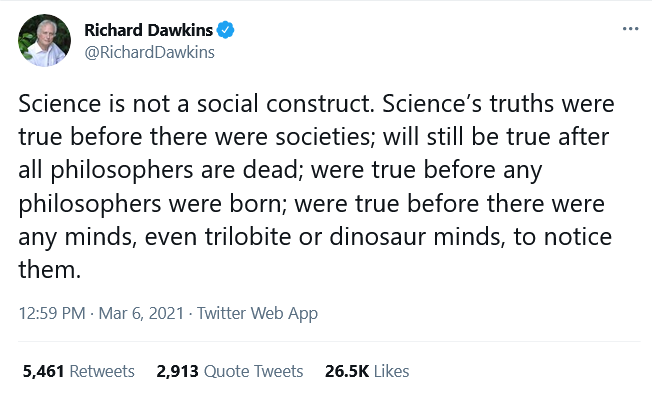
Richard Dawkins, the Clown Prince of the New Atheism, is at it again.  I suppose he's always at it, but I don't follow him on Twitter and only notice some of his wackier performances.  This past weekend he posted this:

Followed a day later by this one:

The first thing to notice about these tweets is that they are not examples of "science's truths," not produced by the Scientific Method <genuflect>, not science or scientific at all.  They're just Dawkins in his familiar idiotic hawker mode, ranting about issues he doesn't understand.

Let's begin with the first tweet.  Typically for him, Dawkins equivocates.  "Science" does not only mean "science's truths."  It means science, and for Dawkins that means Western science, which is a historical and social construct that did not always exist and may not always exist in the future.  Western science originated as a form of magic, seeking not only knowledge but personal power for the practitioner.  Notoriously, some crucial figures saw Nature as a woman to be forcibly disrobed, her private parts probed.  (The metaphor of Nature as the [male, of course] scientist's female adversary, trying to keep her secrets covered, is still very much with us.)  As a historical phenomenon, Western science has often been wrong.  Far from being disinterested seekers after "truths of the real world," scientists have always served the state and the military.  None of this has any eternal, independent existence: it's shaped by human (again, mostly male) hangups and other limitations.

A day after the first tweet, having realized or been told that he hadn't made his point well, Dawkins returns to the fray.  "OBVIOUSLY", he begins, proceeding to pontificate things that aren't obvious at all.  And then he talks like a religious apologist, which is what he is: you can't blame Science for what are now considered bad doctrines, they are the result of human frailty and error.  The trouble with those "scientific beliefs during any particular era - phlogiston, etc." is that in their era they were not "beliefs" but "science's truths," "objective reality."  And scientific progress is not impeded only by religious institutions, perhaps not even mostly by them; it's resisted by scientists, like the Ptolemaic astronomers who rejected Copernicus, or the biologists who rejected Darwin; partly for scientific reasons, such as his lack of a theory of heredity or the fact that his theory required longer periods of time than science's truths at the time allowed.  Another reason for scientific resistance to Natural Selection was that many biologists wanted to believe in evolution as a linear, goal-directed process rather than the messy non-linear one Darwin theorized.  Einstein's resistance to quantum mechanics didn't even pretend: he just didn't like the kind of universe it presupposed.

That's why that bit about "the truths about the real world that science aspires to find" is so funny: Dawkins is canny enough to qualify his claims a bit, and he knows that the "truths" scientists claim to have found often turn out to be false.  (By the way, there is no "science," only scientists.)  Even when scientists' claims hold up for a while, it is never certain that they won't have to be rejected later.  But more important, and more unsettling, it's never certain that the truth about the real world will be found.  Take the extinction of the dinosaurs: the theory that it was caused by an asteroid striking the earth looks pretty good for now, but there are other candidates.  We may never know what happened, and it's not science's truth until science has actually found it. I'm reminded of the "Princeton Bible" postulated by certain Biblical scholars a hundred years ago: the text of the original autograph manuscripts of the Bible, which are irrecoverably lost and therefore can't be appealed to.

As for "objective reality," what is it?  It's one of those terms, like "science," "religion," "truth," or "beauty," that people love to throw around without defining them because OBVIOUSLY, everybody knows what they mean and only "post-modern pseuds" pretend otherwise.  Phlogiston used to be objective reality; so was eugenic sterilization.  I regret having to harp on the latter, but it's still with us, and you may remember that Dawkins recently tried to defend eugenics as a coherent scientific program.  Even if he rejects sterilization of the "unfit", as I suppose he does though for non-scientific reasons, his sputtering efforts to validate eugenics last year showed that he thinks that "improving the species" has some kind of agreed-on meaning, which it doesn't.

I'm a social constructionist myself, though I disagree vehemently with many other social constructionists.  I'd even answer to "postmodernist," for some versions of the term -- it's like "faggot" in that regard, it's meant to refer to people like me, even though it may or may not fit.  But I haven't found that many self-identified postmodernists do any better with the concept than someone like Dawkins does.  But I also concede the validity of "objective reality," as the nutcase Philip K. Dick defined it: "Reality is that which, when you stop believing in it, doesn't go away."  The trouble, whether you're a philosophical naif like Dawkins or a quasti-Gnostic mystic like Dick, is that even though "objective reality" is right there in front of us, we can't quite get at it.  Science is, among other things, the attempt to make models of and describe that reality, but models are not reality and descriptions aren't reality either, so they are always incomplete at best.  At best they're good enough that there aren't very dire consequences from using them; but you never know in advance where or when they'll fail you.

The discussion, to put it loosely, that followed Dawkins's tweets was entertaining.  Several of his crew claimed that Science is like Mathematics.  One declared that pi is science, true before the foundation of the world and true after it.  But pi isn't out there in objective reality, like phlogiston or the Selfish gene: it's an irrational number, and that irrationality has always frustrated those who wanted the world to make sense.  The relationship between mathematics and science is contested, to put it gently, but Pythagoras didn't produce his theorem by studying thousands of right triangles in the lab and producing a theory about them.  Mathematical proof is not remotely like science, and though scientists like to concede the point, insisting that scientific proof is totally different from mathematical truth, they find it difficult to remember their concession for long.

Even if Dawkins were right about the nature of scientific knowledge, that wouldn't mean that his statements about society, religion, women, philosophy, or any other subject, should be taken seriously.  None of them are the result of scientific research, and they seem to spring from nothing but his personal neuroses.  From that point of view Dawkins might merit our sympathy (forgive him, for he knows not what he does).  Even in his field he can't be trusted, as in his incoherent use of "selfish" in his best-known work The Selfish Gene.  His popularity in certain circles can't be because he's right, since he isn't.  His burblings must have some emotional appeal, just as religion does.

Saturday, April 4, 2020

For Those Determined to Miss the Point

Richard Dawkins put his foot in it again last month.  (Yes, I'm lagging behind.)  This time it was a sort of defense of eugenics on Twitter:

Followed by:

One of the things I've noticed about Dawkins is the way he expresses himself with extreme clumsiness, and then, when challenged, goes on the defensive with equal clumsiness, bluster, and irrelevance.  I find this bemusing because I've learned to expect fluency and at least superficial clarity from British writers.  For someone so controversial, Dawkins doesn't seem comfortable with controversy; he takes disagreement personally, and rather than engage it, he denounces it ex cathedra.

I think I came in at the middle of this thread, but I can't find what came before that first tweet and it's not worthwhile to dig further.  So let me begin by asking, just by the way: Has anyone said that eugenics "wouldn't work"?  In the absence of an example to discuss, I'll examine what it would mean for eugenics to work.

On the most basic, neutral technical level, I can't see that eugenics would work.  In The Pure Society (Verso, 2000), the historian of science Andre Pichot quotes a 1930 book by the French biologist Jean Rostand:
All kinds of objections, both practical and theoretical, were raised against the application of eugenic ideas.  In particular against the sterilization of severely defective individuals, in which connection the discouraging slowness of the possible effects was adduced.  Fischer calculated that it would take twenty-two generations to reduce the proportion of mentally ill from 1 in 100 to 1 in 1,000, and ninety generations to reduce it to 1 in 10,000.  The more serious objections, however, were of a moral order; to many consciences, any restriction on the right to procreate was seen as an injury to individual liberty and the dignity of the human person [Pichot, 135].
"The Fischer referred to here is probably Eugen Fischer, a German anthropologist and geneticist, and the author, along with Baur and Lenz, of what at the time was the bible of human genetics...; Fisher was a eugenicist, and compromised by Nazism" (ibid.).

I don't know if Fischer's calculations would stand up today, but it's telling that even a proponent of eugenics acknowledged that it would take about five hundred years to reduce a (supposed) trait by a factor of ten, and a couple of millennia to reduce it by another factor of ten.  This doesn't mean the enterprise is impossible in principle (which I take to be what Dawkins means), but it's definitely impossible as a practical matter.  And that's only one detail, one flaw of many in the genome, that would have to be managed to improve the race.  Perhaps Fischer believed that a Thousand Year Rule would endure long enough to carry out the project, but I doubt Dawkins does, or that he's even thought of the problem.

Then too, mental illness is not a genetically determined trait, though scientists are still trying to claim that it is. (On some level, many are still eugenicists, keeping the faith in their well-funded catacombs against the day when Political Correctness is destroyed and they can carry the faith of their fathers back out into the light.)  Sterilizing the mentally ill (touted as a humane alternative to simply killing them) would not eliminate mental illness.  Nor could a eugenic program affect most of the qualities eugenicists hope to eliminate or augment, since they are not genetically determined.

Presumably in order to ward off moral objections, Dawkins offers the neutral example of breeding "humans to run faster or jump higher."  Even those are dubious, since we have no idea how to breed for such skills, which are a combination of physical endowment and decades of training for each individual.  I've been reading Dick Francis's mystery novels, which are set in the world of high-end horse racing, and a point that crops up repeatedly is that breeding horses to run faster and jump higher is still a crap shoot, with no guarantee that the offspring of elite sires and dams will be a champion.  Training is a factor, as is the ability of the jockey, but also dumb luck in the roll of the genetic dice.  Yet the reproduction of racehorses is under human control in a way that human reproduction isn't.  The most that could be hoped for (if that's the word) is to produce a strain of human beings who might be able to run faster and jump higher in competition with each other, while most of us remained unaffected.  That's a far cry from improving human beings as a species, and as with the fantasy of sending a few colonists to the stars while most people are stuck on a dying earth, it's fair to doubt that eugenicists have ever had any interest in human beings as a species.

When you bring in the breeding of other animals or plants by human beings for human ends, more practical problems appear.  I've already suggested one; human generations are a lot longer than those of the other species.  A racehorse, I gather from Dick Francis, can start competing by the age of two.  Homo sapiens can't breed for at least fifteen years, and preferably longer: the convention for human generations is around a quarter of a century.  That's why Fischer's eugenic program would take so long to have any detectable effect.  Eugenic fantasies of the twentieth century didn't consider this.  The Noble Engineer Robert Heinlein, in his stories about the long-lived Lazarus Long, imagined a privately-funded foundation that encouraged individuals from long-lived lineages to marry individuals from long-lived lineages.  This foundation took the "long view," Heinlein postulated, but it produced significant results in only a couple of generations: people who lived long enough to be noticed and persecuted by their short-lived neighbors.  Heinlein, it should be recalled, is regarded as a practitioner of "hard science-fiction," the coldly realistic, science-based SF that doesn't indulge in airy-fairy wishful thinking and fantasy.

An additional disadvantage of those who would breed humans is that they can't just cull the failures, as selective animal or plant breeders can do.  Even sterilizing them is in bad odor nowadays, thanks to Hitler.  And that brings up another point where Dawkins fumbles: it's not possible to object to eugenics in purely practical terms on one hand or moral/political terms on the other.  There's not a clear boundary between the moral and the practical in any domain that affects human beings.  Advocates of eugenics, then and now, argue in moral terms: don't you want to decrease human suffering, eliminate preventable diseases, and move us ahead to the next evolutionary stage?  If it's pointed out that eugenics will do no such thing, they appeal to the wonders of Science and accuse their critics of anti-intellectual bias, and superstitious hatred of evidence and reason. As Dawkins did here.  I don't accuse him of being a crypto-eugenicist, because I have no idea what lurks in his heart.  I don't think he does, but he argues in such bad faith, he's so intellectually and morally dishonest, that I see no reason to take his protestations seriously.

Finally, just as a purely scientific issue, no one knows what a superior human being would be.  Jumping higher and running faster do not a Homo superior make.  Getting rid of debilitating genetic illnesses would be an improvement, but it wouldn't be a new species.  (Remember too that advocates of genetic manipulation claim that they can do the same job without the traditional eugenic methods, though their claims must be regarded critically too.  Scientists love to promise wonderful outcomes they are nowhere near able to deliver.)  Dawkins is confusing or equivocating between selective breeding, a local intervention, and eugenics, a global one.  Eugenicists appealed to the analogy of breeding animals and plants, but they had a much more ambitious project in mind: that of replacing Homo sapiens with Homo sapiens 2.0.  The racism in their propaganda wavered between the implicit and the explicit, as it does today.

One difference between selective breeding and eugenics is that the former involves the control and manipulation of other species by human beings for human ends.  Breeding doesn't really have the good of its subjects in mind.  Are cows made happier, or even objectively better in evolutionary terms, by being bred to produce more milk for human consumption?  I think it's safe to doubt that.  (Self-styled Darwinians love to accuse people who, e.g., wear spectacles of interfering with Evolution; I can't recall them ever complaining that selective animal breeding does, though it certainly does so.)  When scientists use this analogy, it's reasonable to ask who's breeding whom, to what end, and for whose benefit?  I think they tend to imagine themselves as specimens of Homo superior, selflessly guiding human cattle into the glorious future.  This was also at least a subtext of mid-20th century eugenicist science fiction; aside from Heinlein's Methuselah's Children, see his 1949 novelette "Gulf" in the collection Assignment in Eternity, where the scientific racism is explicit in the text, and its 1982 sequel Friday.  Again, I'm not accusing Richard Dawkins of such an attitude, though his use of the selective-breeding analogy relies on it; I just think that he hasn't thought about it, which doesn't speak well for him either.

This careless equivocation is typical of Dawkins.  It goes back to the beginning of his career as a popular-science writer.  In The Selfish Gene (1976), he flipped between insisting that he called genes "selfish" and "ruthless" as terms of art, 'not even mean[ing] the words in a metaphorical sense," without ever suggesting that organisms are selfish; and casually saying that "This gene selfishness will usually give rise to selfishness in individual behaviour" (TSG, 2) and "we are born selfish" (ibid.).  When critics accuse Dawkins of saying that selfish genes produce selfish organisms, he and his defenders point to his disclaimers while ignoring the passages which undermine the disclaimers.  It's like reading Christian theology: even in a rather short book, you can find contradictory doctrines which can be used as prooftexts for whatever position you like.  I said above that I'm used to British writers expressing themselves clearly, and maybe Dawkins isn't an exception: he dumps his mistakes and contradictions openly on the page, so blatantly that only the mind of faith can miss them.  Dawkins should be dismissed as thoroughly as he dismisses theologians, and for the same reasons.

Saturday, March 30, 2019

Faithful and True; or, It Seemed Like a Good Idea at the Time

While I was working -- well, procrastinating -- on another, still unfinished post, I happened on this tweet:
I’m so glad you at least waited the customary 10 days after a massacre in a mosque to compare Islam to cancer.
It referred to this image:

And referred back to a previous tweet featuring Dawkins' letter to the editor of the London Times, denouncing Cambridge University's rescinding of a fellowship offered to Jordan Peterson, a well-known crank philosopher with arguably racist and sexist views.

I don't think it's accurate to say that Dawkins "compare[d] Islam to cancer."  He was attempting, with his customary tin ear, to draw an analogy.  True, the analogy depended on Islam being bad, but it's not exactly news that Dawkins is hostile to Islam.  Presumably, and I'll return to this, he is equally hostile to all other religions.  The point he was trying to make was something along the lines of "Hate the sin, love the sinner," which is no more convincing from him than it is from Christians.

Let me attempt to disentangle some of the threads of Stupid in Dawkins's tweet. First, bigotry does not necessarily refer to hostility to persons as opposed to their belief systems.  One can be bigoted toward belief systems too, for example by assuming that they are uniform and unchanging, and that all adherents share exactly the same implementations of their system of choice.  I reject Islam, as I reject all belief systems which claim the authority of a god to support their teachings and practices.  But I also recognize that its teachings are internally inconsistent, subject to many (including sectarian) interpretations, and that its adherents vary widely in their observances.  For simplicity's sake, consider the hijab, one of the practices that particularly exercises Dawkins: not all Muslim women wear it, and those who do vary widely in how much they feel God wants them to cover up.  I don't know Dawkins's opinion on this particular issue, but as I've said before, I object to secularist societies which ban the hijab as strongly as I object to societies which require it.  (Should I condemn secularism as a cancer because of its history of intolerance and oppression of, inter alia, women and homosexuals?  By Dawkins's logic, I should.)  A better analogy, though not useful for Dawkins's purposes, might be to "cellular growths" rather than cancer: some are benign, others malignant, some constitute more of a threat to the host than others.

Second, religion is not an "affliction."  Even if it were, we don't blame people with illnesses for their condition.  It is something that happens to them.  The whole point of the medical model is that the patient is a patient, not an agent, with respect to his or her disease.  We don't jail cancer patients, nor do we bomb hospitals to drive the cancer out of them.  Religion is a lifestyle choice, and it's appropriate to criticize morally the choices believers make, though not before we've examined our own.

Sometimes we bomb hospitals for the sheer hell of it, though.  I don't know the basis for Dawkins's claim that Muslims are the principal sufferers from Islam, but Christians and Jews have been doing their best to win that competition for centuries.  As Jimmy Durante used to say, "Everybody wants to get in on the act."  Perhaps Dawkins would acknowledge that Christians are the principal sufferers from Christianity, Jews the principal sufferers from Judaism, Hindus the principal sufferers from Hinduism, and so on, but such acknowledgement wouldn't play as well in a political context that demonizes Islam and Muslims while ignoring the religious component of Christian and Jewish and Hindu offenses.  Indeed, condemning the crimes of a Jewish state is a very serious thoughtcrime in Christian and secularist societies.

Third, and related: the first thing that occurred to me when I read Dawkins's remark about "homosexuals" was "Tell that to Alan Turing!"  Turing, you may recall, was forced by the State to take hormone "therapy" for the crime against Nature of having sex with other males.  Until the early twenty-first century, secularist science in the US was tolerant of secular attempts to "cure" homosexuals, decades after homosexuality was removed from the index of mental disorders and it was widely known that sexual orientation cannot be changed.  It's not clear to me why scientists changed their views on the status of male homosexuality; it doesn't seem to have been because of evidence, because whether a condition is an illness or not is not something that can be settled by evidence. And the whole edifice of psychiatry is of very dubious validity in general.  It reminds me of the way Bob Jones University, which insisted for decades on the Biblical doctrine of racial separation, suddenly awoke one day to discover that there was no such doctrine and they couldn't remember what it was supposed to be.

On women, the record of the "hard sciences" is comparable to that of "religion."  Not only were women regarded by (male, of course) scientists as a lesser breed than men, almost a separate species, but their health issues were largely dismissed.  I've pointed out before that militantly anti-religious scientists are terrible on issues like rape, which they seem incapable of understanding.  But male scientists, not only those of a certain age, still resist with great fierceness allowing women into the labs.  True, this guy is Not All Male Scientists, but he doesn't stand alone, and it's significant that a highly respected newspaper gave him a platform.  And as someone else pointed out, this scientist's claim that "it's not as if they ... build walls to keep women out," is false.  But maybe I should just conclude that scientists are the principal sufferers from science?  If that were so, I might have more sympathy for Dawkins, but it's not so.  Two words: eugenic sterilization.

Perhaps the worst error in Dawkins's analogy between religion and disease is that it's based on the assumption that religion is an external entity, like a radioactive virus, an "affliction" from which human beings "suffer."  Religion is, as an atheist like Dawkins ought to know, a human invention.  If a religion upholds male supremacy, even if all religions uphold male supremacy, a rational thinker should ask why they do so -- especially since Science also does so.  The conviction of female inferiority and the consequent belief that they should live under male tutelage (aka patriarchy) is plastic -- societies, including Muslims ones, vary widely and within themselves on how far women are disadvantaged -- but it's remarkably tenacious.  If it's a precept of many religions, including Science, it must be because male human beings put it there.  This presumption generalizes.

Recently I acquired a copy of a book I've wanted for a long time, a photographic essay about the Naked Festivals in Japan.  It includes some quasi-ethnographic articles about the history and rationale of these festivals, which prompted me to wonder why people decided that the gods wanted young men to strip to loincloths (or less, sometimes) and mass together for a giant game of Keep Away involving various sacred objects.  The visual appeal of such a rite is obvious to a pervert like me, but to the gods...?  At around the same time I saw some discussion of Roman Catholic High Mass.  We know more about the history of this rite rendering service to Yahweh and his Only Begotten Son, but again, people simply invented it in all its complex spectacle or music, costume, scent, and so on.  If one is an atheist, one can hardly claim that it is an expressive of, or compliant, with God's will.  It should be obvious to an atheist (though surprisingly often it's not) that none of the many religious rites or doctrines are the will of any god.  They are the will of the people who perform them.  In many cases, as with the Naked Festival, they are not imposed from above, let alone from outside, but are welcomed by the participants and observers, who not only enjoy the sight of massed naked men in the streets but are deeply moved and edified by it.  Blaming any human practice or belief on "religion" is an act of extreme intellectual and often moral laziness.

One more point, which actually was my starting point for this post.  Someone else commented on this thread:
Dawkins converts more atheists to agnostics than he turns away from faith altogether. Arrogant, dickish, islamophobic. Who would want to co-sign that unless you were one or more of those to begin with?
This annoyed me. I replied:
Any atheist who changes their opinion on atheism because Dawkins is an asshole is a sheep. Certainly can't claim to be an independent thinker. I'm an atheist on the merits, not because of who else is an atheist. If that's your approach, I wouldn't want to co-sign with you either.
Call me old-fashioned, but I don't think that the truth or falsehood of a claim about the world has anything to do with the personality of the person who makes the claim.  His or her personality may be relevant if he or she tries to make it so, but that can be a distraction, and certainly is here.  I've criticized philosophers before who complained that the New Atheists come across as unpleasant.  (Don't forget that Dawkins himself notoriously whined about the "inexplicable hostility of Mary Midgley's assault" in her review of The Selfish Gene.  "I deplore bad manners as much as anyone...", he complained dishonestly, and also claimed falsely that Midgley hadn't read the the book before she reviewed it.  But all of this only influenced my opinion of Richard Dawkins, not of atheism.

And why, now that I think about it, would Dawkins's obnoxiousness make people abandon atheism for agnosticism?  Is there any actual evidence for the claim anyway?  Someone, I think, doesn't know what these terms mean.  But there's a lot of that going around.

Wednesday, April 13, 2016

You've Been Telling Me You're a Genius Since You Were Seventeen

 
Reading Curtis White's The Science Delusion (Melville House, 2013) renewed my respect for Mary Midgley.  I happened on White's book in the library just after I'd reread Midgley's Science and Salvation (Routledge, 1992) and was mulling over the (very critical) blog post I wanted to write about it.  Since White, a novelist and academic social critic, was going over much the same ground, and I enjoyed his title's dig at Richard Dawkins, I decided to give it a try.

I can sum up part of my reaction by quoting this writer at BoingBoing, who says that most reviews of The Science Delusion have missed White's point:
All the invective? White thought he was just being funny and satirical, like Jonathan Swift. The over-generalizing about what all scientists believe and what the culture of science is like? He thought it was clear that he just meant the subset of scientists who don't think there's any value other than entertainment in art, that philosophy is dead, and that culture has no affect on how we interpret science or what we do with it. The weird, pseudo-Deism? He thought he was explaining that science is part of culture, that the questions being asked and the way answers are interpreted are culturally bound and and we have to take that into account. The humanities triumphalism and points where he totally dismisses science and acts like he doesn't understand why somebody would find meaning in being curious about how the mind works? Not what he meant at all, apparently. He just wants to make the case for us needing both science and the humanities to properly understand the world. And White is deeply confused about why reviews of his book keep getting all of this wrong. 
Of course, many writers have had the experience of discovering that the book their readers and critics read was not the book they thought they wrote.  And I must say that I nowhere got the impression that White "totally dismisses" science; only a sloppy and probably biased reader, one with a science-cultist agenda, should have taken that from the book, in much the same way that Obama cultists jump to the conclusion that anyone who criticizes Obama is totally a Republican who hates him and doesn't like or respect or admire anybody. (Or American exceptionalists accuse anyone who argues that the US shouldn't bomb the shit out of countries that haven't attacked us of wanting to see America conquered and destroyed by Al-Qaeda.)

The BoingBoing writer, Maggie Koerth-Baker, complains that The Science Delusion "is written in such a way as to nearly ensure that it will quickly alienate anybody who identifies with science as their community, their career, or their passion."  As I've argued before (and Koerth-Baker herself notices), writers like Dawkins and Hitchens can dish it out but not take it -- Dawkins especially has very tender sensibilities when someone turns his rhetorical style back on him -- so it's highly unlikely that anyone could write a book critical of any aspect of science that wouldn't alienate anybody who "identifies with science."

Still, a humanities-oriented writer, especially one who's been around the block a few dozen times (White is 65, almost exactly my age) should have, you know, thought about the way his or her writing was coming across.  This is why writers show their work to readers they trust before publication: not just to check for factual or typographical errors, but to get their reactions to the content as a whole.  I've mentioned before how surprised I was when I wrote a satirical piece mocking college fraternities with Christian-right rhetoric, and friends (including graduate students in the humanities, from whom I'd have expected better; hadn't they even heard of Swift's "Modest Proposal"? evidently not) took it literally, exultant that I'd given those Greek-system snots what for.  Satire is always tricky that way.  I often showed my poems to people who weren't academics to get their reactions, as I did with my big anti-Christian project (still unpublished) of the 1980s: to see what non-professionals took away from it.  I had better luck with the anti-Christian book; people seemed to get what I intended.

It's to be expected that scientists might have trouble with tone and balance in what they write for a general audience: that kind of subtlety isn't in their job description.  But if White wanted to show the value of the humanities as well as the sciences for understanding the world, he did a poor job of it.  Since I am also humanities-oriented, critical of science triumphalism, and am predisposed to agree with the point he was trying to make, I'm just the audience he was aiming for, and he still left me dissatisfied.

Interestingly, White told Koerth-Baker in e-mail:
I hope you won’t be entirely surprised if I say that I don’t think anything went wrong. The Science Delusion is much like my earlier work, especially The Middle Mind. One person’s “angry screed” is another person’s “passionate defense.” My native audience tends to be among artists, lefty intellectuals, humanists, and other species of the socially dispossessed. This particular book has generated a broader audience, much of which is sensitive to criticism of the sciences. I just received a review by Mark Kingwell, a Canadian philosopher, for the Globe and Mail. It’s a sympathetic review although he complains of the “bad jokes.” (At least he noticed there were jokes!) But the on-line comments about his review hacked him to pieces in the name of the superiority of the scientific worldview. Utter disdain. Baseless contempt. I have to say, the comments made me feel a little better about some of the treatment I’ve received. 
(Wait -- "artists, lefty intellectuals, humanists" are "socially dispossessed"?  Bitch, please.  [P.S., 2017: it just occurred to me that White was perhaps being sarcastic there.])

So it appears that it's Koerth-Baker who misunderstood White's intention.  The part about the attacks on Kingwell's review also fits a pattern I've noticed before: those who try to position themselves as moderates, whether philosophically or politically, tend to find themselves vilified for allegedly taking the very positions they were trying to repudiate.  So, when the journalist Richard Goldstein tried to distance himself from Noam Chomsky's supposed anti-Americanism a decade ago, readers attacked him as anti-American.

Similarly, Koerth-Baker wants to take a middle stance on scientism, by mildly criticizing the tone of writers like Dawkins, and rejecting what she calls "pop-culture, self-help neuroscience."  But "pop culture" isn't really the problem, it's actual working scientists who genuinely believe they know more and can explain more than they can.  So she wrote that "much of White's argument against this hinges on framing pop-neurobollocks as a problem created by and supported by scientists, and a problem that very few people have spoken out about. Neither of which is true."  What she calls "pop-neurobollocks" is in fact created by and supported by scientists.  It's true that other scientists have criticized their colleagues -- see Robert A. Burton's A Skeptic's Guide to the Mind, which I discussed here -- and they locate the problem not in pop culture but in the field itself.  And the criticisms are commonly dismissed by their colleagues as coming from (you guessed it) the humanities, from feminists and leftists who hate science and want to see it destroyed.  Another, superficially milder stratagem is to accuse critics of scientific racism of favoring a "blank slate" view of human nature.

Koerth-Baker also claims that
anthropology was once a field pretty much dedicated to proving the superiority of white, Western colonial powers over their brown subjects. The societal context shaped the questions those early anthropologists were asking, it shaped how they chose to study the world, and it shaped how they chose to interpret the data they came back with. The fact that, by the time I got to anthropology school in 1999, the field had been drastically realigned as a challenge to its former self also says something about the influence of culture and the importance of questioning ourselves and our values in ways that are not purely scientific.
This is mistaken.  First, anthropologists were always divided among themselves.  Many were dedicated to justifying Western imperialism, but others weren't.  Franz Boas is probably the most famous example of an early 20th century anthropologist who opposed and criticized racist anthropology in the service of European colonialism. As an effective critic of scientific racism, he was predictably vilified by his colleages, often on racist grounds.  The eugenicist Madison Grant, for example, jeered that Boas "naturally does not take stock in any anthropology which relegates him and his race to the inferior position that they have occupied throughout recorded history."  (Boas was Jewish, which Grant thought was a "race.")  Second, some anthropologists are still serving Western imperialism.  I'd add that scientific racism based in biology is still very much with us.

But her error is instructive, as an example of the common tendency to speak of "science," "religion," "art," and other fields as if they spoke with one voice and were mutually exclusive.

If Curtis White wants to preach to the choir, that's his lookout.  It's perfectly legitimate to take a side and write for its adherents, to keep up their morale and, if possible, given them good reasons for continuing to believe what they want to.  My complaint about The Science Delusion is not that White picked on science, but that he made such a shitty case for the humanities.  I think that's largely because he too thinks, or writes as if he thinks, that "science" and "the humanities," etc., speak with one voice and are mutually exclusive.

White writes, for example:
What scientists / polemicists like [Lawrence] Krauss refuse to admit, perhaps because they think that it creates an opening for their enemies, is that there is any limit on what they can claim to know.  Nevertheless, it is true even for science that there are unknowable things -- unknowable because not accessible to observation or experiment -- chief among which is the question of being's ultimate origin.  That is not an invitation for the God-mongers to set up camp where science cannot go (creating a "God of the gaps").  Rather, it is simply one of those matters about which science ought to open itself to other forms of thinking, if not knowing, and it might if it felt a little less besieged [53].
What are those "other forms of thinking, if not knowing"?  White isn't willing to concede too much to religion.  He dismisses the "God-mongers" as lightly as the scientists and New Atheists do, and though he stresses that "There are still many and large congregations of liberal Christians, even liberal evangelicals, starting with Barack Obama and Jimmy Carter. And the liberal, even radical, Jewish community is famously large" (34), he doesn't spend much time on liberal or radical religious forms of knowing.
Not for Hitchens that rich cross-cultural fertilization of the Levant by Helenistic [sic!], Jewish, and Manichaean thought.  Not for Hitchens the transformation of a Jewish heretic into a religion that Nietzsche called "Platonism for the masses" [29].
What an anachronistic mess!  Didn't Nietzsche also call Christianity a slave morality?  I doubt that he meant "Platonism for the masses" as a compliment, either.  Did Christianity have answers that science knows not of?  Not that I can see, and White doesn't mention any.

White spends some time on various New Atheists' dismissal of philosophy.  He quotes, for example, the same Lawrence Krauss from a 2012 interview in The Atlantic:
Philosophy is a field that, unfortunately, reminds me of that old Woody Allen joke, “those that can't do, teach, and those that can't teach, teach gym.”  And the worst part of philosophy is the philosophy of science; the only people, as far as I can tell, that read work by philosophers of science are other philosophers of science. [Well, scientists kind of read it sometimes to give themselves conniptions. - D.M.] … And so it's really hard to understand what justifies it.  And so I'd say that this tension occurs because people in philosophy feel threatened, and they have every right to feel threatened, because science progresses and philosophy doesn't [24].
White waxes indignant about these philistines: "What do any of these science writers know about the history of philosophy before Bertrand Russell?  Their comments are merely expressions of an anti-intellectual prejudice.  I would go so far as to say that they are a kind of bigotry" (25).  It might be more to the point to point out that these science writers are still doing philosophy; they're just doing it ignorantly and badly, like the plain-speaking businessman who claims that common sense is good enough for him.  When such scientists try to rebut philosophers and historians of science, they generally get everything wrong.  Philosophers keep worrying away at questions that scientists (and remember, science used to be called "natural philosophy") don't even try to answer, perhaps because they're unanswerable.  To my mind, the benefit of doing philosophy is that it brings home so forcefully how much we don't know.

For Curtis White, the best alternative source of knowledge lies in the arts, specifically in the Romantic movement.
At its inception, Romanticism was about the discovery of a social attitude almost entirely new in the history of Western civilization.  Up through the late 18th century, individuals found themselves only in a group identification with tribe, kingdom, church, nation, and, brutally, social caste.  Romanticism offered a revolutionary and enduring alternative to being absorbed by the culture into which you happened to be born: alienation.  Alienation is the feeling that, as Lord Byron's Childe Harold expressed it, "I stood amongst them but not of them." ... I don't belong anywhere in my own world.  In fact, I see this world for what it is, and it is shameful.  In place of this world I feel something nobler within me that poets and philosophers, not soldiers, must make real...

And yet this sense of being homeless was for the Romantics [like the early Christians] a source not only of pain but of strength and potential joy as well. ... They would be heroes.  They would be free.  They would create themselves [59-60].  
A vain fantasy, and not far from the Promethean fantasies that drive a lot of scientists.  (White overlooks the notorious alienation experienced by many scientists.)  I don't believe White is correct about alienation being wholly new when the Romantics took it up.  Alienation is all over the New Testament, especially but not only in Paul's letters, and it's arguable that a feeling of not being at home in the world accounts for the popularity of mystery religions and other initiations around the Mediterranean in Jesus' time.  Alienation is a basic feature of Gnosticism too.  It seems to me that it's also part of Buddhism, certainly in the Buddha's origin myth (a pampered, sheltered prince, confronted with the reality of human suffering, leaves it all to seek Truth), which reminds me that White thinks almost exclusively in terms of "Western" art, culture and religion; odd that, in one who avows the influence of 1960s California counterculture in his life.

But again, what answers does Romanticism offer?  None that White mentions.  He makes much of its supposed egalitarianism, and throws the word "freedom" around a lot, especially "Schiller's mantra," "Art models freedom" (69).  Freedom is good, who could object to that?  But if Schiller was right, art models freedom through constraint, whether by using established forms or by creating new ones.  Freedom is never absolute. When he tries to get positive about art, White falls as flat as any scientist does.
The more agonistic way would be to say that for the past two centuries artists have hated mop inventors. Beethoven … seemed to hate just about everyone, and wrote his music against them, against his father, against Haydn, against “inkeepers, cobblers, and tailors,” and against the philistine nobility that paid his wages.  In short, [Jonah] Lehrer either has never heard of or simply dismisses the role of social alienation as a driving force for what he blandly calls creativity [117-8].  
What galloping horseshit.  Let's note again the social alienation found in many scientists.  Second, let's note that these alienated kids always expect to be taken care of, usually by women.  White hasn't noticed what a boys' club the arts have always been, no less than the sciences or religion.  Beethoven's hatred of merchants and servants for failing to serve him gratis wasn't "egalitarian" but aristocratic.  Feminism is another alternate way of knowing that doesn't seem to be on his radar.
Lehrer writes, “The story of 'Like a Rolling Stone' is a story of creative insight.  The song was invented in the moment, then hurled into the world” [121]. 
Bullshit, and White recognizes this, but for the wrong reasons. "Like a Rolling Stone" did not spring fully grown from Bob Dylan's head.  Think of the actual process of writing, which was not a moment but went on for some time, producing ten pages of a rant that Dylan whittled down to four long verses.  Then think of the process of arranging and recording, which was protracted and painful.  Some of the versions, including a waltz, have since been released on CD.  The release version emerged in collaboration with other musicians, and Dylan's producer.  Then think of the hostility in the folk community to Dylan's artistic changes.  He was accused of commercialism, though his record label understandably didn't see a six-minute opus as obvious fodder for the charts; but also remember Mim Udovich's rejoinder (from the Village Voice, 29 September 1992, 94-97) to Camille Paglia's lament about commercialism in pop music:
Outrage about the artistic limitations placed on musicians by the marketplace is equally unfounded.  And just to stick on Paglia's elementary level, if Leonard Chess had not told Chuck Berry to ditch the blues for something that would sell, it is arguable that Keith Richards would not be the coolest person living today.  And lastly, if you're going to make this argument at all, you should mention Colonel Tom Parker.
The case of rock'n'roll also brings in the relationship of art and technology -- that is, science.  Dylan could not have made "Like a Rolling Stone" without changes (advances, if you like) in the technology of musical instruments and of recording. The effect of recording on music has not been purely technical -- or rather, technical changes have wrought cultural changes.  A generation, the generation White and I share, learned to think of music as existing in sequence on two sides of a long-playing vinyl record. The advent of CDs changed that, and then music on the Internet, and Youtube, changed it again.  Musical performances used to be ephemeral -- we have no idea what Jenny Lind sounded like, for example -- but we can now listen to the music of long-dead musicians, frozen on lacquer, vinyl, compact discs and now as virtual computer files.
For the scientist, blue is a particular wavelength in the light spectrum that is visible to humans. For the linguist, blue is a sign or symbol carrying meaning (heaven, salvation, Caribbean vacation, etc.).  But for an artist like Messaien, blue is a presence -- both a thing and the experience of the thing -- and only when we are attentive and responsive to this presence can we be said to understand it.  As Messaien shows [except that he didn't, but never mind for now], attention requires a certain non-evaluative openness to the thing [which thing?]; to respond to what the openness offers is the act of music-making itself [162].  
It occurs to me that White always thinks of art from the standpoint of the artist, the Promethean genius who creates, models freedom, and demands our "non-evaluative openness to the thing."  Anytime someone demands "non-evaluative openness" (also known as "faith"), I reach for my critical thinking.  It seems that for White, it's the artist who matters, and the audience exists as a receptacle for "the act of music-making," or poem-making, or painting-making, or philosophy-making.  That's not an "egalitarian" model of the arts, or of life, and it sits oddly with White's insistence, quoting Schlegal, that "To have genius is the natural state of humanity."  Personally, my idea of Hell is a roomful of geniuses, demanding non-evaluative openness to their own products but never paying attention to the products of all the others, who may claim to be geniuses but are just a bunch of posers, man, to say nothing of the stupid sheeple who don't realize the pain of being a supergenius in an uncaring, un-understanding world full of idiots.

One should, of course, take artists' philosophizing about their practice as skeptically as one takes scientists' philosophizing about theirs.  But what is blue to the painter?  A technical problem.  The technology of paint is ancient.  You can't draw a neat line between art and science.  Each practitioner, obsessed with his or her own problems, sees himself or herself as the center of the universe; one role of the philosopher is to decenter them.
The important thing to remember, those few of us who do [really? who is "us" here?], is that there are other metaphors than those offered to us by science, and other ways of thinking about what it's like to be a [sic] human.  There is a long, now dishonored tradition in philosophy and the arts that seeks to account for the "interior distance," our personal and species internal landscape.  The crucial thing to say is that this tradition is under no illusions that it is providing the Truth, the human-in-itself. ... What's more, these metaphors will also provide insight into something science is mostly clueless about: how we ought to live [167].
I disagree that "this tradition is under no illusions that it is providing the Truth"; it seems to me that all these traditions have such illusions, and their "insights" about "how we ought to live" are clueless when they try to prescribe and legislate for everyone.  The religious and philosophical traditions I've gotten the most from acknowledge that "our personal and species internal landscape" can not be accounted for.  People constantly mistake metaphors for reality.  Religious people are especially prone to doing so, with scientists close on their heels. 

White notes that the culture of science "is notoriously thin-skinned and combative" (96), then quotes at length a scientist on the cutthroat competition of science conferences and the scientific professional generally.  I suppose he takes for granted that his readers are aware that this also describes the humanities and the arts, but he doesn't make the point, so let me do it: the culture of the arts is notoriously thin-skinned and combative.  He also told Koerth-Baker that he liked a lot of science writing, such as John McPhee's Annals of the Former World, but he didn't discuss it in The Science Delusion because "McPhee is not in the business of using science to produce pernicious ideology."  Of course, the humanities and the arts have often produced pernicious ideology.  (The Romantics' adulation for, and then disillusionment with, Napoleon Bonaparte is not really addressed by White.) The only way to avoid doing so lies not in a given field or a particular movement in a field, but in not producing pernicious ideology in the first place.  How to avoid that?  There's the rub.  In The Science Delusion Curtis White offered an entertaining though scattershot sendup of the pretensions of scientists, but he merely showcased the pretentions of artists and the humanities.

Sunday, September 13, 2015

Subsisting on Dawkins's Tears

I'm rereading the philosopher Mary Midgley's 1981 book Heart and Mind: The Varieties of Moral Experience.  It's an excellent introduction to the subject of ethics and morality, even if I disagree with some of what she says, which I intend to write about more in the next few days.  In the meantime I've also been looking around the Web for some references on her 1979 critique of Richard Dawkins, which led to the entertaining spectacle (still in progress, apparently) of Richard Dawkins, the No-More-Mister-Nice-Guy of the New Atheists, Mr. Take-No-Prisoners in the War Against Superstition, whining that Midgley had been mean to him, that he couldn't understand why she was so hostile: "I have been taken aback by the inexplicable hostility of Mary Midgley's assault ... I deplore bad manners as strongly as anyone ..."  He also claimed, falsely, that she hadn't read The Selfish Gene when she wrote the review, and though he later retracted the claim, it still moves.

In the course of this agreeable procrastination I found a revealing characterization in a 2015 interview with Midgley.  (She's 95 this year, and though she's lost mobility she's still writing, and as well as ever.)
One gets the impression that Midgley doesn't keep on writing just because she enjoys it, but because she thinks the world needs her to counter prevalent ideas she considers "silly" or "ridiculous", and bring us all back to "talking sense" - and because she believes such questions should not be purely left to scientists. As the philosopher Roger Scruton has put it: "Midgley's view is that philosophy, in leaving the question of human nature to the biologists, has betrayed its mission."
Notice "One gets the impression" there -- Midgley didn't actually say that she thinks "the world needs her."   One gets the impression that the interviewer wanted to give the impression that Midgley has a big head.  Writers write for many reasons -- fame, fortune, and the love of beautiful women, as Freud reportedly said -- and if you want to know why we do it, why not just ask?  I hope that people will read what I write, but I'm agnostic as to whether the world needs me to counter prevalent ideas I consider silly or ridiculous.  What I do know is that I need to write about such things, and why not?  For myself, it's a way of scratching the itch that such ideas put in my brain: instead of just fuming about them, I write about them, as much to explain to myself why they bother me as to explain to anyone else, and thanks to the Internet I can publish myself.  Writing for me, then, is partly habit, and I would imagine that at 95 it's a habit for Midgley too.  I know from experience that some people find my writing useful, as I have found other people's published disagreements with prevalent ideas.

It occurs to me to wonder, however, whether the interviewer would have written such a patronizing suggestion about Richard Dawkins, or Neil DeGrasse Tyson, or Francis Crick, or Carl Sagan, or Bill Nye, any other purveyor of the prevalent ideas that people like Mary Midgley and I feel the need to differ with.  I certainly get that impression from them: they are often explicit about their conviction that the world needs to know the scientific truths of which they are merely the humble prophets and servants.  They even see themselves, rather like many Christians, as an embattled and even persecuted minority, and the ideas they present as anything but "prevalent."  Considering that they have (and welcome, and seek out) much more media access than Mary Midgley, and that Tyson for one was appointed by George W. Bush to government commissions on science, I think that their stance is as dubious as Christian claims of persecution when someone disagrees with them.  Yet it's someone like Midgley who, the interviewer hints gently, thinks that the world needs her opinions.  Well, yes, I think it does.

Monday, October 27, 2014

Not All Atheists?

A couple of days after I got here, I got into a dustup with my Liberal Artist Friend on Facebook.  He posted a link to this meme, which had been posted on an atheist Facebook page.  The comments there are painful enough.  LAF remarked on his repost:
Religious friends: Why are so many of your co-religionists so stupid and hateful? And why can't they write or spell? This person thinks there are dessert islands! (Sounds great!) He thinks bombs hatch. He doesn't capitalize Jesus (!?!). And weirdly and surprisingly, he's concerned about the safety of "out women." Why, why, why???
Now, the first thing to notice about this is its self-righteous stupidity.  Does my friend really believe that if people stopped being religious, their spelling and punctuation would suddenly, magically improve?  I've known too many atheists who can't spell or punctuate (and theists who can) to take that notion seriously.  What do spelling and punctuation have to do with religion anyway?  As for "stupid and hateful", I've been pointing out the stupidity and hatefulness of many atheists, including prominent ones, for years now, and I don't see any improvement coming.

I don't know why many people have difficulty with technical skills like spelling and punctuation, but those skills are not rational (English spelling? please!), and they're not a sign of moral virtue or even intelligence.  They are class markers, of course, which I suspect is why my friend invoked them.  That speaks badly for him, and for his own ability to think critically or rationally.

The same goes for attitudes towards women.  When challenged by one of my friend's friends, I mentioned the attacks on Rebecca Watson for pointing out sexism among atheist males, most infamously by Richard Dawkins (though I hear he's retracted his earlier statement, however belatedly and gracelessly).  My challenger jeered: was that all I could point to?  Why, it was years ago!  Of course it wasn't all I could point to, and it's still a live issue among atheists, as is sexism among scientists.  Another person, a woman this time, argued that you can't expect atheists to get rid of all their sexism instantly:
Sexism is part of our culture. It began in religion but that does not mean a person can easily remove themselves from that reality just because they do not believe in a god.

And a few men do not represent all atheist men. Just as this idiot does not represent all theists.
"Sexism began in religion" is ambiguous, because you could probably say the same of everything in every culture: art, science, cooking, etc.  So where did religion come from?  This person was talking, as so many atheists do, about religion as if it were some autonomous system distinct from human beings, that imposes its will upon us, instead of something that human beings invented.  Religion is sexist, insofar as it is, because human beings were sexist and created their gods in their own image.  Religion has also been a medium through which people have challenged and tried to delegitimize oppressive structures, for the same reason: I don't like it, so obviously God must not like it either. And you know where that goes.

These countermoves were drearily familiar to me. I get them from Christians and other theists all the time.  Oh, that was a long time ago, it's not a problem anymore.  Oh, that is just a problem now because some have fallen away from true faith, it didn't used to be a problem.  You can't judge all Christians by that person, he or she is not typical at all, he or she isn't really a Christian.  Of course Christians aren't perfect, it takes God a long time to cleanse them of their errors and wash away their sins and corruption, but they're so much better than they'd be without Him.

I don't expect atheists to escape or abandon all problematic errors automatically; I certainly haven't.  That's what I've been saying for years.  In my experience and observation, though, it's mainly atheists who blame every problem on religion and talk about "enlightenment" and "waking up" as though error will simply fall away once you throw out belief in gods.  You will then be rational, free of superstition, a new creation in Not-God.  And while my friend and his friends disavowed any such notions, they still are too cavalier about the work needed to get rid of error in themselves.  That's one reason why their cheerleading for science and jeering at the religious annoys me so much: they're like fundamentalist Christians who bask in the intelligence of a few unrepresentative literati or academics like C. S. Lewis, but don't want to work at educating themselves.  I'm enlightened and rational unlike those stupid religious believers who can't spell, because I honor Carl Sagan, Bill Nye, Stephen Hawking, and Neil DeGrasse Tyson!  But these guys are no more representative of atheists than C. S. Lewis was of fundamentalist Christians.  And you know, I'm not a fan of any of them.  For a long time, and maybe still, the most influential atheist in the US was the "prophetess" (as Mary Midgley mischievously dubbed her) Ayn Rand.

As with religion, the not-all-atheists approach backfires.  It's true that not all atheists are like Richard Dawkins or Ayn Rand or any other celebrity atheist.  But what are we like?  I'm not sure there are any universals to cling to, and even generalizations are difficult.  Even what would presumably be the core of atheism, the absence of belief in gods, doesn't look the same in all atheists.  There are what I'd call dogmatic atheists, who are certain there are no gods; and there are what the late Antony Flew dubbed Stratonician atheists, who see no reason to believe that gods exist, and who put the burden of argument on theists to come up with (1) some kind of workable definition of what they mean by "god" and (2) good reasons to believe that such entities exist.  I'm in the latter category myself, and though I have numerous disagreements with Flew, his account of atheism has influenced me more than any other.  I've also seen some atheists dismiss Stratonician atheism as not real atheism, and I suspect the dogmatic atheists are more representative of atheism than I am.  Not that I worry about that.

The point is that no matter what you say about atheists or atheism, it won't be true of all of us.  (The same is true of theists, just to hammer the point monotonously home.)  It's okay to generalize, but to do so responsibly you must have reliable information about the group you're talking about, and I'm not sure we do.  It's likely, I suspect, that the less attractive aspects will be more common and so more representative than the more attractive ones -- and who gets to decide what's attractive? -- so it's just safer to remain ignorant of what your movement is actually like.

This is probably one reason why biblical illiteracy is so common among Christians.  I recently had an exchange with someone on Facebook who assured me that hellfire and damnation, sexual repressiveness, faith-healing and exorcism, and end-times preaching were not Jesus' teaching as found in the gospels, they were added by the Church much later.  This is of course false, and revealed my opponent's ignorance of the Bible.

I was bothered, in the post on Dawkins I linked above, when the blogger wrote that Dawkins is "not a good leader for me, but even Jen McCreight, who recently called for new attitudes in atheism, says she likes Dawkins despite his flaws."  And again: "If Dawkins were to learn from criticism the way Cromwell does, then he’d be valuable as a leader.  But I’m not holding my breath for him to check his privilege, because there are much clearer thinkers to pay attention to."  I don't think atheists should have leaders, though of course many other atheists clearly want them.  (Who's more representative?)  I've learned a lot from other atheists, though also from some theists, but I don't regard any of them as a leader.  Once you have a leader, you're going to have authority and a cult of personality, and people will be expected to be loyal and obedient to the leader and to the movement.

It's ironic.  I've been attacked for arguing that it's odd for atheists to treat 'religion,' rather than human beings, as responsible for the bad things we find in religion and culture, and those other atheists accused me of setting myself up as the Authority on atheism and trying to decide what an atheist should or should think.  None of them tried to address rationally what I'd said; they simply declared me a Bad Atheist, perhaps the Bad Atheist.  (When I pointed out problems with their account of some elements of Christianity on another occasion, one of them accused me of being an antigay fundamentalist Christian.  Don't you just love rational critical thinking?) Authority plays an obvious part in most religions, though such authority is often challenged from within in various ways; but like most problematic phenomena, you don't get rid of it simply by disavowing belief in gods or faith in reason.  You don't have faith in reason: you use it, well or badly.  And many avowed rationalists use it badly.

So, for those atheists who want to disavow or excommunicate Dawkins, Harris, or any other celebrity atheist, I must ask the same question I've asked Christians about Christianity: which atheists are representative of the "movement"?  I spent some years listening to Christians' answers and following up on them, always finding their Christian exemplars wanting and being referred to new ones.  I've probably read more on atheism (and on religion for that matter) than most of my fellow atheists have, so I may have an easier time in this area.  I'm not asking for atheists who'd qualify as leaders, as I indicated before; I'm asking who is knowledgeable about the historical and philosophical issues, responsible, and usually rational?  Probably there are no such people, which doesn't discredit atheism; it should be a reminder of our human finiteness, our lack of omniscience, and of how much we have to learn.  That shouldn't really be a stumbling-block for atheists.  Should it?

Tuesday, October 15, 2013

What Do We Mean When We Talk About Meaning?

I knew I shouldn't have started reading a nonfiction book today!  I got bogged down taking notes and thinking about writing a blog post, instead of finishing this fairly short book and moving on to some of the others that are piled up around the apartment.

The book is The Solitary Self: Darwin and the Selfish Gene (Acumen Publishing, 2010) by the philosopher Mary Midgley.  I was thinking about the online dispute about atheism I'd joined on Facebook the other day, so I began looking up some useful resources, and Midgley came to mind.  I hadn't read anything new by her in some time, so I decided to see if she'd published anything recently.  She is, after all, ninety-six years old now, but she's gone on writing.

Richard Dawkins has long been one of her targets, and one reason I like Midgley is that she once provoked him into yammering that she was mean to him: her "highly intemperate and vicious paper" was "hard to match, in reputable journals, for its patronising condescension toward a fellow academic."  I'd say that Dawkins needs to get out more, but of course the irony lies in his own attack-dog manner: he loves to dish it out but he can't take it.

At any rate, The Solitary Self is a brief discussion of the importance of sociability in nature, and in particular among human beings.  Midgley accepts Darwinian evolution, but holds that Darwin didn't imagine all life as engaged in cutthroat competition: he recognized that cooperation was at least as important as competition, but this aspect of his theorizing got much less attention as natural selection came to be thought of as the sole driver of change in species.

Maybe I'm jumping ahead, but I was struck by Midgley's remarks in the book's introduction that she will begin by "turn[ing] to the vast topic of cosmic meaning":
Dawkins, Peter Atkins and others present the claim that the universe is meaningless as something factual, scientific and, more specifically, Darwinian.  Their ground for considering the biosphere -- or sometimes the whole cosmos -- to be meaningless is that it is ruled by natural selection, which they present as simply a form of chance or, as Jacques Monod put it, a lottery.  From this they conclude, as Steven Weinberg did at the end of The First Three Minutes, that "this is an overwhelmingly hostile universe ... The more the universe seems comprehensible, the more it also seems pointless" ...

Darwin, however, made no such claim.  Although he abandoned the rather naive Christianity of his childhood, he remained deeply impressed by cosmic order and still saw that order as akin to mind.  Questions about the transcendent still struck him not as meaningless, but as genuinely mysterious.  He did not think we could expect certainty about them.  And, of course, this view fits well with the thought that our faculties have largely been evolved for more modest uses.

But his tentative attitude also fits well with that of many physicists today who are struck by the coincidences that are emerging in the cosmic order: quite specific arrangements, like the cosmological constant, for which no reason can be given.  .. Randomness is not, after all, something that could ever be scientifically established.  Taking it for granted it is more a matter of temperament and intellectual fashion than of reasoning [11f].
I don't think I consider it "factual" that the universe is meaningless.  I do think that I'd need pretty good reasons to accept any meaning that someone dreams up and offers.  Walter Kaufmann talked about what he called the exegetical fallacy, which consists of reading one's own ideas into a text and getting them back endowed with the text's authority; I think this fallacy is also at work when people claim to have found "meaning" in the universe and try to impose it on everyone else, because, like, the Universe told them!  Finding meaning in the universe is like seeing a cloud that looks like an owl: the owl isn't there, it's in our heads.  I don't think the universe's lack of meaning is a problem, though, because there's no reason it should have a meaning, or a purpose, or a point.  Human beings are meaning-makers; we give ourselves meaning, we have purposes.  Where we get them from is an open question, but if a god existed, where would it get meanings and purposes?

What bothered me about this passage was the false opposites.  Randomness is not the opposite of meaning, for example.  But like all opposites, it has meaning only because its opposite (whatever you think it is) exists.  Order relies on disorder; meaning needs meaninglessness.  The universe exists prior to meaning, so in that sense you can reject both claims of meaning and meaninglessness, just as you can reject claims that the universe loves you and that it hates you.  The universe isn't hostile, but neither does it care.  It's not apathetic either, since apathy implies that it could care but doesn't.  There's no reason I know of to assign intention to the universe.  That could change with new knowledge, but for now the burden of argument lies on those who want to ascribe meaning to the world apart from human interests.

Mysteriousness is just fine with me, but again, that says more about us and the limitations of our minds than it says about the universe.  Given the common human tendency to convince ourselves that we know more than we actually do, a becoming humility is in order.

Midgley goes on say:
Thus, in the organic as well as the inorganic world, matter itself seems to contain tendencies to develop in one way rather than another.  No extraneous, engineering God on the seventeenth-century model is needed to make this possible, although the traditional theological idea of an immanent God, pervading and animating the world, is perfectly compatible with it [13].
More false opposites.  Before there was an extraneous, engineering God there was an extraneous craftsman God, making Adam out of dust.  Or an extraneous magician God, creating by declaration: Let there be light, and there was light.  The "traditional theological idea of an immanent God" has its own problems.  It should not be confused with "traditional" ideas of God as a kind of all-powerful person.  A theological, immanent God, it seems to me, is the result of rejecting traditional ideas of deity but wanting to hang on to the name.  I also have this feeling about Process theology, for instance: much of it makes some sense to me, but I see no reason to call the processes it describes "God."  For one thing, it is bound to lead to confusion, not only when trying to talk to philosophical laymen but when philosophers talk to each other.  I've noticed that they tend to equivocate between different conceptions of gods, without realizing that they're doing it.  One of the more egregious leaps of this kind was used by Thomas Aquinas in his proofs for God's existence: "And this," he would conclude, "all men understand to be God."  But they don't, not really, because his philosopher's god was not the god of popular, "traditional" theism.  It seems to me preferable to leave talk of gods out of serious philosophy, if only to avoid this kind of confusion.  I'll consider reintroducing the term provisionally if it serves some useful purpose, but so far I haven't seen any cases where that was true.  The burden of argument, again, lies on the advocate for God-talk.

I think Midgley's remark about "the rather naive Christianity of [Darwin's] youth" also indicates something gone wrong in her discussion.  Whose childhood religion isn't naive?  Midgley certainly knows more than I do about Darwin's life and intellectual development, but what I've read about him indicates that he rejected Christianity and theism pretty thoroughly as an adult.  He didn't adopt a more sophisticated Christianity, whatever that would be.  Though Midgley herself is not a Christian, she reminds me of Richard Seymour in her tendency to cut Christianity too much slack.