Friday, March 13, 2009

Poetry Friday - A potter shaped this little pitcher so

A potter shaped this little pitcher so.
Who knows what name in what tongue it was called,
what potions or libations it has held --
the potter may have known. We do not know.
The Holy Grail was made by human hands:
unknown, unknowing hands that never guessed
how their produce would seed crusade and quest.
Between the maker and the made the bonds
are short-lived: delicate and quickly frayed,
then cut. Then down the timestream floats the ware,
to new adventures -- talismans employed
as paperweights, and even timely fore-
casts of apocalypse become a guide
for day-to-day existence evermore.

July 1977
November 1977

Wednesday, March 11, 2009

A Sentimental Education


The video of Amy Goodman's interview with economist Ha-joon Chang is worth watching. Having read Chang's Kicking Away the Ladder and Bad Samaritans, I was curious to see him speak. But the site provides links to the audio alone, as well as a transcript of the interview.

Asked about President Obama's defense of his "recovery package" last Friday in Columbus, Ohio, Chang commented:
I agree with this sentiment, but the people he put in charge of the economy, like Paul Volcker and Larry Summers, I mean, these are people who actually created this problem. You know, Volcker is, if you like, the godfather of monetarism in this country. And Larry Summers, when he was at the World Bank as the chief economist and then when he was at the Treasury later, I mean, was going around the world preaching to other countries that they have to deregulate their financial market, open up their borders to the American and other rich country financial flows. Now, what they are doing now isn’t what they were doing before, but if they have started believing in something else, they should come clean and apologize, don’t you think? I mean, because these are the people, with others, who created these problems.
Chang pointed out the effectiveness of nationalization in developed countries around the world, and argued that America should "play by the capitalist logic. If the taxpayers are paying the money, you have to nationalize them. You know, I mean, the whole problem, people say, is that all these bankers were playing with other people’s money. So now, I mean, that they are being paid by the taxpayers, it is only right that the taxpayers control these companies. If they don’t want this money and they don’t want to be nationalized, they should go bankrupt."
Well, basically, the myth is that America has been founded on the free market; the government has done very little; it has thrived under free trade. But actually, if you look at the history, this is actually the country that has succeeded most with protectionist policies. This is a country which has huge industrial policy, only that it’s called research funding in defense industry and research funding in health research. It actually spends, in proportional terms, a lot more money than Japan or European countries in supporting research and development, thereby steering the industries into certain directions. So let’s put it this way. I mean, this country has to basically come to terms with what it has done. I mean, it has been haunted by this ideology that, “Oh, we never did anything other than free market and free trade.” It’s time to give that up.
Despite Obama's call in his inaugural sermon for Americans to "give up childish things," the myth of free markets and free trade is one childish thing you'd have to pry from his cold, dead fingers. Toward the end of the interview, Chang mentioned the Marshall Plan, and it occurred to me that the Marshall Plan (whose official name is the Economic Recovery Act of 1948) is often brought up by people who want to prove the benevolence of the US. That can be debated, apparently, but it was also a massive government intervention in the international economy, of exactly the kind that Obama is making now. It would be interesting to ask conservatives who oppose Obama's stimulus plan as "socialism" what they think about the Marshall Plan.

Tuesday, March 10, 2009

Who Watches the Watchmen?

I still don't know whether I'll see Watchmen in a theatre. A friend pressed the original book on me back in the mid-90s when it first appeared, and I didn't think much of it. In retrospect I'm not sure I even read the whole thing. I'm not a snob about comics -- I grew up reading them, and was a big childhood fan of Superman, Green Lantern, the Flash; but being the sissy I was, I also liked Little Lulu, Casper the Friendly Ghost, Disney comics, Archie and his spinoffs, and Classics Illustrated -- the Promiscuous Reader even then. But I didn't make the DC-to-Marvel transition that many comics readers -- boys at least -- made in the 60s. Marvel comics never have worked for me. I welcomed the rise of underground comics, and later the much-hyped "serious" works like Maus. So why didn't I like Watchmen? Probably because the idea of flawed, conflicted superheroes had already been done by Marvel, and Watchmen had nothing to add to it that I could see. I did like V for Vendetta, though, quite a lot. Call me a comics reader, not a fan.

So I didn't share the interest that news about a Watchmen movie aroused in many. (After all, many people also got excited about the news of a Transformers movie, expressing exactly the same reservations that They would ruin a great work of art that had shaped the fans' lives from childhood.) When it became clear that the movie would be released, I checked out the book from the library and read it again. This time I liked it rather better, but still thought it was mediocre.

One bit of data caught my attention in the rising hype, though: the question of Dr. Manhattan's penis. For those who don't know, Dr. Manhattan is a character in Watchmen who was transformed by a nuclear accident into a brilliant blue muscleman -- a sort of amalgam of Dr. Solar, Mr. Spock, and the Smurfs. Since he is pure intellect, increasingly alienated from human concerns, he generally doesn't bother wearing clothes. So the filmmakers had to decide whether they'd be True To The Book in this detail. To their credit, I guess, they chose fidelity to the text.

In my local Borders I found a new coffeetable book, Watchmen: the art of the film by Peter Aperlo. Browsing through it, I noticed that except for one photo, all the pictures of Dr. Manhattan showed him wearing superhero briefs, in a color matching his total blueness. (A similar posing strap has been added to this trailer, which makes sense for something aimed at a general audience; but why such bowdlerization in an expensive book ($40 list) that isn't aimed at children?

After Watchmen was released last weekend, I began reading reports of young males in theaters reacting with fits of giggling to the sight of Billy Crudup's (reportedly CGI-enhanced) blue penis. Of course that's just to be expected. It surprised me a bit more when a reviewer complained: "Speaking of distractions, it was difficult to ignore Doctor Manhattan's big blue penis, dangling like a participle with no tomorrow." So did several commenters to that review. "Three hours of staring at a blue man's penis bouncing all around was not what i was less than thrilling for me," wrote one, less than fully coherently. Another agreed: "Why is there a big blue dong throughout this movie......not cool. Besides the fact that I had to stare at some dudes pecker for however long the movie wasn't all that great. Deff NOT as action packed as I would have expected/wanted." In this context, "action packed" probably means "More violence, dewd!" But from what I hear, the film is pretty violent already.

[P.S. After seeing the film, I can report that Dr. Manhattan's penis is onscreen for only a few minutes out of more than two hours' runtime. So where did these people get "a big blue dong throughout this movie" and "three hours of staring at a blue man's penis"? Out of their personal neuroses, I guess.]

I happened to be at the Cinematical site to look for an article there that I'd stumbled on some months ago, about gender differences in reactions to frontal male nudity in films. The consensus was that males are more uncomfortable seeing male nudity in films, and the reactions were interesting.
The sight of naked men [on a TV screen] sent my male cousin running for the other room, gagging -- whereas his sister shrugged off the bare flesh and set to work trying to block the stuff. And I'm now realizing all that throat clearing and awkward squirming I heard around me during Eastern Promises wasn't because Viggo Mortensen's back was being sliced open (which is what made me wince) -- it was because his manly bits were visible.
"Gagging"? What does that cousin do when he takes a shower, or pees? Does he avoid looking at himself? (I've read that in the good old days, Catholic girls in convent schools had to wear a garment when bathing, lest they see their own bodies.) A couple of male commenters opined on the general ugliness and "grossness" of male genitals, including their own. Another wrote, "Actually, I heard about a brain scan study done that said that male brain has similar reactions (in terms of brain activity) to being exposed to gay pornography as it does to seeing someone's own parents having sex." Someone else asked how the (probably apocryphal) researchers had obtained pictures of the subjects' parents having sex to show to them, but 1) again, the subject under discussion was primarily male nudity in commercial entertainment, like Forgetting Sarah Marshall; and 2) who does this guy think watches "gay pornogaphy," if not males, with "male brains"?

Granted, seeing something on a screen is not the same as seeing it in real life, but the males who commented on this article tended to mix up the two: one spoke of seeing his roommate naked from the shower by accident, for example, which was "awkward", though he allowed that "I think it'd be awkward if I walked in on anybody (other than a girlfriend/wife in my situation) naked in person." Yes, but a roommate? This reminds me that American men generally seem to have become more shy about being seen naked by other men, in locker rooms and communal showers, than they were when I was growing up. It's as if in America, nudity has become all about, and only about, sex. But now that I think of it, I guess it has.

Of course, this is partly an American hangup, since movies made in Europe have long been much more casual about showing the penis, and not necessarily just for sexiness. Ingmar Bergman's Scenes from a Marriage, for example, made in 1973 as a miniseries for Swedish TV, showed a dumpy, middle-aged Erland Josephson undressing for bed. Once I became aware of this, I noticed how carefully male actors in Hollywood films are positioned, when shown naked from the rear or side, to ensure that there's no hint of penis.

Hmmmm. Maybe I will go to see Watchmen in a theatre, just to observe other people's reactions to Doctor Manhattan's blue weenie.

Saturday, March 7, 2009

And I Saw a New Heaven and a New Earth

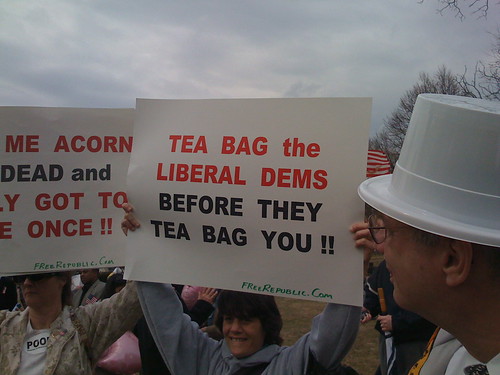
Okay, so the Right is having a fairly good time these days. A week ago there were "Boston Tea Party" demonstrations around the country, (via) drawing literally dozens of patriotic Americans who sought to sound the alarm about Barack Hussein Obama's plan to turn America into a Socialist Worker's Paradise and Islamoterrorist Shooting Gallery. These drew gales of righteous laughter from the liberal and left blogosphere, and for what it's worth, the laughter was well-deserved. The protestors were clearly not just ignorant but wilfully misinformed, parroting talking points from the right-wing propaganda mills. "No taxation without representation" is one of the funnier ones. (Eye-candy above from Roy Edroso's coverage of the New York Tea Party.)

The hubris of naming their peaceful little rallies after a well-known act not just of civil disobedience but of major property damage may have something to do with these folks' acceptance of the established American view that all nonviolent public protest is violent rioting: therefore, they could imagine that by carrying signs and listening to speeches, they were engaged in armed insurrection, just like George Washington and Benjamin Franklin! (Thug violence against peaceful protesters is another matter, of course: that's self-defense by decent Americans upholding their way of life.) When I heard about these forthcoming anti-Obama protests, I entertained fantasies of their being greeted with yells of "Faggots!", "Get a job!", "Take a bath!", or "Go back to Russia!" -- this last, now that post-Soviet Russia has become a capitalists' paradise, would be as relevant as ever. But apparently the worst the Teabaggers had to face at their rallies was boredom, and disappointment that their vast numbers and moral force didn't impel Obama to resign on the spot.
I guess I expected to be more fired up by the crowd and the speakers. I don’t think it was that the crowd was small or that the politicians who took the mikes weren’t sincere, but I think I am becoming cynical, because the party for which I have voted has rolled over and played dead, even when they were in control. Although the Republicans rejected the stimulus package overwhelmingly, I really hoped to see some Korean Parliament-style outrage at its passing. I hoped a senator or two would at least jump over a seat with his fists flying in a fury over our country sliding so rapidly into socialism.

But there was no outrage. Just a lady with a sign wondering along with me.

"No outrage"?! What about those thousands of Real Americans who took to the streets, like the patriots of old, to get in Obama's face and warn their fellow citizens of his totalitarian plans to enslave them with socialist oppression?

The blogger's reference to "Korean Parliament-style outrage" is generous, considering that it was the liberal opposition party in South Korea that got outraged against the right-wing
ruling party for trying to drive through legislation they didn't like. (As opposed to the US, where Obama actively courted the opposition party's cooperation with his program.) No doubt she confuses the very popular Obama with the still very unpopular Korean President Lee Myung-bak, whose approval figures have been as low as Bush's for some time now. (Incidentally, the new U.S. ambassador to South Korea is a former Peace Corps volunteer who actually knows some Korean, obviously a paid agent of Kim Jong-il.)

Another rightblogger crows that Obama has "brought us together. Joe the Plumbers, Santelli & the traders and Sue the entrepreneur going 'John Galt' are embracing a hippie anthem", namely Woody Guthrie's Old-Left anthem "This Land Is Your Land." Our Ms. Brooks quotes one line, "And some are grumblin' and some are wonderin' if this land's still made for you and me." Of course, she conveniently ignores the Depression-era context of that line:
In the squares of the city - In the shadow of the steeple
Near the relief office - I see my people
And some are grumblin' and some are wonderin'
If this land's still made for you and me.
I've seen several anti-Obama commenters talking about food lines and relief offices as if they were imposed on the people by the will of the socialist State (apparently forcing them to eat government-issue cheese instead paying for quality at MacDonald's?), instead of necessities forced on them by the failure (or more exactly, the disinclination) of capitalist institutions to provide for most people. One commenter at alicublog prophesied, "Have fun standing in bread lines and bleeding out in the over worked over crowded emergency room!" to the cyber-assembled liberals -- as though increasing numbers of Americans hadn't already been standing in bread lines and and overcrowded emergency rooms during the Bush years.

(Photo from here via TBogg. No cell phones for these guys! They had better quality poor people in those days.)

Brooks also ignores the now-notorious verse from "This Land Is Your Land" in which the singer tells of ignoring a "No Trespassing" sign on a wall: "But on the other side .... it didn't say nothin!
Now that side was made for you and me!" But who listens to song lyrics, really? (The shocking thing is that she got these Communist-Socialist lyrics from an unofficial Scouting site, which she mistakes for "the Girl Scouts.")

But this sort of memory and thought control is a very American thing. If Republicans have wiped from their minds the Bush administration's responsibility for the current economic situation, Democrats have sent Bill Clinton's policies (which were essentially Reaganite, from NAFTA to welfare "reform") down the memory hole. At his CPAC apotheosis last week, Rush Limbaugh declared that
We love and revere our founding documents, the Constitution and the Declaration of Independence. [Applause] We believe that the preamble to the Constitution contains an inarguable truth that we are all endowed by our creator with certain inalienable rights, among them life. [Applause] Liberty, Freedom. [Applause] And the pursuit of happiness. [Applause]
As IOZ delicately pointed out, those inalienable rights are invoked by the Declaration of Independence, not the Constitution. Details, details. The thing is, I've often had to correct liberals on the same point. A similar amnesia turns up in discourse about Obama's tax policy. The die-hard Republicans are quite hysterical about the prospect of a 40 percent marginal tax rate, which they regard as the lodestar of socialism. Do they really not know that the top marginal rate was never lower than 50 percent from 1932 until 1987, when it was lowered to 38.5? Though even a circumspect libertarian like Will Wilkinson allows that "it’s a bit hard to see tax rates somewhat exceeding the Clinton era’s as a move over some inflection point from the tolerable to the completely outrageous", he frets that under Obama "our money, which might otherwise have gone to capitalize real innovation, will be confiscated in order to finance government directed 'investment' instead." The possibility of a return to, say, the Eisenhower era is obviously not a threat, or even imagined.

Which brings me to the other reason the Right is feeling flush: Limbaugh's ascendancy as a force in the Republican Party, to the point that he's been able to exact submission from senior Republicans who withheld obeisance. There's been some dispute in the liberal blogosphere about how much the Obama administration is exploiting, even fostering this perception. I'd rather dwell on the fact that Limbaugh's celebrity is nothing new. Driftglass, which has some nice discussion here and here, also shares this video clip and Washington Post article from 1994, when the Republicans, having taken control of Congress, thanked Limbaugh for his services and leadership. In the video you can see Limbaugh pronouncing the final defeat of liberalism: every college should have one liberal and one communist professor, he declares, living fossils who will remind students of what they tried to do to America.

This Nostradamus-like prediction should, I think, be borne in mind now as liberal pundits celebrate the end of the conservative movement. Just on general principles, this is never a good idea. The arch-reactionaries who now define conservatism in the U.S. were supposedly defeated for good when Barry Goldwater was defeated by Lyndon Johnson in the 1964 presidential elections -- but sixteen years later Ronald Reagan proved those claims premature. Yes, the Republicans are in serious disarray now, which suits me just fine, but I don't think that Obama is in office, or that the Democrats now control Congress, because the Democrats or his center-right policies are superior to the Republicans' -- it's because the Republicans screwed up the economy so spectacularly. (I say "the economy" because in foreign policy Obama clearly intends to continue screwing things up as Bush did.) The Dems now have a chance to do better, and I hope their timid approach is enough to right the damage that the Republicans inflicted (with Democratic collaboration), because it doesn't take long for the voters to become disgusted with Democratic ineptitude. In particular, Obama is going to have to stand up to the banking system, but so far he only seems to be interested in throwing more money at it. Clinton was elected in 1992 because of Americans' disillusionment with Reaganomics, and he lost his mandate in just two years.

As I said, liberals have jeered at the right's paltry showing in their tea parties, and it's been entertaining to watch the indignant right-wing response to the jeers: Big trees from little acorns grow! There may be just a few of us now, but there will be more! One, two, many Pinochets! ... And after all, the Civil Rights movement, the opposition to the Vietnam war, the women's movement, the gay movement all started with little bands of nutty extremists. The same is true of the conservative movement William Buckley Jr. built, which ultimately took over this country for three decades. So, for that matter, did Christianity, which is a reminder that, contrary to what one commenter argued at the Village Voice, it is not necessary to have realistic or coherent ideas to build a frighteningly successful movement. Irrationality can be a strength. And forty-seven percent of the electorate voted against Obama last November; they lost the election, but they are not a negligible part of the population.

I don't think that the Teabaggers constitute a movement in ovo, not really. But they're also not just a few voices crying in the wilderness -- they have corporate-media allies apart from Limbaugh, and if Obama does put too much pressure on the corporate sector generally, it will be happy to fund and support any opposition it can find. That is not true of the anti-corporate movement, which really does need moral capital and good ideas. What I'm saying is that Democratic/liberal triumphalism is as unattractive, and as short-sighted, as Republican/reactionary triumphalism. Remember Limbaugh gloating in 1994. Complacency is not a luxury the left can afford.

Friday, March 6, 2009

Poetry Friday - We seem ungainly, yes


We seem ungainly, yes; but whales embrace,
and in their element where side by side
they court with tenderness and weightless grace,
they wear their massive bulks with joy and pride.
Cast out on land, love falls from grace: there meat
couples with gasping meat, monstrosity
conjoins with gross monstrosity, and heat
shrivels the heart with thirst for ecstasy.
But in the water love is cool as shade,
and whales embrace while leaping into air
brief as a gasp, and courting hippos wade
in pairs. Our parents touched each other where
they told us only animals would touch.
We need feel no disgrace compared with such.

---
This poem is also from 1977 or so. At times I titled it "Homosexuality," but since I have consistently waffled and flipflopped on that matter, I'm leaving it untitled here. I'm not sure it is specifically about homosexuality, since the ambivalence about sex and the body it describes is not limited to us queers, though we perhaps feel torn by it more than straights. (But now I'm tempted to add the title anyway. There's no reason why straight readers couldn't identity with it, no matter what it's called or ostensibly about.)

Just about no one who's ever seen this poem has liked it. Most of the friends who read the poetry I was writing during this period felt it was too didactic, too preachy. I don't think so; I think that the final lines make a nice twist. I always thought it was good, and it still gives me great pleasure to read it. But see what you think, O reader.

Wednesday, March 4, 2009

We Are Everywhere!


First Openly Gay Racehorse To Compete Sunday

In the wake of Albus Dumbledore and Clay Aiken, gay pride continues to march, prance, and canter! But is Ship's Captain really a gay racehorse, or is he just a racehorse who happens to be gay?

Sunday, March 1, 2009

What's In a Name?

For some reason the word gay seems to upset a lot of people. Since the early 70s when the gay liberation movement made its presence known in the straight media, many straights have protested this act of cultural appropriation. “I can't say 'How gay I feel!' any more,” they complained. “And besides, homosexuals are miserable, not gay!” As late as 1999, news commentator Daniel Schorr digressed during an NPR tirade against the abuse of language by politicians to denounce gay as Orwellian doublespeak.

But it wasn’t only straights who objected to gay. Many older queers (of roughly my parents’ generation and older) disliked the word. From the 1970s I remember Christopher Isherwood, egged on by Dick Cavett, cackling, “Oh, fag, queer, anything but gay!” And Gore Vidal told Fag Rag at around the same time,
I prefer the word faggot which I tend to use myself. I have never allowed, actively, in my life the word “gay” to pass my lips. I don’t know why I hate that word ... Also, I mean, historically it meant a girl of easy virtue in the 17th century. They’d say: “Is she gay?” Which meant: “Is she available?” And this, I don’t think, is highly descriptive of anybody. It’s just a bad word. You see, I don’t think you have to have a word for it. This is what you have to evolve. These words have got to wither away in a true Hegelian cycle.
Okay, we all have our linguistic bugbears. (Mine is family, as in "Is he ... family?", which is used as ingroup code exactly as gay used to be before it went public.) Yet faggot, which historically means a bundle of sticks, doesn't seem that much more descriptive of anybody than gay. Whatever it meant in the 17th century (and a host of other words have also changed their meanings since then), gay hadn't meant a girl of easy virtue, especially in American English, for quite some time before we homosexuals recruited it. But something else occurred to me while I was rereading Vidal's Fag Rag interview: he's always insisted that homosexual is an adjective describing sexual acts, not a noun referring to a kind of person. So, given his position on the matter, how does Vidal justify using a noun like faggot? Not, you understand, because it's derogatory, but because it seems to refer to what Vidal usually called a "homosexualist" as a separate kind of person. But that's another issue, for (I hope) another day.

For now my point is that Vidal admitted himself that his dislike for the word had no rational or even conscious basis. And lately I've been noticing more and more queerfolk who object vehemently to the word gay. When I read Will Fellows' Farm Boys (Wisconsin, 1998), I thought at first that his informant Lon Mickelsen was a random blip. "I've never liked the word 'gay'," Mickelson said. "It doesn't bother me much now, but I used to choke on that word. It seemed like a derogatory term, like black people calling each other niggers." I've often heard gay men, especially of my generation, make exactly the same complaint about queer, so I thought at first that Mickelson had confused the two terms. But since then I've encountered other people who said essentially the same thing. Now that gay has become established as a schoolyard insult, I suppose we're going to see a generation of queer kids who first encountered it as a derogatory term, and can't understand why the gay movement chose such an awful, vulgar word. And because it's engraved that way in their brain paths, they'll probably never be able to hear it differently.

I'm not particularly wedded to gay myself, but I still see its advantages. (That's due to the historical moment in which I am encased, like a fly in amber.) As Edmund White wrote in 1980,
Many homosexuals object to gay on other grounds, arguing that it's too silly to designate a life-style, a minority or a political movement. But, as the critic Seymour Kleinberg has mentioned in his introduction to The Other Persuasion: Short Fiction About Gay Men and Women, "For all its limitations, 'gay' is the only unpompous, unpsychological term acceptable to most men and women, one already widely used and available to heterosexuals without suggesting something pejorative." Gay is, moreover, one of the few words that does not refer explicitly to sexual activity. One of the problems that has beleaguered gays is that their identity has always been linked to sexual activity rather than to affectional preference. The word (whatever its etymology) at least does not sound sexual.
To this I'd add that for me, part of its appeal was that gay was our word for ourselves, not one that had its origins as an epithet hurled at us by straights. I've long thought that this was a major reason for so many heterosexuals' fury at our use of the word: they were supposed to decide what we were called, dammit! That has changed, of course; straights took gay back and made it into an insult, which I suspect was inevitable in a homophobic world. I don't believe there can ever be a word for a stigmatized group that will remain free of negative connotations for long; that's why people of African descent in the US, for example, have kept changing their chosen terminology for themselves, to the parallel annoyance of many whites. ("What do I have to call Them this week? First it was 'Negro,' then it was 'black,' then it was 'Afro-American,' now it's 'African-American.' Why can't They choose one term and stick with it?" It's at least partly because changing labels is necessary to stay ahead of the protean ability of white racism to adapt to changing conditions.)

Despite my preference for gay, though, I've answered to and claimed most of the older words, including the pejoratives. There's a term in contemporary critical theory, "interpellation," which means roughly "hailing," as in "Hey, you! Yes, you!" When a 'phobe yells faggot, fairy, pansy, queer, cocksucker, et cetera (and now gay as well), I am being interpellated, hailed. I see no point in pretending that he's not talking to me; by acknowledging the hail, I'm enabled to talk back, and goodness me, but bigots do squirm and whine when I interpellate them in return. A lot of queers try to evade stigma by defining such words narrowly, so that they refer only to a bad, despicable subset of the GLBTQ+Ï€ community -- dirty, promiscuous, low-class people who gyrate drunkenly on Pride parade floats -- not to respectable Homo-Americans like themselves. Even if they do gyrate drunkenly on a Pride parade float once a year, they're different from Those Others.

What I've been seeing lately has not been much concerned with what straights think, though. This is typical:
Yet despite my same-sex proclivities, I still hesitate to embrace the "gay" identity. What does "gay" even mean? My dictionary says it means happy, exuberant, y'know, gay. Well, I'm not exactly known as being Mr. Sunshine, especially not in a recession. Does being gay mean rainbows, wigs, drag, the latest anorexic fashions from Milan, Adonis-worship, behaving "effeminately" or (God forbid) voting Democrat? Margaret Cho once did a hilarious bit on a gay friend of hers who'd squeal with disdain at the mere thought of vagina - "Ewwwww...I don't want none of that! Ha ha...girl, I'm allergic!" I've had male friends of mine express similar sentiments. Well, that’s not me.
I wonder what dictionary this writer was using -- something from the 19th century, mayhap? A more up-to-date one would have informed him that in addition to happy and exuberant, gay means
3: given to social pleasures ; also : licentious
4 a: homosexual <gay men> b: of, relating to, or used by homosexuals gay rights movement> gay bar>
There's nothing there about effeminacy, or voting Democratic, or palling around with Margaret Cho. Indeed, today's well-informed Homo-American ought to be aware of the existence of Gay Republicans, don't you think? As for "effeminacy," gay men have been trying for decades to put this stereotype to rest, with the result that it requires real tunnel vision to ignore the existence of men who call themselves gay but are fully gender-compliant according to the National Bureau of Standards. If I were going to be charitable, I would have to posit that this writer has spent the past three or four decades sealed in a barrel, with his meals shoved in through the bunghole. But I'm not feeling particularly charitable, and I think it's more probable that he's simply refused to see the variety of homosexual people that was right in front of his face all along. Which is one of the defining qualities of a bigot, isn't it -- a person who watches a Pride parade and can only see the leathermen, the shirtless lesbians, the drag queens, while missing entirely the marching bands, the gay Catholics and Methodists, the gay Tech Geeks, the PFLAG contingent, the full range of people who comprise the GLBTQ population. Granted that there are many gay people who do try to narrow the definition of gay to one or another subgroup's real or imagined traits, my response has always been to insist on the variety that is there for anyone who cares to see it.

Not that this guy, or anyone else, has to "embrace the 'gay' identity." Just don't misrepresent it, okay? As I've written before, it seems to me the real complaint is not that gay is too narrow -- it's that it's too broad and all-embracing, and might embrace him if he's not careful.